Animal Facts
Polar Bear Facts: What the Sources Actually Say
Polar bear fur has no white pigment, and the fibre-optic hair story is not true.
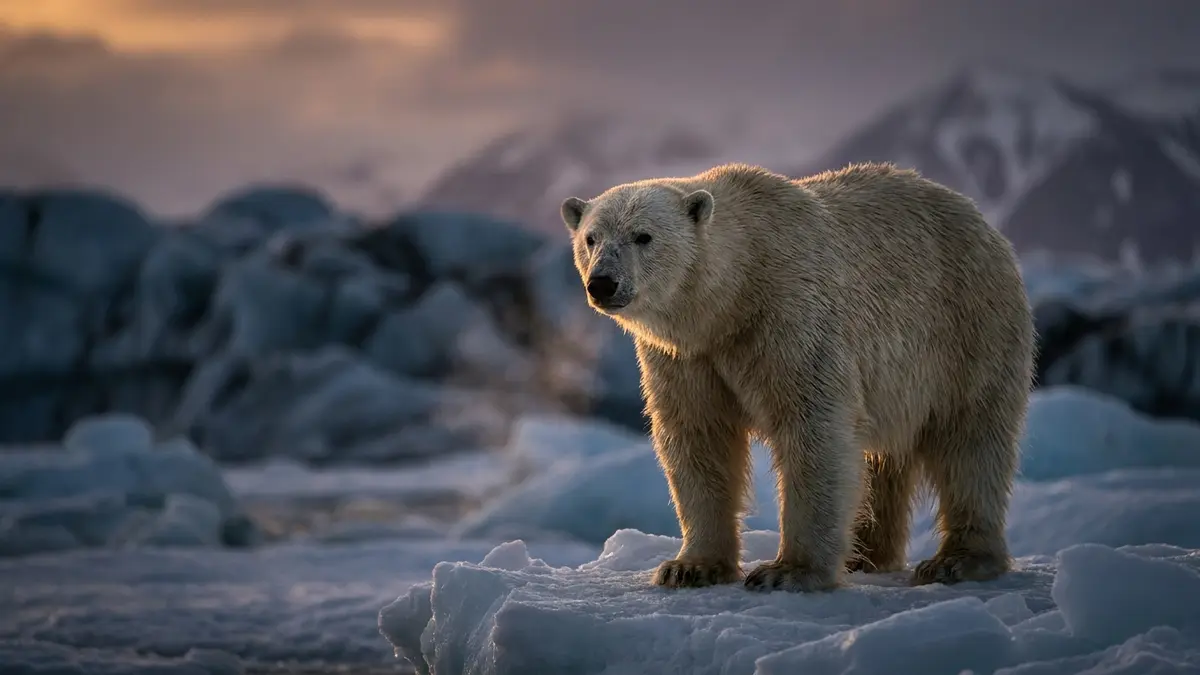
Polar bears (Ursus maritimus) are the largest living bears: males typically weigh 350–650 kg (770–1,430 lb) and females 150–350 kg (330–770 lb). Their coat contains no white pigment — the guard hairs are hollow and transparent — and generally fewer than 2% of their hunting attempts succeed. About 26,000 remain worldwide, though 5 of the 20 subpopulations in the IUCN Polar Bear Specialist Group's 2024 status table have no abundance estimate at all.
An almanac
- Scientific name
- Ursus maritimus — "sea bear"; the species did not receive its Latin name until 1774
- Adult weight
- Males typically 350–650 kg (770–1,430 lb), very large males to 800 kg; females 150–350 kg (330–770 lb)
- Where they live
- 20 subpopulations across Canada, Greenland, Norway, Russia and the United States — the Arctic only, never Antarctica
- Global population
- About 26,000; of the 20 subpopulations in the IUCN PBSG's 2024 status table, 5 have no abundance estimate at all
- Main prey
- Ringed seal (Pusa hispida) — more than 50% of the prey base in most Arctic regions
- Legal status
- Listed as threatened under the U.S. Endangered Species Act on 15 May 2008, with 484,734 sq km of critical habitat
- Longest recorded swim
- 687 km non-stop over nine days, Beaufort Sea, 2008 — the bear lost 22% of her body mass and her yearling cub
Ursus maritimus means "sea bear", and the species did not receive that Latin name until 1774. It is the largest bear alive: males typically weigh 350–650 kg (770–1,430 lb), very large males reach 800 kg, and females are roughly half the size of the males.
Two of the most repeated polar bear claims online are wrong. The fur is not white — there is no white pigment in it anywhere — and the hollow guard hairs are not fibre-optic cables piping sunlight down to the skin. Both stories are corrected below, with the sources.
The conservation numbers need the same care. About 26,000 is the working global figure, but five subpopulations have no headcount at all, and the well-documented decline is regional: Western Hudson Bay fell to 618 bears in 2021, a 27% drop in five years.
Verified Polar Bear Facts
- The largest bear alive. Males typically weigh 350–650 kg (770–1,430 lb), and very large males reach 800 kg (1,760 lb); females typically weigh 150–350 kg (330–770 lb).
- No white pigment anywhere in the coat. The long outer guard hairs are hollow and transparent, and the thinner hairs of the undercoat, while not hollow, are also colourless.
- The green bears of the late 1970s. In the late 1970s scientists investigating why polar bears in zoos around the world were turning green discovered that the algae responsible "were not on the SURFACE of the hairs, as originally supposed, but were INSIDE the hairs (Lewin & Robinson, 1979)" — most likely picked up from the pond water in the bears' enclosures.
- Paws the size of a dinner plate. A polar bear's paws can measure up to 30 centimetres (11.81 inches) across.
- One prey animal above all others. The ringed seal (Pusa hispida) is more than 50% of the prey base in most Arctic regions, and 90% of the energy eaten is assimilated directly to fat stores (Best 1977).
- Smell across a kilometre. A polar bear can detect breathing holes of ringed seals from at least 1 kilometre (0.6 mi) away, helped by an unusually large olfactory surface area inside the snout.
- Most hunting attempts fail. The San Diego Zoo Wildlife Alliance fact sheet puts it as "Time-intensive; generally, less than 2% of hunting attempts are successful" — which is why a bear will wait motionless at a seal's breathing hole for hours. The popular image is an unstoppable apex predator. What makes polar bears formidable is the calorie payload of one success — the stomach can hold more than 70 kg (154 lb) of food — not the hit rate.
- A 687 km swim without stopping. A GPS-collared female in the Beaufort Sea made a continuous swim of 687 km over 9 days in 2008. After the swim she intermittently swam and walked on the sea ice surface for a further 1,800 km; between captures she lost 22% of her body mass and her yearling cub.
- Cubs are born at about a pound. Newborns weigh little more than half a kilogram (one lb) and are ~30–35 cm long.
- Denning runs from autumn to spring. Pregnant polar bears enter maternity dens in October/November, give birth to cubs in December/January, and exit dens in March/April. In the Southern Beaufort Sea, where most bears historically denned on the sea ice, thinning and fragmenting ice has driven a landward shift in denning over the past three decades.
- The liver is toxic to people. Liver tissue is toxic to humans, if consumed, due to its high levels of vitamin A (Amstrup 2003).
- Attacks are rare, and the pattern is specific. Researchers documented 73 attacks by wild polar bears from 1870–2014 across the five range states — Canada, Greenland, Norway, Russia and the United States — resulting in 20 human fatalities and 63 human injuries. The same study found nutritionally stressed adult males were the bears most likely to be dangerous, and predicted more of them as sea ice loss keeps hungry bears ashore near people for longer.
- Threatened under U.S. law since 2008. The polar bear was protected under the Endangered Species Act as threatened, range-wide, on May 15, 2008, and its designated critical habitat covers 484,734 sq km, about 96% of which is sea ice.
- About 26,000 worldwide, with real blanks in the total. About 26,000 polar bears worldwide. The IUCN PBSG's status table, last updated in 2024, covers 20 subpopulations, of which 5 — Arctic Basin, East Greenland, Kara Sea, Laptev Sea and Southeast Greenland — have no abundance estimate at all. Separately, most subpopulations are flagged "Data deficient" for population trend, which is a statement about direction of change, not about whether a headcount exists.
- Western Hudson Bay is down to 618 bears. Aerial surveys led by Stephen Atkinson put the subpopulation at 618 bears in 2021, roughly half the estimated 1987 population of 1,185, a 27% drop from 2016. The 2011, 2016 and 2021 surveys are directly comparable; the 1987 figure used a different technique, so the "halved since the 1980s" framing should be read with caution. The decline was driven by adult females and subadults, while adult male numbers changed little.
- A kilogram of body weight for every fasting day. In Western Hudson Bay the ice-free period is now three to four weeks longer than it was in the early 1980s, and a fasting polar bear sheds about a kilogram (2.2 lb) of body weight every day it goes without food.
- Bears burn more than the models said. When Anthony Pagano's team fitted video-and-metabolic collars to nine hunting females in the Beaufort Sea, the field metabolic rates they measured averaged more than 50 percent higher than previous studies had predicted. Five of the nine lost body mass during the study.
- The ice itself is going. The September Arctic sea ice minimum has been shrinking 12.1 percent per decade relative to the 1981–2010 average since 1979 — about 74,000 square kilometres (29,000 square miles) of ice per year — and the 2025 minimum measured 4.60 million square kilometres.
Polar Bear Myths, Corrected
"Polar bear fur is white." There is no white pigment anywhere in the coat. The guard hairs are hollow and transparent and the undercoat hairs are colourless; the bear looks white because, as the Library of Congress puts it, "the air spaces in each hair scatter light of all colors" back at your eye.
"Each hollow hair works like a fibre-optic cable, funnelling sunlight down to the black skin to warm the bear." The fibre-optic story is the most-repeated polar bear "fact" online, and it does not hold up. As the Library of Congress puts it, "At one time it was suggested that the polar bear hairs might have some of the properties of optical fibers. Apparently this is not the case."
"Polar bears hibernate through the Arctic winter." Polar bears do not undergo true hibernation; only pregnant females den. Bears remain active on the sea ice through the winter, but their peak feeding season is April to August — they gain the majority of their body fat in late spring and early summer, when ringed seal pups are available.
"Climate change is producing a wave of pizzly and grolar bears as polar bears and grizzlies are pushed together." Hybrids are real but vanishingly rare. A genetic study of 819 wild bears sampled across Canada, Alaska and Greenland between 1975 and 2015 turned up only the eight hybrids already known — about 1% of the samples — and all eight trace back to a single female polar bear. The first wild hybrid was not confirmed until 2006.
"Polar bears hunt penguins." They live at opposite ends of the Earth and have never met in the wild. Polar bears don't live in Antarctica; penguins do — every wild penguin species lives in the Southern Hemisphere. The pairing exists only in cartoons, greeting cards and soft-drink adverts.
Polar Bears in Advertising and Pop Culture
Coca-Cola put a polar bear in a French print advertisement as early as 1922, but the bear most people actually picture arrived much later: the "Always Coca-Cola" campaign of 1993, which turned the animal into a soft-drink mascot for a generation of viewers.
That advertising bear is a poor guide to the real one. It is drawn a flat, saturated white, when the animal itself carries no white pigment at all — the colour is an optical effect produced by air spaces inside transparent hairs. The commercial version is also sociable and family-shaped in a way the field data does not support; the bear that ends up in the research literature is a solitary, patient hunter that fails more than 98% of the time.
The most persistent piece of pop-culture nonsense is the polar bear and penguin double act. It appears on cards, in cartoons and in adverts, and it has no basis whatsoever: polar bears are Arctic animals and every wild penguin species lives in the Southern Hemisphere, so the two have never met outside a zoo or an illustrator's brief.
Famous Polar Bears
Polar bears rarely get names in the record. The most famous individual of the last twenty years is known only by her collar: a female tracked by GPS in the Beaufort Sea in 2008, who swam 687 km without stopping over nine days, then intermittently swam and walked across the sea ice for another 1,800 km. Between captures she lost 22% of her body mass and her yearling cub — which is why the swim is cited as a cost, not a feat of athleticism.
Another anonymous female sits behind every hybrid headline. When researchers genotyped 819 wild bears sampled across Canada, Alaska and Greenland between 1975 and 2015, they found only eight grizzly–polar hybrids, about 1% of the samples, and all eight traced back to one female polar bear. The first wild hybrid was not confirmed until 2006.
The green bears of the late 1970s were briefly famous in the opposite way. Zoo polar bears around the world were turning green, and the explanation, published by Lewin and Robinson in 1979, was that algae had colonised the inside of the hairs rather than the surface — most likely picked up from the pond water in the enclosures.
The best-documented group of polar bears is the Western Hudson Bay subpopulation, surveyed from the air in 2011, 2016 and 2021 under Stephen Atkinson, and the nine hunting females Anthony Pagano's team fitted with video-and-metabolic collars in the Beaufort Sea. The nine gave the field its most awkward number: they were burning more than 50% more energy than the models predicted, and five of the nine lost weight while being watched.
Frequently Asked Questions
Are polar bears actually white?
No. There is no white pigment in the coat. The long guard hairs are hollow and transparent and the finer undercoat hairs are colourless; the bear reads as white because the air spaces in each hair scatter light of all colours back to your eye.
Do polar bears hibernate in winter?
They do not undergo true hibernation. Only pregnant females den, entering in October or November, giving birth in December or January and emerging in March or April. Other bears stay active on the sea ice, with peak feeding from April to August when ringed seal pups are available.
How much does a polar bear weigh?
Males typically weigh 350–650 kg (770–1,430 lb), with very large males reaching 800 kg (1,760 lb). Females typically weigh 150–350 kg (330–770 lb). Newborn cubs weigh little more than half a kilogram and are about 30–35 cm long.
How many polar bears are left in the world?
Scientists estimate about 26,000 worldwide, but the total has gaps. The IUCN Polar Bear Specialist Group's 2024 status table covers 20 subpopulations, and 5 of them — Arctic Basin, East Greenland, Kara Sea, Laptev Sea and Southeast Greenland — have no abundance estimate at all.
Do polar bears eat penguins?
No. Polar bears live only in the Arctic and every wild penguin species lives in the Southern Hemisphere, so the two have never met in the wild. Their main prey is the ringed seal, which makes up more than 50% of the prey base in most Arctic regions.
Are polar bears dangerous to humans?
Attacks are rare but real. Researchers documented 73 attacks by wild polar bears between 1870 and 2014 across Canada, Greenland, Norway, Russia and the United States, causing 20 deaths and 63 injuries. Nutritionally stressed adult males were the bears most likely to be dangerous.
More about the Polar Bear
More from Animal Facts


Not sure which animal is yours?
Consult the quiz