Birds · Spirit animal
Peacock Spiritual Meaning & Symbolism
A messenger of confidence, vision, and renewal.
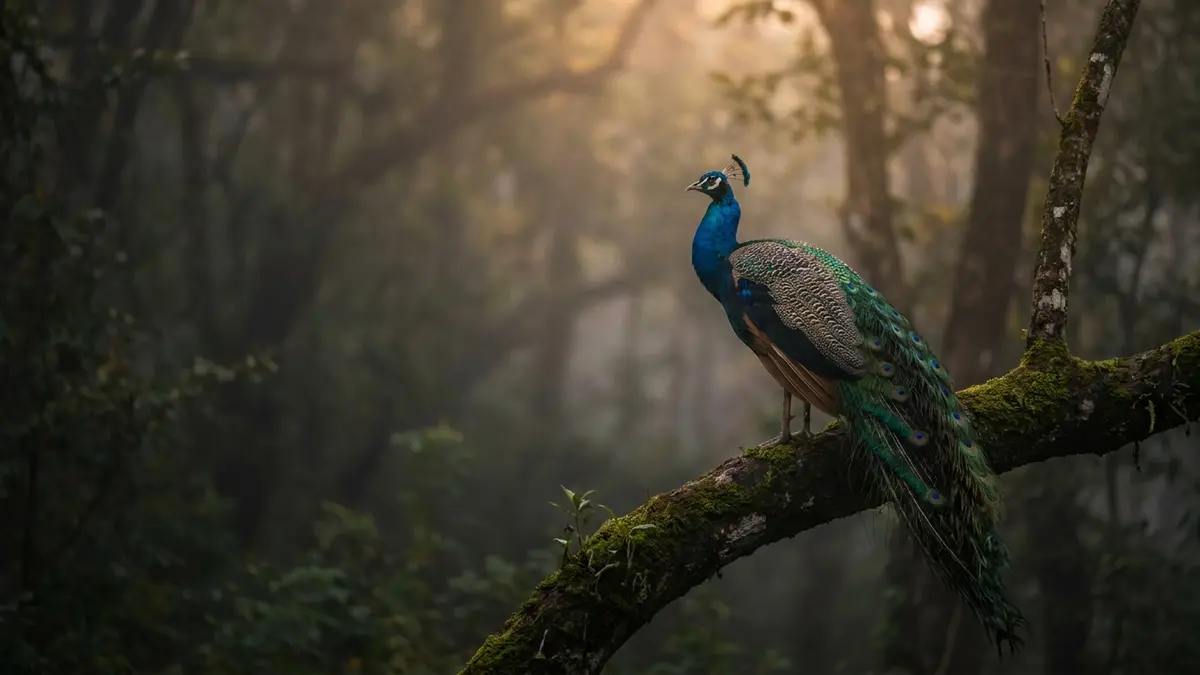
If you feel that the peacock has come into your life as a spirit animal, the meaning could be: confidence, renewal, and knowing that you can allow others to see your true beauty and talent without being worried or ashamed. As a protective symbol in dreams or visions it will keep an eye on the big picture and awaken your intuition. With caution, it warns about unhealthy displays of self-confidence (vanity), or favoring your own desires (ego). A love connection often comes in with this majestic creature's presence as it does for leaders (honest) who enjoy inspiring others to manifest greatness. It can give dignity to those recovering from self-doubt. With beauty and power together, its artistic symbol makes that clear. To have clairvoyant insight into what's real and what needs altering is a glimpse beyond the eye can see.
An almanac
- Core message
- Own your gifts without apology
- Spirit animal
- Self-assurance and joyful confidence
- Totem for
- Honest, natural leaders
- Power animal
- Renewal, romance & clairvoyant sight
- In dreams
- Favorable omen for luck and love
- Watch for
- Vanity or ego overtaking humility
- Male vs female
- Only males are 'peacocks' — females are peahens
- Group name
- An ostentation, muster, or pride of peacocks
The peacock is a very showy bird. It has a long train of feathers which it displays to show itself off. This bird has meant many things to different people in different places for thousands of years. The bird has been thought of as a messenger about beauty and self-worth. It was also thought of as a person's guardian and healer.
Peacock Symbolism & Meaning
Hindu legend tells us that the peacock is the pet of Lakshmi, the goddess of wealth and prosperity. It's also linked to Indra, the Lord of Heaven. In Greek and Roman lore, we see that a trait of their version is how it's tied to Hera, the queen of Olympus.
Persia used this symbolism quite often as well. In literature, alchemists would use it as a sort of physical manifestation to symbolize resurrection and life, much like phoenix.
Christian culture draws symbolism from its habit of getting rid of old feathers and growing new ones over the course of time.
Peacock Spirit Animal
The peacock can glide into your awareness as a spirit guide and make you take notice of moments of splendor and move through your days with a lighter and more grateful heart. It is full of an encouraging energy and wants you to laugh more and doubt less.
One of the main messages you get from peacock energy is self-assurance. Many people hide their ambitions behind the false conviction that it is impossible to achieve them, but actually the skills that they have can be a step towards achieving those ambitions.
Peacocks' flamboyant plumage is particularly male, which means that its presence may show you a balanced way to use the masculine energy that you need to embrace.
The eye-shaped pattern on each feather can mean that the third eye will start working more than it usually does. Peacocks are also seen by shamans as a cleansing presence that can remove any heaviness or stagnation from your field (your subtle layer of energy), so when you are meditating, you can look at an image of peacock's feather or another shape similar to it when you want stability in your meditation and let this bird remind you that showing off what you have achieved once in a while should not be any cause for shame.
Does Peacock fit you?
Tap the ones that sound like you — 6 traits, no right answer.
0 of 6 Nothing picked yet — start tapping.
Peacock Totem Animal
Those who have Peacock as a totem animal tend to be honest, and integrity is a core value for them. Because they are living in alignment with their convictions, they make natural leaders: People sense that they can rely on them to follow through on their word.
The challenge for those with this totem animal is to avoid pride; ego can lead them to show off their strengths instead of using them wisely. In fact, the main skill you can learn from the Peacock is learning how to apply your unique abilities gracefully and humbly. Those with this animal as a birth totem often possess striking qualities on the inside and out. The lesson is to allow that light to shine instead of hiding it. Additionally, this creature encourages being attuned to other people's gifts; it urges you to notice and appreciate other people's beauty while extending compassion in turn.
Self-doubt is also a recurring theme for those with this animal as a birth totem; many people marked by Peacock are intuitive, but that intuition is ignored because it's perceived as imagination. So this totem also encourages trust in your inner wisdom. As you give generosity outward, you can expect it will flow back around and come your way.
Peacock Power Animal
The peacock is a power animal that can lend you strength when you need to be renewed, be romantic, take your chances, or feel whole again. A lot of people who work with energy say that the bird gives them a clearer vision and helps them trust what they see. It's a good companion if you want to better understand your masculine qualities.
If you're feeling worn out and drained, this bird can lift up your spirits with joy and color. Seeing your world in black and white? If you give the power animal a chance, it might show you something of what's ahead.
Above all else, call on the peacock if your confidence is gone or your reputation has been tarnished. Its energy can help you see when there's dishonesty around, so that you don't feel badly about yourself for too long.
Across cultures
10 traditions — pick one to read its take.
Native American Peacock Symbolic Meanings
Peacocks are not indigenous to North America; they arrived as imported status symbols of wealthy households, reaching California and Hawaii around the late 1800s. Because contact came late, tribal interpretations grew out of blending the newcomer bird with existing beliefs rather than ancient tradition.
Some communities in Mexico and the southern United States came to view the bird as a kind of 'sun turkey' that channeled solar deities. Among the Pueblo, peacock feathers found their way into prayer sticks, which linked the bird to communication with the sacred.
Overall associations skew positive — wellness, poise, and grandeur — and shamanic practitioners have used peacock feathers to awaken clairvoyant ability and support healing rites. A central teaching attached to the bird is knowing when to display your gifts and when to stay humble. The feather's eye-like marking also serves as protection against harmful forces.
Christianity Peacock Symbolism
The Bible says the peacock is a 'royal bird' that symbolizes God's majesty. It was important to the life of King Solomon. The bird is also important to Christians because it symbolizes Christ overcoming death. Since the peacock grows new feathers when it sheds its old ones, it also symbolizes renewal. And because its feathers have eyes on them, it reminds believers that God's always watching over you.
Peacock as a Celtic Animal Symbol
The peacock, although not native to the Celtic regions of the British Isles and Ireland, became popular in local heraldry (the arms worn on clothes by knights, etc.) during the Middle Ages. The creature was associated with many qualities, including wisdom, status, wealth, and beauty.
It is possible that people also referred to an oath 'by the peacock' to connote sincerity and integrity. It is likely that this view influenced the meaning of the peacock within Celtic belief.
Far Eastern Peacock Symbolic Meanings
The peacock, India's national bird, is said to embody patience and kindness. In Buddhist tradition, the peacock represents wisdom and the path to enlightenment.
Peacocks were associated with royalty in ancient India. One of the world's most famous works of craftsmanship, the Peacock Throne, was made for Emperor Shah Jahan in the 1600s. The gold-encrusted throne symbolized good fortune and prosperity.
Because of its beautiful display during mating season, the peacock is also seen as a symbol of love. In Hindu tradition, Ganesha — a deity known for removing obstacles from life — is shown riding a peacock.
Greek Peacock Symbolism
The goddess Hera, the guardian of marriage and the family, preserved the hundred eyes of her murdered watchman, Argus Panoptes, in the tail feathers of the peacock. The bird's always-watching gaze — a symbol of her protection — lives on in its feathers.
The ancient Greeks believed that peacock flesh never rotted after death. And when Alexander the Great heard about the bird for the first time in India, he decreed that anyone who killed a peacock would face punishment. In ancient times the peacock was simply called the "Persian Bird".
Peacock in Egyptian Tradition
The Egyptians believed that the peacock's markings were a symbol of the Eye of Horus, which was a symbol of protection. They thought of the peacock as a sacred creature, an earthly form of the phoenix, that represented Ra, the sun god. They usually show the Egyptian god Shu, god of air and peace, wearing a peacock feather.
Peacock in African Folklore
In West Africa the peacock was sacred because of its role as a go-between for people and the supreme deity Olodumare. One story tells of the orisha Oshun changing herself into a peacock to fly an urgent message from the other orishas to Olodumare. In that journey the bird's plumage was singed, but Olodumare, moved by the orisha's sacrifice, healed her and restored her feathers to their former beauty—and beyond.
Hindu Peacock Imagery
The peacock is India's national bird. Some believe that Krishna, an eighth avatar of the god Vishnu, is frequently depicted wearing a crown of peacock feathers because the bird represents compassion, healing, and spiritual insight.
One myth about peacocks holds that they arose from the feathers of Garuda, who is both the king of birds and the mount of Vishnu and Lakshmi. The god Indra sits on a throne made from peacocks' feathers. The goddess Kwan Yin, who represents compassion, also considers the bird sacred because it can safely eat toxic matter — echoing Kwan Yin's capacity to absorb suffering and transmute it into grace.
The divine ties between peacocks and Murugan (Kartikeya), God of War and Eternal Youth, who rides upon a peacock mount named Paravani (the vahana), extend beyond those symbolic associations. According to tradition, Murugan acquired this peacock by splitting the Demon Surapadma (who disguised himself as a mango tree) into two halves — one being a rooster carried on his banner and the other becoming his own mount. Sangam-era poems often describe Murugan as 'the red god seated on the blue peacock,' signifying his dual aspects as both Warrior radiance as well as youthful grace.
Buddhist Perspectives on Peacock
In Buddhism, a fully unfurled peacock's tail represents openness, purity and transcendence. This is part of a legend about the future bodhisattva Kwan Yin.
According to legend, Miao Shan, a devout young woman, sacrificed one of her own eyes to cure her ailing father. She was given eternal life and 100 new eyes as a reward for her selflessness — which meant she could not witness every case of suffering personally. So she attached 100 eyes to peacocks and sent them into the world to gather information about who needed her healing power.
Islamic Peacock Symbolism
Islamic tradition paints a conflicting picture of the peacock. On the one hand, it depicts the bird as vain and untrustworthy, as it let a serpent into Paradise after being tempted by the devil. On the other hand, an alternative tradition describes the peacock's ability to come and go freely in Paradise, and some Kurdish folklore casts it as a messenger of God.
Peacock Types
Of the three species, two — the Indian Peacock and the Green Peacock — both have similar courtship rituals. The male Indian Peacock is more familiar; it's the blue-necked bird with an elaborate train. He uses his display to impress females; the better his display, the better his odds. So this species represents confidence.
The Green Peacock — whose courtship rituals are similar but whose crest is emerald instead of blue — can symbolize love and empathy because its color evokes green as a symbol of the heart center.
The Congo Peacock is native to Africa and more closely resembles a pheasant than the other two peacock species. It's colored in green and brown speckles, and until relatively recently it hadn't been identified as a distinct species. That's a surprise that would align it with pleasant surprises.
Peacock in Feng Shui
Feng Shui considers the peacock to be the earthly counterpart to the mythical phoenix. The peacock's feather 'eyes' are a symbol of heightened awareness. People who show pictures of peacocks in their home believe it attracts good luck, protection, and recognition. People will sometimes put pictures of peacocks in a room as an easy way to encourage love or to attract a partner.
As part of decorative art, people frequently display a pair of auspicious birds like doves and cranes together with a peacock's image. The main reasons people do this are because they believe that it will bring luck, and they want to learn from the peacock, which teaches presence: paying attention to the moment and whatever spiritual guidance arrives at that time so that your personal growth can happen at its own pace, just like how a peacock's train grows slowly.
Mayan Views on Peacock
Peacocks reached Latin America with explorers and soon wove themselves into local legend. One tale credits the rain god Chaac with creating the peacock as a plain songbird who believed his voice alone could win him the crown of the birds.
Realizing his looks needed work, he borrowed showy feathers from the roadrunner in exchange for sharing rulership — then, after winning, forgot his promise entirely. As punishment, the gods stripped away his beautiful voice, leaving him with only a harsh call and the borrowed feathers he never returned.
Peacock in Mesopotamian Tradition
The Yazidi people of the region consider Tawûsî Melek, or the Peacock Angel, a manifestation of God who is also chief among the archangels. In ancient Mesopotamia, a pair of peacocks often flanked a central tree in art. That art has been understood as an expression of the belief that dualities are ultimately held in balance and unity.
China & Japan: Beliefs About Peacock
In Japan, the peacock is considered nurturing, thoughtful, loving, and vigilant. It's also a symbol of grace and healthy pride. Its many eyes are considered to represent fertility, family stability, and good luck, and it's frequently used as decoration for wedding events.
In China, the peacock is a symbol of power, prestige, and divine favor.
Traditions in China describe the bird as a kind of rebirth of the phoenix on earth. Some traditions describe it as a symbol of intelligence or graceful living.
Zoroastrian Peacock Meaning
Many stories tell of peacocks’ sacred roles in Central Asia. For example, the Bukhara Fire Temple believed them to be immortal for having touched the water of life. In the region’s architecture and art, peacocks often appear alongside depictions of a tree of life, particularly entrances to religious schools and mosques. Persian poetry portrays the bird as a guard who guides the righteous while warding off evil forces, and Sufi lore describes a peacock angel enthroned above all other creation.
The Alchemical Peacock
Alchemists cared just as much about spiritual transformation as they did about the physical kind. A number of alchemists adopted the peacock as a symbol for beauty. Heinrich Khunrath shows a green peacock to illustrate renewal and vitality. And centuries later, psychologist Carl Jung looked at the same work and thought the peacock represented the Holy Spirit because it's all colors combined into one.
Peacock in Dreams
People sometimes dream of peacocks. When they do, it's usually a good sign.
Sometimes, people think it's a sign that they will find a partner, and it often points to luck, satisfaction, and a long life. People who dream about peacocks should try to work less hard to impress others and not be so vain.
If you see a calm peacock walking past you, this could mean that your self-confidence will grow. This could also mean that your momentum is growing.
If you receive a gift of a peacock, this means you will have good news soon and your relationships will grow stronger. If you see a baby peacock, this could be about you or someone close to you.
If the peacock scares you in your dream, this might be an issue that needs to be faced. You might also avoid responsibility or feel burdened by it.
If you find the nest where a peacock lives as part of your dream, this may show a chance for new beginnings. When there is conflict in a relationship and a peacock flies away in your dream, this may mean it is time for things to end.
Peacock in Astrology & Zodiac
In the "Mayan Zodiac" (which isn't really about the Mayans), people born from Nov. 15 through Dec. 12 are considered peacocks. They're known for being charismatic, witty, and poised; they're also highly creative and have strong self-belief.
Peacock people love a good competition and can reinvent themselves as needed. They have no time for mediocrity.
They're not proud or vain, but just want to be loved for who they are. Women born under this sign tend to wear bold styles and want respect and admiration from their partners. Men under this sign tend to have leadership skills, charisma, and a drive for success that they should continue building upon.
Peacock Tattoo Meaning
Peacock tattoos are bright, beautiful, and energetic, and they carry both masculine and feminine symbolism. The 'eye' design found in peacock feathers (as well as the colorful flash of the bird itself) is a warning against ill will.
More generally, a peacock tattoo can represent themes of love, confidence in one's self-worth, and the desire to be seen rather than remain hidden out of modesty or shame. It can also symbolize a desire to build up others rather than show off one's power or status.
Some peacock tattoos depict just the peacock's head as an invocation of the crown chakra. Others use only one of the bird's feathers as an eye tattoo.
Peacock Spiritual Meaning
Longevity, protection, love, and quiet immortality make up Peacock's spiritual message, useful even outside regions where the bird naturally lives. It encourages you to use your voice, loudly if necessary, especially when facing dishonesty — a nod to the bird's own famously unmusical but unmistakable call.
The rainbow spectrum across its feathers is often used as a meditative focus for balancing the chakras, while the feather's eye motif points toward heightened perception, insight beyond the physical senses, and a connection to sky and sun deities across cultures.
Color carries nuance too: blue draws attention to mysticism, white suggests angelic support, and green signals health and good fortune. In matters of love, the bird's courtship dance is a reminder that expressing your best self openly isn't showing off — it's simply natural. The peacock keeps returning to the same question: what makes you exceptional, and why aren't you owning it?
Peacock Facts Behind the Symbolism
Although they are sometimes called peacocks, it's really only the male bird that should be called a peacock. Females are called peahens, and the young of both sexes are peachicks.
The male and the female are a pair, but they represent different things. The male's brightly colored tailfeathers symbolize outward boldness. The plain brown or green feathers of the female stand for quiet and watchfulness. And as is common with many species of birds, it's the female who chooses her mate.
So if you see a group of peafowl, also called peacocks, call them an ostentation, a muster, or a pride. Those names refer to the habit of a male putting on an elaborate show to attract females.
The peafowl can also remind you that sometimes it's important to get together with people just like you — for example, to cheer one another up or ask for help. But at other times you might just want to stay in your own circle.
Frequently Asked Questions
What does the peacock symbolize spiritually?
The peacock symbolizes renewal, protection, intuition, and confident self-expression. Its feathers have "eyes" marked on them, and in some cultures these represent inner vision. When the bird loses its feathers, which it will, it grows new ones. This connection with death and rebirth has links with mythology in other parts of the world.
Is seeing a peacock a good omen?
Seeing a peacock or dreaming about a peacock is a good sign of luck and positive growth. It can suggest success in your career, love, and personal life. It may also be a gentle reminder to be humble and not let pride get in the way.
What does a peacock totem say about your personality?
People with a peacock totem are honest and confident. They're natural leaders who have a genuine inner beauty that they need to learn to display. It's easy for them to let ego and showmanship take over.
What's the difference between a peacock and a peahen?
What's the difference between a peacock and a peahen? "Peacock" refers only to the male bird, whose iridescent train of feathers flaunts long eye-shaped spots. The female is called a peahen: Her drab brown feathers offer concealment while she's nesting. Symbolically, they speak of a balance between bold, colorful display and quiet watchfulness.
What is a group of peacocks called?
An ostentation is a group of peacocks, especially during breeding season. There are other collective nouns for peafowl, too: a muster and a pride.
Outside breeding season, peacocks often travel in single-sex groups of five to ten birds. This reflects the idea that not everything needs to be a showstopper — even peafowls need to take turns stepping into the spotlight.
Peacock also represents
- Other animals that represent rebirth and change →Alongside Butterfly, Snake, Dragonfly, Frog
- Other animals that represent protection →Alongside Bear, Wolf, Dog, Elephant
- Other animals that represent healing →Alongside Snake, Deer, Dog, Bee
- Other animals that represent creativity →Alongside Spider, Raven, Hummingbird, Flamingo
Sources
Claims on this page were checked against these published sources.
- Green peafowl
native to the tropical forests of Southeast Asia and Southern China
Read the source → - Peacock Throne
On the top of each pillar there were to be two peacocks thick set with gems, and between each two peacocks a tree set with rubies and diamonds, emeralds and pearls... Inauguration: March 22, 1635
Read the source → - Argus Panoptes
Hera had Argus' hundred eyes preserved forever in a peacock's tail so as to immortalise her faithful watchman.
Read the source → - 1 Kings 10:22 (KJV)
bringing gold, and silver, ivory, and apes, and peacocks.
Read the source → - Peafowl
(no mention of California/Hawaii introduction date found in this article)
Read the source → - Murugan
He is typically represented as an ever-youthful man, riding or near an Indian peafowl (named Paravani)... with each half transforming into a peacock and a rooster, respectively. After Surapadma was killed, Kartikeya took the peacock as his vahana... the red god seated on the blue peacock, who is ever young and resplendent.
Read the source → - What is a Group of Peacocks Called? (Complete Guide)
Ostentation - Derives from the male's ornate tail display during courtship... Pride - References the male's behavior of proudly strutting around in groups... Flocks typically contain five to ten different birds... Outside breeding season: single-sex groupings or bachelor groups form.
Read the source →