Animal Facts
Pig Facts: What the Sources Actually Say
Most modern pig science traces back to one sow's DNA, catalogued as Duroc 2-14.
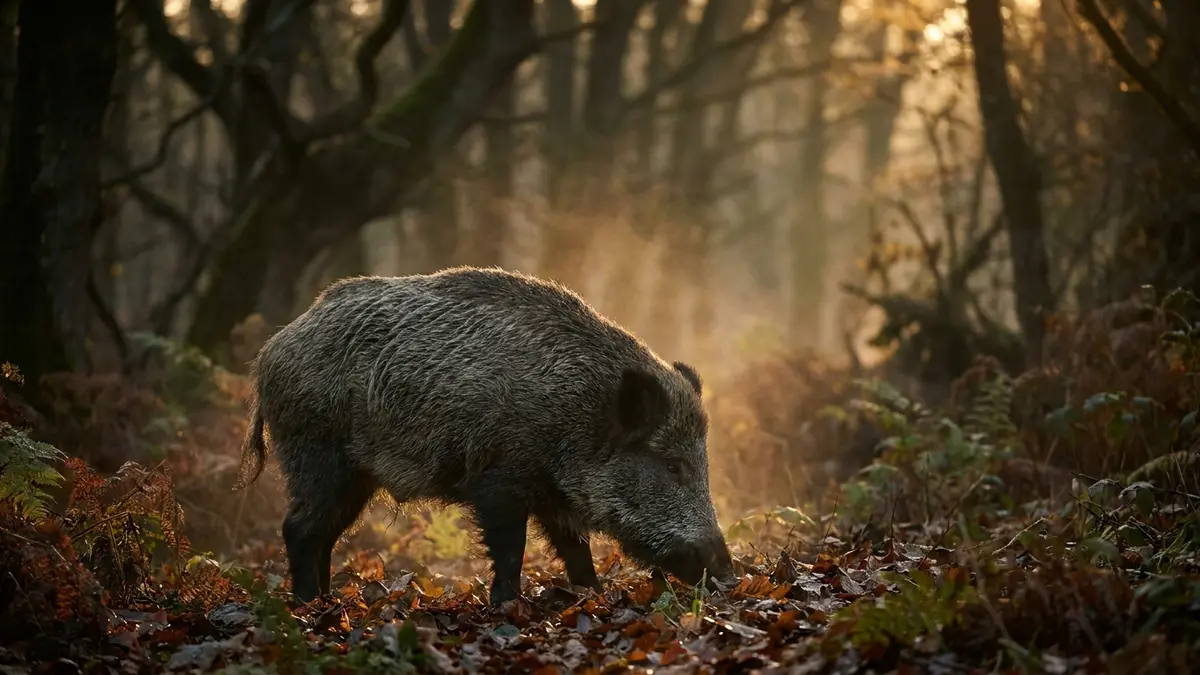
The domestic pig is Sus scrofa, a subspecies of the wild boar, domesticated at least 9,000 years ago; China is home to almost half the world's pigs. A sow carries for 115–116 ± 1 days from first service and delivers piglets at intervals averaging 10–15 minutes. Pigs have only a limited number of functional sweat glands, so above their upper critical temperature they shed heat mainly by increasing their respiratory rate.
An almanac
- Scientific name
- Sus scrofa — the domestic pig is a subspecies of wild boar
- Domesticated
- At least 9,000 years ago
- Reference genome
- Built from one Duroc sow, catalogued "Duroc 2-14" (Nature, 2012)
- Gestation
- 115–116 ± 1 days from first service
- Sense of smell
- 1,301 olfactory receptor genes — a 2012 record, since beaten by the elephant's ~2,000
- Feral in the USA
- Over 6 million, in at least 35 states, descended from 1500s imports
- Where most pigs live
- China — home to almost half the world's pigs
The domestic pig is a subspecies of the wild boar, Sus scrofa, kept by humans for at least 9,000 years. China is home to almost half the pigs alive today, and in the United States alone more than 6 million feral swine now range across at least 35 states, descended from animals imported in the 1500s.
Almost everything people repeat about pigs has been sanded down somewhere along the way. Pigs barely sweat, so the phrase "sweating like a pig" is borrowed from ironworking rather than animals. Teacup pigs do not exist as a defined type and routinely reach 45.5–68.2 kg. The pigs that "played video games" pushed a joystick with their snouts through a task built for primates, and their record across difficulty levels was uneven.
Every claim below is tied to a named source, and where the popular version and the source disagree, the disagreement is stated rather than smoothed over. Two well-travelled pig statistics have quietly expired since they were first published, and both are flagged where they appear.
Pig facts, checked against the sources
- A wild boar in a farmyard. The domestic pig is a subspecies of the wild boar, and pigs were domesticated at least 9,000 years ago.
- One sow stands behind most pig science. The pig reference genome — the DNA blueprint behind most modern pig research — was assembled from a single Duroc sow catalogued as "Duroc 2-14", published in Nature in 2012.
- The lineages split long before farming. European and Asian wild boars split from one another roughly 1 million years ago — long before humans had anything to do with pigs.
- A smell record that no longer stands. When the pig genome was published in Nature in 2012, pigs had the largest repertoire of functional olfactory receptor genes then known — 1,301 of them. That record has since been broken: a 2014 survey of 13 placental mammals found African elephants carry about 2,000 functional olfactory receptor genes. The pig figure still shows how much of its genome the animal devotes to smell; it is no longer a record.
- Very little of that machinery is broken. Across the pig's olfactory receptor sequences — 1,301 genes plus 343 partial sequences — only 14% are pseudogenes, the lowest fraction observed in any species so far.
- Bitterness barely registers. Pigs are less sensitive to bitter tastes than humans and tolerate higher concentrations of bitter compounds. This gets repeated as "pigs will eat literally anything", which overshoots: the genome shows 17 intact bitter-taste receptor genes in the pig against 25 in humans, 18 in cattle, 19 in horses and 15 in dogs, so pigs are not even the least bitter-sensitive animal on that list. Reduced bitter sensitivity explains why pigs can eat things we find foul; it does not mean they lack food preferences.
- The joystick study, minus the headlines. In a 2021 study, four pigs — two Yorkshire barrows and two Panepinto micro pigs — learned to move an on-screen cursor with a joystick and hit targets at rates better than chance. It was one cursor-to-target exercise originally designed for primates, the pigs pushed the joystick with their snouts, and the authors present the result as evidence of conceptual understanding rather than gaming skill. All four pigs beat chance on the easiest one-walled targets; three of four also beat chance on two-walled targets, and both micro pigs beat chance on three-walled targets. Performance was uneven across difficulty levels rather than limited to the easiest one.
- Every pig tested was far-sighted. Each subject in that study measured between +1 and +2 diopters of hyperopia.
- Grunts carry the mood. An algorithm trained on more than 7,000 recordings — 7,414 sounds from 411 pigs, captured from birth to death — sorted 92% of pig calls into the correct emotional context.
- A happy pig sounds different from a frightened one. In positive situations calls are far shorter, and grunts begin high and gradually go lower in frequency; screams and squeals cluster in negative situations.
- Heat leaves through the breath. Above its upper critical temperature, a pig relies mainly on evaporative heat loss by increasing its respiratory rate — shedding heat as moisture from the respiratory tract.
- The gestation rhyme is out of date. "Three months, three weeks and three days" gives 114 days and is quoted almost everywhere. Average gestation is 115–116 ± 1 days from first service, and Merck notes it has been increasing over time — while also noting it runs slightly shorter in sows with larger litters. The source gives no cause for the upward drift.
- Piglets arrive one at a time. Delivery intervals average 10–15 minutes, though the gap between siblings can range from 5 to 45 minutes.
- Kunekunes are an import with an unclear past. Kunekune sows — a relatively small breed whose origin is unknown, sharing traits with domestic pigs from Asia, South America and the Polynesian Islands, and whose ancestors were likely brought to New Zealand in the 1800s by whalers and then traded with Māori communities — carry for about 116 days and give birth to litters of 6–12 piglets.
- One island breed stores fat like no other hog. Ossabaw Island hogs, feral descendants of Spanish pigs marooned on a Georgia island, developed a unique biochemical system of fat metabolism that lets them store a larger proportion of fat than any other hog.
- Feral swine hold a third of the United States. They have been reported in at least 35 states, the population is estimated at over 6 million and rapidly expanding, and the first animals arrived in the 1500s.
- Half the world's pigs live in one country. China is home to almost half of all the pigs on Earth.
- Babirusa tusks grow through the face. Male babirusas — a wild pig of Sulawesi and neighbouring Indonesian islands — grow upper canines that first point downward, then curve back up and through the skin of the snout toward the forehead, reaching up to 12 inches if they are not first worn down or snapped off in fights. Females have only the lower tusks.
Myths that need correcting
"Sweating like a pig — pigs must be famously sweaty animals." Pigs barely sweat at all. The phrase has nothing to do with the animal: it comes from iron smelting, where molten iron poured into sand cooled into linked ingots that looked like a sow with suckling piglets, and "sweated" condensation as they cooled.
"Pigs wallow in mud because they are dirty animals that enjoy filth." What is documented is the physiology. Pigs have only a limited number of functional sweat glands, so they cannot cool by sweating the way we do, and above their upper critical temperature they rely mainly on evaporative heat loss through increased respiratory rate. The usual follow-on — that a coating of mud supplies the evaporative cooling the skin cannot manage — is not supported by the thermoregulation review cited here, which never mentions mud or wallowing, so treat that half as unverified rather than established.
"A teacup or micro pig will stay small enough to sit on your lap for life." There is no such thing as a defined teacup pig. Veterinary reference data puts typical adult weight for miniature pet pigs at 45.5–68.2 kg (100–150 lb) and notes they can be heavier — and that they keep growing until they are two to three years old, long after the cute piglet phase is over.
"Javelinas (peccaries) are American wild pigs." Peccaries are Tayassuidae, not Suidae. San Diego Zoo says the most reliable tell is the mouth — the number and arrangement of teeth. Internally, a peccary's complex, three-chambered stomach houses microflora for digesting cellulose, which no pig has, and it carries a pungent dorsal scent gland near the rump.
"Warthogs are called warthogs because they are covered in warts." The "warts" are not warts and not a disease — they are thickened pads of skin on the face that help cushion blows during fights between males.
Pigs in books, film and television
Pigs get cast as either tyrants or innocents, rarely anything in between. George Orwell made them the ruling class in Animal Farm, first published in 1945, where Napoleon and Snowball turn a farmyard revolution into a police state. E. B. White inverted the arrangement in Charlotte's Web (1952): Wilbur is the runt everyone intends to eat, rescued by a spider who writes advertising copy in her web.
Television softened the image considerably. Miss Piggy arrived with The Muppet Show, which began broadcasting on 5 September 1976, and quickly outgrew the ensemble to become its diva. Peppa Pig premiered on 31 May 2004 and became one of the most widely exported British preschool series ever made.
On film, Chris Noonan's Babe (1995) played the talking-animal premise straight enough to win over adult critics, and its sheep-herding pig remains the reference point for anthropomorphic livestock. Warner Bros.' Porky Pig, meanwhile, has spent decades as the stuttering everyman who closes out the cartoon.
The pigs that actually mattered
The most consequential pig in modern science has a catalogue number rather than a name. Duroc 2-14 was the sow whose DNA was used to assemble the pig reference genome published in Nature in 2012 — the sequence underpinning most pig research since.
In medicine, the landmark animal was an unnamed genetically modified donor pig whose heart went to David Bennett, Sr., 57, at the University of Maryland Medical Center in January 2022, the first such transplant into a living person. Bennett's new heart worked with no obvious sign of acute rejection for nearly seven weeks; sudden heart failure killed him two months after surgery.
Wild pigs have their own entries in the record. The pygmy hog was feared extinct after two decades without a sighting, then rediscovered.
Frequently Asked Questions
Do pigs actually sweat?
Barely. Pigs have only a limited number of functional sweat glands, so they cannot cool by sweating the way humans do. Above their upper critical temperature they rely mainly on evaporative heat loss by increasing their respiratory rate. The phrase "sweating like a pig" comes from iron smelting, not from the animal.
How long are pigs pregnant for?
Average gestation is 115–116 ± 1 days from first service, and veterinary reference data notes the figure has been increasing over time, while running slightly shorter in sows with larger litters. The old rhyme "three months, three weeks and three days" gives 114 days and is now out of date. Piglets are then delivered at intervals averaging 10–15 minutes, ranging from 5 to 45.
Do teacup pigs stay small?
No, and there is no such thing as a defined teacup pig. Veterinary reference data puts typical adult weight for miniature pet pigs at 45.5–68.2 kg (100–150 lb), notes they can be heavier, and notes they keep growing until they are two to three years old.
Can pigs really play video games?
Four pigs in a 2021 study learned to move an on-screen cursor with a joystick they pushed with their snouts, using a cursor-to-target task originally designed for primates. All four beat chance on the easiest one-walled targets, three of four beat chance on two-walled targets, and both micro pigs beat chance on three-walled targets. The authors present this as evidence of conceptual understanding, not gaming skill.
Do pigs have a better sense of smell than dogs?
No study cited here pits pig noses against dog noses on the same detection task. What the 2012 genome showed was a gene count: pigs then had the largest known repertoire of functional olfactory receptor genes, 1,301 of them. A 2014 survey of 13 placental mammals found African elephants carry about 2,000, so the pig no longer holds the record.
Are javelinas a type of pig?
No. Javelinas are peccaries, family Tayassuidae, while true pigs are Suidae. San Diego Zoo says the most reliable tell is the mouth — the number and arrangement of teeth. Peccaries also have a complex, three-chambered stomach that no pig has, plus a pungent scent gland near the rump.
More about the Pig
More from Animal Facts


Sources
Claims on this page were checked against these published sources.
- Domestic Pig
Pigs are believed to have been domesticated at least 9,000 years ago. Domesticated pigs are a subspecies of wild boar.
Read the source → - Analyses of pig genomes provide insight into porcine demography and evolution
CHORI-242 library clones prepared from DNA from a single Duroc sow (Duroc 2-14)
Read the source → - Acquisition of a Joystick-Operated Video Task by Pigs (Sus scrofa)
All pigs were significantly above chance on first attempts to contact one-walled targets (_p_ < 0.05).
Read the source → - Pig grunts reveal their emotions
By training an algorithm to recognize these sounds, we can classify 92% of the calls to the correct emotion.
Read the source → - Breeding Management of Pigs
The average gestation length of the pig has been increasing and now ranges 115–116 ± 1 days from first service
Read the source → - Kunekune pig
Females have a gestation period of about 116 days, after which they give birth to litters of 6-12 piglets.
Read the source → - Ossabaw Island hog
they developed a unique biochemical system of fat metabolism, enabling them to store a larger proportion of fat than any other hog
Read the source → - Pigs — Global distributions, Livestock Systems
China being home to almost half the world's pigs
Read the source →
Not sure which animal is yours?
Consult the quiz