Animal Facts
Moth Facts: 160,000 Species, Sonar Jamming, Star Maps
Moths do not fly at lights — they tilt their backs toward the brightest thing they see.
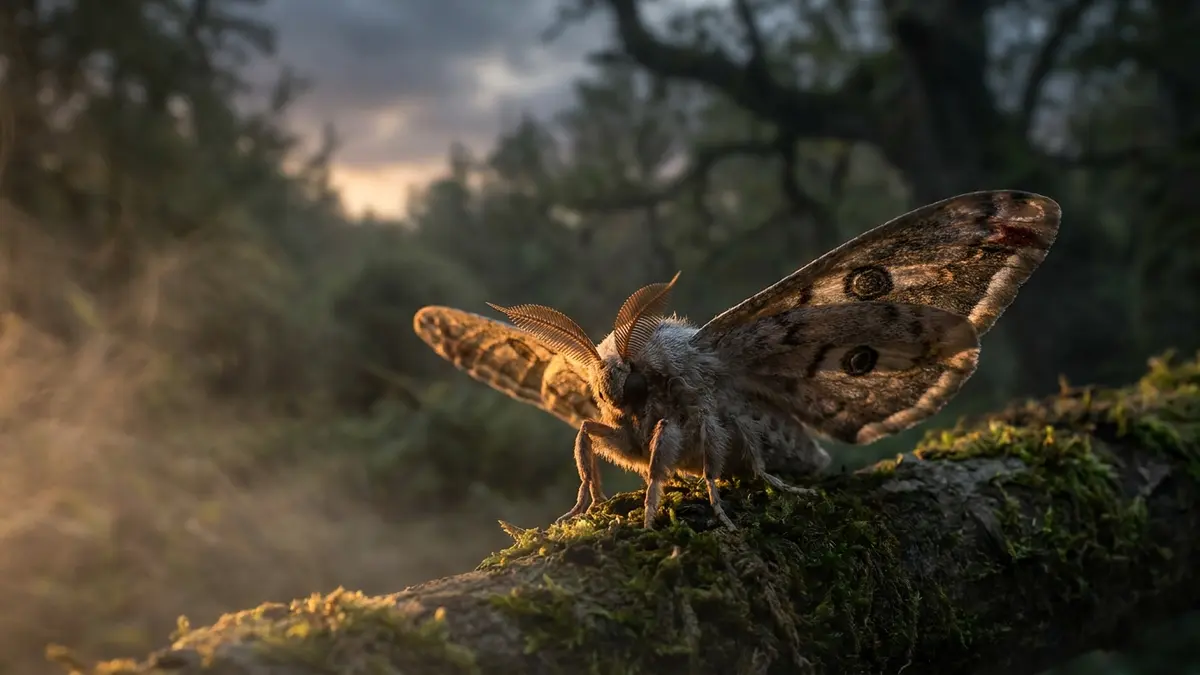
There are about 160,000 known moth species worldwide against roughly 17,500 butterflies, with nearly 11,000 moth species in the United States alone. Moths are not attracted to light in the usual sense: high-speed footage published in 2024 shows flying insects turn their backs toward the brightest source, which locks them into an orbit around a bulb. Adult clothes moths have no working mouthparts and eat nothing at all — the larvae do the damage, and only to keratin fibres such as wool, silk, fur and feathers.
An almanac
- Order
- Lepidoptera — Greek for 'scaly-winged'. Moths and butterflies share it; there is no clean dividing line between them.
- Known species
- About 160,000 moths worldwide against 17,500 butterflies; nearly 11,000 moth species in the United States alone.
- Largest wing area
- Atlas moth, wingspan up to 27 cm according to the Natural History Museum — wider than a human handspan.
- Longest reported span
- White witch, up to 280 mm reported, though the only specimens actually measured came in at 260 and 266 mm.
- Longest tongue
- Across roughly 130 Xanthopan specimens from Africa, the Comoros and Madagascar, proboscises measured 15 to 28.5 cm — the longest of any insect, with the record a Madagascan male.
- Sharpest ears
- Greater wax moth senses up to 300 kHz, the highest recorded frequency sensitivity of any animal. Humans top out near 20 kHz.
- Long-distance migrant
- Bogong moth, up to 1,000 km across southeast Australia to alpine caves it has never visited.
Moths are the bulk of the Lepidoptera and always have been. Around 160,000 species have been named worldwide against roughly 17,500 butterflies, and nearly 11,000 moth species live in the United States alone. Britain has over 2,500 moth species and fewer than 70 butterflies.
Almost everything people repeat about them fails on the mechanics. The porch light is not attraction. The wardrobe damage is not done by the adult. The antennae rule does not reliably separate a moth from a butterfly, because no rule does.
What sits underneath the folklore is harder to summarise: wing scales that absorb ultrasound like a stealth coating, a tiger moth that jams bat sonar, hearing that runs to 300 kHz, and a migrant that reads the night sky as a compass.
Verified moth facts
- Moths outnumber butterflies roughly nine to one. About 160,000 known moth species worldwide against some 17,500 butterflies, with nearly 11,000 moth species in the United States. In Britain the ratio is starker still: over 2,500 moth species to fewer than 70 butterflies, of which around 900 are 'macro-moths' and the rest micros.
- The atlas moth's wingspan is routinely exaggerated. The Natural History Museum gives up to 27 cm — wider than a human handspan — and the caterpillars reach 12 cm. The 12-inch (30 cm) figure that circulates online is not what museums report; Washington State's agriculture department describes the moth as 'up to almost 10 inches', about 25 cm. The real number sits in the mid-to-high 20s of centimetres, and it is the wing area rather than the span that makes atlas moths look enormous.
- Adult atlas moths cannot eat. The proboscis is tiny and does not work, so they live one to two weeks on fat reserves laid down as caterpillars, then run out of the energy needed to power their wings.
- Their cocoons are used as purses. Atlas moth caterpillars secrete a coarse brown broken-stranded silk called fagara, and in some Asian countries the abandoned cocoons are durable enough to be repurposed.
- Its Cantonese name translates as 'snake's head moth'. The wingtips resemble a cobra's head, and a threatened moth drops to the ground and writhes, flapping slowly to imitate a snake's head and neck.
- The largest-moth record is shakier than it looks. The white witch (Thysania agrippina) of South America is credited with the longest reported span of any lepidopteran, up to 280 mm, though the only specimens actually measured came in at 260 mm and 266 mm. On wing area rather than span, several southern Asian saturniids surpass it.
- Luna moth tails are anti-bat decoys. In laboratory trials against big brown bats, tailed luna moths had roughly a 47% survival advantage over moths whose tails had been removed, and bats struck the spinning tails instead of the body in 55% of encounters.
- One tiger moth jams bat sonar. Bertholdia trigona is palatable, so its ultrasonic clicks cannot be an honest toxicity warning — ultrasonic recordings and high-speed infrared video show they jam the bat's sonar instead. Other tiger moths do use clicks aposematically or to startle; jamming adds to that repertoire rather than replacing it.
- Moth wings are an acoustic stealth coating. The scale layer works as a metamaterial ultrasound absorber, soaking up 72% of sound intensity at 78 kHz in a layer 111 times thinner than the longest wavelength it absorbs.
- Bogong moths read the starry sky as a compass. Tethered in a flight simulator under a naturalistic moonless sky with the geomagnetic field nulled, they still flew in their seasonally correct migratory direction — evidence that stars alone suffice, though the authors conclude the moths combine stellar and magnetic cues into one compass system. The migration runs up to 1,000 km, to alpine caves the individual moth has never visited.
- The greater wax moth hears higher than any other known animal. It senses frequencies up to 300 kHz, the highest recorded frequency sensitivity in nature. Humans manage about 20 kHz; dolphins stop near 160 kHz.
- Moths deposit pollen faster than daytime insects. Across 10 South East England sites, 83% of insect visits to bramble happened in daylight and moths made only 15% of visits, yet moths deposited pollen at a faster rate — the researchers' conclusion is that moths are the more efficient pollinators, not that they contribute more pollination overall, which the study did not report.
- The peppered moth's black form came from a jumping gene. The textbook example of evolution in action traces to a transposable element that inserted itself into the first intron of a gene called cortex. Statistical inference from recombined haplotypes dates the event to around 1819, at the height of the Industrial Revolution.
- Wallace's sphinx moth has the longest tongue of any insect. Across roughly 130 Xanthopan specimens from Africa, the Comoros and Madagascar, proboscises measured 15 to 28.5 cm, with the record a Madagascan male. They were too long to store extended in the museum's existing drawers.
- The death's-head hawkmoth squeaks by pumping air through its throat. Each squeak lasts about 200 milliseconds and consists of an inflation phase, a short pause and a deflation phase. The inflation burst carries around 50 pulses peaking near 8 kHz, with harmonics running past 60 kHz.
- Vampire moths drink blood, with caveats. Moths in the genus Calyptra pierce mammal skin with a barbed proboscis, human skin included. It is the males that do it, and only in some species; females feed on fruit juice and nectar, larvae eat leaves, the single North American Calyptra species is not a known blood-feeder, and none is known to transmit disease.
- North America's spongy moth invasion started in one backyard. The amateur entomologist Étienne Léopold Trouvelot reared larvae from imported egg masses in cages on trees behind his home in Medford, Massachusetts. They escaped in 1868 or 1869, and no control was attempted until 1890.
- Britain's larger moths are in steep decline. The abundance of Britain's larger (macro-)moths has fallen 28% since 1968, and 40% in southern Britain. Butterfly Conservation counts 51 British moth extinctions since 1900, with some species since recolonising or being re-found.
Myths, corrected
"Moths fly into your porch light because they mistake it for the moon and their lunar navigation goes haywire." They are not flying toward the light at all. In 2024, high-speed motion capture and field stereo-videography showed that insects tilt their backs toward the brightest thing they can see — a reflex that normally keeps them upright under an open sky. Near a bulb, that reflex locks them into a perpendicular orbit around it. Nobody is aiming at anything, and no lunar compass is being fooled.
"Moths eat your clothes." Adult clothes moths have no working mouthparts and do no damage whatsoever, so the fluttering thing in your wardrobe is not the culprit, it is the parent. The larvae do the chewing, and only on keratin: wool, fur, silk, feathers, felt, leather. Cotton and synthetics are safe unless blended or food-stained. Of Britain's 2,500-plus moth species, only a handful touch fabric at all.
"You can always tell a moth from a butterfly: butterflies have clubbed antennae, moths have feathery or threadlike ones." Day-flying burnet moths have club-like antennae, and the popular rules do not hold. Both groups sit in the same order, Lepidoptera, and there is no clean dividing line between them.
Moths in popular culture
The moth's assigned cultural role is to be drawn to a flame, and the image has survived mainly because nobody tested it. When researchers finally did, using high-speed motion capture in the laboratory and stereo-videography in the field, the result was published in Nature Communications in 2024 and read as a flat contradiction: insects do not steer toward the light. They turn their dorsum toward it, which is a reflex for keeping the back to the open sky, and near a point source that reflex produces flight bouts perpendicular to the bulb. The moth circling your porch is not chasing anything. It is trapped in a postural correction that has nothing left to correct against.
The second stock role is the horror prop, and here the animals cooperate more readily. The USDA's Agricultural Research Service runs its own Halloween billing for the blood-drinking moths of the genus Calyptra, which pierce skin with a barbed proboscis — though the agency is careful to note that it is the males doing it, that females stick to fruit, and that no disease transmission is known. The death's-head hawkmoth earns its billing acoustically rather than visually, forcing air in and out of its throat to produce a 200-millisecond squeak of about 50 pulses, peaking near 8 kHz with harmonics past 60 kHz. The atlas moth does the most theatrical impression of all: its Cantonese name translates as snake's head moth, its wingtips resemble a cobra's head, and a threatened individual drops to the ground and writhes, flapping slowly to sell the illusion. Its cocoons, spun from a coarse brown silk called fagara, end up as purses in parts of Asia — the same animal serving as monster and as haberdashery.
Famous moths
The peppered moth is the moth almost everyone has met, usually in a school textbook as the standard demonstration of natural selection under industrial soot. The molecular explanation arrived in 2016: the black form was produced by a transposable element — a jumping gene — inserting itself into the first intron of a gene called cortex. Statistical inference from the distribution of recombined carbonaria haplotypes dates that insertion to around 1819, which fits the historical record of the Industrial Revolution.
Wallace's sphinx moth was famous before it was a species of its own. Predicted to exist by Darwin and Wallace, the Madagascan population was described as Xanthopan praedicta in 2021. Measurements across roughly 130 Xanthopan specimens from Africa, the Comoros and Madagascar returned proboscises of 15 to 28.5 cm, the longest of any insect, the record held by a Madagascan male — and too long to store extended in the museum's drawers, so the researchers rolled them back in by returning each head to water.
Australia's Bogong moth made Nature in 2025 for navigation rather than size. It migrates up to 1,000 km across southeast Australia to alpine caves it has never previously visited, and tethered flight-simulator experiments under a naturalistic moonless sky, with the geomagnetic field nulled, showed it still held its inherited migratory direction. Stars alone are sufficient, though the authors conclude the moths combine stellar and magnetic cues into a single compass system.
Two more are famous inside their own field. Bertholdia trigona, a palatable tiger moth with no honest toxicity to advertise, was shown in 2009 to jam big brown bat sonar with ultrasonic clicks. The luna moth's long spinning hindwing tails were shown in 2015 to be acoustic decoys, giving tailed moths roughly a 47% survival advantage against the same bat species, with strikes landing on the tails in 55% of encounters. And the spongy moth is famous for the worst reason: Étienne Léopold Trouvelot reared imported larvae in his Medford, Massachusetts backyard, they escaped in 1868 or 1869, and nobody attempted control until 1890.
Frequently Asked Questions
Are moths actually attracted to light?
Not in the way the phrase suggests. Research published in Nature Communications in 2024, using high-speed motion capture and field stereo-videography, found insects do not steer toward a light source. They turn their backs toward the brightest thing in view — a reflex that normally keeps them upright under an open sky — which near a bulb produces flight perpendicular to it, so they end up orbiting rather than approaching.
Do moths eat clothes?
Adult clothes moths do not feed at all and cause no injury to fabrics. The larvae do the damage, and only to keratin: wool, fur, silk, feathers, felt and leather. Cotton and synthetics are safe unless blended or food-stained, and of Britain's 2,500-plus moth species only a handful touch fabric.
How can you tell a moth from a butterfly?
There is no reliable single test. Moths and butterflies share the order Lepidoptera and there is no clean dividing line between them. The antennae rule fails immediately: day-flying burnet moths have club-like antennae.
What is the biggest moth in the world?
It depends on what you measure. The atlas moth has the largest wing area, with the Natural History Museum giving a wingspan up to 27 cm — the 30 cm figures online are not what museums report. The white witch is credited with the longest reported span, up to 280 mm, though the only specimens actually measured came in at 260 mm and 266 mm.
Do any moths drink blood?
Yes, moths in the genus Calyptra pierce mammal skin with a barbed proboscis and drink blood, human blood included. It is the males that do it, and only in some species; females feed on fruit juice and nectar, the larvae eat leaves, the one North American Calyptra species is not a known blood-feeder, and none is known to transmit disease.
Are moths good pollinators?
They are efficient ones. Across 10 sites in South East England, 83% of insect visits to bramble flowers happened in daylight and moths made only 15% of visits, yet moths deposited pollen at a faster rate. The researchers' conclusion is that moths are the more efficient pollinators — not that they contribute more pollination overall, which the study did not report.
More about the Moth
More from Animal Facts


Sources
Claims on this page were checked against these published sources.
- BugInfo: Moths
There are some 160,000 species of moths in the world, compared to 17,500 species of butterflies. In the United States, there are nearly 11,000 species of moths.
Read the source → - Spotlight: the atlas moth
The atlas moth is among the biggest insects on the planet, with a wingspan stretching up to 27 centimetres across - that's wider than a human handspan.
Read the source → - Chapter 32: Largest Lepidopteran Wing Span, University of Florida Book of Insect Records
This neotropical species is reported to attain wing expanses of up to 280mm. While all books on Lepidoptera and entomology consulted award this status to T. agrippina, no supporting documentation from the primary literature was located.
Read the source → - Moth tails divert bat attack: evolution of acoustic deflection
We pit luna moths against big brown bats (Eptesicus fuscus) and demonstrate a survival advantage of ∼ 47% for moths with tails versus those that had their tails removed.
Read the source → - Tiger moth jams bat sonar
Using ultrasonic recording and high-speed infrared videography of bat-moth interactions, we show that the palatable tiger moth Bertholdia trigona defends against attacking big brown bats (Eptesicus fuscus) using ultrasonic clicks that jam bat sonar.
Read the source → - Bogong moths use a stellar compass for long-distance navigation at night
Here we show that Bogong moths use the starry night sky as a compass to distinguish between specific geographical directions, thereby navigating in their inherited migratory direction towards their distant goal.
Read the source → - World's most extreme hearing animal: The greater wax moth
Researchers at the University of Strathclyde have discovered that the greater wax moth is capable of sensing sound frequencies of up to 300 kHz – the highest recorded frequency sensitivity of any animal in the natural world.
Read the source → - Moths are more efficient pollinators than bees, shows new research
Studying 10 sites in the South East of England throughout July 2021, the Sussex researchers found that 83% of insect visits to bramble flowers were made during the day. While the moths made fewer visits during the shorter summer nights, notching up only 15% of the visits, they were able to pollinate the flowers more quickly.
Read the source → - The industrial melanism mutation in British peppered moths is a transposable element
Statistical inference based on the distribution of recombined carbonaria haplotypes indicates that this transposition event occurred around 1819, consistent with the historical record.
Read the source → - Moth predicted to exist by Darwin and Wallace becomes a new species
Varying from 15 to 28.5 centimetres long, the moth proboscises were, however, too long to store extended in the existing drawers, so the researchers decided to roll them back in by placing the moth's head back in water.
Read the source → - The unique sound production of the Death's-head hawkmoth (Acherontia atropos (Linnaeus, 1758)) revisited
Single squeaks of A. atropos last for ca. 200 ms and consist of an inflation phase, a short pause and a deflation phase. The inflation phase is characterised by a burst of ca. 50 pulses with decreasing pulse frequency and a major frequency peak at ca. 8 kHz, followed by harmonics ranging up to more than 60 kHz.
Read the source → - Scary Insects for Halloween: The Blood-Thirsty Calyptra
Scientists have found that male vampire moths are more likely to suck blood than females. Female moths stick to feeding on fruit; the larvae feed on leaves of fruit trees and other plants.
Read the source → - Forest Insect and Disease Leaflet 162: Spongy Moth
The amateur entomologist Éttiene Léopold Trouvelot, an immigrant to the United States from France living in Medford, MA, obtained spongy moth egg masses from Europe and reared spongy moth larvae in cages on trees in the backyard of his home. They escaped in 1868 or 1869.
Read the source →
Not sure which animal is yours?
Consult the quiz