Animal Facts
Orangutan Facts & Trivia: Apes, Not Monkeys
A great ape that is neither a monkey, nor a vegetarian, nor entirely solitary.
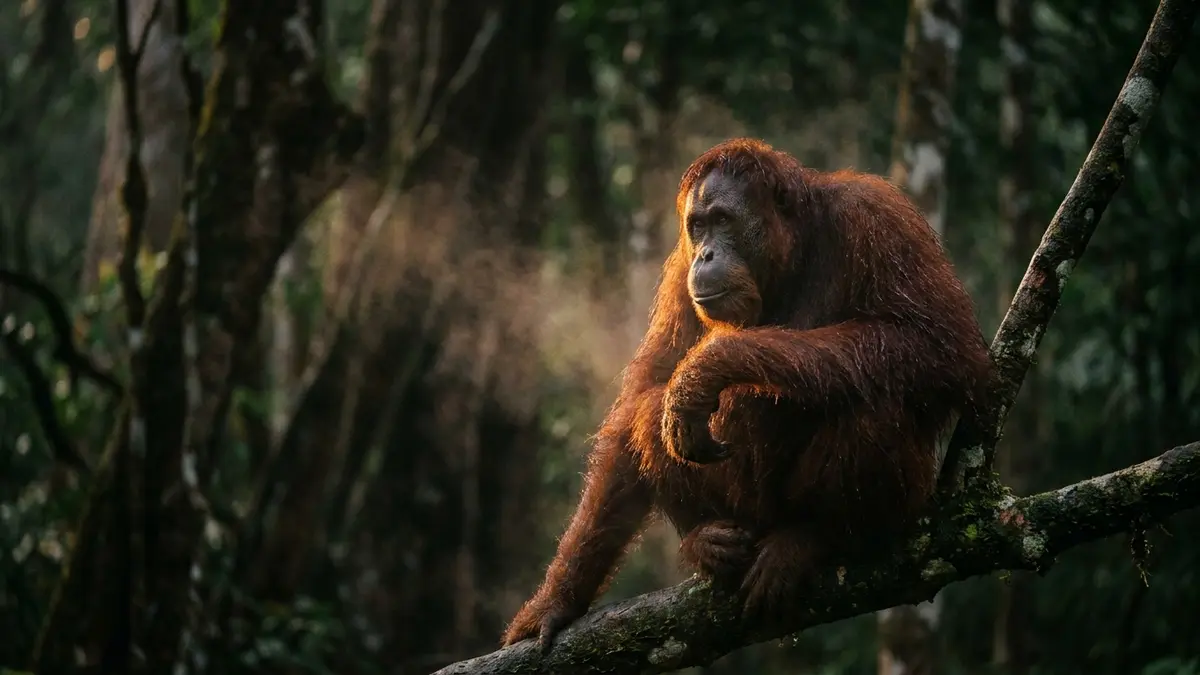
An orangutan is a great ape, not a monkey — it has no tail and is far more closely related to us than to any monkey. Only some adult males grow the wide cheek pads, and which ones do is socially determined rather than automatic. They also spend more time on the ground than their reputation allows.
An almanac
- Lifespan
- About 40–45 years in the wild; median life expectancy in AZA zoos is far lower (25–28 years for males)
- Size
- Wild males 170–220 lb (77–100 kg); wild females 80–120 lb (36–54 kg)
- Arm span
- Over 7 feet (2 m) from fingertip to fingertip — arms about twice as long as the trunk
- Range
- Sumatra and Borneo only — the only great apes living outside Africa
- Diet
- Mostly ripe fruit, up to 100 kinds; figs and durian most common, plus leaves, bark, honey and insects
- Conservation status
- All three species — Bornean, Sumatran, Tapanuli — are Critically Endangered (IUCN)
- Standout number
- 7.6 years between surviving births — the longest average interbirth interval of any mammal
The single most common error about orangutans is the easiest to fix: they are apes, not monkeys. No tail, and a far closer relative of ours than of any monkey.
The more interesting corrections are about the males. Not every adult male grows the famous wide cheek flanges — whether he does depends on the social situation around him, and unflanged males can stay that way for years before developing them.
And the picture of a permanently arboreal, solitary, fruit-only animal is wrong in all three parts.
Orangutan Facts Worth Knowing
- A third orangutan species, the Tapanuli orangutan (Pongo tapanuliensis), was described in 2017 — with only about 800 individuals, confined to the Batang Toru forests of North Sumatra.
- All three orangutan species are listed as Critically Endangered.
- Orangutans are the largest tree-dwelling mammals on Earth.
- Humans and orangutans share 97 percent of their DNA sequence, established when the orangutan genome was published in January 2011.
- The orangutan genome has stayed structurally almost unchanged for 15 million years — unusually stable compared with the human and chimpanzee genomes, which underwent large-scale rearrangements.
- Gigantopithecus blacki — a primate up to three metres tall and perhaps 600 kg, the largest ape that ever lived — is the orangutan's closest known extinct relative; the two lineages split about 12 million years ago. Popular retellings often call Gigantopithecus a 'giant orangutan' or an orangutan ancestor. It was neither: the 2019 enamel-protein study places it as a sister lineage that branched off around 12 million years ago, so orangutans did not descend from it.
- Orangutans have the longest average interval between births of any mammal — a study pooling seven field sites found an average closed interbirth interval of 7.6 years.
- Wild orangutans typically live about 40–45 years. The much-quoted figure of 'about 27 years' comes from AZA median life expectancy tables for zoo populations (males 27.8 years for Bornean, 25.4 for Sumatran) — a statistical median, not a natural lifespan. Field data put wild longevity at 40–45 years, and the oldest known captive orangutan reached 61.
- An orangutan's arms span more than 7 feet (2 metres) from fingertip to fingertip — longer than the animal's own body.
- A flanged male's 'long call' can carry more than a mile through the forest, amplified by an inflatable throat sac that works as a resonating chamber.
- When building their nightly tree nests, orangutans exploit 'greenstick' fracture — snapping branches only halfway through so they stay attached and can be woven — using thicker, stiffer branches for the frame and thinner ones for the lining.
- Across five long-term study sites, cheek-flanged males fathered 69.57% of sampled offspring while unflanged males fathered 23.91%.
- Borneo lost more than 100,000 orangutans between 1999 and 2015 — roughly half the island's population — according to a survey that counted 36,555 nests across the species' range.
- The Sumatran orangutan population was estimated at 14,613 individuals in 2015, and modelling suggested as many as 4,500 more could vanish by 2030.
- Habitual foraging tool use is not a species-wide orangutan trait — it is concentrated in a handful of populations, most famously Suaq Balimbing in Sumatra, where orangutans poke sticks into Neesia fruits to flick the seeds straight into their mouths. Documentaries and listicles present stick tools as something 'orangutans do'. In fact most wild populations have never been recorded using foraging tools; the behaviour is a local cultural tradition, and researchers link it to Suaq's unusually high social tolerance, which lets youngsters watch and copy unrelated adults.
- A 2025 analysis of Sumatran female alarm calls found rhythms nested inside rhythms across three hierarchical levels — 'third-order self-embedded isochrony' — a recursive structure previously thought absent from animal vocalisations.
What People Get Wrong About Orangutans
“Orangutans are monkeys.” They are great apes — the same group as chimpanzees, bonobos, gorillas and humans. Apes have no external tail, and orangutans are the only great apes living outside Africa.
“Orangutans essentially never come down from the trees, and any orangutan on the ground is a sign of habitat destruction.” A Borneo-wide camera-trap dataset of 159,152 trap days at 1,409 stations recorded orangutans on the ground about as often in primary forest as in heavily degraded forest, and in every age–sex class. Walking on the ground is normal behaviour, not just a symptom of logging.
“Orangutans are vegetarians that eat only fruit and leaves.” Fruit dominates the diet, but orangutans have been recorded killing and eating vertebrates. Sumatran orangutans at Ketambe were seen eating slow lorises, and in 2017 a Bornean male was filmed catching and eating one. Such predation is rare and opportunistic, but it is real.
“Every adult male orangutan has the big flat cheek pads.” Males come in two adult forms. All start unflanged, and some stay that way for decades; wild males have been recorded developing flanges anywhere between the ages of 14 and 30. An unflanged male is a fully mature, sexually active adult, not a juvenile.
“Orangutans are solitary animals that avoid each other.” They are semi-solitary with fission–fusion dynamics — individuals meet, travel together and separate. Females stay in their birth area and preferentially associate with related females, and Sumatran orangutans are markedly more gregarious than Bornean ones.
In Culture
Disney's The Jungle Book (1967) gave orangutans their most-seen role: King Louie, a character invented for the film and absent from Kipling's stories — and a zoological impossibility, since orangutans have never lived in India. Christopher Walken voiced him in the 2016 remake. Clint Eastwood's Every Which Way But Loose (1978) starred an orangutan named Manis as Clyde; by the 1980 sequel Any Which Way You Can he had outgrown the part and was replaced by C.J. Dunston Checks In (1996) featured Sammy (1989–2010), who was retired to the Center for Great Apes in Florida in 2004. The Planet of the Apes films cast orangutans as scholars: Maurice Evans played Dr. Zaius in 1968, and Rise of the Planet of the Apes (2011) named its orangutan Maurice after him, performed in motion capture by Karin Konoval. In print, Terry Pratchett turned Unseen University's Librarian into an orangutan in The Light Fantastic (1986), became an Orangutan Foundation trustee in 1994, and filmed Jungle Quest (Channel 4, 1995) and Facing Extinction (BBC2, 2012). Nicolas Philibert's Nénette (2010) is 70 minutes of one Paris zoo orangutan staring back.
Notable Individuals
Ken Allen (born 13 February 1971, San Diego Zoo) escaped three times in the summer of 1985 — first on 13 June — earning the nickname "Hairy Houdini"; he died on 1 December 2000. Chantek (born 17 December 1977 at Yerkes) learned roughly 150 American Sign Language signs, moved to Zoo Atlanta in 1997 and died there on 7 August 2017, aged 39. Sandra, born in Germany in 1986, was granted legal rights by an Argentine court on 18 December 2014 and moved from the Buenos Aires Zoo to the Center for Great Apes in Wauchula, Florida, on 5 November 2019. Inji, a wild-born Sumatran female who arrived at the Oregon Zoo in 1961, was euthanised on 9 January 2021 aged 61, believed the world's oldest orangutan. Nénette, born in Borneo in 1969, has lived at the Jardin des Plantes in Paris since 1972.
Frequently Asked Questions
Are orangutans monkeys?
They are great apes — the same group as chimpanzees, bonobos, gorillas and humans. Apes have no external tail, and orangutans are the only great apes living outside Africa.
Do orangutans ever come down from the trees?
A Borneo-wide camera-trap dataset of 159,152 trap days at 1,409 stations recorded orangutans on the ground about as often in primary forest as in heavily degraded forest, and in every age–sex class. Walking on the ground is normal behaviour, not just a symptom of logging.
Are orangutans vegetarian?
Fruit dominates the diet, but orangutans have been recorded killing and eating vertebrates. Sumatran orangutans at Ketambe were seen eating slow lorises, and in 2017 a Bornean male was filmed catching and eating one. Such predation is rare and opportunistic, but it is real.
Why do only some male orangutans have cheek pads?
Males come in two adult forms. All start unflanged, and some stay that way for decades; wild males have been recorded developing flanges anywhere between the ages of 14 and 30. An unflanged male is a fully mature, sexually active adult, not a juvenile.
Are orangutans solitary?
They are semi-solitary with fission–fusion dynamics — individuals meet, travel together and separate. Females stay in their birth area and preferentially associate with related females, and Sumatran orangutans are markedly more gregarious than Bornean ones.
More about the Orangutan
More from Animal Facts


Sources
Claims on this page were checked against these published sources.
- New orangutan species described in Indonesia
isolated population of around 800 individuals in the Batang Toru forests in Sumatra, Indonesia
Read the source → - Orangutan
All three orangutan species — Bornean, Sumatran and the newly discovered Tapanuli — are critically endangered.
Read the source → - Are Orangutans Monkeys? And Other Orangutan Facts
Native to the forests of Borneo and Sumatra, orangutans are the world's largest arboreal, or tree-dwelling, mammals.
Read the source → - Scientists publish orangutan genome sequence
orangutans and humans share 97 percent of their DNA sequence
Read the source → - Extinct giant ape directly linked to the living orangutan
the lineages of orangutan and Gigantopithecus split up about 12 million years ago
Read the source → - The slow ape: High infant survival and long interbirth intervals in wild orangutans
the longest average interbirth intervals of all mammals
Read the source → - Orangutans (Pongo spp.) Fact Sheet: Reproduction & Development
About 40-45 years (Wich et al. 2004; Kuswanda et al. 2021)
Read the source → - Orangutan
Their arms stretch out longer than their bodies—measuring over 7 feet (2 meters) from fingertip to fingertip.
Read the source → - The amazing orangutan long call
The long call is a booming series of extended shouts that, under the right conditions, can travel for over a mile.
Read the source → - Nest-building orangutans demonstrate engineering know-how to produce safe, comfortable beds
branches only break half-way across in 'greenstick' fracture to weave the main nest structure
Read the source → - Flanged males have higher reproductive success in a completely wild orangutan population
flanged males sired a greater proportion of offspring (69.57%) than did unflanged males (23.91%)
Read the source → - In 16 Years, Borneo Lost More Than 100,000 Orangutans
more than 100,000 of the island's orangutans disappeared between 1999 and 2015.
Read the source → - Land-cover changes predict steep declines for the Sumatran orangutan (Pongo abelii)
we estimate a population of 14,613 in 2015
Read the source → - The Suaq culture
Suaq is one of the only orangutan populations which shows habitual tool use in the foraging context.
Read the source → - Third-order self-embedded vocal motifs in wild orangutans, and the selective evolution of recursion
From the data, we propose third‐order self‐embedded isochrony: three hierarchical levels of nested isochronous combinatoric units, with each level exhibiting unique variation dynamics and information content relative to context.
Read the source →
Not sure which animal is yours?
Consult the quiz