Animal Facts
Octopus Facts: Three Hearts, Blue Blood
Two thirds of an octopus's neurons sit in its arms, not in its head.
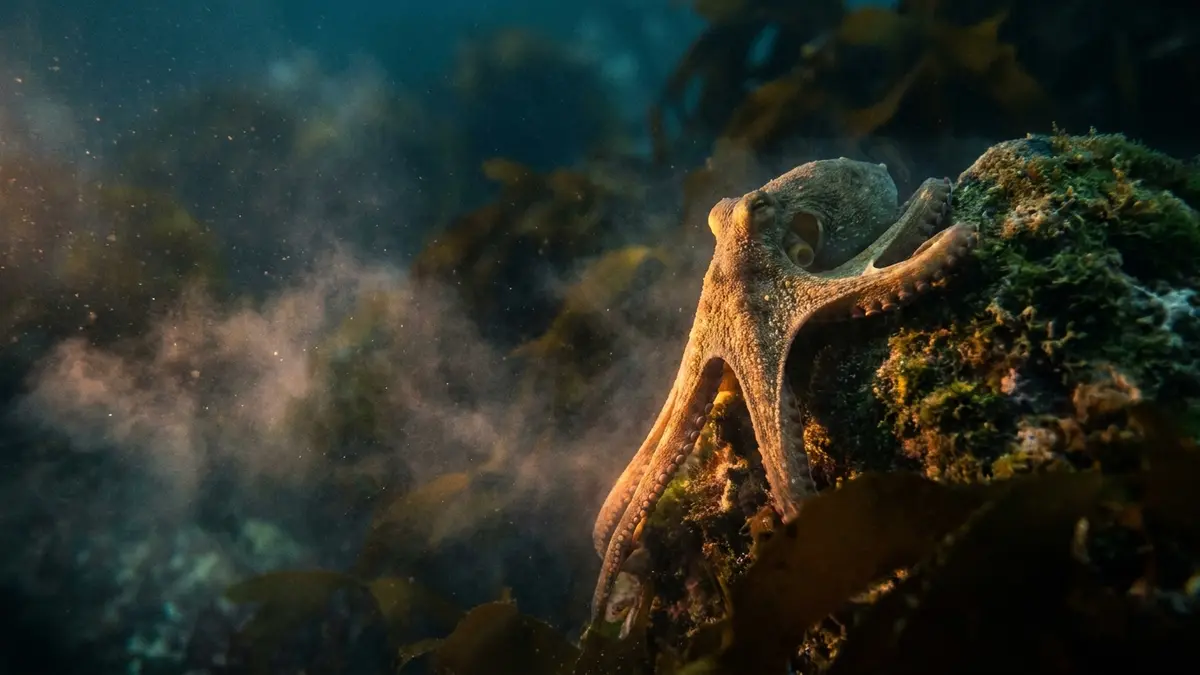
An octopus has three hearts and blue, copper-based blood, and the common octopus carries around 500 million neurons — roughly a dog's count — with about two thirds of them in the arms rather than the head. The giant Pacific octopus, the largest species, lives only three to five years, and the heaviest on record weighed 200 pounds and measured nearly 20 feet across. It has eight arms, not tentacles: tentacles are the two extra limbs squid and cuttlefish have and octopuses do not.
An almanac
- Limbs
- Eight arms, no tentacles
- Hearts
- Three: two branchial, one systemic
- Blood
- Blue, carried by copper-based haemocyanin
- Neurons
- About 500 million; two thirds in the arms
- Lifespan
- 3 to 5 years (giant Pacific octopus)
- Heaviest on record
- 200 pounds, nearly 20 feet across
- Deepest confirmed dumbo sighting
- Almost 7,000 m, Java Trench, 2020
An octopus runs on three hearts and blue blood, carries roughly 500 million neurons with about two thirds of them in the arms, and is dead by five years old. Those are the parts that hold up when you go back to the sources.
Around them sits a layer of repetition that does not. The 600-pound giant Pacific octopus is a story, not a weighed animal. "Octopuses are colourblind" is accurate at the level of the light receptor and misleading as a full stop. And "octopi" is not the sloppy error people say it is — Merriam-Webster records three plurals and endorses two of them.
Everything below is tied to a named source: Smithsonian Ocean, the Natural History Museum in London, Monterey Bay Aquarium, MBARI, Harvard, Berkeley, PLOS ONE, and the LSE review that put octopuses into British law.
Verified octopus facts
- Three hearts, two of them dedicated to the gills. The two branchial hearts push oxygen-depleted blood through the gills, while the systemic heart pumps the oxygenated blood around the rest of the body (Smithsonian Ocean).
- The blood is blue because the oxygen carrier is copper, not iron. Cephalopods use haemocyanin, a copper-based molecule that binds oxygen and powers the muscles, where we use iron-based haemoglobin.
- About 500 million neurons, and most of them are not in the head. The Natural History Museum puts the common octopus (Octopus vulgaris) at roughly the neuron count of a dog, with about two thirds of those neurons in its arms.
- The beak is the main constraint on how small a gap an octopus can squeeze through — if the beak fits, the rest of the body follows — so a fully grown giant Pacific octopus can fit through a hole the size of a lemon.
- At the reflex level an octopus sucker will not attach to octopus skin: on a freshly amputated arm the suckers grab Petri dishes and skinned flesh but never the arm itself, and skin extract from octopuses (but not from fish) blocks the grabbing reflex — evidence of a chemical signal in the skin. Living animals can override the reflex from the brain and will sometimes grab a severed arm anyway.
- The suckers taste what they touch. Harvard researchers, publishing in Cell in October 2020, identified a novel family of chemotactile receptors in the first layer of cells inside the suction cups, tuned to detect molecules that barely dissolve in water.
- One clutch, tens of thousands of eggs, then death. A female giant Pacific octopus lays 18,000 to 74,000 eggs about a month after mating, occasionally as many as 100,000, guards them until they hatch, and dies (Monterey Bay Aquarium).
- Three to five years is a long octopus life. That is the stated lifespan of the giant Pacific octopus, the largest species there is.
- Monterey Bay Aquarium gives the heaviest giant Pacific octopus on record as 200 pounds and nearly 20 feet across, with a full-grown adult over 50 pounds. The 600-pound, 30-foot animal quoted almost everywhere else is an anecdotal report rather than a weighed specimen.
- Fifty-three months of brooding, without a break. Researchers writing in PLOS ONE watched a single Graneledone boreopacifica guard the same clutch of about 160 eggs at 1,400 metres in Monterey Canyon for more than four years — by far the longest egg-brooding period reported for any animal.
- MBARI documented 5,718 octopus in a 2.5-hectare area at the centre of the Octopus Garden, 3,200 metres down at Davidson Seamount, where water in the rock crevices reaches nearly 11°C against an ambient 1.6°C. The team estimates the full 333-hectare hillock could exceed 20,000 individuals.
- Colourblind at the receptor level, with a possible workaround. Cephalopod eyes contain only one type of light receptor. A 2016 PNAS hypothesis from Alexander and Christopher Stubbs argues the odd U-shaped and dumbbell pupils exaggerate chromatic aberration, so an octopus could infer wavelength from which colours come into focus — a proposed mechanism, not a settled finding.
- Genuine tool use, with coconut shells. In 2009 the veined octopus (Amphioctopus marginatus) was recorded in Indonesia digging up discarded coconut shells, cleaning them with jets of water, carrying them across the seabed and assembling them into a shelter.
- The blue-ringed octopus does not make its own poison. Symbiotic bacteria in its salivary glands produce the tetrodotoxin. The famous "1,000 times more toxic than cyanide" line is hedged even by the Natural History Museum as something "some reports state"; fatal encounters are rare, the bite is nearly painless, and swallowing the toxin is roughly 50 times less dangerous than being injected with it.
- "Octlantis" is a crowd, not a city. In Jervis Bay, Australia, researchers reported 13 occupied and 10 unoccupied gloomy octopus dens with 10 to 15 animals present at once (Marine and Freshwater Behaviour and Physiology, 2017). The interactions logged included mating and signalling but also evicting each other from dens — tolerance under crowding on scarce hard shelter, not society.
- The deepest confirmed sighting of a dumbo octopus — the group the Natural History Museum calls the deepest octopus species — was filmed in 2020 almost 7,000 metres down in the Java Trench. Dumbo octopuses also have no ink sac at all.
- Sentient in British law since 2022. The Animal Welfare (Sentience) Act 2022 extended protection to cephalopod molluscs and decapod crustaceans, following a government-commissioned LSE review of more than 300 scientific studies published in November 2021.
What the popular version gets wrong
"An octopus has eight tentacles." It has eight arms. "Tentacle" is a specific anatomical term for the two extra, extendable limbs that squid and cuttlefish use to snatch prey from a distance, and octopuses do not have them. Documentaries and cartoons use the word loosely; biologists do not.
"There is one correct plural and the others are errors." Merriam-Webster records three — octopi (oldest, from treating the word as Latin), octopuses (an English ending on an English word), and octopodes (rarest, from treating it as Greek). MW's own advice is to use either octopuses or octopi; both are standard.
"Octopus eyes work like ours, so they simply look at a reef and copy the colours." Cephalopod eyes contain only one type of light receptor, which at the receptor level makes them colourblind. But that may not mean they are blind to colour: a 2016 PNAS hypothesis from Alexander and Christopher Stubbs argues their U-shaped and dumbbell pupils exaggerate chromatic aberration, so an octopus could infer wavelength from which colours come into focus. Proposed mechanism, not settled fact.
"Something that big and clever must live for decades — a giant Pacific octopus is like an elephant of the sea." Three to five years, total, and that is the long-lived end of the octopus range. Everything an octopus learns, it learns in the space of a toddler's childhood, and then it breeds once and dies.
"If a blue-ringed octopus bites you, there's an antivenom." There isn't one. Treatment is supportive — keeping the patient ventilated until the tetrodotoxin wears off, because the toxin paralyses the diaphragm while the victim generally stays conscious. Rescue breathing, not a syringe, is what saves people.
The octopus in pop culture
Ringo Starr wrote "Octopus's Garden" after a 1968 boating holiday off Sardinia, on a yacht lent to him by Peter Sellers. The captain told him octopuses collect shiny stones, tin cans and bottles and arrange them outside their caves like a garden, and the song turned up on Abbey Road the following year.
Pixar's Finding Dory (2016) gave its breakout character, Hank, seven arms rather than eight. The animators modelled each arm separately, only seven would fit the body, and the missing limb was written into the script afterwards; the Hollywood Reporter noted that the design drew on the real mimic octopus. The word the studio settled on was "septopus".
Craig Foster's My Octopus Teacher reached Netflix in 2020 and did more than any documentary before it to move the octopus out of the monster slot and into the role of an animal an audience is invited to know as an individual.
Famous octopuses
The best-known individual octopus in science has no name, only a location. Between 2007 and 2011, researchers in Monterey Canyon returned again and again to the same female Graneledone boreopacifica at 1,400 metres, clinging to a rock face over a clutch of about 160 eggs. She was there for 53 months — the longest egg-brooding period ever reported for any animal, published in PLOS ONE in 2014.
The veined octopuses filmed in Indonesia in 2009 are famous for a different reason. Digging up discarded coconut shells, rinsing them with jets of water, then carrying them across open seabed to assemble later as a shelter is one of the cleanest cases of tool use recorded outside the vertebrates.
Two crowds also earned names. At the Octopus Garden on California's Davidson Seamount, MBARI documented 5,718 octopus in a 2.5-hectare patch 3,200 metres down, where water in the rock crevices reaches nearly 11°C against an ambient 1.6°C, and estimates the full hillock could hold more than 20,000. Off Jervis Bay in Australia, the site the press christened "Octlantis" held 13 occupied dens and 10 to 15 gloomy octopus at a time — an aggregation on scarce shelter, complete with evictions.
The record-holders round it out: the heaviest giant Pacific octopus on record at 200 pounds and nearly 20 feet across, and a dumbo octopus filmed in 2020 almost 7,000 metres down in the Java Trench, the deepest confirmed sighting of the group the Natural History Museum calls the deepest octopus species.
Frequently Asked Questions
How many hearts does an octopus have?
Three. Two branchial hearts push oxygen-depleted blood through the gills, and a third systemic heart pumps the oxygenated blood around the rest of the body.
Why is octopus blood blue?
Because it carries oxygen using haemocyanin, a copper-based molecule, rather than the iron-based haemoglobin in our blood. Copper gives the blood its blue colour.
Do octopuses have arms or tentacles?
Arms — eight of them. "Tentacle" is the term for the two extra extendable limbs that squid and cuttlefish use to grab prey at a distance, and octopuses do not have those.
How long do octopuses live?
Not long. The giant Pacific octopus, the largest species, lives about three to five years, and that counts as a long lifespan for an octopus. The female lays one clutch of eggs, guards it until it hatches, and dies.
Is it octopuses or octopi?
Both are fine. Merriam-Webster records three plurals — octopi, octopuses and the rare octopodes — and advises using either octopuses or octopi.
Is there an antivenom for a blue-ringed octopus bite?
No. Care is supportive: the tetrodotoxin paralyses the diaphragm while the victim generally stays conscious, so treatment means keeping the patient ventilated until the toxin wears off. The toxin is produced by symbiotic bacteria in the octopus's salivary glands, and fatal encounters are rare.
More about the Octopus
More from Animal Facts






Sources
Claims on this page were checked against these published sources.
- Cephalopods: Octopus, Squid, Cuttlefish, and Nautilus
Cephalopods have a lot of heart—three hearts to be exact. The two branchial hearts push oxygen-depleted blood through the gills while the systemic heart pumps the oxygenated blood throughout the body.
Read the source → - Octopuses keep surprising us – here are eight examples how
Octopuses have about as many neurons as a dog – the common octopus, Octopus vulgaris, has around 500 million. About two thirds are in its arms.
Read the source → - Giant Pacific octopus
A month or more after mating, she lays 18,000 to 74,000 eggs (occasionally up to 100,000)
Read the source → - Deep-Sea Octopus (Graneledone boreopacifica) Conducts the Longest-Known Egg-Brooding Period of Any Animal
At 53 months, it is by far the longest egg-brooding period ever reported for any animal species.
Read the source → - Weird pupils let octopuses see their colorful gardens
Octopuses, squid and other cephalopods are colorblind – their eyes see only black and white
Read the source → - Octopus' suction cups hold its taste and touch sensors
The scientists identified a novel family of sensors in the first layer of cells inside the suction cups that have adapted to react and detect molecules that don't dissolve well in water.
Read the source → - The blue-ringed octopus: small, vibrant and exceptionally deadly
Symbiotic bacteria in blue-ringed octopus salivary glands produce tetrodotoxin (TTX).
Read the source → - Octopuses rewire their brains to adapt to seasonal temperature shifts
Temperature-sensitive editing occurred at about one third of our sites—over 20,000 individual places
Read the source → - New evidence suggests that octopuses aren't loners
The number of octopuses observed at the site ranged from 10 to a high of 15.
Read the source → - The science of feeling: why octopuses, lobsters and crabs require legislative protection
animal welfare protections were to be extended to cephalopod molluscs and decapod crustaceans – including octopuses, lobsters and crabs
Read the source →
Not sure which animal is yours?
Consult the quiz