Animal Facts
Ostrich Facts: Two Toes, 43 mph, No Sand
The only bird that walks on two toes — and the only one that passes urine separately.
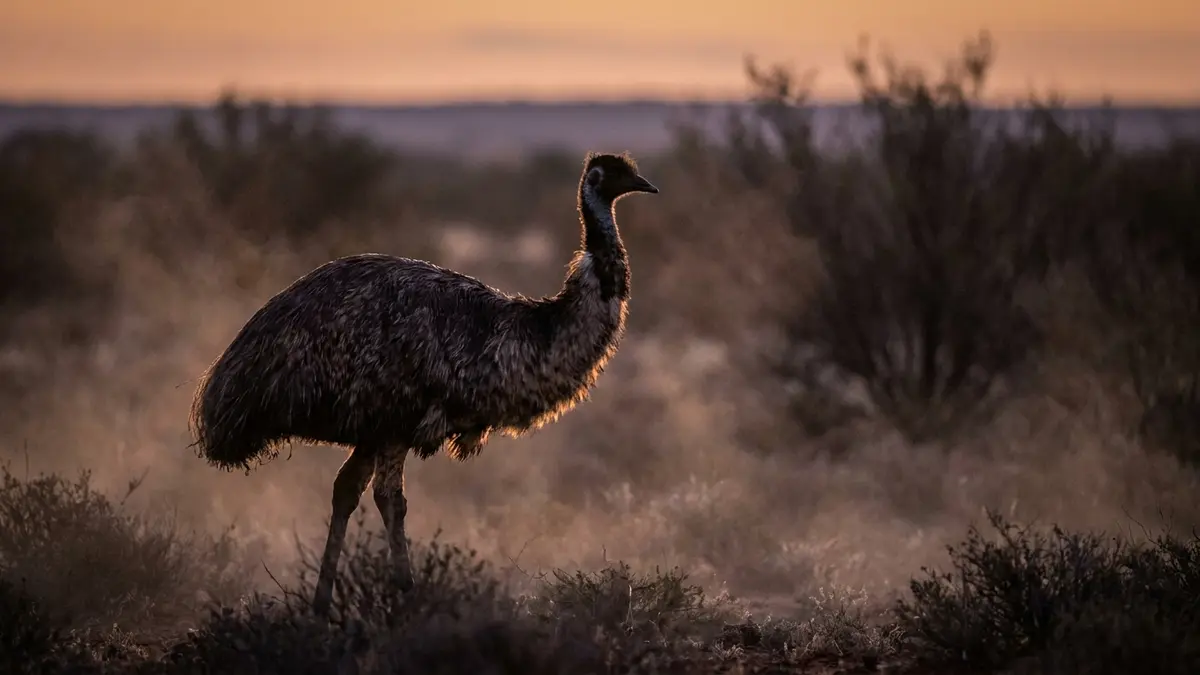
A fully grown common ostrich stands up to 9 feet (2.7 m) tall including its neck, sprints up to 43 mph (70 km/h) in short bursts, holds about 31 mph (50 km/h), and covers 10 to 16 feet in a single stride. It is the only bird with two toes on each foot, and its eye — almost 2 inches across — is the largest of any land animal. It does not bury its head in the sand: a cornered ostrich drops flat and lies still with its neck stretched along the ground.
An almanac
- Species
- Common ostrich (Struthio camelus); Somali ostrich (Struthio molybdophanes), split off as a separate species in 2014
- Size
- Up to 9 ft (2.7 m) tall including the neck; 200-300 lb (90-136 kg)
- Top speed
- 43 mph (70 km/h) in short bursts; 31 mph (50 km/h) sustained; stride 10-16 ft
- Egg
- The largest egg of any living bird — about as much as 24 chicken eggs; an extinct elephant bird egg was worth roughly 120
- Feet
- Two toes per foot, the only bird with two; inner toe carries a claw about 4 in long
- Lifespan
- 30-40 years in the wild; a median of about 10 years in human care, with rare individuals near 70
- Status & range
- Common ostrich Least Concern across Africa south of the Sahara; Somali ostrich Vulnerable (Somalia, Ethiopia, Djibouti, Kenya)
The ostrich is the tallest bird alive: up to 9 feet from the ground to the top of its head, fast enough to sprint at 43 mph in short bursts, and built on feet that no other bird has — two toes each, where every other bird carries three or more.
It is also one of the most consistently misreported animals on the internet. The sand story is false. The "biggest egg ever laid" claim is false. The famous 43 mph is a burst, not a travelling speed, and the line about its eyes being bigger than its brain gets repeated as if it measured intelligence, which it does not.
What follows is the checked version. Where a popular figure comes from a weaker source than people assume — a 1983 trivia book, a captive-bird study, a zoo median rather than a wild maximum — that is said plainly rather than smoothed over.
Ostrich facts
- Tallest bird alive. Including their necks, a fully grown ostrich can measure up to 9 feet (2.7 m) tall. Nothing else flying or walking comes close among living birds.
- 43 mph is a burst, not a cruising speed. The San Diego Zoo pairs the famous sprint figure of 43 mph (70 km/h) with a sustained 31 mph (50 km/h), and the Smithsonian's National Zoo reports scientists observing continuous running at 30-37 mph. Popular retellings quote 43 mph as if an ostrich travels at that speed all day.
- One stride covers 10 to 16 feet. That is 3 to 5 metres per step.
- Chicks are already fast at one month. Ostrich chicks can run at speeds approaching 35 mph (56 km/h) at just a month old.
- Two toes, and it is the only bird with two. All other birds have three or more.
- The two toes do different jobs. Schaller et al. (Journal of Experimental Biology, 2011) used pedobarography to map how load is distributed across the ostrich's two toes. The ostrich's didactyl anatomy — body mass borne on the 3rd claw-bearing toe and the lateral 4th toe — is the study's premise, not its result; the study found the 3rd toe carries roughly 78% of peak phalangeal load, with the 4th toe modulating balance early in stance.
- The legs work like springs. Research led by Jonas Rubenson (University of Western Australia), published in the Journal of the Royal Society Interface in 2010, found that the release of stored elastic energy in the tendons generated 83% more work in an ostrich than in a human.
- The largest eye of any land animal. An ostrich's eye is almost 2 inches (5 cm) across.
- Bigger eyes than brain — which says nothing about intelligence. The comparison is about physical bulk. Oversized eyes are a predator-spotting adaptation for open country; eye-to-brain volume does not measure cognition, though the line is almost always repeated as proof the bird is stupid.
- Lifespan depends entirely on which number you quote. In the wild, ostriches live up to 30-40 years. The San Diego Zoo gives ostriches in human care "a median life expectancy of about 10 years," well below the 30-40 year wild figure and the near-70-year outlier — but note these measure different populations (captive median vs. wild ceiling) and are not directly comparable.
- They nest communally. Ostriches breed communally: groups of unrelated males and females attempt to breed in one shared nest, with the females laying into it. A 2022 eLife study experimentally manipulated 97 captive breeding groups totalling 280 adult ostriches (127 males, 153 females) over seven years.
- Incubation is split by colour. By day the brown female sits on the eggs and blends into the brownish landscape; at night the black male takes over and disappears against the dark. Each parent matches the light conditions of its shift.
- Stones in the gizzard do the chewing. A 2021 Poultry Science study of 61 domesticated ostriches on controlled diets found the gizzard held a mean 1,213 g of stones — the highest stone mass and the highest stone percentage (4.76%) of any gut compartment.
- It is the only bird that separates urine from faeces. The ostrich is the only bird documented to completely separate urine from faeces; urine collects in the coprodeum, a cloacal compartment. The 2003 Skadhauge study found this compartment is NOT built like a mammalian bladder — instead a thick goblet-cell mucus layer shields the epithelium from urine that runs up to 500 mOsm hyperosmotic to plasma during dehydration.
- More REM sleep than any other bird. Lesku et al. (PLOS ONE, 2011) found ostriches get more REM sleep than any other bird species, and their brains flip between REM-type activity and slow waves mid-episode — a pattern otherwise seen in the platypus.
- Attacks are real, rare, and thinly documented. A 2015 abdominal-trauma case report in Annals of Medicine and Surgery repeats an estimate — originally from the 1983 Guinness Book of Animal Facts & Feats — that two to three ostrich attacks causing serious injury or death occur each year in South Africa. No modern surveillance data is cited. The paper notes ostriches may turn aggressive rather than run when cornered, or when defending their offspring or territories. It is largely a farm-and-fence problem rather than a wilderness one; South Africa is where feral and farmed ostriches live alongside people.
- Ostrich eggshell beads are the oldest manufactured ornaments in the world. A 2021 Nature study by Jennifer Miller and Yiming Wang analysed more than 1,500 beads from 31 African sites spanning 50,000 years. Rather than relying on an object's natural size or shape, the makers completely transformed the shells to produce beads.
Myths, corrected
"Ostriches bury their heads in the sand when they are frightened." They never do it. A threatened ostrich that cannot outrun danger drops flat to the ground and lies still, head and neck stretched along the soil, so it reads as a lump on the horizon. The illusion comes from nesting: ostriches scrape shallow ground nests and dip their heads in several times a day to turn the eggs.
"The ostrich lays the biggest egg of any animal that has ever lived." Biggest of any living bird, yes — but Madagascar's elephant birds, extinct since at least the 17th century, laid far larger ones. An ostrich egg is worth about 24 chicken eggs; National Geographic reports an elephant bird egg was worth roughly 120.
"There is only one kind of ostrich." Since 2014 there have been two recognised species. The Somali ostrich (Struthio molybdophanes) of Somalia, Ethiopia, Djibouti and Kenya was split off from the common ostrich and immediately assessed as Vulnerable on the IUCN Red List, its population thought to be in rapid decline because of hunting, egg-collecting and persecution. The common ostrich remains Least Concern.
"Ostriches are primitive birds whose ancestors never learned to fly." Backwards. Genetic work on ratites shows flight was lost repeatedly and independently in separate lineages as an adaptation to running — the ostrich's ancestors could fly. Flightlessness is a later specialisation, not a leftover from before flight evolved.
"Birds don't urinate — they pass everything out in one white splat." True for essentially every bird except this one. The ostrich is the only bird documented to completely separate urine from faeces; urine collects in the coprodeum, a cloacal compartment. The 2003 Skadhauge study found this compartment is NOT built like a mammalian bladder — instead a thick goblet-cell mucus layer shields the epithelium from urine that runs up to 500 mOsm hyperosmotic to plasma during dehydration.
The ostrich in culture
The ostrich's best-known screen role is comic ballet. Madame Upanova, the ostrich ballerina, opens the "Dance of the Hours" segment of Walt Disney's Fantasia (1940), dancing alongside hippos, elephants and alligators.
Video games gave the bird a stranger job. Joust, released by Williams Electronics in September 1982, put player one on a flying ostrich and player two on a giant stork, lances out, flapping a button to stay airborne. Designer John Newcomer chose ostriches specifically to avoid making yet another spaceship shooter, and the game became an arcade classic.
Off-screen, the ostrich's biggest cultural moment was fashion. In the early 1900s ostrich plumes were worth close to their weight in gold, and Oudtshoorn in South Africa's Klein Karoo became the self-styled "Feather Capital of the World", its merchants building sandstone "Feather Palaces" that still stand. The market collapsed after the First World War. The idiom "head in the sand" outlasted all of it, and is, as zoos keep pointing out, biologically false.
Named ostriches
Linda arrived at Smithsonian's National Zoo in November 2021 at four years old and was introduced to the public on 4 February 2022. She stands around 8 feet tall at the Cheetah Conservation Station, where keepers described her as "alert and observant" and said she "keeps us on our toes."
Red, Zoo Miami's long-time male ostrich, arrived in August 1996 and was found dead at 27, in a notice posted on 3 December 2021. He was the last ostrich at the zoo.
Karen had lived at the Topeka Zoo since its Giraffe & Friends habitat opened in March 2023. She reached over her fence, grabbed and swallowed a staff member's keys, and died in April 2024 after surgical and non-surgical efforts failed. The zoo called her their "dancing queen."
Frequently Asked Questions
Do ostriches really bury their heads in the sand?
No. An ostrich that cannot outrun danger drops flat to the ground and lies still, head and neck stretched along the soil, so it reads as a lump on the horizon. The illusion comes from nesting: ostriches scrape shallow ground nests and dip their heads in several times a day to turn the eggs.
How fast can an ostrich run?
Up to 43 mph (70 km/h) in short bursts, with a sustained pace of about 31 mph (50 km/h); the Smithsonian's National Zoo reports scientists observing continuous running at 30-37 mph. A single stride covers 10 to 16 feet, and chicks approach 35 mph (56 km/h) at just a month old.
How many toes does an ostrich have?
Two on each foot. It is the only bird with two — every other bird has three or more. Schaller et al. (2011) used pedobarography to map the load and found the 3rd claw-bearing toe carries roughly 78% of peak phalangeal load, with the lateral 4th toe modulating balance early in stance.
Can ostriches fly?
No, but their ancestors could. Genetic work on ratites shows flight was lost repeatedly and independently in separate lineages as an adaptation to running, so flightlessness is a later specialisation rather than a leftover from before flight evolved.
How long do ostriches live?
In the wild, up to 30-40 years, and rare individuals in human care have reached almost 70. The San Diego Zoo gives ostriches in human care "a median life expectancy of about 10 years" — but a captive median and a wild ceiling measure different populations and are not directly comparable.
Are ostriches dangerous to humans?
Rarely, and mostly around farms. A 2015 abdominal-trauma case report in Annals of Medicine and Surgery repeats an estimate — originally from the 1983 Guinness Book of Animal Facts & Feats — that two to three ostrich attacks causing serious injury or death occur each year in South Africa. No modern surveillance data is cited. The paper notes ostriches may turn aggressive rather than run when cornered, or when defending their offspring or territories.
More about the Ostrich & Emu
More from Animal Facts





Sources
Claims on this page were checked against these published sources.
- Ostrich
Including their necks, a fully-grown ostrich can measure up to 9 feet tall
Read the source → - Ostrich
Ostriches can sprint in short bursts up to 43 miles per hour (70 kilometers per hour)
Read the source → - Ostriches run fast because of 'springy' tendons
the release of this elastic energy generated 83% more work in the ostrich than in the human
Read the source → - Ostrich
By day, the female is well camouflaged – her drab brown feathers blend into the brownish landscape. At night, the male is well camouflaged – his black feathers disappear against the dark nightscape.
Read the source → - Studies on the weight of the gastrointestinal tract, digesta composition and occurrence of gastro- and enteroliths in adult domesticated ostriches fed different diets
the gizzard had the highest significant stone mass (1,213 g) compared to the other individual GIT compartments.
Read the source → - Ostriches sleep like platypuses
The amount of REM sleep in ostriches is greater than in any other bird species.
Read the source → - Ostrich Eggshell Beads Reveal 50,000-Year-old Social Network Across Africa
the world's oldest fully manufactured ornaments, meaning that instead of relying on an item's natural size or shape, humans completely transformed the shells to produce beads.
Read the source →
Not sure which animal is yours?
Consult the quiz