Animal Facts
Orca Facts: The Dolphin That Hunts Great Whites
The ocean's top predator is a dolphin, and no wild one has ever killed a person.
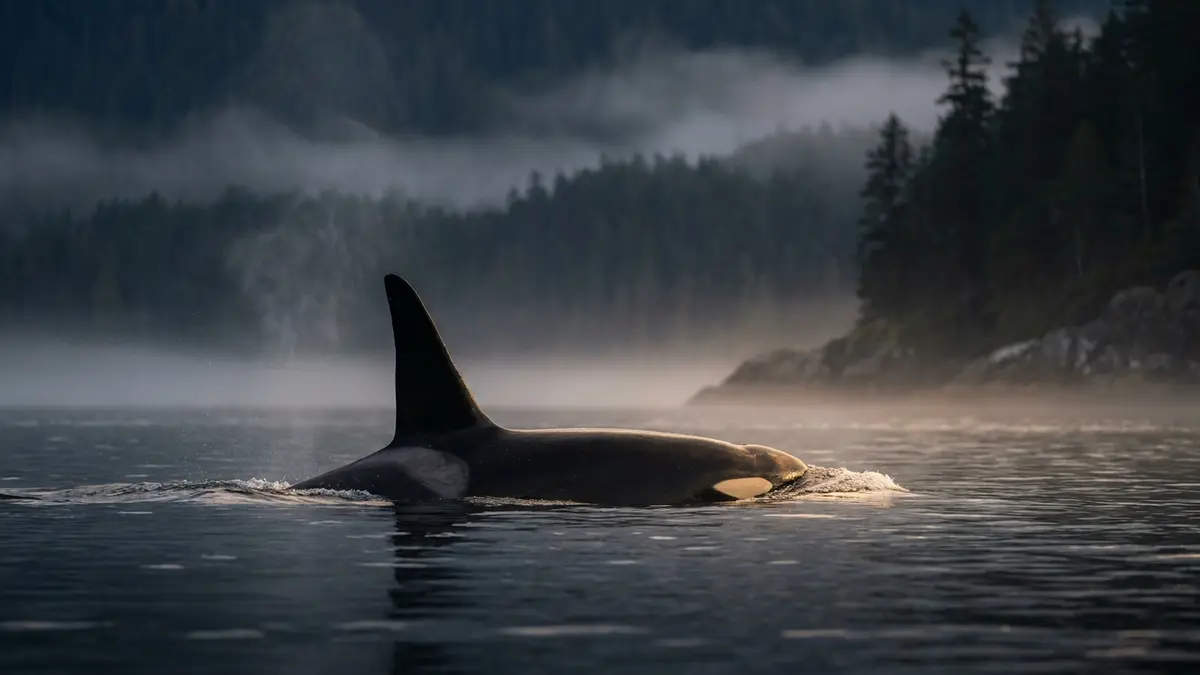
Orcas (Orcinus orca) are the largest members of the oceanic dolphin family and live in every ocean, with roughly 50,000 worldwide and about 2,500 in the eastern North Pacific. As a species they have the most varied diet of any cetacean, but each population is a narrow specialist: Southern Resident orcas eat close to 100% Chinook salmon in spring. That population is endangered in the US, and the July 2025 census counted just 74 whales.
An almanac
- Scientific name
- Orcinus orca — one of roughly 37 species in the oceanic dolphin family, Delphinidae (counts vary by authority)
- Size
- Up to 32 feet (9.8 m) and up to 11 tons; males develop disproportionately larger fins, flippers and flukes than females
- Lifespan
- Males average about 30 years (max 60+); females average about 50 years (max 90+)
- Global population
- Roughly 50,000 worldwide; about 2,500 in the eastern North Pacific
- Range
- Every ocean on Earth — most abundant in cold water, but present in the tropics too
- Diet
- The most varied diet of any cetacean as a species, yet each population is a narrow specialist
- Conservation
- Southern Resident population listed as endangered in the US — just 74 whales in the July 2025 census
The orca is the ocean's top predator and not, taxonomically, a whale. Orcinus orca is the largest member of Delphinidae, the oceanic dolphin family — roughly 37 species, though counts vary by authority and by how recent the taxonomy is.
It is also the most widely distributed of all cetaceans, present in every ocean, and the species with the most varied diet of any whale or dolphin. That last statistic is a species-level average and describes no individual animal: each population works from a narrow menu set by its own group, and neighbouring pods in the same water can eat entirely different things.
Most of what circulates about orcas is a real finding with the qualifier stripped off — a burst speed reported as a cruising speed, a proposal reported as a ruling, a species-wide diet reported as one whale's. The qualifiers are kept below.
Orca facts, with the qualifiers left in
- An orca is a dolphin. NOAA Fisheries calls the killer whale the ocean's top predator and the largest member of Delphinidae — one of roughly 37 species in the oceanic dolphin family, with counts varying by authority and by how recent the taxonomy is.
- It lives in every ocean on Earth. Orcas are the most widely distributed of all cetaceans, most abundant in cold water but present in the tropics too.
- Roughly 50,000 worldwide. About 2,500 of them live in the eastern North Pacific, home to the most well-studied killer whale populations anywhere.
- The Southern Residents are down to 74. The July 2025 census counted 74 whales in this endangered Pacific Northwest population — fewer than the 98 counted at their 1995 peak.
- The "two new species" story is not settled. In March 2024 researchers proposed splitting North Pacific resident and Bigg's killer whales off from Orcinus orca, calling residents Orcinus ater for their dominant black colouring and Bigg's whales Orcinus rectipinnus. Headlines announced two new species. The Society for Marine Mammalogy's taxonomy committee has so far listed them as subspecies — Orcinus orca ater and Orcinus orca rectipinnus — pending further evidence. Worldwide, orcas are still formally one species.
- Menopause is one of the rarest traits in biology, and orcas have it. Of more than 5,000 mammal species, only six are known to go through menopause. Sources disagree on the roll-call: NOAA lists five — killer whales, belugas, narwhals, short-finned pilot whales and humans — while the Natural History Museum's six adds false killer whales. Either way it is five toothed whales plus us, and nothing else confirmed.
- Menopause buys about 40 extra years. A 2024 study in Nature found that whale species with menopause live around 40 years longer than similarly sized whales without it, while their reproductive lifespan stays roughly the same.
- Grandmothers measurably keep calves alive. A calf whose maternal grandmother died in the previous two years faced about 4.5 times the mortality risk of one with a living grandmother. If the grandmother that died was post-reproductive, the risk rose by a further factor of 1.5, to roughly 6.7 times — the paper's central finding that grandmothers who have stopped breeding matter most.
- Wild orcas offer food to people. They have been recorded trying to give food to humans 34 separate times over two decades, in waters off California, New Zealand, Norway and Patagonia.
- The varied diet is a species statistic, not a whale's. Taken as a whole the orca has the most varied diet of any cetacean, but the popular line about eating everything from herring to blue whales is true only if you pool every population on Earth. Individual orcas are rigid specialists whose menu is set by the learned culture of their group: Pacific Northwest residents eat fish and essentially nothing else, while Bigg's whales in the very same water eat marine mammals and squid.
- Southern Residents eat almost nothing but Chinook in spring. A 14-year study of prey and faecal samples put Chinook salmon at about 50% of the diet in autumn, 70–80% in mid-winter and early spring, and close to 100% in spring.
- Antarctic orcas make waves to knock seals off ice. Pack-ice whales swim in formation to generate a wash that sweeps seals from floes. Researchers logged 120 waves across 22 separate attacks in a single January, taking 12 of the 14 seals killed straight off the ice.
- Two orcas rewrote a great white shark hotspot. Two males known as Port and Starboard have been linked to eight great white shark carcasses on the South African coast since 2017, and after each attack the surviving great whites vacated the site for weeks or months.
- They have killed the largest animal that has ever lived. The first confirmed killing of an adult blue whale by orcas was recorded off Western Australia in late March 2019, during annual research surveys.
- Orcas are among the most PCB-contaminated mammals on Earth. Modelling published in Science in 2018 found that PCB effects on reproduction and immune function threaten the long-term viability of more than half the world's killer whale populations.
- Every pod has its own dialect. Each orca pod has a unique, recognisable set of calls that is stable over time and works as a family badge; whistles and calls carry for miles.
- Cruising speed is walking speed. Orcas travel at an average of 3 to 4 miles per hour, slowing further when resting. The famous 30 mph is a sprint, not a travelling pace, which is why pods can cover ground for hours without tiring.
- The boat-ramming orcas are Critically Endangered. The whales interacting with sailboats off Spain and Portugal belong to an Iberian subpopulation of possibly fewer than 40 individuals, and severe damage has occurred in only about 20% of the interactions. At least 15 whales — at least 11 juveniles and four adult females — have been identified participating in or observing the interactions, with no evidence of a ringleader; at least five damaged vessels have sunk since spring 2021. The open letter setting this out carries 35 signatories.
What people get wrong
"An orca is a whale." Taxonomically it is a dolphin — the biggest one. Orcas sit inside Delphinidae, the oceanic dolphin family, which holds roughly 37 species depending on the authority you follow. The same is true of pilot whales and false killer whales, whose common names also say whale when their anatomy says dolphin.
"They are called killer whales because they kill people." The name is a flipped translation. Spanish whalers called them whale killers for what they did to other whales; English reversed the word order into killer whale. The genus name Orcinus is grimmer still — it means of the kingdom of the dead.
"Orcas are dangerous to swimmers and have killed people in the wild." Every human death caused by an orca has happened in captivity. Despite orcas being formidable pack hunters found in every ocean, and despite constant contact with fishermen, divers and kayakers, there is no documented case of a wild orca killing a person.
"A flopped-over dorsal fin proves an orca lived in a tank." Collapsed fins are overwhelmingly a captivity phenomenon — most captive adult males have one — but they are not exclusive to it. A worldwide review found bent dorsal fins in 17 cetacean species and at least 101 known cases, including free-swimming orcas. Port and Starboard, the shark-hunting pair off South Africa, are wild whales named for the direction their fins fold. In wild populations the rate is under 1%.
The orca in public imagination
The distortion starts with the name. Spanish whalers watched these animals hunt other whales and called them whale killers; English inverted the phrase into killer whale, and the reversal has been doing reputational damage ever since. The genus name is no gentler — Orcinus translates as of the kingdom of the dead — and the American Cetacean Society's older nickname, the wolf of the sea, points the same way. What the sources actually record alongside that ferocity is an animal with no documented case of killing a human in the wild.
The repeated statistics tend to be real numbers doing the wrong job. Orcas eating everything from herring to blue whales is true of the species and false of any individual whale, because each population is locked into a narrow, culturally inherited menu. The 30 miles per hour that gets quoted as an orca's speed is a burst; the everyday pace is 3 to 4 miles per hour, roughly a walk. The flopped-over dorsal fin has become visual shorthand for a captive animal, and it is a fair signal — but bent fins turn up in 17 cetacean species and at least 101 documented cases, wild ones included.
Two recent stories show the pattern at full speed. In March 2024, a proposal to split resident and Bigg's killer whales into separate species was reported as though the split had happened; the relevant taxonomy committee has so far filed them as subspecies, and worldwide the orca remains one species. And the Iberian sailboat encounters were rewritten as a fleet of vengeful orcas sinking boats, when severe damage occurred in only about 20% of interactions and the whales involved belong to a Critically Endangered population of possibly fewer than 40 animals.
Named whales and landmark cases
The best-known individual orcas alive are Port and Starboard, two males named for the directions their collapsed dorsal fins fold. Since 2017 they have been linked to eight great white shark carcasses on the South African coast, and after each attack the surviving great whites vacated the site for weeks or months.
The most closely watched group is the Southern Residents of the Pacific Northwest, listed as endangered in the US. The July 2025 census counted 74 whales, down from a peak of 98 in 1995, and their spring diet is close to 100% Chinook salmon — an endangered predator tied to a depleted prey fish. They are part of the eastern North Pacific's 2,500-odd orcas, the most intensively studied population on the planet.
Off Spain and Portugal, the Iberian orcas have become the most reported whales in the world for the wrong reason. At least 15 whales — at least 11 juveniles and four adult females — have been identified participating in or observing the interactions with boats, with no evidence of a ringleader; at least five damaged vessels have sunk since spring 2021. The scientists' open letter on the subject, signed by 35 researchers, stresses that this is a Critically Endangered population of possibly fewer than 40 individuals.
Two hunts stand as landmark records. In Antarctic Peninsula waters, pack-ice orcas were documented producing 120 waves across 22 attacks in a single January, washing seals off floes in coordinated formation. And in late March 2019, off Western Australia, researchers recorded the first confirmed killing of an adult blue whale — the largest animal that has ever lived. Against that, the same species has been recorded 34 times over two decades trying to hand food to people, off California, New Zealand, Norway and Patagonia.
Frequently Asked Questions
Are orcas whales or dolphins?
Dolphins. The orca is the largest member of Delphinidae, the oceanic dolphin family, which contains roughly 37 species depending on the authority. The common name says whale; the anatomy and taxonomy say dolphin, as they also do for pilot whales and false killer whales.
Why are they called killer whales?
Spanish whalers called them whale killers, after watching them hunt other whales. English reversed the word order into killer whale. The scientific genus name, Orcinus, means "of the kingdom of the dead".
Has a wild orca ever killed a human?
There is no documented case of a wild orca killing a person. Every human death caused by an orca has happened in captivity, despite orcas living in every ocean and being in constant contact with fishermen, divers and kayakers.
How long do orcas live?
Males average about 30 years, with a maximum past 60. Females average about 50 years and can exceed 90. Orcas are one of only about six mammal species known to go through menopause, and whale species with menopause live around 40 years longer than comparable whales without it.
What do orcas actually eat?
It depends entirely on the population. As a species the orca has the most varied diet of any cetacean, but individuals are narrow specialists following the learned habits of their group. Southern Resident orcas eat close to 100% Chinook salmon in spring, while Bigg's whales in the same water eat marine mammals and squid.
Are orcas really sinking boats in Spain?
A small number, yes, but the popular version overstates it. Severe damage occurred in only about 20% of the recorded interactions, and at least five damaged vessels have sunk since spring 2021. At least 15 whales have been identified participating or observing, with no evidence of a ringleader, and the population is Critically Endangered with possibly fewer than 40 individuals.
More about the Orca
More from Animal Facts

Sources
Claims on this page were checked against these published sources.
- Killer Whale
The killer whale, also known as orca, is the ocean's top predator. It is the largest member of the Delphinidae family, or dolphins.
Read the source → - New Research Reveals Full Diversity of Killer Whales as Two Species Come into View on Pacific Coast
The team proposed to call resident killer whales Orcinus ater, a Latin reference to their dominant black coloring. Bigg's killer whales would be called Orcinus rectipinnus.
Read the source → - Going through the menopause helps whales become long-lived grandparents
There are more than 5,000 mammal species and only six are known to go through menopause.
Read the source → - Endangered predators and endangered prey: Seasonal diet of Southern Resident killer whales
Chinook salmon were identified as an important prey item year-round, averaging ~50% of their diet in the fall, increasing to 70–80% in the mid-winter/early spring, and increasing to nearly 100% in the spring.
Read the source → - Cooperative hunting behavior, prey selectivity and prey handling by pack ice killer whales (Orcinus orca), type B, in Antarctic Peninsula waters
Of the seals killed, the whales took 12/14 (86%) off ice floes using a cooperative wave-washing behavior; they produced 120 waves during 22 separate attacks and successfully took 12/16 (75%) of the Weddell seals attacked.
Read the source → - Killer whales that attack great white sharks are changing a marine ecosystem
The presence of the orca pair, known as Port and Starboard by scientists, has been linked with eight great white shark carcasses washing up on the country's shoreline since 2017.
Read the source → - First records of killer whales hunting largest animals on Earth
In late March 2019, annual whale and dolphin research surveys led by Cetacean Research Centre (CETREC WA), discovered the first ever record of killer whales hunting and killing an adult blue whale.
Read the source → - Predicting global killer whale population collapse from PCB pollution
Using an individual-based model framework and globally available data on PCB concentrations in killer whale tissues, we show that PCB-mediated effects on reproduction and immune function threaten the long-term viability of >50% of the world's killer whale populations.
Read the source → - FAQ about The Southern Resident Endangered Orcas
Orcas travel at an average rate of 3 to 4 miles per hour. They slow down when resting and at a sprint can reach a speed of up to 30 miles per hour.
Read the source → - Open letter regarding Iberian orcas and their interactions with boats
The Iberian orcas are categorised on the International Union for Conservation of Nature's Red List as Critically Endangered. There may be fewer than 40 individuals in this population.
Read the source →
Not sure which animal is yours?
Consult the quiz