Animal Facts
Moose Facts & Trivia: Antlers, Danger and Ticks
The most dangerous large animal in the north woods is the vegetarian.
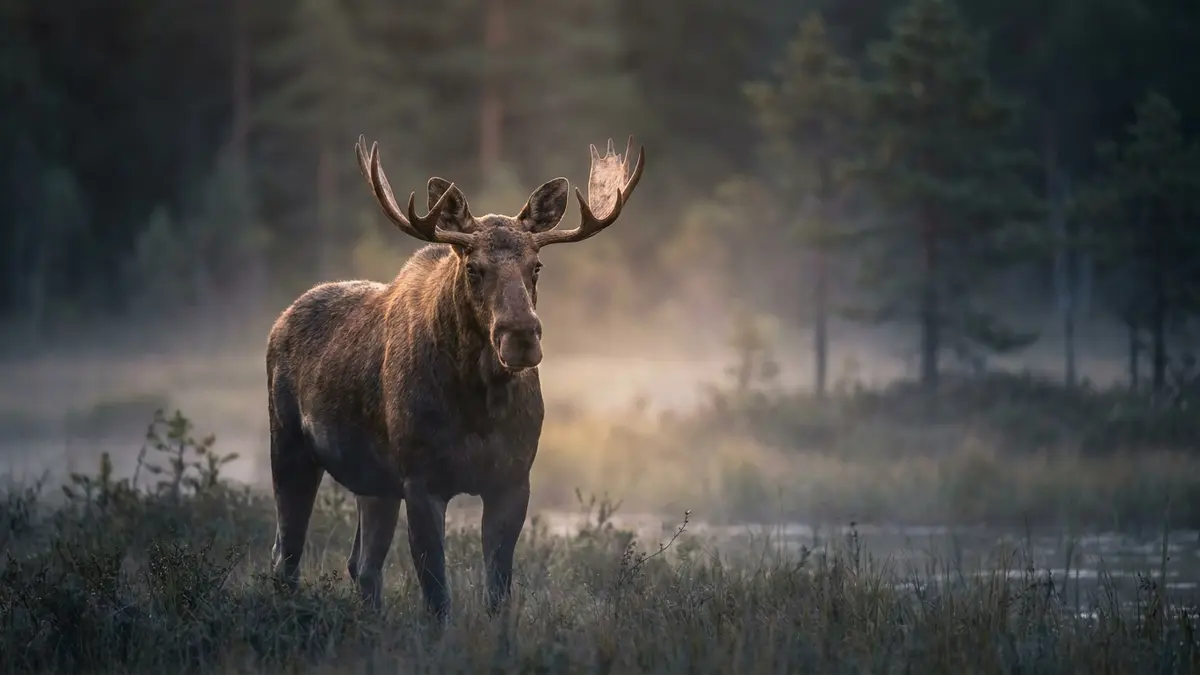
A moose injures more people in Alaska than bears do. Its antlers are not horns — they are shed and regrown every single year, and a full rack can span six feet. Running from a charging moose is the correct thing to do, which is the opposite of the advice for bears.
An almanac
- Species
- Alces alces — the largest member of the deer family; called "elk" throughout Europe
- Size
- Bulls 800-1,600 lb and roughly 6 ft at the shoulder; heaviest on record 1,697 lb (Kenai Peninsula, Alaska)
- Lifespan
- Rarely past 15-16 years in the wild; one cow was recorded at 22
- Range
- Circumpolar boreal north — Alaska, Canada, northern US, Scandinavia, Siberia to northern Mongolia and China; introduced to New Zealand, now extinct there
- Diet
- 40-60 lb of woody browse a day (willow, birch, aspen); "moose" comes from an Algonquian word meaning "eater of twigs"
- Conservation status
- IUCN Red List: Least Concern — but Minnesota fell 58% (2006-2017) and Vermont over 50% since 2005
- Standout number
- About an inch of antler and a pound of bone per day — the fastest-growing tissue of any mammal, up to an 80-lb rack in one summer
The animal most likely to hurt you in the north woods is not a bear. Moose injure more people in Alaska than bears do, and the reason is precisely that nobody expects a vegetarian to be a threat.
The safety advice is also inverted. With a bear you stand your ground; with a charging moose you run, and put something solid between you and it. Getting that backwards is how people get hurt.
The naming confusion is worth clearing up too: Europe's "elk" is this same animal, and North America's elk is something else entirely.
Moose Facts Worth Knowing
- The moose (Alces alces) is the largest living member of the deer family — and the animal Europeans call an "elk" is this exact same species.
- The heaviest bull moose recorded at Alaska's Moose Research Station on the Kenai Peninsula weighed 1,697 lbs, including antlers, in November.
- A mature bull's pair of antlers averages 45–50 pounds in Interior Alaska, with the heaviest weighing up to 75 pounds. The much-repeated "80-pound rack" is the outer limit of one summer's growth in the biggest Alaskan bulls, not a typical figure. Ordinary mature bulls carry roughly half that, and moose in the lower 48 carry less still.
- The widest moose antler spread on record measures 2,048 mm — about 6 feet 8 inches, tip to tip. That is a single record specimen, almost certainly an Alaska-Yukon bull (Alces alces gigas), the largest race. New York's wildlife agency describes ordinary mature bulls as reaching "more than 5 feet" — the 6-foot-plus spread is exceptional, not standard.
- A moose has four stomachs, and the first one — the rumen — can weigh 90 pounds in summer and 112 pounds in winter.
- An adult moose eats 40 to 60 pounds of woody browse every single day.
- Bull moose stop eating for roughly two weeks during the autumn rut and can shed up to 20% of their body weight doing it.
- A moose's nostrils seal themselves shut underwater — the pressure difference alone closes them, no muscles required. Anatomist Lawrence Witmer worked it out by dissecting four frozen heads of road-killed moose shipped from Newfoundland, publishing in the April 2004 Journal of Zoology.
- Biologists have found individual moose carrying up to 90,000 winter ticks at once.
- Each adult female winter tick removes about one milliliter of blood — which, at 90,000 ticks, works out to nearly 24 gallons from a single moose.
- Moose numbers have collapsed along the southern edge of their range: Minnesota lost 58% between 2006 and 2017, Vermont over 50% since 2005, New Hampshire over 40% since 2014, and Maine 22% since 2012. These are edge-of-range declines in the northern United States, not a species-wide crash. The Mammal Diversity Database lists Alces alces as IUCN Least Concern, Alaska alone holds 175,000–200,000 moose, and Newfoundland's introduced population is so dense it is culled by the tens of thousands each year.
- Researchers have tested moose down to −22°F without the animals showing signs of cold stress.
What People Get Wrong About Mooses
“Moose are placid vegetarians — it's bears you have to worry about in the north woods.” In Alaska, moose injure more people every year than bears do. They don't bite; they charge, stomp and kick. Cows defending calves are the classic scenario, and the warning signs are the hump hairs standing up, ears laid flat and lip-licking.
“Never run from a large wild animal — running triggers a chase.” Moose are the exception to the rule everyone learns for bears and dogs. Alaska's wildlife agency tells you to run, and to put something solid between you and the animal, because a moose won't pursue you far and can't corner as tightly as you can around a tree trunk.
“The moose is a North American animal, and Europe's "elk" is a different, smaller creature.” They are one species. Alces alces circles the northern hemisphere; what Britons and Scandinavians call an elk is precisely the animal North Americans call a moose. The confusion runs the other way too — the North American "elk" is a wholly different deer, the wapiti (Cervus canadensis), which is the second-largest deer, not the first.
“A bull moose's rack is a set of horns he grows once and carries for life.” They're antlers, not horns, and he throws away the entire structure every winter and grows a new one from bare skull each summer. Horns are the permanent, keratin-sheathed things cattle and sheep have; no deer has them. Moose antlers drop between November and January.
“Winter ticks kill moose by draining all their blood.” Blood loss is only part of it. A tick-covered calf spends over two hours a day grooming, which burns calories and rubs off the insulating hair. What actually kills it in March is the combination — anemia, a calorie deficit, and a coat with no insulation left — so the animal simply freezes.
In Culture
Bullwinkle J. Moose, created by Jay Ward and Alex Anderson, debuted on ABC in Rocky and His Friends on 19 November 1959, broadcasting from Frostbite Falls, Minnesota; a live-action/CGI feature, The Adventures of Rocky and Bullwinkle, followed in 2000. Monty Python and the Holy Grail (1975) buried a moose in its fake Swedish opening subtitles — "A moose once bit my sister" — sacked the credit crew twice over it, and warned that "moose bites can be pretty nasty." National Lampoon's Vacation (1983) made Marty Moose the mascot of Walley World. Northern Exposure (1990-1995) opened every episode with a bull moose wandering through Roslyn, Washington. Disney's Brother Bear (2003) cast Rick Moranis and Dave Thomas as Rutt and Tuke, essentially their SCTV McKenzie Brothers with antlers. In games, Red Dead Redemption 2 (2018) hides a Legendary Moose named "Anoki" in Roanoke Ridge, while The Long Dark's Rugged Sentinel update (2017) added a moose that charges, flattens you, and leaves a Broken Ribs affliction. Online, Swedish broadcaster SVT has livestreamed Den stora älgvandringen (The Great Moose Migration) each spring since 2019; the first year drew close to a million viewers, and by 2021 the stream logged 12 million watched hours.
Notable Individuals
Morty, a bull from Washington State University's captive research herd, is the moose ambling through the opening credits of Northern Exposure (1990-1995), filmed in Roslyn, Washington. WSU records that he died in 1994 of an illness linked to a mineral deficiency. Buzzwinkle was Anchorage's downtown bull, named by Anchorage Daily News reporter Julia O'Malley in November 2007 after he lurched around the city with Town Square holiday lights tangled in his antlers, apparently loaded on fermented crabapples; state biologist Rick Sinnott put him down in 2008, emaciated and at least 13 years old. And on 6 September 2011, a cow moose drunk on fermenting apples got wedged in a tree at Särö, outside Gothenburg, Sweden. Per Johansson heard the roaring, called the fire brigade, and they winched the tree down to free her. She slept it off in his garden.
Frequently Asked Questions
Are moose dangerous?
In Alaska, moose injure more people every year than bears do. They don't bite; they charge, stomp and kick. Cows defending calves are the classic scenario, and the warning signs are the hump hairs standing up, ears laid flat and lip-licking.
Should you run from a moose?
Moose are the exception to the rule everyone learns for bears and dogs. Alaska's wildlife agency tells you to run, and to put something solid between you and the animal, because a moose won't pursue you far and can't corner as tightly as you can around a tree trunk.
Is a European elk the same as a moose?
They are one species. Alces alces circles the northern hemisphere; what Britons and Scandinavians call an elk is precisely the animal North Americans call a moose. The confusion runs the other way too — the North American "elk" is a wholly different deer, the wapiti (Cervus canadensis), which is the second-largest deer, not the first.
Do moose shed their antlers?
They're antlers, not horns, and he throws away the entire structure every winter and grows a new one from bare skull each summer. Horns are the permanent, keratin-sheathed things cattle and sheep have; no deer has them. Moose antlers drop between November and January.
How do winter ticks kill moose?
Blood loss is only part of it. A tick-covered calf spends over two hours a day grooming, which burns calories and rubs off the insulating hair. What actually kills it in March is the combination — anemia, a calorie deficit, and a coat with no insulation left — so the animal simply freezes.
More about the Moose & Elk
More from Animal Facts
Sources
Claims on this page were checked against these published sources.
- Moose (Alces alces) Species Profile
Known as moose across North America, but called elk in Europe, Alces alces is the largest member of the deer family.
Read the source → - Moose: Did You Know?
The largest bull recorded at the Moose Research Station on the Kenai Peninsula in Alaska was 1,697 lbs in November, which included antlers.
Read the source → - Alces alces (Eurasian elk)
The widest antler spread recorded is 2048 mm
Read the source → - Moose
An adult moose eats 40 to 60 pounds of browse every day.
Read the source → - Why is a moose's nose so big?
When a moose dips its head under water, the difference between the water pressure and the air pressure causes the nostrils to close
Read the source → - Species Spotlight - Moose
In what can only be described as a nightmare scenario, biologists have encountered moose with 40,000, 75,000, even up to 90,000 ticks feeding on them.
Read the source →
Not sure which animal is yours?
Consult the quiz