Animal Facts
Camel Facts: What the Hump Actually Holds
Camels evolved in North America and died out there — the desert ones are immigrants.
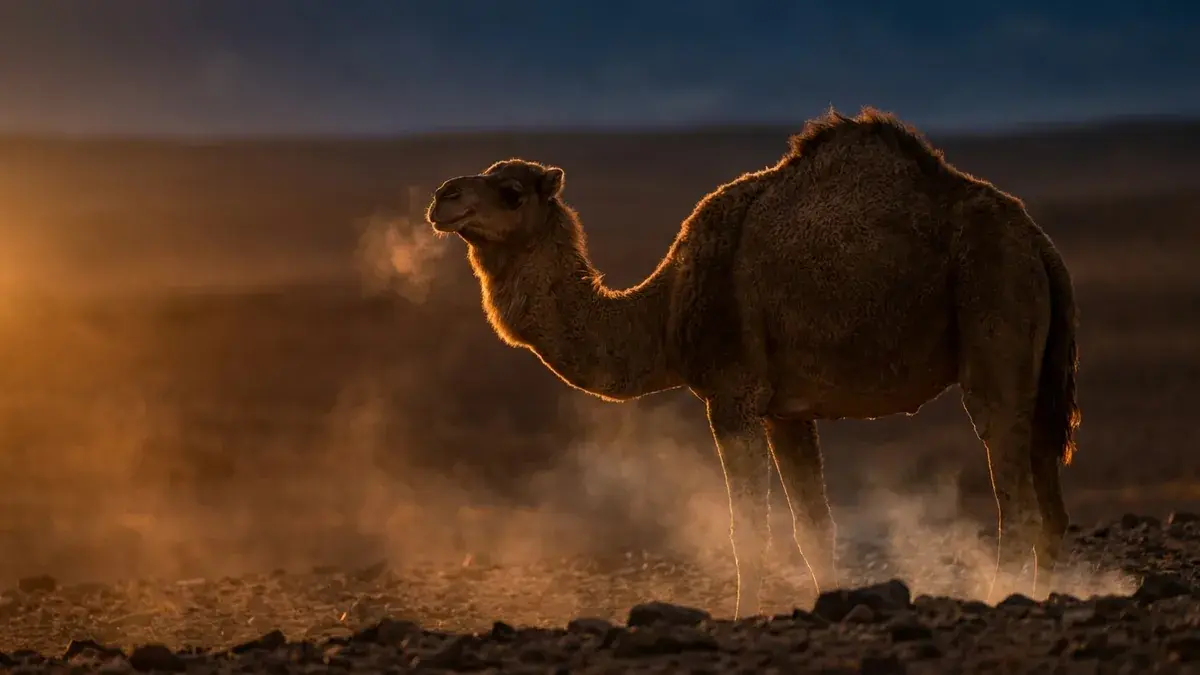
A camel's humps store fat, not water: roughly 25 to 35 kg in each hump of a Bactrian camel, a reserve of about 250,000 to 350,000 kcal. The water handling happens elsewhere — camels survive losing up to 30% of their body weight in water, pass syrupy urine and dung dry enough to burn, and reclaim moisture from their own exhaled breath. The whole family evolved in North America, where the last native species, Camelops, died out around 13,000 years ago.
An almanac
- What the hump holds
- Fat — about 25 to 35 kg per hump in a Bactrian
- Water loss survived
- Up to 30% of body weight (FAO, NHM)
- Single drinking session
- Up to 145 litres (32 gallons), none of it stored
- Feet
- No hooves — two toes on a broad, spreading pad
- Where the family evolved
- North America; last native species gone ~13,000 years ago
- Wild camel (Camelus ferus)
- Endangered since 2025; minimum ~780 mature individuals
- World numbers
- More than 41 million; Kenya leads camel-milk production
Most of what people know about camels is a single fact, and that fact is wrong. The hump is not a water tank. It is fat — roughly 25 to 35 kg in each hump of a Bactrian camel, a calorie reserve of 250,000 to 350,000 kcal, which is why a starving camel's hump flops sideways rather than a thirsty one's.
The water engineering is real, it just happens elsewhere. It happens in kidneys that produce syrupy urine and dung dry enough to burn, in a nose that pulls moisture back out of exhaled air, in red blood cells that swell instead of bursting, and in a body temperature the animal simply lets drift over the course of a day. The result is a mammal that can lose 30% of its body weight in water and keep walking.
The last surprise is geography. Camels are North American animals that emigrated and then went extinct at home. Today more than 41 million of them live on other continents — Kenya, not any Gulf state, is the world's biggest camel-milk producer — while the one genuinely wild species is down to a few hundred mature animals in the Gobi.
Camel Facts
- The hump is a fuel tank, not a water tank. Each fatty hump on a Bactrian camel contains around 25 to 35 kg of fat, equivalent to a calorie reserve of 250,000 to 350,000 kcal (FAO, World Animal Review).
- A camel can lose 30% of its body weight in water and survive it. The Natural History Museum puts the ceiling at "far more than most other mammals could survive" — for most species that level of dehydration is fatal.
- The famous 145-litre drink is a rescue, not a stockpile. San Diego Zoo Wildlife Alliance describes a camel surviving a 40 percent weight loss and then drinking up to 32 gallons (145 litres) in one session. Two caveats: none of it is stored — the NHM notes camels "take in vast amounts of liquid quite quickly, but they don't store it for later, so it's just enough to rehydrate themselves" — and sources disagree on the survivable loss, with San Diego Zoo saying 40 percent while FAO and the NHM both cite 30 percent.
- Camel red blood cells are elliptical and flat rather than round and biconcave, and they resist bursting in dilute conditions. In a 2024 PLOS ONE study, camel RBCs incubated in saline diluted to 0.25% NaCl did not lyse — their mean area roughly doubled, from about 15 μm² to 29.8 μm² — while white blood cells in the same baths were damaged.
- In Schmidt-Nielsen's desert experiments, dehydrated camels let body temperature fluctuate by up to 7°C in a day. A 2014 controlled study (Bouâouda et al.) measured a smaller but still large swing — a mean daily amplitude of 3.8°C when dehydrated versus 2.4°C when watered — and showed the camel alternates daily between poikilothermic and homeothermic phases.
- The nose works as a dehumidifier. Schmidt-Nielsen, Crawford and Hammel (Proc. R. Soc. B, 1981) traced the lowest respiratory water losses to "the exhalation of air at temperatures far below body temperature, and, in addition, removal of water vapour from the exhaled air, resulting in exhalation of air at less than 100% relative humidity" — moisture that other mammals simply breathe away.
- Camels do not have hooves. Each foot ends in two toes on a broad, flat pad that spreads under the animal's weight. The NHM's description is "wide snowshoe-like feet with two toes".
- They lack the stifle fold. In most hoofed mammals a stretch of skin connects the abdominal region to the thigh; camels have no such flap (FAO), so air can move underneath the body while the animal lies down.
- The waste comes out wrung dry. Camels have thick, syrupy urine, and faeces dry enough that, in the NHM's words, "they can be used as fire starters".
- The eyelashes are the correct length, not merely long. Research has identified an optimum ratio of about one third the width of the eye the lashes protect. Camel lashes look extreme because camel eyes are unusually large.
- Camels are North American animals by origin. Roughly 100 extinct camelid species are known from North America alone, and when Camelops vanished around 13,000 years ago, camels disappeared from the continent where they had first originated (Smithsonian Magazine).
- A giant camel lived in Canada's High Arctic. From a fragmentary limb bone found on Ellesmere Island in mid-Pliocene deposits, and informed by its cortical thickness and surface dimensions, the tibia is estimated to have been approximately 575 mm in length — 29% larger than that of modern camels (Nature Communications, Rybczynski et al., 2013).
- The wild camel is down to about 780 mature animals. IUCN's 2025 assessment estimates a minimum of 780 mature individuals of Camelus ferus, with a maximum of 1,380 and the true figure possibly lower, spread across only three isolated populations.
- Wild camels drink water domestic camels reject. The same assessment records that "in some areas it has adapted to drinking saltwater slush, which the domestic camel will not touch".
- Domesticated camels reach the southern Levant surprisingly late: in Ben-Yosef and Sapir-Hen's excavations of the Aravah Valley copper sites, camel bones turn up almost exclusively in layers dating from the last third of the 10th century BCE or later.
- Australia imported camels in 1840 and never got rid of them. The stock came from the Canary Islands, and the Northern Territory government now puts the feral population at over one million across more than 37% of the mainland. That total comes from aerial-survey modelling rather than a headcount, Australian agencies quote widely different figures, and the same page's line about the population doubling every nine years is a projection that assumes no culling — culling has in fact been carried out.
- There are more than 41 million camels on Earth, and the milk capital is not in the Gulf. FAO ranks Kenya as the largest camel-milk producer in the world, followed by Somalia and Pakistan.
- Dromedaries are the animal reservoir for MERS, and they show nothing. Per the WHO, "infected dromedaries do not get sick, therefore diagnosis in animals relies on laboratory testing".
Myths About Camels
"A camel's hump is a built-in water tank." The hump is a fat store. The Natural History Museum is blunt about it: "But they don't store water in them. Instead, their humps are made of fat." That fat is metabolised for energy when food runs out, which is why the hump droops or flops sideways in a starving animal rather than a thirsty one. The water tricks happen in the kidneys, the nose and the blood.
"Camels are native animals of Arabia and North Africa." The family evolved in North America. As Rybczynski et al. put it, "camels originated in North America and dispersed to Eurasia via the Bering Isthmus, an ephemeral land bridge linking Alaska and Russia." Camels arrived in the Old World as immigrants and later went extinct in their actual homeland; every camel in the Sahara today descends from that emigration.
"The wild Bactrian camels of the Gobi are just domestic camels that escaped and went feral." IUCN's 2025 assessment states that Wild Camel (Camelus ferus) and the domestic Bactrian Camel (C. bactrianus) are genetically distinct at the species level based on DNA and the Y chromosome, citing Ji et al. 2009, Silbermayr et al. 2010, Li et al. 2017 and Felkel et al. 2019 — and the ICZN ruled in 2023 that the wild name is not invalidated by the domestic one. Two things that distinctness does not mean: the two forms can produce viable offspring, and the same assessment reports extensive introgression of domestic camel genes in the Mongolian wild population. Separate species, not sealed off.
"A camel can cross a desert for weeks, even months, without drinking." The months-long figure is real but conditional. FAO's own phrasing is that "where green forage is available in mild climates, the camel may go several months without drinking" — the water is coming in through the food. Working in genuine desert heat, the same source puts it at every eight to ten days, with a loss of up to 30 percent of body weight through dehydration.
"The wild camel is Critically Endangered — the most urgent red-list category." It was, from 2002 to 2024. A reassessment published in 2025 moved Camelus ferus down one step to Endangered on the strength of better population data. This is not a recovery story: the assessment cites a small, fragmented population of much less than 2,500 mature individuals, hybridisation, mining, fragmentation and drying water sources, a projected reduction of at least 20% over the next two generations, and a projected 44% loss of suitable habitat in China by the 2050s.
The Camel in Pop Culture
Camels sell things, and one of them sold too well. R.J. Reynolds redesigned a cartoon dromedary for the American market in 1988, and the Joe Camel campaign ran until 1997. A 1991 study in the Journal of the American Medical Association reported that 91.3% of six-year-olds could correctly match Old Joe with a cigarette — roughly as many as could match Mickey Mouse with the Disney Channel. The campaign was pulled in July 1997 under political pressure, and the Federal Trade Commission finally dismissed its complaint in January 1999.
Documentaries have treated the animal better. Byambasuren Davaa and Luigi Falorni's The Story of the Weeping Camel (2003) follows Gobi herders coaxing a mother camel into accepting the rare white calf she has rejected; it was nominated for Best Documentary Feature at the 77th Academy Awards in 2005. Robyn Davidson's Tracks, her 1980 memoir of walking from Alice Springs to the Indian Ocean with four camels and a dog, reached cinemas as a feature film starring Mia Wasikowska in 2014.
Famous Camels
In 1855, prodded by Secretary of War Jefferson Davis, the U.S. Congress appropriated $30,000 for camels; by 1857 the Army had imported 75 of them. That June, Edward Fitzgerald Beale drove more than two dozen out of Camp Verde, Texas toward California, reaching Fort Tejon five months and over 1,200 miles later.
The experiment left individual animals behind in American memory. One camel, nicknamed Old Douglas, served as mascot of Company A, 43rd Mississippi Infantry — the "Camel Regiment" — and was shot and killed during the 1863 siege of Vicksburg. Arizona's "Red Ghost", a feral camel blamed for trampling a woman to death in 1883, was eventually shot by a rancher near Eagle Creek.
The most recent famous camels were working animals with a job to finish. In 1977 Robyn Davidson crossed 2,700 kilometres of Australian desert with four camels and a dog, from Alice Springs to the Indian Ocean — the walk that became Tracks.
Frequently Asked Questions
Do camels store water in their humps?
No. The humps are fat. A Bactrian camel carries roughly 25 to 35 kg of fat in each one, a reserve of about 250,000 to 350,000 kcal, and it is burned for energy when food runs short. The Natural History Museum states plainly that camels do not store water in them.
How long can a camel go without drinking?
It depends entirely on the conditions. FAO says that where green forage is available in mild climates, a camel may go several months without drinking, because the water arrives in the food. Working in real desert heat, the same source puts the interval at every eight to ten days, with a loss of up to 30 percent of body weight through dehydration.
How much water can a camel drink at once?
San Diego Zoo Wildlife Alliance describes a severely dehydrated camel drinking up to 32 gallons (145 litres) in a single session. That is a refill, not a reservoir — the camel uses it to rehydrate and stores none of it for later.
Where do camels actually come from?
North America. Roughly 100 extinct camelid species are known from that continent alone, and the family crossed into Eurasia over the Bering land bridge. The last native North American species, Camelops, died out around 13,000 years ago, so camels are extinct in their own homeland.
Are there any truly wild camels left?
Yes, one species: Camelus ferus, in the Gobi and Taklamakan. IUCN's 2025 assessment estimates a minimum of about 780 mature individuals in three isolated populations and lists it as Endangered, downgraded from Critically Endangered on better data rather than on recovery.
Why do camels have such long eyelashes?
Research has found an optimum eyelash length of about one third the width of the eye being protected. Camel lashes hit that ratio; they look exceptional because camel eyes are unusually large.
More about the Camel
More from Animal Facts

Sources
Claims on this page were checked against these published sources.
- The two-humped camel (Camelus bactrianus)
Each fatty hump contains around 25 to 35 kg of fat, which is equivalent to a calorie reserve of 250 000 to 350 000 kcal.
Read the source → - Camel
It can survive a 40 percent weight loss and then drink up to 32 gallons (145 liters) of water in one drinking session!
Read the source → - How do camels survive in deserts?
Camels can withstand a loss of up to 30% of their bodyweight in water, which is far more than most other mammals could survive.
Read the source → - Respiratory water loss in camels
The lowest values for respiratory water loss can be explained by the exhalation of air at temperatures far below body temperature, and, in addition, removal of water vapour from the exhaled air, resulting in exhalation of air at less than 100% relative humidity.
Read the source → - Camelus ferus (Wild Camel) — Red List assessment
It is estimated that the Wild Camel population consists of a minimum of 780 mature individuals (with a maximum estimate of 1,380, but the true figure may be lower than this).
Read the source → - Feral camel
Camels were first introduced into Australia from the Canary Islands in 1840. There are now over one million feral camels in Australia and that population may double in size every nine years.
Read the source → - Camels — Dairy production and products
Kenya is the largest camel milk producer in the world, followed by Somalia and Pakistan.
Read the source →
Not sure which animal is yours?
Consult the quiz