Mammals · Spirit animal
Camel Spiritual Meaning & Symbolism
The steady traveler that conserves its strength, trusts the path, and carries you through life's hardest stretches.
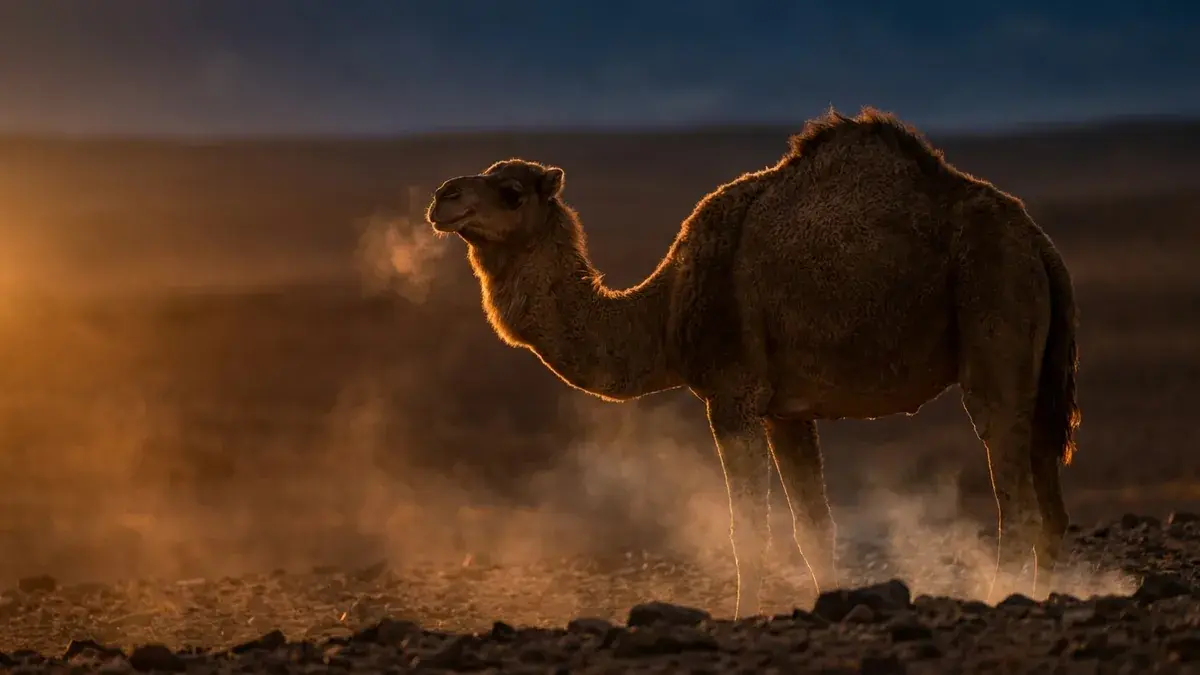
A camel's spirit animal symbolizes endurance and self-sufficiency. They tell you to save your energy, build relationships based on trust and commitment, and believe that steady progress is better than impatience.
An almanac
- Core message
- Pace yourself and conserve energy for the long haul
- Spirit animal
- A demanding journey ahead calls for commitment and patience
- Totem for
- Self-reliant, independent survivors
- Power animal
- Guidance when lost, depleted, or called to serve others
- In dreams
- A lucky sign of good fortune and burdens released
- Cultural roots
- Bedouin, Central Asian, and Feng Shui traditions
- Biblical & Quranic role
- A sign of hospitality, divine testing, and sacred covenant
Camels are built to cross the most punishing of terrain, far too rough for other animals to survive. They're built to carry people and commerce across vast distances. When you meet the Camel in your life, it's often not something exciting or dramatic, but it's a question of whether or not you're pacing yourself for your journey ahead.
Camel Symbolism & Meaning
Camels make enormous contributions to human culture: they kept civilization connected across vast stretches of desert.
Most animals store water when they get thirsty, but camels store energy instead, which keeps them moving without taking a break. As if that wasn't impressive enough, those big humps on their backs don't store water at all; they're just built-in fuel tanks full of fat that they burn as they go. That energy-use system works on a different schedule from most other living things.
They teach us to pace ourselves and never take an extra breath when we're approaching a hard part. We'll get there in our own time and if we try to cheat it or skip the process, it'll cost us more.
That idea carries through in Tarot too: the High Priestess card uses the word "camel" (in Hebrew) to symbolize veiled or hidden things, or perhaps just reminders about what lies ahead for us on our journey through life.
Camel Spirit Animal
Spirit Guide Camel usually signals a long journey ahead, both physical and emotional. As you navigate the twists and turns of your path, rely on the steadiness of Camel to support you and steady your steps. Embrace the pace of journey, while avoiding any temptations to rush past the many lessons along the way.
Riding a camel asks of us to trust in our partners, just as the rider is completely reliant on their animal's loyalty. In much the same way, your spirit guide may be inviting you to build relationships — romantic or otherwise — that are based on mutual trust and shared commitments. Your loyalty and ability to be patient is not only necessary, but also holds great rewards for our future.
Patience is key when it comes to Spirit Guide Camel. Remember that our goals do not always happen overnight — it requires dedication and perseverance until we reach our destination.
Throughout our journey, we should be honest about our limits and needs; Spirit Guide Camel knows that there is power in taking note of what we need for each stage of life.
Does Camel fit you?
Tap the ones that sound like you — 6 traits, no right answer.
0 of 6 Nothing picked yet — start tapping.
Camel Totem Animal
People with the camel totem are aware and in tune with the natural world, and they have a strong survival instinct.
Calm and self-reliant, you're known for choosing the wisest courses of action for yourself and others. And you instinctively know how to conserve your energy for a long-term effort.
The message of the camel totem isn't about hoarding your resources; it's about knowing what you need and when you need it. It's about relieving yourself of unnecessary burdens. It's about doing more for others and for the natural world while still taking care of yourself.
Camel Power Animal
If you are feeling lost, literally or figuratively, Camel is the spirit guide for you. This steadfast and hardy creature will patiently lead you on the correct path and teach you to find your way even in the face of challenges. It has the power to endure long voyages, moving along at its own comfortable pace. Camel teaches how to make wise decisions without being rushed.
Whenever energy levels start to fall and even service work begins to feel futile, Camel's wise presence is invoked. Its power flows through you and gives you hope to go on.
Life doesn't always move according to our schedule; it often takes longer than expected. When life unfolds slowly, this guide leads the way with patience, telling you that nothing has changed: only the process.
Camel in Arabian & Bedouin Tradition
In Bedouin folklore, one story tells of how a group of herders found camels on a mountain. The herders didn't know those camels belonged to anyone else. Camels belonged to different tribes that lived in the desert. The herders took the camels and started using them for food and drink.
Since then, camels were important to Bedouin life. For example, Bedouin traveled by riding on camels. They also used the milk, meat, and hides from camels.
Bedouin people say their love for their sons comes before their love for their wives or before their love for camels. But they don't agree on which comes first.
There are two kinds of camels: dromedaries and Bactrian camels.
Camels don't always fight with each other, but if they do, they fight really hard. And if they get thirsty, they can drink a lot of water in one sitting.
Bedouin herders used to take care of their camels. They guided them to food and sang so the animals could drink while they ate.
Bedouin people were very attached to these animals and wanted them for many parts of life.
Far Eastern Camel Symbolism
Camels have been used as a symbol of financial protection and prosperity in feng shui for a long time. People think that single-humped camels protect the money you already have, while two-humped ones are good for getting rid of money troubles. You should put both in the part of the room that is said to represent wealth.
Long ago, camels were used to move silk from China to other parts of the world and bring back wool, jade, and other goods. That's how they helped create some of the trade between China and other countries along old roads.
Camel in Dreams
If you dream of a camel, it may be read as an omen of good fortune, prosperity, or the end of struggles. It can have several different meanings:
- If the camel is carrying you alone: You will accomplish long-held goals through continued determination and effort.
- If there are many camels carrying bundles: You will receive wealth or good fortune.
- If a camel does not want to move: It may be a sign that you are carrying excess baggage and should let it go.
- If there is a camel in an open desert: It could be a call for optimism and perseverance in your current inner journey.
- If you are riding a camel or leading one: It can represent control over your path in life, urging you to shape it according to your desires.
Overall, these dreams encourage you to embrace life's changes and adapt when your plans change.
Spiritual Meaning of Camel
If Camel teaches us anything, it's that strength can be sustainable. Camels can't sprint; they can only pace themselves. Camels don't panic when resources run low — they simply conserve energy until they've arrived at their destination. Spiritually, they remind us to watch where we're getting our sustenance from, how we're rationing our energy, and whether we're being too impatient or too harsh on ourselves along the journey. Camels remind us that endurance, humility, and self-trust are strong values that will help us navigate our lives.
Camel in Biblical & Quranic Tradition
Before Camel entered New Age symbolism, sacred texts were already using it as a test of character and a covenant of God. Genesis tells how Abraham's servant, asking for a sign, wanted the bride to give a drink to his camels as well as to him; the servant wanted to see how she would tend even the thirsty, unglamorous needs of others. Not only did she give him a drink but she said she would water his camels too — and said it before being asked twice. When Salih is sent by God to deliver His message to the people of Thamud, they ask for proof: a she-camel suddenly appears out of a solid rock, meant as a living symbol of trust and hospitality. Once the people break this covenant by killing the camel, it turns out that the whole community must suffer for their mistake.
Both stories agree: Camel is a living test — not just obedience to a clear command but willingness also to do the unglamorous things that tend animals' basic needs.
Camel Pose: The Yoga Connection
The yoga pose called camel pose, which involves lifting the chest backward from a kneeling position and arching the spine, is named directly for its resemblance to the shape of a camel's back. The Sanskrit word for camel (uṣṭra) is included in the name of the pose (which translates to "camel posture"). Practicing Ustrasana takes some real openness and trust: it feels easy to brace against or reject what feels too hard, but backbends like this one ask you to keep trying to stay open to the stretch rather than guarding against it. That's what Camel is asking us in general, too: to remember that we can be transformed by struggles rather than defining ourselves by them.
Camel reminds us that no matter how our lives may have hardened us against pain or struggle, it's still possible to stay open long enough to be reshaped by change if we make space for it.
Frequently Asked Questions
What does Camel symbolize spiritually?
In spiritual terms, a camel represents endurance, self-sufficiency, and the importance of staying steady and humble on a long journey. It is important to be wise about how you manage your energy so that you don't burn out early on; just as important, trusting that the steady, patient pace of progress will get you where you need to go.
What does it mean when Camel is your spirit animal?
If you feel like Camel is speaking to you, you're probably about to embark on a demanding chapter. Whether it's a literal travel or a metaphorical stretch of endurance, it's one that calls for your best effort.
Camel wants you to understand that the process is long and will require commitment. So lean into sustainable effort. You'll trust the results of a patient attitude and honest assessment of your limits.
What does it mean to dream about a camel?
Seeing a camel in your dreams is generally thought to be a positive sign, indicating good luck, reaching goals through persistence, or a need to let go of unnecessary burdens. Numerous camels carrying goods can mean money coming in or new opportunities.
What does the Bible say about camels?
Camels are mentioned a lot in the Old Testament, showing how important they were to the people who lived there. People valued camels for wealth and for the long journeys they could make.
A famous story in Genesis tells how Rebekah watered Abraham's servant's camels at a well. She did this without being asked to, and that made Abraham's servant decide that Rebekah was the woman he had been sent to find. Rebekah was going to be Isaac's wife, and the fact that she gave water to Abraham's servant shows that she had a generous character.
What is the story of Prophet Salih's camel in Islamic tradition?
In the Quran, Prophet Salih (S) was given a she-camel that emerged miraculously from solid rock as a miracle to prove his prophethood. The people of Thamud were disbelievers who agreed to share water with the camel, but killed her anyway. When this sacred trust was broken, destruction came on the whole tribe — a warning to never violate a sacred trust.
Camel also represents
- Other animals that represent strength →Alongside Lion, Bear, Tiger, Elephant
- Other animals that represent resilience →Alongside Cockroach, Salmon, Turtle, Ant
- Other animals that represent intelligence →Alongside Crow, Raven, Dolphin, Fox
- Other animals that represent patience →Alongside Turtle, Heron, Spider, Ant
Sources
Claims on this page were checked against these published sources.
- Camel
It is a common myth that a camel stores water in its hump, but the humps in fact are reservoirs of fatty tissue, which can be used as a reserve source of calories, not water.
Read the source → - Gimel
the letter's form is a conventionalized image of a camel.
Read the source → - Genesis 24 (King James Version, verses 19-20)
I will draw water for thy camels also, until they have done drinking... and drew for all his camels.
Read the source → - The Story of Prophet Salih – I
the she-camel used to drink all the water in the wells in one day, and no other animals could approach the water... its milk sufficient for thousands of men, women and children.
Read the source → - She-Camel of Salih (a)
Several young men plotted to hamstring and then kill the she-camel... the people were destroyed by an earthquake.
Read the source → - Ustrasana
The name comes from the Sanskrit words उष्ट्र Uṣṭra, meaning "camel", and आसन Asana, meaning "posture" or "seat".
Read the source → - Bactrian Camel
a third eyelid which acts like a windshield wiper to wash sand or dirt out of their eyes.
Read the source → - Why Do Camels Have Humps?
The camel's hump is where the camel stores fat... storing it in their humps is not one of them [regarding water].
Read the source →