Animal Facts
Chameleon Facts & Trivia: Colour, Tongue and Bone Glow
It changes colour by moving crystals, and its skull glows blue.
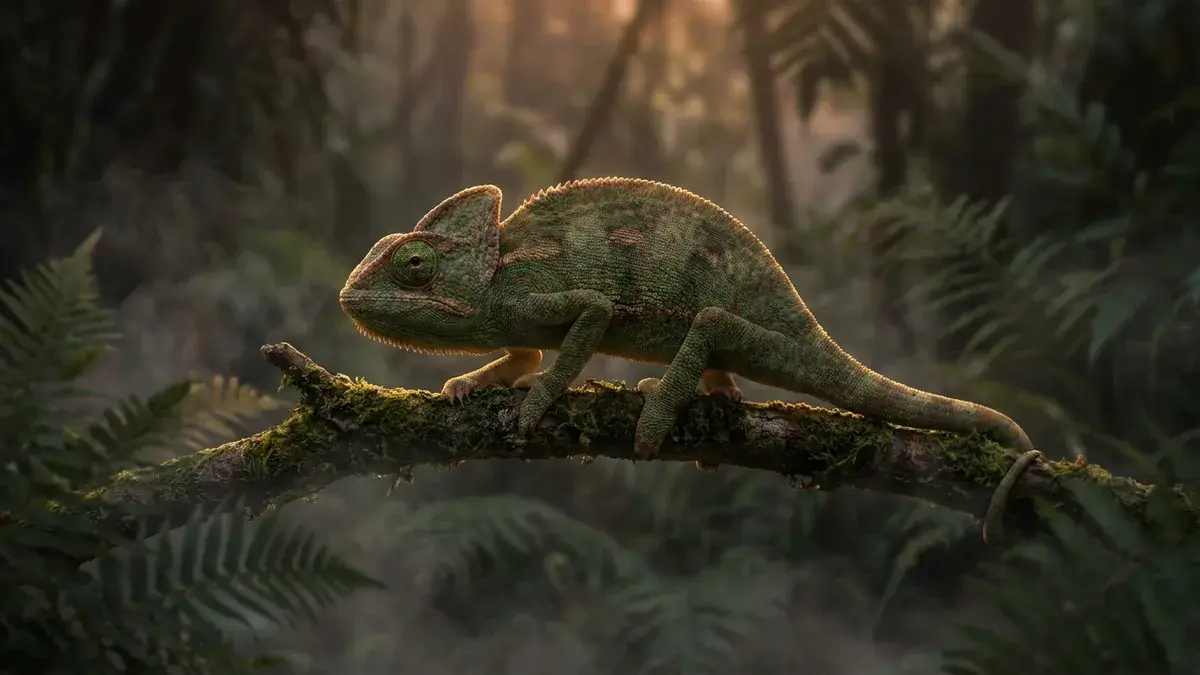
A chameleon does not pump pigment around. It re-spaces a lattice of guanine nanocrystals inside its skin — about 30% closer together at rest than when excited — and that gap is the entire colour shift. Its skull also fluoresces blue under ultraviolet, through skin only 20 micrometres thick.
An almanac
- Species
- 240 in the family Chamaeleonidae (The Reptile Database)
- Size range
- 21.6 mm total length (male Brookesia nana) up to around 68 cm and 700 g (Parson's chameleon)
- Lifespan
- 4-5 months after hatching in Labord's chameleon; 8-10 years wild and up to 14 in human care for Parson's chameleon
- Range
- Africa, Asia and Europe, with most species in Madagascar and Africa; outliers in southern Spain, the Arabian Peninsula, India and Sri Lanka
- Diet
- Insects and other invertebrates - crickets, roaches and worms at the National Zoo; large species occasionally take small vertebrates
- Conservation status
- Parson's chameleon is Near Threatened on the IUCN Red List, with the population down 20% in under two decades
- Standout number
- 264 g - peak tongue acceleration measured in a 47 mm Rhampholeon spinosus, the highest of any amniote movement
Colour change in a chameleon is not what almost everyone thinks. There is no pigment being pumped around the skin. The animal physically re-spaces a lattice of guanine nanocrystals inside cells called iridophores, retuning which wavelengths bounce back — the crystals sit about 30% closer together in resting skin than in excited skin, and that gap is the whole effect.
The reason for it is not camouflage either, and the tongue record everyone quotes belongs to one small Tanzanian species rather than to chameleons in general.
The strangest finding is recent: chameleon skulls glow blue under ultraviolet light, in at least eight of the twelve genera, through skin thin enough to be a window.
Chameleon Facts Worth Knowing
- There are 240 recognised species in the chameleon family, Chamaeleonidae.
- Chameleons have zygodactyl feet: the toes on each hand and foot are fused into two opposed bundles that work like pincers on a branch.
- The mucus on a chameleon's tongue tip is roughly 400 times more viscous than human saliva, which is what lets it drag prey back on retraction.
- Colour change is not pigment being pumped around: chameleons physically re-space a lattice of guanine nanocrystals inside skin cells called iridophores, retuning which wavelengths bounce back.
- In panther chameleons the guanine crystals sit about 30% closer together in resting skin than in excited skin - that gap is the entire colour shift.
- Panther chameleons have a second, deeper layer of iridophores that appears to work as heat shielding rather than display.
- The bony crests and tubercles on chameleon heads glow blue under ultraviolet light, and this occurs in at least 8 of the 12 recognised chameleon genera.
- The glow works because the skin over each bony tubercle is only 20-25 micrometres thick - a transparent window straight onto the skull.
- Labord's chameleon (Furcifer labordi) of southwest Madagascar lives just 4-5 months after hatching - the shortest lifespan known in any four-limbed vertebrate.
- For 8-9 months of the year, every single living Labord's chameleon is an unhatched egg buried in the ground.
- CT scanning in 2025 revealed that chameleons have coiled optic nerves - like a telephone cord - which no other lizard has. Aristotle had wrongly claimed they had no optic nerves at all.
- Parson's chameleon eggs take longer to hatch than any other reptile's - a clutch at Chester Zoo incubated for 569 days, well over a year and a half.
- Brookesia nana, described in 2021 from northern Madagascar, is a contender for the smallest reptile on Earth: the male measures 21.6 mm nose to tail-tip. The "world's smallest reptile" title is provisional, not settled. Only two adult specimens - one male, one female - have ever been found, and the researchers themselves hedge with "may be".
- A Meller's chameleon's tongue is about 20 inches long - roughly the entire length of its own body.
What People Get Wrong About Chameleons
“Put a chameleon on a chessboard and it will turn checkered. Chameleons can copy any background, pattern included.” They cannot. The colour repertoire of any given species is limited, and the viral videos showing chameleons adopting tartan, chessboards or brand logos are fabricated. Evolutionary geneticist Michel Milinkovitch, who led the study that decoded the crystal mechanism, says so flatly.
“Chameleons change colour in order to hide. Camouflage is the whole point of the ability.” The dramatic changes are mostly social - signalling to rivals and mates - plus temperature control. Camouflage is real but secondary and much subtler: a 2025 study found flap-necked chameleons could match brightness against black and shift towards some hues, especially yellow, rather than reproducing a scene.
“A chameleon's two eyes are fully independent, as though each has its own brain running its own errands.” They are coordinated, and the coordination changes with context. Experiments tracking chameleons watching two targets moving in opposite directions showed the eyes are decoupled while scanning, but locked together during binocular tracking - and still coordinated even when tracking separately.
“Chameleons only exist in far-off tropical forests. You will never meet one in the wild in the United States.” Escaped and released pets have established breeding populations. Veiled chameleons have been living wild in Florida since 2002, with later introductions in several more counties, and they are established on Maui in Hawaii, where importing or moving them is illegal.
In Culture
The single most famous chameleon is a song. Culture Club's "Karma Chameleon," from the 1983 album Colour by Numbers, spent six weeks at UK number one across September and October 1983, ended the year as Britain's biggest-selling single, and topped the US Billboard Hot 100 for three weeks from February 1984. Boy George's harmonica-driven earworm gave the animal its lasting metaphorical job: the person who changes to please everyone.
On screen, Disney's Tangled (2010) gave Rapunzel a silent green sidekick, Pascal, whose blushes and colour flashes carry most of the film's comic reaction shots. A year later Gore Verbinski's Rango (2011) cast Johnny Depp as a pet chameleon stranded in a desert town called Dirt; it grossed $245.7 million and won the Academy Award for Best Animated Feature, the first non-Disney, non-Pixar winner since Happy Feet. TV Tropes catalogues the whole pattern under "Hollywood Chameleons."
Online, the animal's biggest export is a lie: clips of chameleons turning checkerboard, tartan or rainbow. Researchers who study the actual mechanism call those videos completely fake.
Notable Individuals
Genuinely famous individual chameleons are scarce, because the celebrated ones are cartoons. The real ones tend to be zoo hatchlings. "Titch" is the best-known: a panther chameleon that hatched at ZSL Whipsnade Zoo on Sunday 7 November 2021, measuring 3 cm, photographed perching on a pencil, and nicknamed by keepers because its sex could not yet be determined. In 2022 Chester Zoo hatched the first clutch of Parson's chameleons recorded in a UK zoo; the first of the ten arrived at 2 cm and 1.5 grams after 569 days of incubation. Two more individuals matter to science rather than to publicity: the single male holotype of Brookesia nana, described in 2021 at 21.6 mm total length, and the dime-sized juvenile sealed in Myanmar amber roughly 100 million years ago, unveiled in 2016 as the oldest chameleon known.
Frequently Asked Questions
Can a chameleon turn any colour, like a chessboard pattern?
They cannot. The colour repertoire of any given species is limited, and the viral videos showing chameleons adopting tartan, chessboards or brand logos are fabricated. Evolutionary geneticist Michel Milinkovitch, who led the study that decoded the crystal mechanism, says so flatly.
Do chameleons change colour to camouflage themselves?
The dramatic changes are mostly social - signalling to rivals and mates - plus temperature control. Camouflage is real but secondary and much subtler: a 2025 study found flap-necked chameleons could match brightness against black and shift towards some hues, especially yellow, rather than reproducing a scene.
Can a chameleon move each eye independently?
They are coordinated, and the coordination changes with context. Experiments tracking chameleons watching two targets moving in opposite directions showed the eyes are decoupled while scanning, but locked together during binocular tracking - and still coordinated even when tracking separately.
Where do chameleons live in the wild?
Escaped and released pets have established breeding populations. Veiled chameleons have been living wild in Florida since 2002, with later introductions in several more counties, and they are established on Maui in Hawaii, where importing or moving them is illegal.
How fast is a chameleon's tongue?
The record is 2,590 m/s² — 264 times the acceleration of gravity — measured in a 47 mm Rhampholeon spinosus, the highest acceleration recorded for any movement by a reptile, bird or mammal. It belongs to that one small species: tongue performance scales inversely with body size, so the large chameleons people picture are markedly slower.
More about the Chameleon
More from Animal Facts





Sources
Claims on this page were checked against these published sources.
- Advanced search: Chamaeleonidae
Species found: 240
Read the source → - Chamaeleonidae
diagnostic zygodactyl feet, in which adjacent digits are fused on each hand and foot, forming opposable grasping pads
Read the source → - Dynamics of the prey prehension by chameleons through viscous adhesion: A multidisciplinary approach
The viscosity of this secretion is found to be about 400 times larger than the one of human saliva.
Read the source → - Photonic crystals cause active colour change in chameleons
chameleons shift colour through active tuning of a lattice of guanine nanocrystals within a superficial thick layer of dermal iridophores.
Read the source → - Widespread bone-based fluorescence in chameleons
This externally visible bone-based fluorescence is not restricted to Calumma but also occurs in at least 8 of the 12 chameleon genera currently recognized.
Read the source → - A unique life history among tetrapods: an annual chameleon living mostly as an egg
the chameleon Furcifer labordi, with a posthatching life span of just 4-5 months.
Read the source → - Scientists discover chameleon's telephone-cord-like optic nerves once overlooked by Aristotle and Newton
Behind their bulging eyes lie two long, coiled optic nerves — a structure not seen in any other lizard.
Read the source → - 10 extremely RARE Parson's chameleons have hatched at the zoo!
Parson's chameleons currently hold the record for the longest incubation period of any reptile
Read the source → - A new chameleon may be the world's tiniest reptile
the newly described species, Brookesia nana, may be the smallest reptile on Earth
Read the source → - New at the Zoo: Meet a Meller's Chameleon
At 20 inches long, the tongue is about the length of the chameleon's body.
Read the source →
Not sure which animal is yours?
Consult the quiz