Animal Facts
Chicken Facts & Trivia: The Bird That Counts
The most numerous bird on earth, and a far better mathematician than its reputation allows.
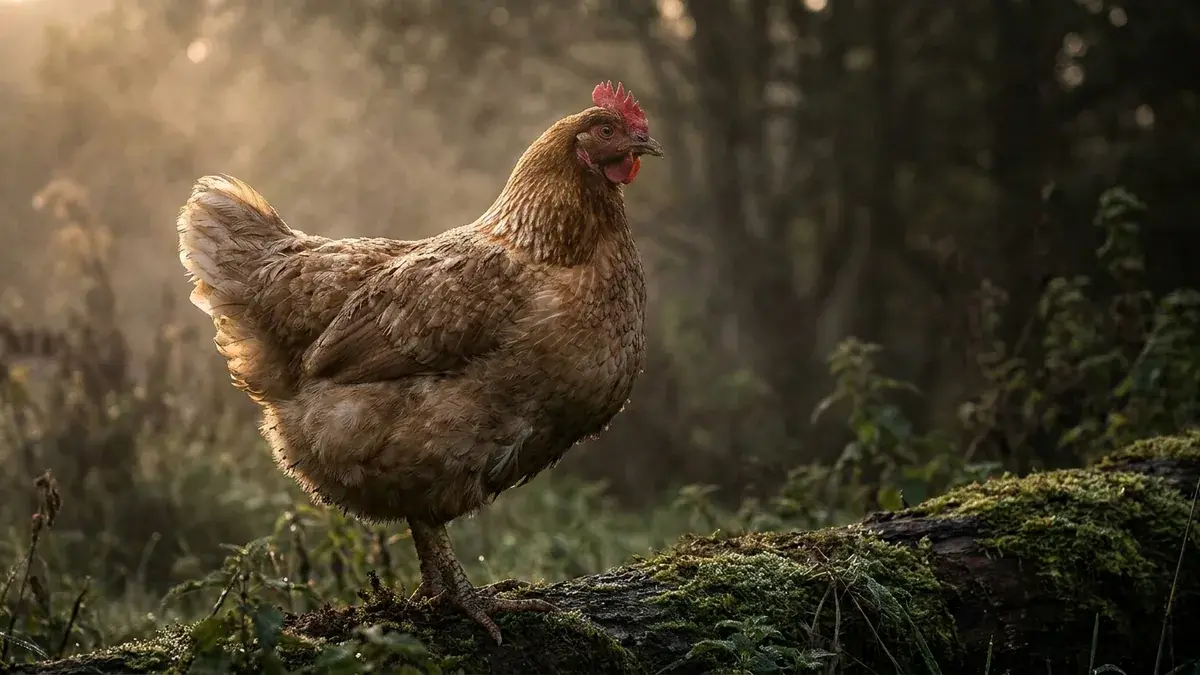
Chicks only three or four days old can add and subtract objects hidden behind screens, and they lay numbers out in space small-to-left, large-to-right, the way literate adults do. Hens tell roughly 30 flockmates apart. And the chicken was domesticated far later than the textbooks said — the oldest unambiguous bones are about 3,500 years old, from central Thailand.
An almanac
- Scientific name
- Gallus gallus domesticus, from the red junglefowl subspecies Gallus gallus spadiceus
- Domesticated
- About 3,500 years ago; earliest secure bones from Ban Non Wat, central Thailand
- Reached Europe
- Late — earliest directly dated birds in southern Europe are 776–540 BCE
- Colour vision
- Five cone types including a violet cone reaching into the UV; humans have three
- Social memory
- Roughly 30 individual flockmates; structure breaks down past about 30–60 birds
- Standout number
- About 23 billion broilers alive at any moment, most living around six weeks
The chicken is the most numerous bird on the planet and one of the most consistently underestimated animals in it.
The research is not subtle. Chicks a few days old track objects hidden behind screens through a running series of additions and subtractions and reliably choose the screen hiding more. They arrange quantities in space the way literate humans do — small to the left, large to the right — before they can fly. Mother hens show a physiological stress response when their chicks are mildly distressed.
Several widely repeated chicken facts turn out to be wrong, including the domestication date, the ultraviolet claim, and the Tyrannosaurus one. Those are covered below rather than skipped.
Chicken Facts Worth Knowing
- One subspecies, not the whole species. The domestic chicken descends from Gallus gallus spadiceus, one particular red junglefowl subspecies native to northern Thailand, Myanmar and southwestern China — not from red junglefowl generally.
- Domestication is much more recent than the textbooks said. A 2022 re-dating programme discarded the old claims: the oldest bones unambiguously belonging to domestic chickens are roughly 3,500 years old, from Ban Non Wat in central Thailand. Older finds from northern China and Europe did not survive re-examination.
- Chickens arrived in Europe late. The earliest directly dated chickens in southern Europe come from two Greek colonies in Italy, dated 776–540 BCE.
- It was the first bird, and the first farm animal, to have its genome sequenced and analysed, published in 2004.
- Five kinds of cone, against our three. The chicken retina carries five cone photoreceptor types, including a violet-sensitive cone reaching into the ultraviolet. "Chickens see in UV" overstates it — the cone picks up only part of the UV range — but their colour vision genuinely outclasses ours.
- Those cones are arranged as interlocking mosaics in which no two cones of the same type ever sit side by side.
- Chicks do arithmetic at three or four days old. They track objects hidden behind screens through a running series of additions and subtractions and reliably pick the screen hiding more.
- They also have a mental number line. Three-day-old chicks lay quantities out in space small-to-left and large-to-right, the same orientation literate humans use.
- A hen knows about thirty faces. Laying hens tell roughly 30 individual flockmates apart; past about 30–60 birds the social structure begins to break down. The widely shared "100 faces" figure is not what the research supports.
- Hens respond physiologically to their chicks' distress. When chicks were mildly stressed with a puff of air, mothers' heart rates rose and their eye temperature dropped.
- Breeding changed the bird itself. Between 1957 and 2005, selection increased broiler growth by more than 400% while halving the feed needed per kilogram gained.
- There are roughly 23 billion broilers alive at any given moment, most living about six weeks — which is why geologists have proposed the broiler skeleton as a marker fossil for the Anthropocene. A separate figure, 8.82 birds produced per living human in 2016, counts a whole year of production rather than birds alive at once.
- The heart starts on day two. Inside an incubated egg, the chick's heart is beating by the 44th hour.
- No sweat glands at all. Chickens shed heat through bare skin — the wattles, the shanks, and the thinly feathered area under the wings.
Four Chicken Facts That Are Not True
*"The chicken is the closest living relative of T. rex." The 2008 study everyone cites recovered six collagen peptides from a 68-million-year-old Tyrannosaurus* and compared them with 21 modern species. The dinosaur grouped with birds in general — ostrich as much as chicken — and closer to birds than to reptiles such as alligators. It never singled out the chicken.
"A hen needs a rooster to lay eggs." Ovulation runs on its own clock and does not depend on mating. A rooster changes only whether an egg is fertile, not whether one appears.
"A red spot in the egg means a chick was starting to form." A blood spot is a broken blood vessel from the moment the yolk was released, deposited while the egg was being assembled. It has nothing to do with fertilisation and does not affect safety or nutrition.
"Chickens have been farmed for 10,000 years, first in China or the Indus Valley." The 2022 re-dating threw this out. The secure record starts around 3,500 years ago in central Thailand.
Chickens in Culture
The chicken carries more idiom than almost any other animal: playing chicken, chickening out, counting chickens before they hatch, the chicken and the egg. Aardman's Chicken Run (2000) was for two decades the highest-grossing stop-motion film ever made, and returned with Dawn of the Nugget in 2023. Foghorn Leghorn strutted through Warner Bros. cartoons from 1946. Family Guy built a recurring gag around Peter's brawls with Ernie the Giant Chicken from 1999 onward. In games, the cuccos of The Legend of Zelda taught a generation that attacking a chicken has consequences.
Famous Chickens
Mike the Headless Chicken survived a botched beheading in Fruita, Colorado, on 10 September 1945 — the axe missed the jugular vein and most of the brain stem — and lived a further 18 months, fed through his oesophagus with an eyedropper. Fruita still holds an annual festival in his name.
The breed most people can name is the Rhode Island Red, adopted as the state bird of Rhode Island in 1954. And the hens of Aardman's Chicken Run did more for the public image of the bird than any campaign has managed since.
Frequently Asked Questions
Can chickens count?
Yes, in a meaningful sense. Chicks only three or four days old track objects hidden behind screens through a running series of additions and subtractions and reliably choose the screen concealing the larger number. They also arrange quantities in space small-to-left and large-to-right, the same orientation literate humans use.
How many faces can a chicken recognise?
Roughly 30. Laying hens tell about that many individual flockmates apart, and past about 30–60 birds the flock's social structure starts to break down. The frequently repeated figure of 100 faces is not supported by the research.
Do hens need a rooster to lay eggs?
No. Ovulation runs on its own clock and is unaffected by mating. A rooster determines only whether an egg is fertile, not whether it is laid.
When were chickens domesticated?
Much later than long believed. A 2022 re-dating programme found the oldest bones unambiguously from domestic chickens are about 3,500 years old, from Ban Non Wat in central Thailand. Claims of 10,000-year-old domestication in China or the Indus Valley did not survive re-examination.
Are chickens really the closest relatives of T. rex?
No. The 2008 collagen study placed Tyrannosaurus with birds as a group — ostrich as much as chicken — and closer to birds than to alligators. It did not identify the chicken as a nearest relative.
Do chickens see ultraviolet?
Partly. They have five cone types including a violet-sensitive cone that reaches into the UV range, against three cone types in humans. Saying they see in ultraviolet overstates it, but their colour vision is genuinely richer than ours.
More about the Chicken
More from Animal Facts




Sources
Claims on this page were checked against these published sources.
- Origin of the domestic chicken from modern biological and zooarchaeological approaches
G. g. spadiceus, indigenous to northern Thailand, Myanmar, and southwestern China, is its main wild ancestor.
Read the source → - The biocultural origins and dispersal of domestic chickens
the earliest directly dated chickens in southern Europe have been excavated in Italy from two Greek colonies dated to 776 to 540 BCE.
Read the source → - Researchers Compare Chicken, Human Genomes
The chicken is the first bird, as well as the first agricultural animal, to have its genome sequenced and analyzed.
Read the source → - Birds 'one-up' humans in ability to see color
Avian retinas also have a cone that can detect violet wavelengths, including some ultraviolet.
Read the source → - Arithmetic in newborn chicks
Results suggest impressive proto-arithmetic capacities in the young and relatively inexperienced chicks of this precocial species.
Read the source → - Number-space mapping in the newborn chick resembles humans' mental number line
Similarly to humans, chicks associate smaller numbers with the left space and larger numbers with the right space.
Read the source → - Normal Behaviors of Chickens in Small and Backyard Poultry Flocks
Recent research suggests that laying hens are able to recognize around 30 individuals.
Read the source → - The foundations of empathy are found in the chicken
When the chicks were exposed to a puff of air, the hens' heart rate increased and eye temperature decreased.
Read the source → - Growth, efficiency, and yield of commercial broilers from 1957, 1978, and 2005
From 1957 to 2005, broiler growth increased by over 400%, with a concurrent 50% reduction in feed conversion ratio
Read the source → - Chickens to be marker of Anthropocene
approximately 23 billion in the world at any one time
Read the source → - Counting Your Chickens: The World's Most Numerous Bird
in 2016 there were 8.82 chickens for every person.
Read the source → - Stages in chick embryo development
By the 44th hour of incubation, the heart and vascular systems join, and the heart begins beating.
Read the source → - Hot Weather Management of Poultry
Body heat is dissipated from wattles, shanks, and unfeathered areas under the wings.
Read the source →
Not sure which animal is yours?
Consult the quiz