Animal Facts
Chimpanzee Facts: Strength, Hunting and Real Numbers
Chimpanzee muscle out-performs human muscle by about 50 percent, not 500.
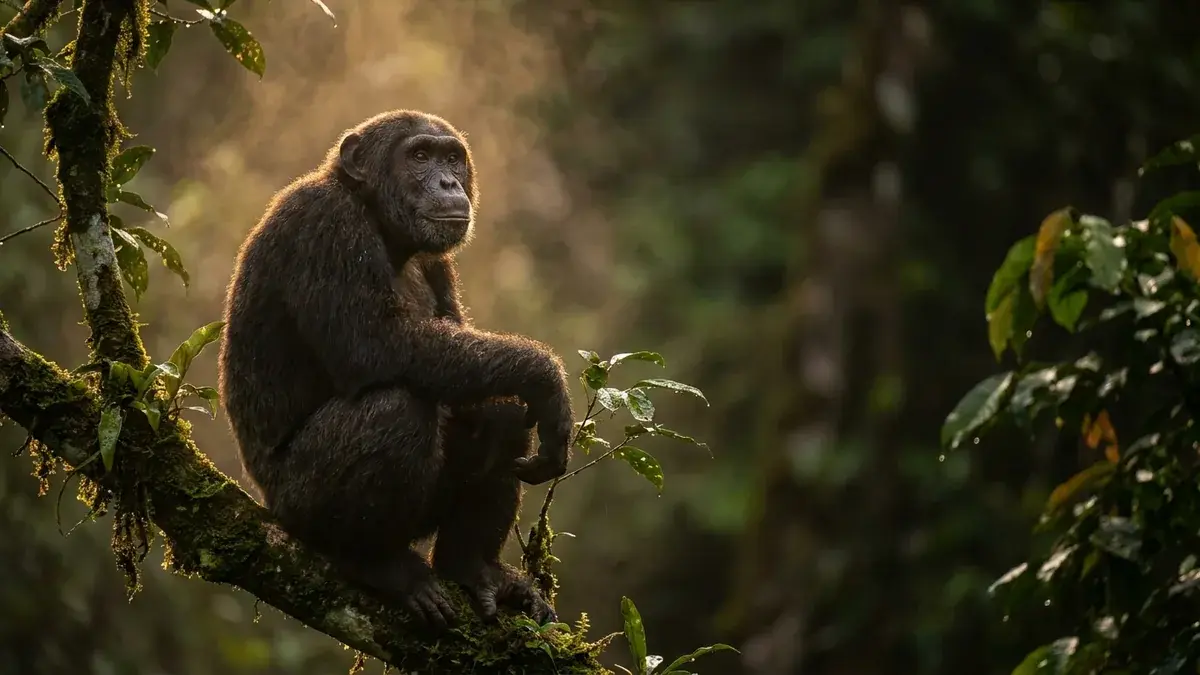
Chimpanzees (Pan troglodytes) are listed as Endangered by the IUCN, assessed 24 March 2016 under criteria A4bcde. Communities average about 35 members and split into shifting parties through the day, fruit forms roughly half the diet, and young are weaned at four to five years old. The claim that a chimpanzee is five to ten times stronger than a person overstates the evidence: mass-specific muscular performance is put at about 1.5 times human, and modelled whole-muscle force and power at 1.35 times a human muscle of similar size.
An almanac
- Scientific name
- Pan troglodytes
- IUCN status
- Endangered, criteria A4bcde (assessed 2016)
- Range
- Over 2.6 million km² across 21 African countries
- Community size
- About 35 members; Ngogo is the largest known
- Weaning age
- 4–5 years; next birth 4.6–7.2 years later
- Life expectancy at birth
- 32.8 years at Ngogo, Uganda
- Generation time
- 25 years
Chimpanzees are the animal people are most confident they already know, which is why so much of what circulates about them is wrong. The strength multiplier is inflated by roughly an order of magnitude, the population figure quoted as current is from 2003, and the famous grin is a submission signal rather than a smile.
What holds up is stranger than the folklore. Chimpanzees chew leaves into sponges to drink rainwater out of tree holes, jab modified branches into cavities to pull out bushbabies, drum on tree buttresses with timing that differs between subspecies, and left nut-cracking stones in Côte d'Ivoire 4,300 years ago.
Everything below is sourced to the IUCN Red List assessment, peer-reviewed papers, or the field projects that did the work — with the popular version corrected wherever it overstates what the evidence actually says.
Chimpanzee facts
- Endangered, and not just recently. The IUCN lists Pan troglodytes as Endangered under criteria A4bcde (assessed 24 March 2016, errata version 2018) because the maximum population reduction over a three-generation, 75-year window from 1975 to 2050 is suspected to exceed 50%. That is a suspected worst case across the window, not a point forecast, and the species has been listed as Endangered continuously since 1996.
- The headline population number is from 2003. The most-cited species-wide figure — 172,700 to 299,700 chimpanzees — comes from a 2003 estimate. The four subspecies are counted separately today: probably fewer than 6,000–9,000 P. t. ellioti, 181,000–256,000 P. t. schweinfurthii, approximately 140,000 P. t. troglodytes and 18,000–65,000 P. t. verus — the last two from unpublished work in preparation at the time of assessment. These are separate surveys from different years by different teams, not a synchronised census, and the population is still decreasing.
- The widest range of any great ape. Over 2.6 million square kilometres, spread discontinuously across 21 African countries from Senegal east to Tanzania. They are considered possibly extinct in Benin, Burkina Faso and Togo.
- Communities average about 35, and they split up all day. Chimpanzees live in multimale-multifemale, fission-fusion communities: rather than travelling as one troop, they break into small parties whose membership shifts through the day. Chimpanzee communities average about 35 members; Ngogo in Kibale is by far the largest known, cited at roughly 150 in the 2016 IUCN assessment (after Mitani and Watts 2005) and reported at 166 members by the Ngogo project as of September 2011.
- Reproduction is slow. Offspring are typically weaned at four to five years of age, and when the preceding infant survives the interbirth interval averages 4.6 to 7.2 years. Generation time for the species is estimated at 25 years.
- About half the diet is fruit. Fruit forms about half the chimpanzee diet, with most of the remainder terrestrial herbaceous vegetation, leaves, stems, seeds, bark, pith and honey; eggs, insects and medium-sized mammals make up a small share — enough to make chimpanzees the most carnivorous of the great apes, which is a low bar.
- Roughly 80 recorded foods. Scientists have catalogued about 80 different items chimpanzees eat, including seeds, fruit, leaves, bark, honey, flowers and insects.
- They manufacture a drinking tool. When water is scarce, chimpanzees chew leaves until they are soft and sponge-like, then dip the wad into tree holes to soak up rainwater.
- Life expectancy at birth of 32.8 years — at one unusually good site. At Ngogo in Uganda's Kibale National Park, life expectancy at birth for both sexes combined was 32.8 years across a sample of 306 individuals, inside the 27-to-37-year range recorded for human hunter-gatherer populations. This is not the same as saying chimpanzees live to 33: the figure is dragged down by high infant mortality, individuals regularly live far longer, and the IUCN puts maximum lifespan at around 50 years. Ngogo had abundant food, no leopards and no major epidemics during the study, and its life expectancy is nearly double that of some other chimpanzee communities.
- Ngogo hunts better than anywhere else. Its parties take red colobus monkeys with a success rate above 80 percent, and average four monkeys per successful hunt, where chimpanzees at most other sites catch one.
- Tool-assisted hunting at Fongoli, mostly by females. Savanna chimpanzees at Fongoli were recorded in 308 tool-assisted hunts over ten years, breaking off branches, modifying the end, and jabbing them into tree cavities to extract bushbabies. Females hunted with tools more often than males (175 instances to 130).
- Chimpanzee archaeology exists. Excavations in Côte d'Ivoire recovered behaviourally modified chimpanzee nut-cracking stones dated by chronometric means to 4,300 years old, still lodging starch residue from the nuts — the only prehistoric ape archaeology known anywhere, and older than settled farming in that part of the rainforest.
- They drink palm wine, and they steal it. At Bossou in Guinea, wild chimpanzees were recorded from 1995 to 2012 raiding raffia palms (Raphia hookeri) tapped by local people for palm wine, dipping leaf sponges into the villagers' collecting containers to drink sap averaging 3.1% ABV and reaching 6.9% ABV.
- Young chimpanzees keep sleeping in their mother's nest. A 2025 study of nest building at Ngogo notes that across apes, individuals can become proficient at nest building by around three years old, while young chimpanzees keep regularly sharing their mother's night nest at least until weaning at four to five — and in some recorded cases until they are ten.
- Drumming with measurable rhythm. Wild chimpanzees drum on tree buttresses with non-random timing and isochrony, and the two subspecies studied do it differently: western chimpanzees hit isochronously, eastern chimpanzees alternate short and long gaps. The authors argue rhythmic drumming on instrumental substrates may have been present in our last common ancestor.
- Eight to six million years since the split. Humans and chimpanzees last shared a common ancestor between 8 and 6 million years ago. That ancestor was an ape, and it was neither a human nor a chimpanzee.
- The chimpanzee genome came from one named animal. The genome published in Nature on 1 September 2005 was sequenced from the blood of a captive male chimpanzee called Clint, at the Yerkes National Primate Research Center in Atlanta.
Myths about chimpanzees
"A chimpanzee is five to ten times stronger than a human — it could tear a grown man's arm off without effort." A critical review of the available data puts chimpanzee mass-specific muscular performance at about 1.5 times human, and simulations of species-specific whole-muscle models put maximum dynamic force and power output at 1.35 times a human muscle of similar size — not five to ten times. The advantage comes from a higher proportion of fast-twitch fibres, not from any exotic muscle chemistry: individual fibres in the two species contract much the same way. A chimpanzee is genuinely stronger pound for pound, and an agitated adult is dangerous — but the folk multiplier is off by roughly an order of magnitude.
"Humans evolved from chimpanzees — chimps are what we used to be." Chimpanzees are a cousin lineage, not an ancestral stage. Both species descend from a shared ape ancestor that lived 8 to 6 million years ago and looked like neither of us; chimpanzees have been evolving away from that ancestor for exactly as long as we have. Living primates are the ends of branches, not steps on a ladder.
"When a chimpanzee pulls its lips back and shows its teeth, it is smiling — it's happy to see you." That face is the bared-teeth display, a rank-related signal. In chimpanzees it is directed up the dominance hierarchy, and it has long been read as appeasement or submission rather than amusement. Researchers do treat it as the evolutionary origin of the human smile, which is why it reads as friendly to us — but the animal making it is signalling about status, not enjoyment, and photographs of "grinning" chimps in adverts are usually pictures of stress.
"Chimpanzees can't really be endangered — you see them in adverts and films all the time — and a hand-raised one makes a manageable pet." That ubiquity is itself the problem, and the effect has been measured experimentally. People shown commercials featuring "entertainment" chimpanzees came away understanding less about the species' endangered status and unsuitability as pets than people shown neutral footage. The IUCN has listed the species as Endangered continuously since 1996, with the western subspecies in worse shape still.
Chimpanzees on screen
Chimpanzees are among the most heavily used animals in advertising, and the consequences of that have been measured rather than merely complained about. In a study published in PLoS ONE, viewers shown commercials featuring "entertainment" chimpanzees came away with a worse understanding of the species' endangered status and its unsuitability as a pet than viewers shown neutral footage. Familiarity on screen reads to an audience as abundance in the wild, which is close to the opposite of the truth: the IUCN has listed chimpanzees as Endangered continuously since 1996, and the western subspecies is in worse shape still.
The other thing the adverts get wrong is the face. The wide, teeth-baring expression that photographs so well is the bared-teeth display, a rank-related signal directed up the dominance hierarchy and long interpreted as appeasement or submission. Researchers do treat it as the evolutionary origin of the human smile, which is why it reads as friendly to us — but the animal producing it is signalling about status, not enjoyment, so most "grinning chimp" pictures are pictures of a stressed animal.
A third staple, the march-of-progress line-up with a chimpanzee at one end and a person at the other, has the family tree backwards. Chimpanzees are a cousin lineage rather than an earlier draft of us, and they have been evolving away from the shared 8-to-6-million-year-old ancestor for exactly as long as we have.
Famous chimpanzees and famous communities
The most consequential individual chimpanzee in modern science is a captive male called Clint, who lived at the Yerkes National Primate Research Center in Atlanta. The chimpanzee genome published in Nature on 1 September 2005 was sequenced from his blood, so a large share of human-chimpanzee comparison since then traces back to one named animal.
Most of the other famous chimpanzees are communities rather than individuals. Ngogo, in Uganda's Kibale National Park, is followed by the Ngogo Chimpanzee Project, run out of Yale (David Watts) and the University of Michigan (John Mitani). It is by far the largest community known — cited at roughly 150 in the 2016 IUCN assessment and reported at 166 members as of September 2011 — and its hunting parties take red colobus monkeys with a success rate above 80 percent and an average of four monkeys per successful hunt, where chimpanzees at most other sites catch one. Ngogo is also the site where life expectancy at birth was measured at 32.8 years, a figure that owes a great deal to abundant food, an absence of leopards and no major epidemic during the study.
Fongoli in Senegal is the savanna community where tool-assisted hunting was documented: 308 hunts over ten years, with females hunting with tools more often than males. Bossou in Guinea is the community recorded from 1995 to 2012 raiding tapped raffia palms and drinking palm wine through leaf sponges. And in Côte d'Ivoire, archaeologists recovered chimpanzee nut-cracking stones 4,300 years old with starch residue still lodged in them — the only prehistoric ape archaeology known anywhere, and older than settled farming in that part of the rainforest.
Frequently Asked Questions
How strong is a chimpanzee compared to a human?
Stronger, but nothing like five to ten times. A critical review of the available data puts chimpanzee mass-specific muscular performance at about 1.5 times human, and simulations of species-specific whole-muscle models put maximum dynamic force and power output at 1.35 times a human muscle of similar size. The difference comes from a higher proportion of fast-twitch fibres, not from unusual muscle chemistry — individual fibres in the two species contract much the same way.
Did humans evolve from chimpanzees?
No. Humans and chimpanzees both descend from a shared ape ancestor that lived between 8 and 6 million years ago, and that ancestor was neither a human nor a chimpanzee. Chimpanzees have been evolving away from it for exactly as long as we have.
How long do chimpanzees live?
At Ngogo in Uganda's Kibale National Park, life expectancy at birth for both sexes combined was 32.8 years across 306 individuals — within the 27-to-37-year range recorded for human hunter-gatherer populations. That number is pulled down by high infant mortality rather than describing a typical adult life: individuals regularly live far longer, and the IUCN puts maximum lifespan at around 50 years. Ngogo is also an unusually favourable site, with a life expectancy nearly double that of some other communities.
Do chimpanzees eat meat?
Some, and more than other great apes do. Fruit forms about half the diet, with most of the remainder terrestrial herbaceous vegetation, leaves, stems, seeds, bark, pith and honey; eggs, insects and medium-sized mammals make up a small share. That is enough to make chimpanzees the most carnivorous of the great apes, which is a low bar. At Ngogo they hunt red colobus monkeys with a success rate above 80 percent, and at Fongoli they jab modified branches into tree cavities to extract bushbabies.
Are chimpanzees endangered, and how many are left?
The IUCN lists Pan troglodytes as Endangered under criteria A4bcde, assessed 24 March 2016, because the maximum population reduction over a three-generation, 75-year window from 1975 to 2050 is suspected to exceed 50%. The widely quoted total of 172,700 to 299,700 is a 2003 estimate, not a current headcount; the four subspecies are now counted separately, from surveys done in different years by different teams, and the population is still decreasing.
Why do chimpanzees show their teeth?
The bared-teeth display is a rank-related signal, directed up the dominance hierarchy and long read as appeasement or submission. It is treated as the evolutionary origin of the human smile, which is why it looks friendly to us, but the chimpanzee making the face is signalling about status rather than enjoyment.
More about the Chimpanzee
More from Animal Facts

Sources
Claims on this page were checked against these published sources.
- Pan troglodytes (Chimpanzee) — The IUCN Red List of Threatened Species 2016: e.T15933A129038584
The maximum population reduction over a three-generation (75 year) period from 1975 to 2050 is suspected to exceed 50%, hence qualifying this taxon as Endangered under criterion A.
Read the source → - Chimpanzee
Scientists have recorded about 80 different items chimps eat, including seeds, fruit, leaves, bark, honey, flowers, and insects.
Read the source → - Favorable ecological circumstances promote life expectancy in chimpanzees similar to that of human hunter-gatherers
Life expectancy at birth (e0) for both sexes combined was 32.8 years
Read the source → - 4,300-Year-old chimpanzee sites and the origins of percussive stone technology
Recent archaeological work has yielded behaviorally modified stones, dated by chronometric means to 4,300 years of age, lodging starch residue suggestive of prehistoric dietary practices by ancient chimpanzees.
Read the source → - Developmental and Sex-Based Variation in Nest Building Among Wild Immature Chimpanzees
Infants can become proficient in nest building by around 3 years old; however, infants continue to regularly share night nests with their mothers at least until they are weaned (at 4–5 years old).
Read the source → - Chimpanzee drumming shows rhythmicity and subspecies variation
We show that wild chimpanzees drum with non-random timing and isochrony, providing evidence that rhythmic drumming on instrumental substrates may have been present in our last common ancestor.
Read the source → - Frequently Asked Questions
We do share a common ape ancestor with chimpanzees. It lived between 8 and 6 million years ago.
Read the source → - New Genome Comparison Finds Chimps, Humans Very Similar at the DNA Level
The DNA used to sequence the chimp genome came from the blood of a male chimpanzee named Clint at the Yerkes National Primate Research Center in Atlanta.
Read the source →
Not sure which animal is yours?
Consult the quiz