Animal Facts
Cheetah Facts: Speed, Spots and What's Actually True
The fastest speed ever measured on a hunting cheetah is 58 mph, not 70.
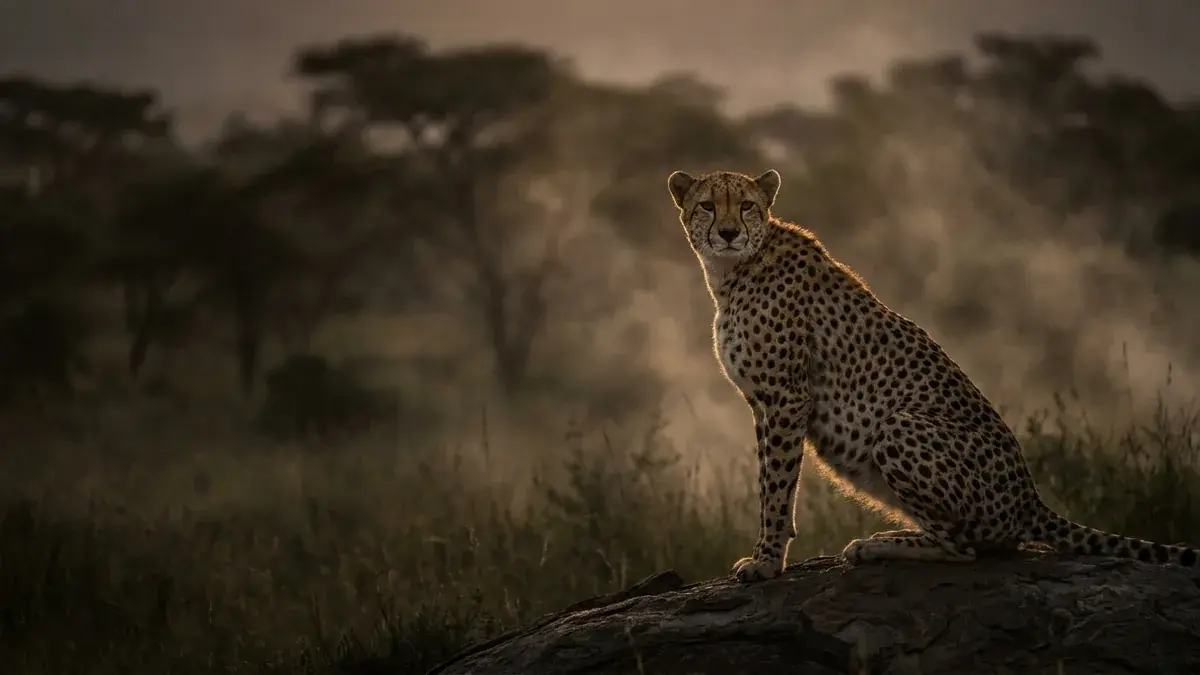
The cheetah (Acinonyx jubatus) is listed as Vulnerable, with the global population tentatively estimated at about 6,500 mature individuals and a projected 37% decline between 2017 and 2032. The fastest speed ever recorded on wild hunting cheetahs is 58 mph (25.9 m/s), from 367 runs by five GPS-collared animals in Botswana; a captive cheetah named Sarah was clocked at 61 mph over a certified 100 m course in 2012. It is not a Panthera cat — its closest living relatives are the puma and the jaguarundi, which is why it purrs and cannot roar.
An almanac
- Scientific name
- Acinonyx jubatus — the genus name means roughly "non-moving claw" in Greek, from a time when the claws were thought not to retract at all; "cheetah" comes from the Hindi chita, "spotted one"
- IUCN status
- Vulnerable (assessed 2021, published 2022) — roughly 6,500 mature individuals and declining
- Fastest measured in the wild
- 58 mph (25.9 m/s), GPS-collared hunting cheetahs, Botswana (Wilson et al. 2013)
- Fastest measured in captivity
- 61 mph (Sarah, Cincinnati Zoo, 2012, lure-chase on a certified straight course)
- Size and lifespan
- 75–140 lb (34–64 kg), about 30 inches (77 cm) at the shoulder; 8–10 years in the wild
- Range today
- 18 countries in Africa plus Iran — 19 extant range states in all (IUCN 2022) — about 9% of the species' historic range (Djibouti and Libya are listed separately as "Possibly Extant")
- Closest living relatives
- Puma and jaguarundi, not lions or leopards
The cheetah is usually introduced with a number, and the number is usually wrong. Most of what circulates about it — 70 mph, hunts abandoned because the animal overheats, claws that cannot retract at all — is either an estimate that hardened into a fact or a single local finding that got generalised to the whole species.
What measurement actually shows is more interesting than the shorthand. Wild cheetahs fitted with GPS collars in Botswana never exceeded 58 mph, and most of their hunts were run at moderate speed, with the kill decided by grip, braking and turning. Temperature loggers implanted in free-living cheetahs found body temperature at the end of a chase to be normal; the spike comes after a successful kill, and the researchers read it as stress rather than exertion.
The part that gets least attention is the state of the species. Roughly 6,500 mature individuals remain, spread across about 9% of the range cheetahs once held, and more than three-quarters of them live on farmland alongside people rather than inside protected parks.
Cheetah facts, checked against the sources
Every bullet below is tied to the source it comes from, and where two respectable sources disagree, both figures are given.
- Vulnerable, and still falling. The IUCN Red List assesses the cheetah as Vulnerable, with the global population tentatively estimated at about 6,500 mature individuals and a projected reduction of 37% (range 21–51%) over three generations — roughly 15 years — between 2017 and 2032.
- Zimbabwe lost 85% of its cheetahs in 15 years. It is the only large area covering both protected and unprotected landscapes with reliable population estimates from two points in time, which is why that decline carries so much weight in the assessment.
- About 9% of the historic range is left. Cheetahs once ranged across Asia and Africa; today fewer than 7,100 adult and adolescent cheetahs remain in the wild.
- Most surviving cheetahs live outside parks. More than 75% are on rural farmland alongside human communities, and Namibia holds more individuals than any other country.
- Zero to 45 mph in 2.5 seconds. The Smithsonian's National Zoo puts the acceleration at zero to 45 miles per hour (72 km/h) in two and a half seconds.
- Airborne more than half the time it is running. Estimates of stride length at full speed run from about 20 to 23 feet (Cincinnati Zoo: 20–22 ft; Smithsonian: 23 ft), at roughly four strides per second — about the same stride as a racehorse.
- 58 mph is the fastest speed ever measured on wild hunting cheetahs. Alan Wilson's team recorded a peak of 25.9 m/s — 58 mph, 93 km/h across 367 runs by five GPS-and-accelerometer-collared cheetahs in Botswana. The familiar 70 mph is a textbook estimate, not a measurement of a hunting animal; most hunts were run at moderate speed, and success came down to grip, braking and turning.
- Sarah ran 100 metres in 5.95 seconds. At the Cincinnati Zoo in 2012 she beat her own 6.13-second mark from 2009 and the 6.19 seconds set by a male South African cheetah named Nyana in 2001. Her top speed was clocked at 61 mph — on a USATF-certified 100 m course, chasing a lure, during a National Geographic high-speed-camera shoot.
- The genome is about 95% homozygous. That is nearly four times the level found in an outbred domestic cat, whose genome is 24.08% homozygous.
- A fixed sperm-gene defect. The cheetah has fixed five function-damaging variants in AKAP4, a sperm-development gene; four of the five were Sanger-confirmed as homozygous in nine of ten Namibian cheetahs. The authors propose this likely explains the species' extraordinary rate of malformed sperm — on average 81.6% damaged spermatozoa.
- Two population crashes, not one. The first was more than 100,000 years ago; the second between roughly 11,084 and 12,589 years ago in Africa, coinciding with the late Pleistocene extinction of large mammals.
- No roar, but plenty of noise. Cheetahs purr, bark, stutter, growl, hiss and chirp, and the chirp does real work — females chirp in estrus, both sexes chirp when distressed, and coalition males chirp when separated and reunited. Cheetahs may even recognise each other by chirp.
- No two spot patterns match. A cheetah's spots and the ring pattern of its tail are unique to the individual, much like a human fingerprint, which is how researchers tell animals apart.
- The paw print looks canine. Cheetahs have blunt, semi-retractable claws, so their tracks show visible claw tips and read more like a dog's than a cat's. The genus name Acinonyx means roughly "non-moving claw" in Greek — a name given when the claws were thought not to retract at all; they are in fact semi-retractile.
- Its nearest relatives are American. Molecular evidence places the cheetah closest to the puma and the jaguarundi, in the puma lineage of the Felinae rather than in Panthera. That is also why it purrs and cannot roar: genetically it sits much nearer a mountain lion than a leopard, spots notwithstanding.
- A 210-degree field of view. The cheetah's high-set eyes let it scan a wide area; a person sees objects within only about 140 degrees.
- Back in India after about 75 years. On 17 September 2022 eight Namibian cheetahs arrived at Kuno National Park in Madhya Pradesh — described by the Government of India as the first ever intercontinental, wild-to-wild wildlife translocation — about 75 years after the cheetah went locally extinct in the country. Twelve South African cheetahs were translocated and released there in February 2023.
- The first captive birth on record was in 1613. Emperor Jahangir documented it in Mughal India, and also described the only known "white" cheetah, shown to him by Raja Bir Singh Deo of Orcha in 1608.
Five cheetah myths that measurement has already settled
Each of these is repeated in good faith, usually by people quoting a source that was once accurate about one place or one moment.
"Cheetahs break off a chase because they overheat — run too long and the body cooks itself." Direct measurement killed this one. When researchers implanted temperature loggers in four free-living cheetahs and tracked spontaneous hunts, body temperature at the moment the chase ended averaged only 38.4°C — normal. The real spike comes after a successful kill, and it is bigger than after a failed one (1.3°C vs 0.5°C) despite identical exertion. The authors read that as stress hyperthermia, not exercise-induced hyperthermia: a cheetah standing over fresh meat is scanning for lions and hyenas.
"The king cheetah is a separate species, a subspecies, or a cheetah-leopard hybrid." It is one ordinary cheetah species carrying a recessive mutation in a single gene, Taqpep, which turns spots into blotches and stripes. The same gene makes blotched tabby house cats. The mutation was pinned down by Kaelin and colleagues in Science in 2012, but the species question had already been settled in 1981, when two normally spotted captive females each gave birth to a king.
"Cheetahs are the one cat that cannot retract its claws at all — they have fixed, dog-like claws." They are semi-retractable, not fixed. The claws do withdraw, just not fully, and they lack the sheath that keeps other cats' claws sharp — which is exactly the point, since permanently exposed tips work like sprint spikes.
"Lions kill about 95% of cheetah cubs, so cheetahs cannot survive anywhere large predators live." That figure comes from one place: the Serengeti Plains, where only 4.8% of 125 monitored cubs reached adolescence. Repeat the same monitoring in the Kgalagadi Transfrontier Park — which also has lions — and 35.7% of cubs survive to 14 months, seven times higher, with lions not implicated in a single death. The Serengeti number is a local result that hardened into a global fact.
"Cheetahs lose most of their kills to lions and hyenas — they hunt, then hand the meat over." They lose a minority. In Serengeti National Park the figure is up to 12.9% of kills, which makes theft a real cost of doing business rather than the defining fact of the animal's life.
The cheetah in language and popular science
The cheetah's public image rests on one number, and that number was never measured on a hunting animal. Seventy miles an hour is a textbook estimate; when Alan Wilson's team at the Royal Veterinary College put custom GPS-and-accelerometer collars on wild cheetahs in Botswana, the highest speed they ever recorded across 367 runs was 58 mph, and most hunts were run well below it. The footage everyone has actually seen is of a captive animal: Sarah's 5.95-second 100 metres at the Cincinnati Zoo in 2012, run on a course certified by the Road Running Technical Council of USA Track & Field, chasing a fluffy dog toy on a lure, for a National Geographic camera shoot.
The names carry old mistakes with them. "Cheetah" comes from the Hindi chita, "the spotted one", while the genus name Acinonyx means roughly "non-moving claw" in Greek — coined when naturalists believed the claws did not retract at all. They do, just not fully. Filing the cheetah alongside lions, tigers and leopards as a "big cat" is the same kind of inherited shorthand: molecular evidence places it in the puma lineage, next to the puma and the jaguarundi, which is why it purrs and has no roar.
No animal has had a stranger run of mistaken identity than the king cheetah. It was taken for a separate species, then a subspecies, then a cheetah-leopard hybrid, before being settled first by two captive spotted mothers giving birth to kings in 1981 and then by genetics: a recessive mutation in Taqpep, the same gene behind the blotched tabby pattern on ordinary house cats.
Named cheetahs, from Jahangir's court to Kuno
The best-documented individual cheetah is Sarah, of the Cincinnati Zoo. She first took the land-speed title in 2009, covering 100 metres in 6.13 seconds and breaking the previous mark of 6.19 seconds set in 2001 by a male South African cheetah named Nyana. In 2012 she lowered it again to 5.95 seconds, with her top speed clocked at 61 mph, on her first attempt at the run.
The oldest named cheetahs on record belong to the Mughal court. Emperor Jahangir documented the first birth of cheetahs in captivity anywhere in the world, in 1613, and described the only known "white" cheetah, shown to him by Raja Bir Singh Deo of Orcha in 1608 — an animal no one has recorded since.
The newest famous cheetahs are the Kuno animals. On 17 September 2022 eight Namibian cheetahs arrived at Kuno National Park in Madhya Pradesh, in what the Government of India describes as the first ever intercontinental, wild-to-wild wildlife translocation, about 75 years after the species went locally extinct in India. Twelve South African cheetahs were translocated and released there in February 2023.
Frequently Asked Questions
How fast can a cheetah actually run?
The fastest speed ever measured on wild hunting cheetahs is 58 mph (25.9 m/s), recorded across 367 runs by five GPS-collared cheetahs in Botswana. A captive cheetah, Sarah, was clocked at 61 mph on a certified 100 m course while chasing a lure. The commonly quoted 70 mph is a textbook estimate, not a measurement of a hunting animal.
Are cheetahs endangered?
The IUCN Red List classifies the cheetah as Vulnerable, not Endangered, with the global population tentatively estimated at about 6,500 mature individuals and a projected 37% decline between 2017 and 2032. In Zimbabwe, the one large landscape with reliable counts from two points in time, numbers fell 85% in 15 years.
Why can't cheetahs roar?
Because the cheetah is not a Panthera cat. Molecular evidence puts it in the puma lineage, closest to the puma and the jaguarundi, so it purrs rather than roars. It also barks, stutters, growls, hisses and chirps; females chirp in estrus, both sexes chirp when distressed, and coalition males chirp when separated and reunited.
Do cheetahs stop chasing prey because they get too hot?
No. When researchers implanted temperature loggers in four free-living cheetahs, body temperature at the moment a chase ended averaged 38.4°C, which is normal. The temperature rise comes after a successful hunt and is larger than after a failed one (1.3°C vs 0.5°C) despite identical exertion, which the authors interpret as stress rather than overheating.
Is a king cheetah a different species?
No. The king cheetah is an ordinary cheetah carrying a recessive mutation in a single gene, Taqpep, which turns spots into blotches and stripes and also produces blotched tabby house cats. Two normally spotted captive females each gave birth to a king in 1981, settling the question before genetics confirmed it in 2012.
Are there cheetahs in India again?
Yes. Eight Namibian cheetahs arrived at Kuno National Park in Madhya Pradesh on 17 September 2022, in what the Government of India describes as the first ever intercontinental, wild-to-wild wildlife translocation, about 75 years after the cheetah went locally extinct in the country. Twelve South African cheetahs were translocated and released there in February 2023.
More about the Cheetah
More from Animal Facts
Not sure which animal is yours?
Consult the quiz