Animal Facts
Chinchilla Facts: What Is True and What Is Not
Wild chinchillas live as low as 73 m in coastal fog, not high in the Andes.
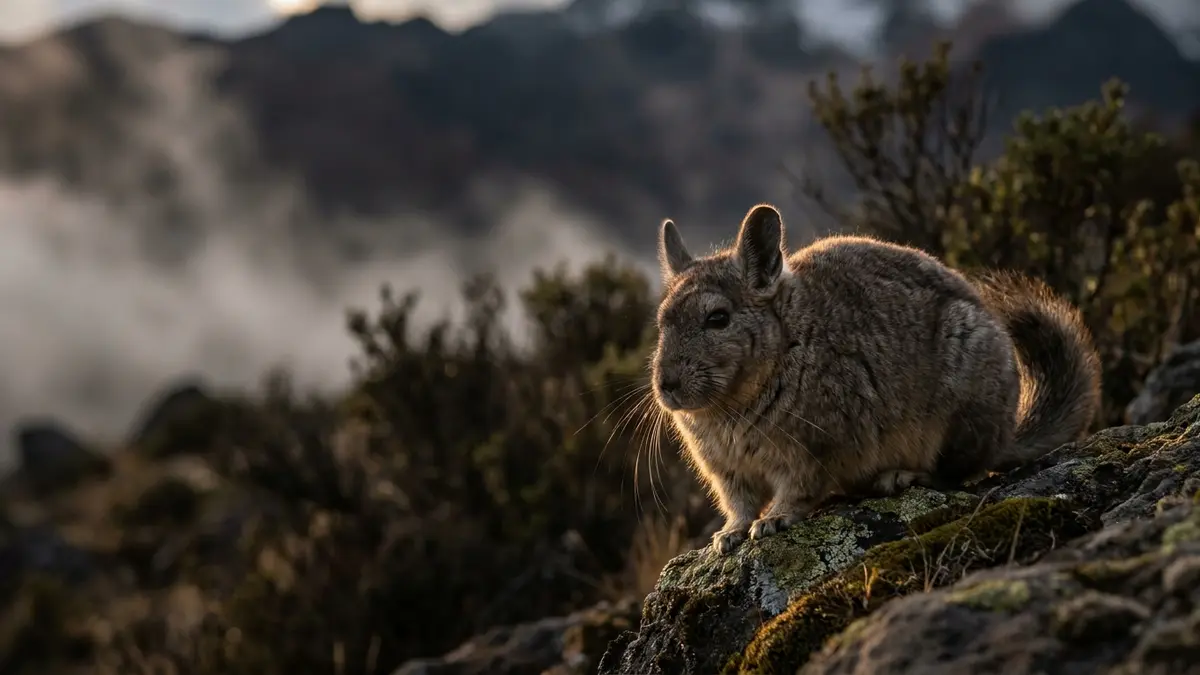
On the rump, where its coat is thickest, a long-tailed chinchilla packs up to about 25,000 hairs per square centimetre — the densest fur of any land animal, per Guinness World Records. That coat cannot shed heat: Merck gives the adapted range as 18.3–26.7°C (65–80°F), and above 80°F (27°C) heat stroke can be fatal, which is why the species bathes in dust rather than water. The long-tailed chinchilla was reassessed by the IUCN in April 2025 and remains Endangered, with an area of occupancy of just 200–500 km² across only two to five known locations.
An almanac
- Species
- Chinchilla lanigera, the long-tailed chinchilla
- IUCN status
- Endangered, reassessed April 2025
- Range
- Chile, 73–1,900 m above sea level
- Fur density
- Up to c. 25,000 hairs per cm² on the rump
- Safe temperature
- Adapted to 18.3–26.7°C (65–80°F)
- Breeding
- 111-day gestation, 214 days between births
- Record age
- 29 years 229 days (Radar, died 2014)
The chinchilla is a rodent from Chile, in the suborder Hystricognatha alongside guinea pigs and porcupines, with the mountain viscachas as its nearest living relatives. Two species exist; the one behind every pet chinchilla is the long-tailed chinchilla, Chinchilla lanigera.
Almost everything written about it leads with the fur, and the fur really is the record — but the popular version of the record is wrong in specific ways, and several of the other stock lines (the high Andes, the orange teeth, the exact birth weight) fall apart when you check them against the sources they are supposedly drawn from.
What follows is the checked version. Where sources disagree — and on this animal they disagree more than you would expect — the disagreement is stated rather than smoothed over.
Chinchilla facts
- The densest fur of any land animal. On the rump, where its coat is thickest, a long-tailed chinchilla packs up to about 25,000 hairs per square centimetre — the densest fur of any land animal, per Guinness World Records.
- Dozens of hairs from a single follicle. Sources disagree on the exact count: Guinness World Records says each follicle can produce 50–80 fine hairs, while the Merck Veterinary Manual says up to 60 (against 1–3 for a human follicle). Either way the order of magnitude is the point — dozens of hairs per follicle, not one.
- Fur slip is a stress reaction, not a proven escape trick. Chinchillas can release a large patch of fur, exposing clean skin underneath — a protective reaction vets call "fur slip." Merck documents it as a response to rough handling, fighting, or overexcitement; the predator-escape function is a widely repeated inference, not something the veterinary source states.
- They bathe in dust, on a schedule. The veterinary protocol is a pan holding about 2.5 cm (1 inch) of dust, offered two to three times a week for up to 15 minutes — not water.
- Heat is what kills them. That same insulating coat makes heat lethal: above 80°F (27°C), especially with humidity, a chinchilla can die of heat stroke.
- The teeth never stop. All of a chinchilla's teeth are open-rooted and grow continuously, and VCA puts the growth rate at 2–3 inches (5–7.5 cm) per year — which is why constant chewing on abrasive hay is not a habit but a requirement. (Note the rate describes the incisors; cheek teeth erupt far more slowly.)
- A standard model for human hearing research. Chinchillas have been the standard laboratory model for human hearing and noise-induced hearing loss for over 50 years, partly because their cochlea has three turns to a human's two and three-quarters.
- Endangered, on a very small map. The long-tailed chinchilla was reassessed by the IUCN in April 2025 and remains Endangered, with an area of occupancy of just 200–500 km² spread over only two to five known locations.
- Not a high-Andean animal. IUCN's 2025 assessment gives Chinchilla lanigera an elevation range of 73–1,900 m, with rediscovered coastal colonies in the Antofagasta Region of northern Chile at just 73 m asl. That contradicts the widely repeated "3,000–5,000 m high Andes" figure — which appears not only on zoo pages but in the Merck Veterinary Manual, Animal Diversity Web and the Smithsonian National Zoo. Treat it as a live disagreement between the current IUCN assessment and older secondary sources, not as a confusion with the short-tailed chinchilla.
- Some colonies drink fog. Newly documented chinchilla colonies on Chile's Antofagasta coast survive on water held in rock pools that are refilled by camanchaca — the Pacific fog that rolls into the Atacama Desert.
- Slow breeders, for rodents. Gestation runs 111 days, females average 459 days old at their first litter, and there are 214 days between births.
- Born ready — but the weight figure is contested. Baby chinchillas are born precocial — fully furred with their eyes open. Published birth weights vary widely by source: Animal Diversity Web gives up to 35 g, while the Merck Veterinary Manual gives about 60–70 g. Cite the range, not a single number.
- Wild chinchillas are homebodies. The longest single-night journey ever recorded for one individual was 250 metres, and most stay within 50 metres of where they were detected.
- Protection on paper came 54 years before protection in practice. Chile passed a law protecting chinchillas in 1929, but it went largely unenforced until the Reserva Nacional Las Chinchillas was created at Auco in 1983; the species has been on CITES Appendix I since 1977.
- The fur trade ran on volume. At the peak of the fur boom around 1900, Chile was exporting roughly 500,000 chinchilla skins a year — and the Smithsonian's National Zoo notes that well over 100 pelts go into a single fur coat.
- The whole pet population comes from about a dozen animals. Two numbers circulate and both trace to real sources. Britannica and the Merck Veterinary Manual both say 13 animals imported in 1927; the historical account in Arcadia documents mining engineer Mathias F. Chapman arriving at the Port of Los Angeles in 1923 with 11 chinchillas. The safe statement is the one both versions agree on: the entire domestic population traces back to roughly a dozen wild-caught Chilean animals, which is why captive chinchillas are so genetically narrow.
- The record holder lived nearly 30 years. The oldest chinchilla on record, a male named Radar, reached 29 years and 229 days.
Myths worth correcting
"Chinchillas have the densest fur of any animal on Earth." Densest of any land animal — that qualifier is part of the actual Guinness record title. Sea otters beat them outright, with more than a million hairs per square inch at the thickest point, versus roughly 25,000 per square centimetre (about 161,000 per square inch) on a chinchilla's rump.
"A chinchilla's orange teeth are stained that colour by iron in the enamel." Rodent incisors carry an iron-rich outer enamel layer. A 2024 ACS Nano study of beavers, coypus, squirrels, marmots, rats, voles and mice found the iron pockets make up under 2% of that layer's volume and provide acid resistance, not colour — the orange comes from a thin surface film of aromatic amino acids and inorganic minerals. Chinchillas were not among the species examined, so the finding is an extrapolation to them.
"Chinchillas are extinct in the wild — the only ones left are pets and fur-farm stock." They were written off in the 1960s and then found again. Both species are currently listed as Endangered, not Extinct, and the 2025 IUCN reassessment added newly documented coastal colonies in the Antofagasta Region that extend the species' known northern limit.
"Chinchillas are basically fluffy rabbits, or a kind of squirrel." They are hystricognath rodents — the same broad branch as guinea pigs and porcupines, not rabbits (which are lagomorphs) and not squirrels. Their nearest living relatives are the mountain viscachas, in the family Chinchillidae.
"Chinchillas are hardy little animals that do fine at normal room temperature." Their adapted range tops out at about 26.7°C (80°F), and past that heat stroke can kill them. Room temperature in a warm house is genuinely dangerous for an animal built to shed no heat through a coat this dense.
The chinchilla in pop culture
Chinchillas rarely headline, but they recur. Nintendo made the family canon in Generation V of Pokémon (Black and White, 2010): Minccino's official Pokédex category is literally "Chinchilla," and its entry — "These Pokémon like things neat and tidy. They are always sweeping and dusting their habitat, using their tails as brooms" — is a nod to real dust-bathing behaviour. Minccino evolves into Cinccino, the "Scarf Pokémon," with a Shiny Stone.
In 2023 the animal got a show of its own. Chip Chilla, created by Eric Branscum and Ethan Nicolle, premiered on Bentkey on 16 October 2023 with Rob Schneider voicing the father of an anthropomorphic chinchilla family; season two followed on 6 April 2024.
The name travelled into other species too. The Chinchilla rabbit, named for its resemblance to Chinchilla lanigera, was first shown in April 1913 at Saint-Maur, France, reached the New York State Fair in 1919, and was renamed the American Chinchilla in 1924. And in twentieth-century fashion the chinchilla coat was shorthand for money — the Smithsonian's National Zoo notes that well over 100 pelts go into a single garment.
The most famous chinchilla
The best-documented individual is Radar, and his claim is simply age. Born in Germany on 1 February 1985 and owned by Christina Anthony, he was 29 years and 229 days old when he died in Acton, California, on 18 September 2014 — the oldest chinchilla ever recorded by Guinness World Records.
He is worth treating as an outlier rather than a benchmark. A single verified individual approaching 30 years tells you what the species is capable of under ideal care; it says nothing about what a typical chinchilla lives to, and the wild population has never been followed closely enough to produce a comparable figure.
Frequently Asked Questions
Why do chinchillas take dust baths instead of water baths?
Dust is the veterinary standard, not water. The Merck Veterinary Manual's protocol is to place a dust box or clean litter pan holding about 2.5 cm (1 inch) of dust in the cage two to three times a week, for up to 15 minutes at a time.
Can chinchillas live at normal room temperature?
Only at the cool end of it. Merck gives their adapted range as 18.3–26.7°C (65–80°F), and VCA Animal Hospitals warns that temperatures above 80°F (27°C), especially with high humidity, can easily lead to fatal heat stroke. A warm house is a real risk for an animal whose coat sheds almost no heat.
Are chinchillas rodents or are they related to rabbits?
Rodents. They belong to the suborder Hystricognatha, the same broad branch as guinea pigs and porcupines. Rabbits are lagomorphs, a separate order, and chinchillas are not squirrels either. Their closest living relatives are the mountain viscachas, in the family Chinchillidae.
How long do chinchillas live?
The verified ceiling is high. Radar, a male born in Germany on 1 February 1985, was 29 years and 229 days old when he died in Acton, California, on 18 September 2014 — the oldest chinchilla ever recorded by Guinness World Records. That is a record, not a typical lifespan.
Are chinchillas extinct in the wild?
No. The long-tailed chinchilla was thought extinct in the 1960s and later rediscovered. The IUCN reassessed it in April 2025 and lists it as Endangered, with an area of occupancy of just 200–500 km² across only two to five known locations, and that assessment added newly documented coastal colonies in the Antofagasta Region.
Do chinchillas really live high in the Andes?
Not the species pet chinchillas come from. IUCN's 2025 assessment gives Chinchilla lanigera an elevation range of 73–1,900 m, with coastal colonies in northern Chile at just 73 m above sea level. The widely repeated "3,000–5,000 m" figure appears in the Merck Veterinary Manual, Animal Diversity Web and on the Smithsonian National Zoo's page, so it is best treated as a live disagreement with the current IUCN assessment rather than a settled fact.
More about the Chinchilla
More from Animal Facts

Sources
Claims on this page were checked against these published sources.
- Densest fur (land animal)
Each of its follicles can produce between 50 and 80 fine hairs, with up to c. 25,000 hairs per square centimetre
Read the source → - Description and Physical Characteristics of Chinchillas
Chinchillas have very thick fur because they have up to 60 hairs growing from each hair follicle (versus the 1–3 hairs that grow from each human hair follicle).
Read the source → - Chinchillas — Exotic and Laboratory Animals
To bathe chinchillas, place a dust box or clean litter pan filled with approximately 2.5 cm (1 inch) of dust in the cage 2–3 times a week for up to 15 minutes at a time.
Read the source → - Chinchillas — Health Conditions
Temperatures above 80oF (27oC), especially if high humidity is also present, can easily lead to fatal heat stroke.
Read the source → - The chinchilla animal model for hearing science and noise-induced hearing loss
Anatomical similarities with humans include a similar number of cochlear turns (humans: two and three quarters; chinchillas: three)
Read the source → - Chinchilla laniger (Long-tailed Chinchilla), 2025 assessment
It has limited area of occupancy (AOO), estimated at 200–500 km². It is currently restricted to 2–5 locations, all of which are subject to ongoing habitat loss from grazing by cattle and goats, mining activities, and the extraction of firewood.
Read the source → - Oldest chinchilla ever
The oldest chinchilla ever was Radar (Germany, b. 01 February 1985), who was owned by Christina Anthony (Germany), and was 29 years 229 days old when he died in Acton, California, USA on 18 September 2014.
Read the source → - Chinchilla laniger (Long-tailed Chinchilla), 2016 assessment — Conservation Actions
Legislation to protect the species has been in place since 1929, but was not efficiently enforced until the establishment of the Reserva Nacional Las Chinchillas in Auco, Chile in 1983 (Jimenez 1996). This species has been included in CITES Appendix I since 1977.
Read the source → - Long-tailed Chinchilla
Around 1900, Chile exported about 500,000 chinchilla skins each year.
Read the source → - chinchilla
All chinchillas in captivity are descended from 13 animals taken into the United States in 1927.
Read the source →
Not sure which animal is yours?
Consult the quiz