Mammals · Spirit animal
Skunk Spiritual Meaning & Symbolism
Confident, boundary-setting energy that broadcasts one clear warning, then lets calm handle the rest.
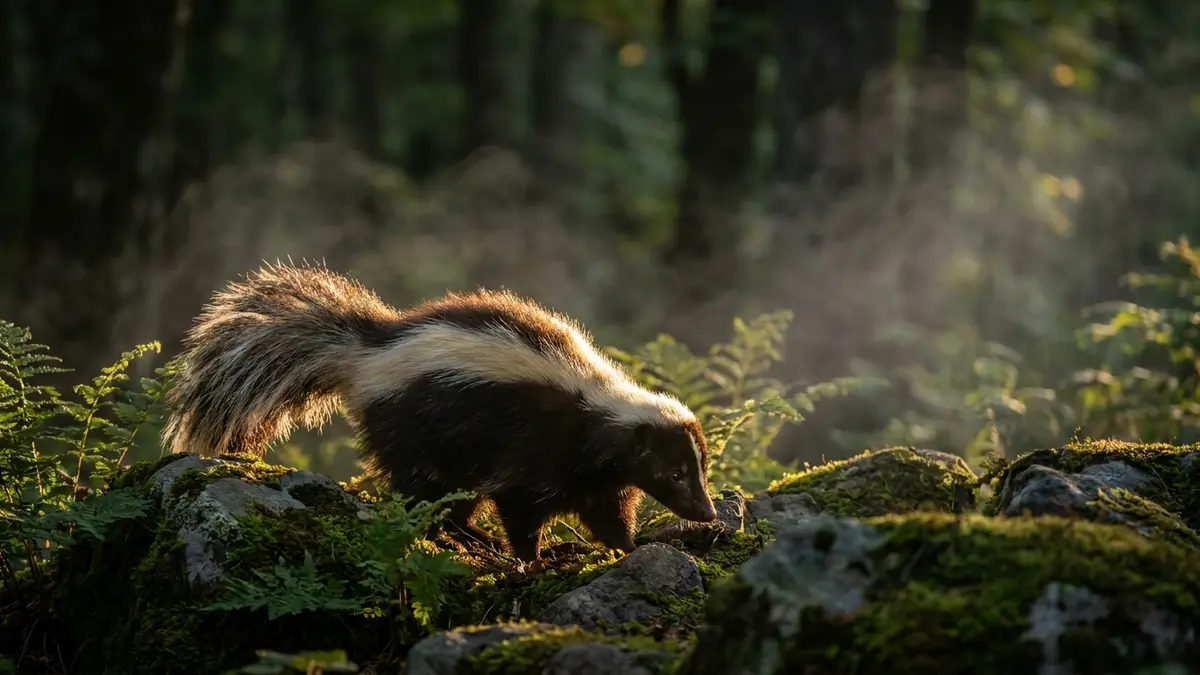
The spirit animal skunk, or totem, or power animal, represents setting clear boundaries: It's all about stating firmly how much you can and can't stand, backed by conviction, saved for when it actually matters rather than wasted on little annoyances. It teaches awareness of who you are and quiet self-respect, and it shows that a single strong and confident response can go a lot further than an angry outburst. In your dreams, the skunk may show you that you've been pushing people away in a subtle way.
An almanac
- Core message
- Guard your boundaries, then let calm handle the rest
- Spirit animal
- Sharpens situational awareness and quiet confidence
- Totem for
- Independent loners who expect their space respected
- Power animal
- Dismantles fear and cools a rising temper
- In dreams
- Often signals worry over pushing someone away
- Cultural roots
- Algonquian origin; clan animal for Creek, Choctaw, Chickasaw
- Defense range
- Aimed spray up to 15 feet, adjustable to mist or stream
Skunk looks cute until it isn't. The moment of transition, from harmless dainty creature to terrifying offensive weapon, is where the skunk's spiritual reputation comes from. As a spirit animal, totem animal, and power animal, the skunk teaches the importance of clearly defined boundaries. This lesson does not mean you should be picking fights, but it does mean you need to know how to convey your self-respect confidently so you don't get picked on.
Skunk Symbolism & Meaning
Skunks combine a pretty face and a strong weapon to survive in the wild. Before the scent gets sprayed out, it stamps its feet and hisses, and sways its tail upwards to send a warning.
Skunks don't waste their strongest weapons on minor irritations; instead, they save them for situations where they truly need to be used. If you use only strong weapons on every situation, your stronger weapons could eventually run out at a time when you most need them. That's the symbolism that skunks teach us — the symbolism that restraint is better than aggression. Remember this: use the sharpest reactions only when they're needed.
Skunks have no one bothering them, even though they are small animals. Since not many predators want to get sprayed by skunks twice, skunks live an untroubled existence in the woods, grasslands, and deserts. They borrow burrows from other animals in search of safety and shelter, but always make sure there is water nearby. That's why it's associated with both water and land.
Litters arrive, with typically two to ten kits each time. These kits are born blind and also stay dependent on their mothers for weeks. By the late summer these male young ones become independent enough to leave home. Female youngsters usually remain with their mothers for another spring.
Taxonomists had earlier placed the animal among weasels, badgers and otters under one family tree. In the 90s genetic studies revealed that actually skunk belongs to a distinct family of its own.
Skunk Spirit Animal
A skunk is an animal that sharpens your awareness. It asks you to notice what's really going on around you instead of draining your energy with things that really aren't your concern. It also has a message for you about picking the right battle. Take note before getting involved, and if the conflict is worth pursuing, consider whether the timing and place are right.
The tension skunk is trying to resolve may not be external, but rather a matter still simmering inside your head. Above all, this animal offers quiet confidence because it never doubts its own capabilities; when you carry it in your own character in this way, it can calm an entire room.
If you've felt as though other people's expectations have been swallowing you up, skunk arrives with a clear message: your individuality was never meant to be hidden — be proud of it and show it off.
Does Skunk fit you?
Tap the ones that sound like you — 6 traits, no right answer.
0 of 6 Nothing picked yet — start tapping.
Skunk Totem Animal
People with Skunk as a totem animal usually like their own space, and they'll make that clear pretty clearly. If you cross those boundaries, you'll know it. That's preferable to outright aggression, though the same idea is behind both.
Skunks know well the harm they could do if they had to do it. That's why they seldom have to do it.
It's also why people tend to notice and admire them when they do speak. They don't waste time putting on airs; they say what needs to be said with the utmost accuracy.
They also have deep reserves of resilience. Most problems fade away sooner or later, especially if a person sticks with something really dear to their heart.
Skunk Power Animal
When fear makes you wish the ground would open up and swallow you whole, call on the skunk. It reminds you that there's no need to apologize for being different, and shows you how to separate the things that threaten you from those that simply annoy you.
This guide teaches that it's possible to be strong and humble at the same time. You don't have to stand up to someone by walking all over them, and it's possible to hold your ground without holding anyone else down.
The skunk is a valuable guide when your temper starts climbing toward boiling point. It chases off threats that would otherwise escalate into conflict, preventing your emotions from getting out of control.
Native American Skunk Symbolism
The word skunk may have come from a Native American word related to seganku, which was used by the Algonquians. The Lenape had a similar word of their own. In some traditions, skunks were seen as a dangerous creature, eventually beaten by a hero. In those stories, the skunk becomes just a pest you have to deal with while walking along the path.
To the Muskogee, skunks were loyal and brave animals who would risk their lives to protect their family. The smell was considered a sign of protection, not a bad thing. Several tribes (Creek, Choctaw and Chickasaw) recognized the skunk as an animal related to a specific clan.
Skunk in Dreams
A skunk slipping into a dream is a message that you've been pushing people away, whether that was your intention or not. The reassuring part is that you can still fix things by retracing your recent words and actions.
- Smelling the spray is a sign that you've put up defenses against something. Instead of running away from the thing that scares you, face it head-on.
- A skunk spraying someone else is a warning sign. Trust your instincts about a person, instead of explaining away those feelings.
- A skunk hiding in its den suggests that you need to gather information quietly before making any moves.
- A skunk chasing someone is telling you that you need to give yourself some space from someone or something.
- A skunk standing its ground means that you are becoming more confident in yourself and have good diplomatic skills that you should use.
- Seeing a mother skunk with her young reflects your nurturing instincts and an urge to go back home and be with family.
Skunk Spiritual Meaning
If Skunk's spiritual message narrows to one idea, it's this: peace is something you earn through discipline, not luck. Real power rarely needs to be advertised — a clear boundary, calmly held, accomplishes more than any outburst ever could.
Skunk also wants you to value your own separateness. Its ancestry stands genuinely apart from its closest relatives, proof that being different is not the same thing as being lesser. Let this animal teach you to save your strongest reactions for what truly threatens your peace, to speak plainly instead of at length, and to trust that quiet self-respect earns more genuine regard than any demand for it ever could.
Wherever Skunk shows up, it leaves behind the same simple instruction: guard your space first, then let calm handle everything else.
Lakota Skunk Symbolism (Maká)
The Lakota called Skunk “Maká.” They looked at the animal differently than most: not so much about the chemical weapons it used, but more about the poise and inner confidence it showed. Skunk moves with quiet sureness, relying on its presence rather than brute strength. Even when approached by a much larger intruder (like a bear), it will stand its ground and not flee. Tradition describes Maká as standing firm in front of a bear.
Lakota warriors thought of skunk skin as a talisman of courage. To the warriors, skunk wasn't just some odd creature that lived on the Great Plains. It was an actual source of courage.
When you look at Skunk this way, you can see how it's connected to other parts of this page about animal symbolism. It doesn't mean that courage is the same as not having any danger. The thing you need most is not safety; it's inner strength.
The Skunk Origin Myth
A Ho-Chunk (Winnebago) origin story explains how Skunk came to exist at all, and it's a myth about vanity meeting its match. A girl born with startling white hair grew into a beauty who cared for little beyond her own reflection. She perfumed her days with crushed flower petals and turned away every suitor who approached. When a homely stranger came courting, she mocked his looks openly, not realizing he was Turtle, one of the great spirits in an ordinary disguise.
Turtle's response was swift: "Since you rejected one of the great spirits, you shall be transformed into a lowly animal! When people see you, they will turn away from your repulsive odor." The girl shrank, her skin darkened to black fur, and only a single pale stripe remained of her once-famous white hair, a permanent reminder down her back of what vanity had cost her. She became the first of her kind.
Whatever else Skunk symbolizes elsewhere, this origin story adds a pointed footnote: the odor wasn't Skunk's original nature. It was a consequence, a lesson in humility for looking past people instead of at them.
Frequently Asked Questions
What does a Skunk spirit animal mean?
When you need better boundaries, or you feel you're losing touch with what's authentic to you, a Skunk spirit animal could have a message about self-respect. Rather than watering down yourself to suit others, be sure to pick your battles and trust that your uniqueness is worth protecting.
What does it mean when a Skunk appears in your dreams?
Dreaming about a Skunk often points to how you feel distant from someone — whether through your own actions or their choices. For example, if the dream involves you smelling the Skunk's spray, it's usually a sign of fear. If a Skunk stands its ground instead, then it might mean that you're starting to gain confidence and self-trust.
Is Skunk a good or bad omen?
Not everyone interprets skunks as lucky or unlucky. Some Native American traditions say skunks crossing your path is bad luck. Some traditions treat them as good luck, honoring their loyalty. Most spiritual readings teach that it's a reminder to set limits or boundaries in your life.
How far can a skunk actually spray, and how many times?
Skunks have musk glands that can hold a teaspoonful of musk each, about enough for a series of powerful sprays. If necessary, they can shoot spray up to 15 feet and control the direction with a fine mist or a direct jet aimed at just one target.
For skunks, this kind of precision is spiritual. When they spray, it's not to saturate everything in sight: it's so that they strike one target and nothing else.
Skunk also represents
Sources
Claims on this page were checked against these published sources.
- Skunk
threatened skunks will go through an elaborate routine of hisses, foot-stamping, and tail-high deimatic or threat postures before resorting to spraying.
Read the source → - Spotted skunk
They may warn with a unique 'hand stand'—the back vertical and the tail waving.
Read the source → - Mephitis mephitis (Striped Skunk)
Mephitis mephitis can produce a litter that ranges from 2 to 10 individuals
Read the source → - Mephitidae
Skunks were formerly classified as a subfamily of the Mustelidae (the weasel family); however, in the 1990s, genetic evidence caused skunks to be treated as a separate family.
Read the source → - skunk (n.)
a southern New England Algonquian language (perhaps Massachusett) word, from Proto-Algonquian */šeka:kwa/, from */šek-/ "to urinate" + */-a:kw/ "fox"
Read the source → - Skunk Legends, Meaning, and Symbolism from the Myths of Many Cultures
škakw in Lenape
Read the source → - Skunk Spirit Animal, "Maká" – Lakota Meaning
war chiefs sometimes lined the heels of their moccasins with a skunk skin to give them the courage to take on all comers... The skunk will even stand his ground with an approaching bear.
Read the source → - The Skunk Origin Myth
Since you rejected one of the great spirits, you shall be transformed into a lowly animal! When people see you, they will turn away from your repulsive odor.
Read the source → - Controlling Skunk Damage (NebGuide)
Each sac holds about a teaspoon of musk and is enough for multiple sprays... shoot up to 15 feet with 'both barrels'
Read the source →