Birds · Spirit animal
Raven Spiritual Meaning & Symbolism
The dark-winged messenger who turns endings into openings and secrets into wisdom
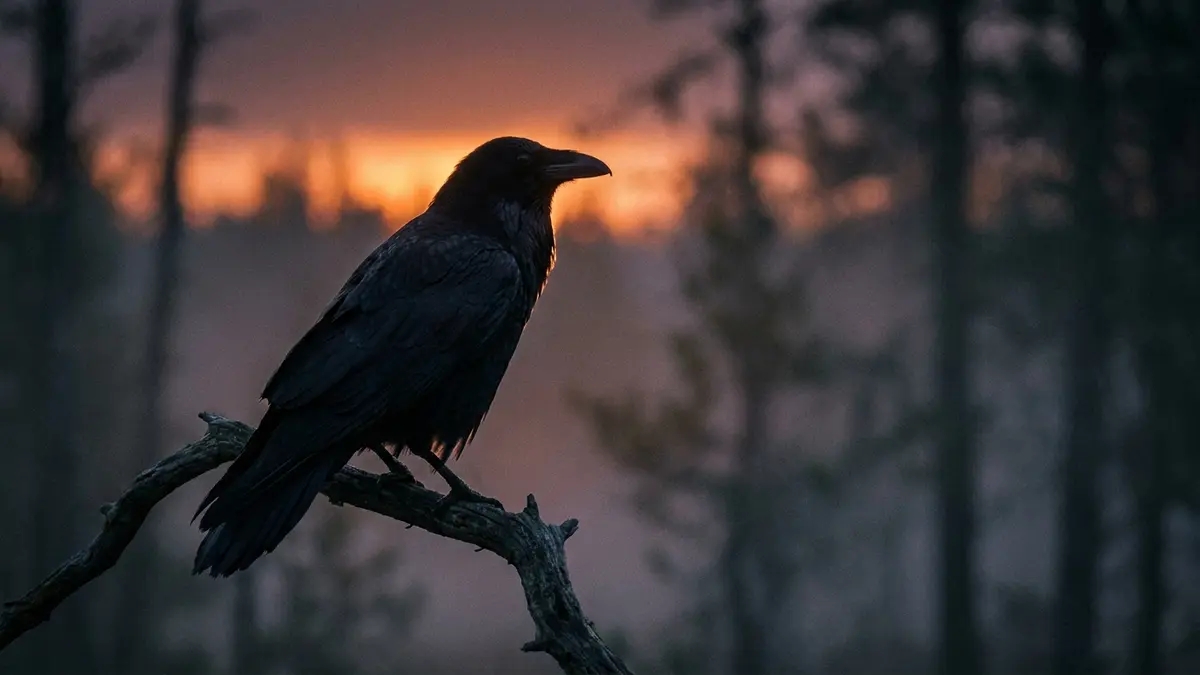
Ravens are messengers. They're strongly associated with death. If you're drawn to ravens, it's time to let go of the old things you're outgrowing.
Native American peoples have long considered ravens signs of prophecy and healing. The raven is also an important animal to several European peoples, including the Norse and the Celts.
When the raven appears to you, it can be a sign that you're transitioning into a new phase of life. It could mean that something large is about to change, or that something small is happening under the radar right now. Embrace change by releasing what no longer serves you and by welcoming into your life that which can help you transform into your highest self.
An almanac
- Core message
- Endings clear space for rebirth
- Spirit animal
- Keeper of secrets and playful teacher
- Totem for
- Inventive, intuitive healers and wisdom-keepers
- Power animal
- Sharpens instincts and self-respect
- In dreams
- Transformation and approaching change
- Cultural roots
- Native American, Celtic, Norse, Christian
- Haida clans
- Raven and Eagle moieties, passed through the mother's line
A Raven crossing your path rarely feels like coincidence. Larger and lonelier than its cousin the crow, this glossy black bird has carried associations with death, prophecy, and hidden knowledge across dozens of unrelated cultures, from Celtic battlefields to Norse mythology to the American Northwest. Its darkness is rarely a warning, though — more often it's an invitation to let something end so something truer can begin.
Raven Symbolism & Meaning
Glossy black is death and the underworld to a lot of people. Ravens feed on what's dead, and so are often linked to things like cleansing. They clear away what's done to make room for new stuff.
Black feathers shift from black to blue to black as light hits them. Ravens are thought to carry messages between gods like Apollo, so they have this connection to solar, prophetic things. They're pretty quick witted and they'll use their voice, so they're a good reminder that you should too — and that it's often healthy to let something die off before it can blossom into something new.
Raven Spirit Animal
Some Native American traditions describe Raven as a keeper of secrets: If you have the honor of knowing a secret, it wants you to treat that with complete confidentiality. But if you try to pretend with Raven, it will call you out, probably sharply.
At the same time, Raven has a genuinely playful streak. Some of the most important lessons it brings may arrive disguised as apparent mischief or silliness, and it gives people some sense of humor back when they most need that. It gravitates towards people on a path of deeper study or who want to get into shapeshifting work and offers them calm and support through their hardest lessons.
Raven is also an amazing mimic, so it can help you by teaching things like people's habits or speech patterns.
Does Raven fit you?
Tap the ones that sound like you — 6 traits, no right answer.
0 of 6 Nothing picked yet — start tapping.
Raven Totem Animal
People born with the raven as a totem animal tend to be inventive, sharp of intuition, and sometimes a bit sly. They notice opportunities that most people miss. Darkness doesn't frighten these people; they have a sense for moving quietly through it, since silence allows them to get in touch with their own true inner self.
Through meditation they receive information for other people, sometimes turning them into an intermediary. For them magic grows along with the person rather than just staying as it is. People who carry raven totem are often also healers and caretakers of knowledge, though in order to share these things they first have to heal themselves.
Raven Power Animal
As a power animal, Raven sharpens your ability to notice those subtle signals that most people forget to pay attention to, nudges from the natural world like hunches and those small signs that you tend to overlook. Raven also connects you to your natural instincts and helps you develop faith in them rather than dismissing them as having no value.
A core lesson for this power animal is self-respect. Raven gives you courage to stand up for yourself, to choose your path over following the crowd, even if it means facing the challenge of rejection.
Raven tends to stir up dormant memories and surface them so that you can deal with any conflicts underneath them. This process isn't always comfortable.
Across cultures
6 traditions — pick one to read its take.
Raven in Native American Tradition
Raven appears in many Native American stories as a clever trickster and protector, and in some cultures Raven plays the part of creator, shaping the world and pairing people together. The Raven has a special place in Inuit traditions, among others. Haida culture knows a popular legend about Raven stealing the light: He makes himself tiny enough to sneak into a lodge where the sun, moon, and stars are guarded. He takes these treasures, escaping in a smoke-fogged scurry.
Raven’s feathers were white when he set out to steal the light; smoke from his exit left them black forever. This black coloring also serves as a symbol of the void — or place of nothingness — from which everything begins and to which it eventually returns.
Raven’s influence varies greatly from one tribe to another. Overall, however, Raven still ranks among the most powerful creatures one can work with.
Raven in Celtic Tradition
The Celtic tradition has a complex association between raven and three major figures. These include Morrigan, the war goddess; Bran, a giant king and protective god; and Lugh, the god of light. The raven is sometimes associated with conflict and with prophecy, and it also sometimes acted as a messenger between the gods and mortals in Celtic lore.
Morrigan took the shape of a raven before heading into battle. Known as Badb at that time, Morrigan's raven energy helps you to read the intentions of an opponent, even if they aren't yet fighting you or will never fight you.
Bran's name means 'raven' or 'crow' in Welsh. Welsh tradition remembers him as an immortal guardian whose head was buried in his final act as a powerful talisman of protection.
Raven in Norse Mythology
In Norse myth, Odin — that is, the All-Father of the Gods — has a couple of ravens as his trusted advisers and agents. They're named Huginn and Muninn, which mean Thought and Memory. They flew out every day, circling around humanity, then returned and reported on everything they had seen.
And that, really, is the essence of Raven in Norse tradition: they're there not just to watch over you but also to keep you connected with what's happening on the other side of town and down the road. The Old Norse poem Grímnismál captures it perfectly, where Odin's ravens are shown traveling far out into the world before returning to perch on his shoulders with their report.
Raven in Christianity & the Bible
Christianity holds the raven in real ambivalence. Yet they're said to have feasted on Noah's flood victims and been barred from the ark in some stories. They're also proof of God's generosity: Luke shows ravens as watchful creatures that neither plant nor harvest, yet a lesson in faith all the same. Legends say they guarded St Vincent of Saragossa's remains and saved St Benedict of Nursia from poisoned bread.
Raven in Egyptian Mythology
Raven's association with Nephthys may come from some recent spiritual writings. But the kite, not Raven, was identified in ancient Egyptian sources with the goddess Nephthys, who is often associated with death and mourning. But in these sources, that association was with the kite's mourning cry. This role fits Raven's wider reputation as a bird who stands at the threshold between the divine and human realms.
Raven in Far Eastern & Hindu Tradition
Chinese, Japanese, and Korean folklore often combine descriptions of ravens and crows into a single solar symbol, saying they carried the sun, helped with sacred journeys. In China, a raven sighting may warn one of shifting weather. If one were to encounter an ancestor visiting in the form of a red raven during the Zhou era, that would be thought of as an even more reassuring visit than usual.
In Japan, tales tell of Yatagarasu who was said to guide Japan's first emperor toward sacred destinations. Festivals at shrines continue to include imagery of a bird whose beauty helps inspire safety and protection. Hindu tradition describes it as a customary action to place food for the departed’s favorite bird — either a raven or crow — so that the loved one knows they have arrived in peace.
Raven Colors, Feathers & Omens
It's rare to find a raven that isn't completely black, though spotting a white one is a sign of things moving in new directions. Ravens appear in many different colors in dreams, and the color plays a key role.
If you find a feather, it may mean that your ancestors or spirit guides are watching out for you. And finding a dead raven can mean trouble is over.
Raven Tattoo Meaning
A raven tattoo carries whatever meaning its wearer brings to it — a loyalty to Morrigan, a love of Edgar Allan Poe's writing, or a tribute to Yatagarasu, the three-legged crow who helped emperors. But throughout history, certain associations with ravens have reappeared again and again: intelligence, resourcefulness, the ability to communicate in speech and silence, and a deep tie to the cyclical journey of life and death.
People who choose this ink are often communicating that they identify with one or more of these traits. They might also be inviting this quality into their lives or finally admitting that they've long possessed it.
Raven in Folklore & Pop Culture
Due to its association with black, a color linked to the mysterious and the unsettling, the raven was thought to be an ill omen. Its reputation was reinforced by its ability to mimic human speech, encouraging superstitious beliefs that it whispered messages from the spirit world. The bird's literary fame further cemented its standing: Edgar Allan Poe's famous poem made raven synonymous with insistent, immovable grief, while Dickens transformed his pet raven into a mischievous character in his own stories. The animal's ill repute even impacted sports — Baltimore's football team borrowed its name directly from Poe's poem.
Raven in Dreams
Dreaming about raven almost always points to transformation, so treat it as a nudge to stay open-minded about whatever shift is approaching. Depending on what the bird is doing, the message shifts: - A raven near a lost loved one may signal an attempt to reach you with guidance you haven't caught yet. - A flock behaving with unusual intensity often warns of a busy, eventful stretch ahead. - Chasing or catching a raven can represent real progress toward a goal you're pursuing. - A raven carrying something valuable sometimes points to gains made through less-than-honest means. - Persistent, scolding calls may reflect arrogance worth addressing directly. Contrary to old superstition, this dream rarely predicts literal death; it's more often about closing one door so a new path can open.
Raven Spiritual Meaning
Ravens have a message of initiation. During your times of change and transition, stay flexible and adaptable, and find the lesson in conflict.
The Raven's trickster behavior is not aggressive, but a call to help you outwit whatever harsh situation you're going through. Just make sure your motive for trickery is good and the outcome leads to growth rather than self interest. The Raven spirit animal is with you to help you through the worst times, urging you to find your voice.
Raven and the Tower of London: Britain's Protective Omen
The presence of these birds is said to be an important part of the institution.
The story goes like this: John Flamsteed, who was a noted astronomer, complained that the Tower's ravens were fouling his telescope. King Charles II was supposed to be so superstitious that he chose not to risk bad luck by disturbing the Tower's ravens.
The truth of this story is hard to find. It's first documented in 1883 and it may be little more than a Victorian fiction. Regardless, it echoes the belief held by many people throughout history that a raven at a certain place can add power to that location — or at least keep it from losing what power it has.
Frequently Asked Questions
Is seeing a raven a bad omen?
A raven is not necessarily a bad omen. The bird's black coloring and its association with carrion have caused some cultures to link ravens with death and misfortune, but that reputation is largely folkloric. Many cultures have positive associations with the raven, too, as a symbol of transformation and a harbinger of important messages. While a raven does not itself predict tragedy, you may want to pay closer attention if you see one.
What's the difference between raven and crow symbolism?
Ravens and crows live in similar habitats and look almost exactly alike. However, ravens are bigger, usually travel in pairs instead of flocks, and have a deeper, more guttural call.
From a symbolic standpoint, the two overlap. This is especially true in East Asian traditions where they're often treated interchangeably. That said, ravens tend to have a stronger association with prophecy and magic and receiving direct communication from the divine.
What does it mean if raven is your totem or power animal?
If raven is your power animal, you've got natural intuition and inventiveness, and you aren't afraid of darkness. You notice the small signs that other people miss.
Raven sharpens your instincts and reminds you to feel proud of yourself. Raven is a good ally for people working through difficult changes.
Why do so many cultures see the raven as wise or prophetic?
Cognition research on common ravens shows that they can solve multi-step problems, detect unfair treatment, and remember where they've hidden food for months. They perform about as well on tests of reasoning and social learning as adult chimpanzees and orangutans by about four months of age.
Some native peoples observed these traits in the wild and recognized how those traits reflected on raven in particular. This supports the tradition of seeing ravens as messengers and prophets.
Raven also represents
- Other animals that represent death →Alongside Crow, Buzzard & Vulture, Owl, Moth
- Other animals that represent rebirth and change →Alongside Butterfly, Snake, Dragonfly, Frog
- Other animals that represent wisdom →Alongside Owl, Elephant, Turtle, Fox
- Other animals that represent intelligence →Alongside Crow, Dolphin, Fox, Octopus
Sources
Claims on this page were checked against these published sources.
- Common Raven, Life History/Overview
Much larger than crows... forages in pairs, the two birds sometimes cooperating to flush out prey... Deep, varied, guttural croaking; a hollow wonk-wonk.
Read the source → - Huginn and Muninn
Huginn and Muninn fly each day over the spacious earth... Odin sends Huginn and Muninn out at dawn, and the birds fly all over the world before returning at dinner-time. As a result, Odin is kept informed of many events.
Read the source → - Brân the Blessed
The name 'Brân' in Welsh is usually translated as crow or raven... brân means crow [in Welsh]... bran means raven in both Cornish and Irish.
Read the source → - Morrígan
she 'often appears as a crow, the badb'... In the Táin Bó Cúailnge, the Morrígan appears to the bull in the form of a crow and warns him to flee... she appears as a crow flying overhead
Read the source → - Yatagarasu
Yatagarasu is a mythical crow and guiding god in Shinto mythology... the creature has three legs... it led Emperor Jimmu from the Kumano region eastward... to Kashihara, where he established the Yamato Imperial Court.
Read the source → - Baltimore Ravens
The name 'Ravens' was inspired by Edgar Allan Poe's poem The Raven... The selection honors Poe, who spent the early part of his career in Baltimore and is buried there.
Read the source → - Genesis 8 (NIV)
he sent out a raven, and it kept flying back and forth until the water had dried up from the earth.
Read the source → - Luke 12:24 (NIV)
Consider the ravens: They do not sow or reap, they have no storeroom or barn; yet God feeds them.
Read the source → - Raven (mythology)
ravens guarded his executed body from scavenging animals until followers could retrieve it... A raven allegedly protected this saint by removing poisoned bread that jealous monks had blessed, preventing Benedict's death through the bird's intervention.
Read the source → - Tower ravens
if the Tower of London ravens are lost or fly away, the Crown will fall and Britain with it.
Read the source → - Haida people
The Haida nation was split between two moieties, the Raven and the Eagle. Marriages between two people from the same moiety were prohibited. Due to this any children that were born after the marriage would officially become part of the moiety that the mother had come from.
Read the source → - Common raven
by four months of age, ravens do about as well as adult chimpanzees and orangutans on tests of causal reasoning, social learning, theory of mind, etc.
Read the source →