Birds · Spirit animal
Owl Spiritual Meaning & Symbolism
Wisdom, intuition and seeing through the dark
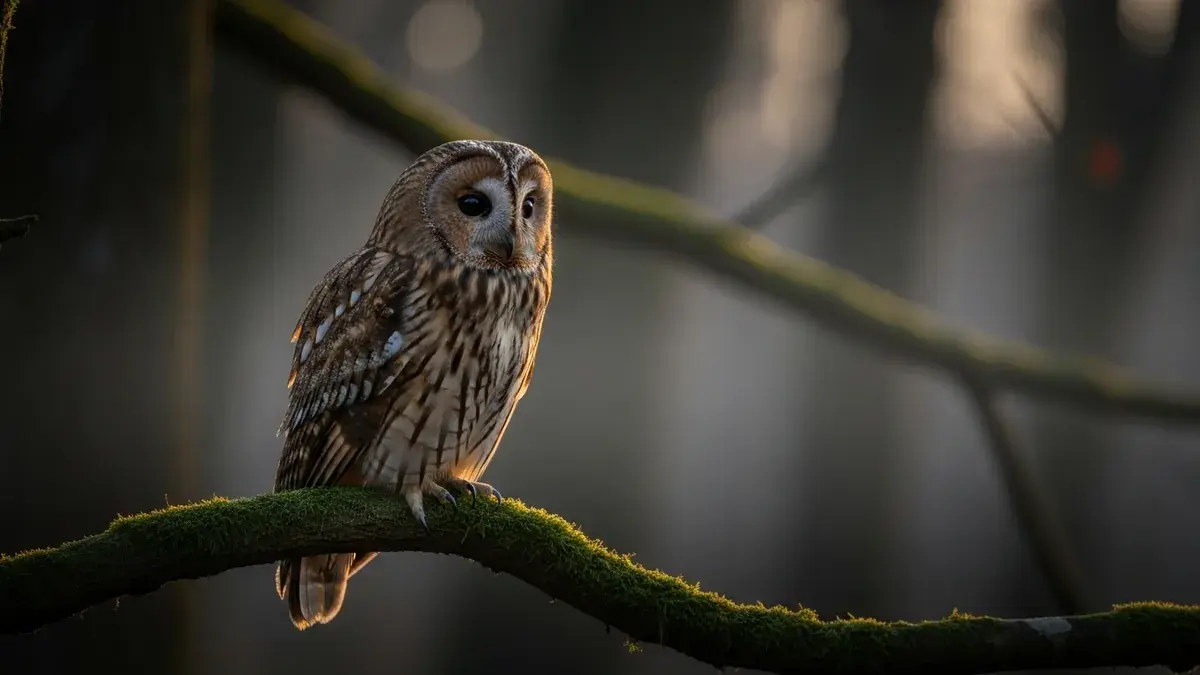
The owl represents intuition, wisdom and seeing what is hidden. You'll probably receive this animal as guidance when you're trying to dig out deeper truth or when you need to trust your inner sight to look past appearances. Owls have night vision and they can fly silently, so the symbolism also includes transition or mystery.
An almanac
- Core message
- Trust your intuition and see the truth beneath the surface
- Spirit animal
- Trust your inner sight, look past appearances
- Totem for
- Perceptive, thoughtful, quietly wise people
- Power animal
- Clarity and discernment through confusion or transition
- In dreams
- Intuition, hidden truth or a coming insight
- Cultural roots
- Native American, Celtic and Christian traditions
- Natural history
- ~220 species worldwide; heads rotate up to 270°
The Owl belongs to the borderlands between sleeping and waking, silence and sound, darkness and light. This is why owls have been nearly universal symbols for wisdom and hidden knowledge. If you are guided by an owl, it means that it's time to trust your intuition and look deep into something. Maybe there's a hidden meaning or a secret insight waiting right beneath the surface of what you already think you know.
Owl Symbolism & Meaning
Owls are powerful symbols of wisdom and insight. They hunt by sight in the dark—what we can't see is revealed to the Owl. For this reason, owls have long been associated with deeper knowledge than what can be found in books: the instinct for truth that guides wise decision-making.
Since owls come out at night, they are also symbols of mystery and transition, reminding us of the power of change and new beginnings and the courage it takes to live in reality.
Owl Spirit Animal
When the owl shows up as a spirit animal or totem, it typically means that it's time to trust your intuition and dig below appearances. Someone or something might not be what they seem at first glance, but with Owl around you can see through this façade into their true nature.
Owl also encourages honesty with yourself. Its clear night vision is well-suited to seeing things as they truly are, even if the truth isn't always pleasant to confront.
Does Owl fit you?
Tap the ones that sound like you — 6 traits, no right answer.
0 of 6 Nothing picked yet — start tapping.
Owl Totem Animal
People who have an owl symbol are perceptive, thoughtful and quietly wise. They notice details that others might miss and can often sense things about a situation or someone else without being able to explain exactly how they know this. An Owl-totem person values truth. In general, these people feel most comfortable with solitude and quiet hours.
Owl-totem people's biggest challenge is sharing their wisdom in warm and compassionate ways. They are not always the best at letting others know about what they see.
Owl Power Animal
The owl is your power animal when it comes to clarity and discernment. Call on him in times of confusion, deception, or difficult choices to sharpen your focus, develop intuition, and find the truth inside a situation. The owl can also be a good ally during transitions. When you use its energy while moving through an uncertain period, you'll be more willing to trust whatever arises.
Across cultures
3 traditions — pick one to read its take.
Native American Owl Symbolism
To many Native American peoples, the owl symbolizes knowledge, guardianship at night, and watchfulness. In several traditions it also signifies connection to the spirit world and to mysteries involving death and change.
Owl as a Celtic Animal Symbol
In Celtic mythology the Owl is often seen as a guide to the Otherworld. It can also represent wisdom gained through experience. An old bird's eye view is honest and unflinching, able to uncover truth or find a path through difficult times. The Owl is said to be a guardian of secrets and a protector of land.
Owl in Christian & Biblical Symbolism
In Christian symbolism, an owl is a symbol of mixed feelings. For one thing, as a nocturnal bird it's associated with solitude and mourning because it only comes out after dark. Yet it's also symbolic of wisdom and vigilance because it keeps watch over its territory during the hours of darkness, waiting for the night to pass.
An owl symbolizes our hope that we can live through even the darkest times with faith in a brighter future.
Seeing an Owl: What the Encounter Means
Owls are shy animals that come out at night. Daytime sightings or close encounters are rare, and in most cultures are considered significant. These readings reflect folk traditions rather than predictions of what will happen. What owl visits do, without fail, is make you notice things about yourself. Usually the new observation is some truth that wasn't obvious a week ago, but is clear now.
When owls fly out at night, their presence means little more than that the animals were active in your neighborhood. In contrast, a daytime sighting has been read by many traditions as surfacing of something hidden, or arrival of a truth too plain to deny. Since these birds are quiet and solitary, they don't often call attention to themselves, so a day visit is especially unusual.
An owl that visits one house, over several days, suggests in some cultures protection from threat, but more often a warning about the need to change. The idea is consistent: the visitor, or visitors, are watching the household either way.
A flying owl, suddenly before you on the road, can be disturbing. Traditional readings agree that owls signal the need for a course correction — to look again at some decision already half-made — but no one would mistake this bird's appearance for anything other than an invitation to reconsider.
Hearing an Owl Hoot: Calls and Their Meanings
Hearing owls call instead of seeing them is more common than most people think. An owl hoots to stake out its territory, calling to any rivals who are nearby and letting potential mates know it's ready for courtship and breeding. Those kinds of calls happen mostly at night, which makes springtime the season when owls seem loudest.
In old folk tales, hearing an owl was a sign to pay extra-close attention both to what was happening around you right then and to things you'd been thinking about. That's because owls' usual practice is not to announce their presence in the open but to hoot from out of sight. To people familiar with those calls, that made it easy to associate them with hidden information, including messages they thought were being sent just for them.
In many folk tales and old traditions, three hoots in a row have special weight, signaling something important: often a warning about changes ahead or a message to keep repeating until someone listens. The Great Horned Owl's normal call is four or five notes at once; Barred Owls call so differently that people always remember them as "Who cooks for you?"
In Europe, seeing or hearing an owl was considered unlucky because it could bring illness and death to a household. That same sense makes owl symbolism darker in some parts of the continent than it is in Greece or North America.
White, Black and Barn Owl Symbolism
White owls show up plainly. Pale barn owls stand out from their dark surroundings. For that reason these owls can symbolize the light of truth breaking through or leading you into more openness.
The barn owl is pale like other owls but its heart-shaped face makes it look more human, almost childlike. It flies silently because its feathers have a comb-like structure on their leading edges. When an air current moves over those little combs, noise from that movement of air is broken up, and we don't hear the owl's wings moving. For this reason the barn owl symbolizes something flying unseen or unheard.
When people say "a dark owl", they are not referring to a distinct species but rather to any owl seen by poor light, which means most owls in low-light conditions appear black rather than pale and showy. If an interpretation is made, it often refers to subconscious or unknown aspects of something — things you have not yet looked at closely.
The Great Horned Owl with its ear tufts has a deep call that makes it distinctive even if you're not close enough to see it well. It's more like the fierce and protective side of owl symbolism than the benevolent part.
Owl in Dreams
An owl, calm and watchful, might point to intuition. It can also indicate insight or a hidden truth about to be revealed.
Hooting and calling owls may mean an important message is on its way or a truth soon ready to come out of hiding.
If seeing an owl feels scary, it could mean you are afraid of looking at yourself honestly.
Seeing an owl in the daylight may mark some uncomfortable truths being exposed.
Owl Spiritual Meaning
The Owl asks us to believe that we can see what others cannot see. What is unseen holds the deepest truth. To be wise is to trust what we know beyond all words, in our bones. When things go dark, listen closely for the quiet voice inside. Learn from it and find a way to walk through the mystery with courage and clarity.
Owl in Greek & Roman Mythology (Athena's Owl)
Athena — Greek goddess of wisdom and strategy and craft — had her own constant companion: an owl. They even started putting the owl on coins minted around Athens, so much that people there ended up calling it the "owl coin" — glaux, in ancient Greek.
Historians still wonder why Athena picked the owl to be with her all the time: some guess she saw how owls could see perfectly clearly at night and thought they must have some keen insight into life like she had; others reckon she chose the owl for its constant nesting on hillsides near Athens — those hills now famous as the site of the Acropolis. Whatever the reason, we know that Rome later borrowed Athena's owl for their goddess Minerva.
Athena holding her little owl as a symbol for how clear-sighted you can be even in the dark.
Is an Owl a Bad Omen? Death Folklore Around the World
We know owls as a wise symbol. But that same bird was also linked with death in some traditional stories. The Kikuyu people of East Africa believed an owl sight was a warning that someone nearby would die soon. To the Aztecs and Mayas, owls symbolized the underworld itself. In the Roman Empire, seeing an owl inside the government building once set off rituals to purify the city. Even Hindus hold mixed beliefs about owls: sometimes they're messengers of death but other times they're companions to Lakshmi, goddess of prosperity.
But none of this makes an owl encounter or its screech predict the future, and that's how these stories should be heard — as a reminder to take life's messages more seriously. Don't turn away from something unsettling just because you don't like it. Try looking at it without fear instead.
Owl and Witchcraft in European Folklore
The owl and witchcraft are entangled in European folklore, and the roots go back to ancient times. The Roman poet Ovid described a "strix", which was a nocturnal creature said to be big-headed, with sharp claws, like an owl, and it supposedly ate infants in their cradles. But Ovid also linked these striges to witches, saying that they transformed into this night-crying form.
This association made its way across different languages, so Romanian speakers might still refer to barn owls as "strigă" because it's a name for an owl, while the words "strigoi" and "strigoaică" became names for male and female vampiric spirits. In this sense, the owl shares the same linguistic root as restless dead.
Barn owls are often seen as witches' familiars or even disguised witches themselves in medieval and early-modern Europe, due to their silent nature during flights. The soft comb on their feathers — also contributes to the eerie atmosphere around them. So the link between owls and witchcraft is less about their actual nature as birds but more about how frightening an unseen night visitor felt before the advent of electric light.
How to Connect With Your Owl Spirit Animal
If an owl has been showing up in your life, here is one way you can start to connect with its spirit. Find someplace comfortable and sit down near dusk or in the dark of night when everything else goes quiet. Take a few deep breaths until you're breathing at the same pace as all the stillness around you.
Now imagine an owl flying over toward you, silently arriving exactly like it would be doing out in nature. As it settles nearby, ask this owl what it wants to help you see better with your own two eyes.
Finally, keep a little notebook handy nearby. The kinds of messages that the spirit of an owl might have are often going to be really subtle and kind of quiet, almost like things you'd normally just wave away or not pay any mind to, so it's important to grab them quick right after your eyes open up because everything is still nice and quiet.
Frequently Asked Questions
What does the Owl spirit animal mean?
The owl spirit animal speaks of spiritual wisdom, intuition, and insight into things unseen. When this animal appears in dreams or other portent symbols it means we need to trust our instincts more and pay attention to what's really going on beneath appearances.
Is seeing an Owl good luck?
Some cultures see owls as signs that big changes are coming soon. Other cultures believe an owl sighting is generally positive and a message to trust your gut feelings.
What is the spiritual meaning of hearing an Owl at night?
Sometimes people hear an owl when it hoots at night. For some people this makes them feel that their intuition is speaking to them, telling them to stop and take heed of some truth they need to notice.
What does it mean when you see an owl?
In traditional cultures, people believe that seeing an owl during the day is like getting a big wake-up call to pay attention to something they've been ignoring or sort-of-seeing but now needs more investigation.
What does a white owl mean spiritually?
A white owl can be a very encouraging sight. If you see one, it is probably a snowy or barn owl. White owls usually mean that something difficult has been successfully overcome and lighted up by new ideas. Or maybe, they suggest that you are going to have a better understanding of what needs to be done now.
What does it mean when an owl keeps coming to your house?
Traditionally, people in different parts of the world see owls coming back into their homes as either protection or a warning that something isn't quite right. But there's probably an easier explanation: Owls often return to areas where hunting is good. So you might find an owl outside your house more than once if your garden has mice or birds gather at a feeder outside.
Is it a bad omen if an owl visits you or if you hear one hoot repeatedly?
In many cultures of the past, a sudden visit from or a repeated hooting cry from an owl was thought of as a warning of imminent death — 'When owls sing, someone dies' — but these are old beliefs shaped by the rarity and startling nature of such encounters rather than modern predictions. Most people now consider this kind of sign more like a message to be mindful of what is going on around you.
Why is the owl associated with Athena and wisdom in Greek mythology?
There isn't full agreement on why this little owl became Athena's companion in Greek mythology and was portrayed beside her on Athens' coins by 500BC. A leading theory says night vision is the bird's symbol of insight, while another suggests it had a lot to do with how common the birds were around the Acropolis hilltop temple dedicated to Athena. The association between owls and wisdom kept up through the centuries in Rome, where Athena morphed into Minerva, and ever since then across much of the Western world.
Owl also represents
Sources
Claims on this page were checked against these published sources.
- Owl
Most owls are nocturnal, actively hunting their prey in darkness.
Read the source → - Western barn owl
tiny serrations on the leading edges of its flight feathers and a hairlike fringe to the trailing edges help to break up the flow of air over the wings, thereby reducing turbulence and the noise
Read the source → - Great horned owl
The great horned owl's song is normally a low-pitched but loud ho-ho-hoo hoo hoo (or also transcribed as bu-bubu booh, who-hoo-ho-oo or who-ho-o-o, whoo-hoo-o-o, whoo) and can last for four or five syllables.
Read the source → - Barred owl
Its usual call is a series of eight accented hoots ok-ok-ok-ok ok-ok-buhooh, or the 'typical two-phrase hoot' with a downward pitch at the end.
Read the source → - Snowy owl
The snowy owl is mostly white.
Read the source → - Athena
Through its association with Athena, the owl evolved into the national mascot of the Athenians and eventually became a symbol of wisdom.
Read the source → - Little owl
the little owl is closely associated with the Greek goddess Athena and the Roman goddess Minerva, and hence represents wisdom and knowledge
Read the source → - Owl of Athena
the owl of Athena even became the common obverse of the Athenian tetradrachms after 510 BC; ... the Athenian tetradrachm was known as glaux (γλαύξ, little owl)
Read the source → - Strix (mythology)
a bird of ill omen, the product of metamorphosis, that fed on human flesh and blood ... a large-headed bird with transfixed eyes, rapacious beak, greyish white wings, and hooked claws ... The striges also came to mean 'witches.' ... Strigăt is also the Romanian name of the barn owl ... Strigoaică is the name of the Romanian feminine vampire, and strigoi is the Romanian male vampire
Read the source →