Birds · Spirit animal
Swift Spiritual Meaning & Symbolism
The tireless flier who trusts momentum over rest

The Swift, a spirit animal, symbolizes swiftness, intuition, and connection to the element of Air. When it appears as a spirit animal, it's a wake-up call to seize opportunities before they disappear. It teaches that timing is more important than perfection and that even the busiest people must find places to rest and return to community. Dreaming of a high-flying Swift promises good fortune, while exhausted Swifts or storms scattering Swifts foretell overwork or trouble ahead.
An almanac
- Core message
- Timing matters more than perfection
- Spirit animal
- A wake-up call to act before opportunity closes
- Totem for
- Energetic, dependable, communal-living people
- Power animal
- Sustained drive to finish what you started
- In dreams
- Soaring = good fortune; landing exhausted = burnout; storm = turbulence ahead
- Element
- Air
- Family
- Apodidae — Greek for 'without foot'
- Diet
- Airborne insects, caught entirely mid-flight
Few birds are as committed to the sky as the Swift. This bird feeds, drinks, and even sleeps in flight, and for months on end it never lands. Many of them gather in large groups year after year, returning to the same roosting sites, including a colony that nests every spring in the stonework of Jerusalem's Western Wall beside folded prayers tucked into the same cracks.
The Swift's combination of restless motion and quiet devotion represents two opposite ideas.
Swift Symbolism & Meaning
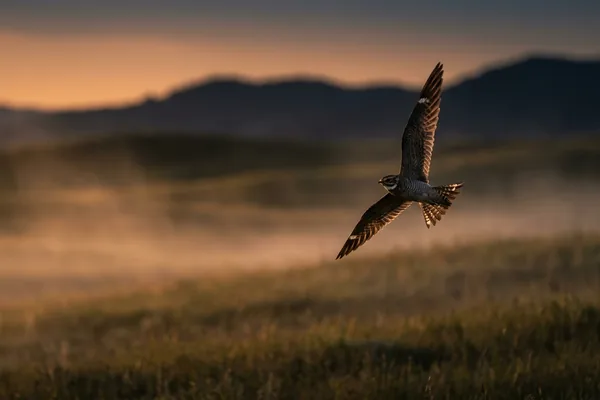
The swift is one of the most obvious examples of birds representing Air. More than any other bird it seems to live in the sky, staying aloft to eat, drink, and nest for 10 months a year, coming down just long enough to build its nest and lay eggs.
It's also one of the only birds to roost in colonies: Swifts link up at roosting walls and many species navigate tight crevices with echolocation. So there's that link to group or community, even reverence — it can seem like a bird who instinctively knows sacred ground on sight.
Their flying speed is also remarkable. They have been clocked at 69 miles an hour, faster than any other bird that flies level in the open air.
Swifts make nests from their own saliva, so they not only manage long flights, but are tough enough to build tiny buildings that can hold fast to sheer surfaces — they're not called Swifts for nothing.
About two months after a baby Swift hatches, it's strong enough to fly — just two months — and you might be surprised to see that its eyes are protected by tiny eyebrow bristles. That's another example of how this bird is perfectly built for high-speed travel.
Swift Spirit Animal
You take the swift-spirit animal's presence as a sign to get going. There's nothing to hesitate or stall over: a chance that you've been waiting for is here, with a person or situation. If you delay, you could lose the whole thing. Swift's message is simple: timing is more important than perfection.
It's reminding you to align your thoughts and emotions so they're on the same course rather than pulling in opposite directions, and it sharpens your instincts around uncertainty, so you know when to start moving and when patience is the better way.
Because Swift channels air so much, you might find it helps how you communicate or nudges you toward learning a new skill entirely. In its influence, you feel more nimble: able to avoid problems, seize opportunities in the moment, make do with what you have right now. Above all, Swift offers stamina that lasts a long time: strength enough to keep you traveling.
Does Swift fit you?
Tap the ones that sound like you — 6 traits, no right answer.
0 of 6 Nothing picked yet — start tapping.
Swift Totem Animal
If you carry the swift totem, you don't sit still easily. Even when you rest, you radiate energy. You're the type to wake up early and stay active and put together even on low-effort days.
You love motion. You might have a favorite spot or two where you can relax, but your usual rhythm is to spend a lot of time on the go. You find consistency and reliability reassuring, though.
In small ways, showing off comes easily to you—party tricks and things like that. It helps that you're naturally skilled at it; getting good at complicated stuff might be easy for you if it appeals to you. But for the most part, living your life is more rewarding to you than heavy intellectual effort.
Swift Power Animal
For tasks that seem daunting or unlikely to ever get done, call on the Spirit of the Swift. This energy can light a fire under your feet and get you moving—but don't expect the torch to run out too quickly. For ongoing tasks, you can count on this spirit to keep you energized until the work is finished.
The Swift is particularly great for helping people who struggle with saying the wrong things at the wrong time and getting sideways looks. When you notice yourself drifting into one of these situations, focus first on truly listening. Your delivery may shift as if by itself, becoming something you'd prefer to say instead.
Swift Folklore & Legend
Old superstition wasn't always kind to the Swift. One legend nicknamed it the "legless devil's bird," imagining it lived buried in mud and blamed its cry on tormented souls, a myth likely born from how short and stubby its actual legs appear.
Heraldic tradition picked up a similar theme, using a "footless" Swift to represent a family's fourth-born son, someone symbolically unable to inherit land of his own.
That superstition wasn't pulled from nowhere: it's baked into the bird's own scientific name. Apus, the genus behind the swift family designation Apodidae, comes from Ancient Greek for 'without foot,' the same mistaken belief early naturalists held about a bird they almost never saw land. Folklore didn't invent the footless Swift; it just gave a naturalist's error a haunted backstory.
Shakespeare gave the bird a more ambiguous cameo in Macbeth, where Banquo greets the "temple-haunting martlet" as a hopeful guest of summer right as Duncan arrives at the castle where he'll be murdered, a chilling twist on what should have been good news. Scottish folklore along the Moray coast went further, blaming Swifts for cursing anglers' luck, which led some farmers to shoot the birds outright; one tale even claims karma answered in kind, killing off exactly as many cattle as birds that farmer had shot.
More modern writers have softened that reputation, casting the Swift instead as clever, curious, and always game for adventure.
Far Eastern Swift Symbolism
Far Eastern culture has a rich tradition of believing that swifts signify marital devotion, elegance and beauty. Similar to the symbolism of swallows, swifts and "rain swallows" are called the same thing (although differing in language, which represents both a commonality and a diversity among the people of the East).
Swift in Dreams
If you have a dream about Swifts, take it as a reminder that life is full of ups and downs, not always easy but with moments of fun and exciting change.
A) If they're up in the sky above you, this is a great omen. Good luck is coming to you and things are going to get easier. Watch carefully for the right moment to move forward.
B) If one lands near you, this means your energy may be low and you're feeling unsure about the direction you're going in life. Stop now and regroup before taking another step forward.
C) If lots of Swifts are circling each other high up, it's time to show off your talents to friends and family members. Share your gifts and help deepen the bonds of friendship.
D) Or else maybe there are lots of different Swifts flying around close together. This means someone nearby is struggling with a secret burden that only you could see. Offer comfort whenever you spot an opportunity.
E) And if there's suddenly a storm right after all these different Swifts fly away, things will soon turn gloomy in waking life as well. Get ready for change by keeping yourself safe from any bad luck which might come your way.
Swift Spiritual Meaning
Ignore the flying and sprinting records for a minute and focus on the spiritual meaning of this bird. If you do, you'll find that lessons about momentum and energy apply only as much as they apply to momentum and energy in your own life.
There's more to consider. It's important to bring an element of decisiveness, trust your instincts, and accept that even the most energetic and organized person needs a place to land once in a while.
Swift vs. Swallow: A Case of Mistaken Identity
Despite their shared forked tail, dark feathers, and penchant for slicing open skies, the Swift and the swallow aren't even related. Swallows are perching songbirds of the order Passeriformes, while Swifts are in the Apodiformes, a distinct family altogether.
Even their matching silhouettes are just a fluke. Despite the visual similarities, Swallow and Swift evolved independently towards becoming swift fliers—a phenomenon called "convergent evolution." Being distant relations has nothing to do with their shared features; it's all about how they live.
But what makes this weird mix-up so moving is how the Far Eastern naming tradition viewed them. The Japanese, Chinese, and Mongolian languages use the same word for "Swift" that they also use for "rain-swallow." A foreign bird is folded into a family it never belonged to—and this tradition doesn't see that as a sign of foreignness, but as a kind of honor. The Swift earned its way into devoted, elegant company not through bloodline but through how it lives. Belonging isn't just earned by pedigree; it's earned by character—and more than that: by shared purpose.
Swiftlet Nests & the Gift of Devotion
A lot closer to home, but still part of the family tree, live the swiftlets of Southeast Asia. A nest made from hardened saliva is not only their home but also their treasure: bird's nest soup starts from here.
Spiritually, this is an extension of the message from the Swift: a creature that gives everything it has to its home and its work is worth way more than just itself. When your gifts are meaningful, not just showy; when devotion comes in doing — that kind of commitment means more to those who get it.
Frequently Asked Questions
What does a Swift symbolize spiritually?
Spiritually, Swifts represent constant forward motion, keen intuition, and connection to the air element. This bird signifies the ability to move quickly and decisively, but it also represents the importance of returning home. Swifts are associated with timing and endurance.
What does it mean when a Swift is your totem animal?
You thrive in shared or communal living situations, don't care much for abstract theory, and prefer practicality to impracticality. You like to be dependable, you favor consistency over spontaneity, and you show off your practical talents in predictable ways.
Is dreaming about a Swift a good sign?
It depends on what you dream about. If a swift is soaring high or several are flying together in your dream, this may mean good fortune and a chance to shine. If, however, one swift lands exhausted at your feet, this suggests burnout. If there's a storm and the swifts are scattered, there's an impending sense of turbulence.
Are swifts really footless, like folklore claims?
No — Swifts are not footless. They have short, clawed legs, shorter than those of most birds, and weaker. But they can use them to cling to a vertical surface, like the side of a cliff or building. The myth that swifts have no feet traces back to the scientific name Apus, which means 'without feet' in ancient Greek. That's what naturalists called this bird long ago, since they almost never saw it land.
Why do some cultures call the Swift a kind of swallow?
The Japanese, Chinese, and Mongolian traditions call the Swift a kind of swallow. There's even a single term that's close to 'rain swallow'. But the two birds aren't related at all; they belong to separate orders. It just turns out that Swallows and Swifts have nearly identical silhouettes, due to convergent evolution.
What are swift nests used for besides raising chicks?
Bird's nest soup is a dish made from the solidified nests of some swiftlet species. It is one of China's dishes, highly valued for its supposed health benefits. Some is harvested wild from cliffs and caves, while some is made in specially built towers intended to attract swiftlet pairs.
Swift also represents
Sources
Claims on this page were checked against these published sources.
- Common swift
non-breeding individuals may spend up to ten months in continuous flight; Some individuals go 10 months without landing.
Read the source → - Swiftlet
their ability to use a simple but effective form of echolocation to navigate in total darkness through the chasms and shafts of the caves where they roost at night and breed
Read the source → - The swifts gather here at the Western Wall
The swifts reside here for about three months before they return home to Africa. But have no fear - they'll be back again next year!
Read the source → - Martlet
It has been suggested that the restlessness of the martlet due to its supposed inability to land, having no usable feet, is the reason for the use of the martlet in English heraldry as the cadency mark of a fourth son.
Read the source → - Macbeth, Act 1, Scene 6
This guest of summer, / The temple-haunting martlet, does approve, / By his loved mansionry, that the heaven's breath / Smells wooingly here...
Read the source → - Apodidae of Japan
Swifts are known in Japanese as アマツバメ ama-tsubame or 'rain swallows', written in Chinese characters as 雨燓.
Read the source → - Edible-nest swiftlet
The soup is made by soaking and steaming the nests in water. It is said to improve kidney health, reduce phlegm, and to be an aphrodisiac.
Read the source →