Animal Facts
Raven Facts: Intelligence, Size and Common Myths
Ravens plan 17 hours ahead for tools and trade, matching great apes.
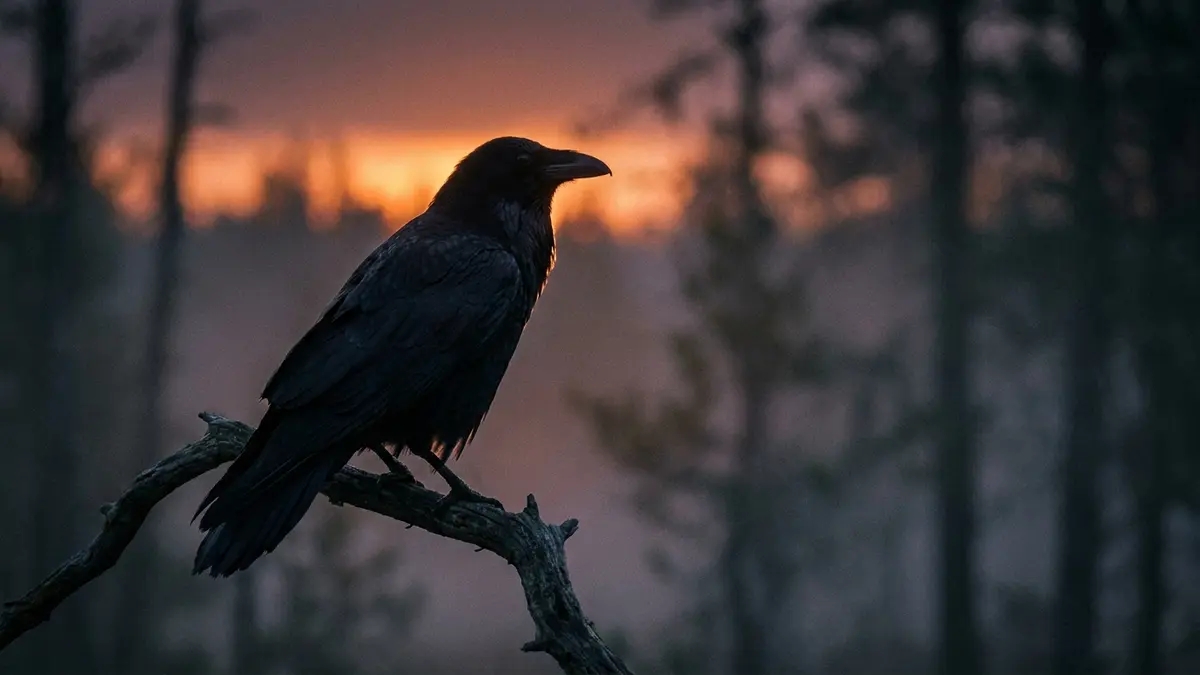
The common raven (Corvus corax) is one of the two largest passerines in the world, alongside Ethiopia's thick-billed raven, which averages heavier. Adults run 54–71 cm and 0.69–2.25 kg across the species' range, with Alaskan birds averaging 63 cm and 1.2 kg. In a 2017 Science study, ravens planned for tool use and bartering with delays of up to 17 hours, matching great apes.
An almanac
- Scientific name
- Corvus corax
- Length
- 54–71 cm across range (63 cm in Alaska)
- Weight
- 0.69–2.25 kg (1.2 kg in Alaska)
- Oldest banded wild bird
- 22 years 7 months, Nova Scotia
- Global breeding population
- About 29 million; low conservation concern
- Vocal range
- More than 30 distinct vocalizations
- Diet
- Carrion, small animals, eggs, insects, fish, berries, dung, rubbish
The common raven, Corvus corax, is one of the two largest perching birds on earth and the subject of more repeated misinformation than almost any bird of comparable size. Much of what circulates about it is either a Victorian invention or a real experiment stripped of its hedges.
The verified record does not need the embellishment. Ravens plan seventeen hours ahead for tasks that have nothing to do with hiding food, change their caching behaviour when they can only hear a rival through an open peephole, offer moss and twigs to a partner, and still prefer the human who traded fairly with them a month earlier.
What follows separates the confirmed from the corrected. Where the popular version overstates the evidence — the grudge that supposedly lasts years, the world's-largest superlative, the Tower ravens dating to Charles II — the correction is stated plainly rather than smoothed over.
Raven facts that hold up
- One of the two largest perching birds. The common raven is one of the two largest passerines in the world, alongside Ethiopia's thick-billed raven, which averages heavier. The flat claim that it is the largest songbird is contested, and length and weight give different answers.
- The famous measurements are Alaskan, not global. Alaskan common ravens average 63 cm and 1.2 kg; across the species' range adults run 54–71 cm and 0.69–2.25 kg. California birds average well under a kilogram.
- More than 30 distinct calls. A study in Alaska found ravens have more than 30 distinct vocalizations. Separately, the Alaska Department of Fish and Game describes the raven's repertoire as including mews, whistles, high-pitched cries, "glooks" and dripping-water sounds.
- Roosts of hundreds of birds. As many as 800 ravens have been counted in one roost near Fairbanks, Alaska. When not breeding, ravens may travel 30 to 40 miles a day between roost and daytime feeding areas.
- Long-lived by songbird standards. The oldest known banded wild Common Raven in North America was at least 22 years, 7 months old, recovered in Nova Scotia; a longer ringing record of 23 years 3 months is reported elsewhere.
- Flight as play. Ravens roll and somersault in the air, and one bird was seen flying upside down for more than half a mile. Young ravens play games with sticks, dropping them repeatedly and diving to catch them in midair.
- They have learnt what a gunshot means. A study in Wyoming found that during hunting season the sound of a gunshot drew ravens in to investigate a presumed carcass, while sounds that are just as loud but harmless — an airhorn, a car door slamming — were ignored.
- Occasional two-bird raids. Ravens sometimes work in pairs to raid seabird colonies, one distracting the incubating adult while the other grabs an egg or chick. This is an opportunistic tactic, not their standard way of feeding.
- Mimicry is copying, not speech. Ravens imitate the calls of other birds, and captive-raised birds can imitate human words — one was taught to mimic "nevermore". The bird is copying an acoustic pattern the way a starling or a mynah does. There is no evidence it understands the word, and wild ravens do not spontaneously speak English.
- Planning 17 hours out. A 2017 Science study showed ravens plan for events unrelated to caching — tool use and bartering — with delays of up to 17 hours, exert self-control, and take the temporal distance to future events into account, paralleling great apes.
- Neurons packed tighter than in mammal brains. Large-brained parrots and corvids have forebrain neuron counts equal to or greater than primates with much larger brains, according to a 2016 PNAS study.
- Gestures aimed at a partner. Over three consecutive field seasons in the Northern Alps of Austria, researchers recorded 38 social interactions among seven raven pairs in which birds showed or offered non-edible items such as moss and twigs, prompting the recipient to orient towards the object and the signaller. These were the first referential gestures documented outside the primate line.
- Caching with an unseen rival in mind. Ravens guard their caches against discovery in response to the sounds of other ravens when a peephole into the next room is open, but not when it is closed — with no bird ever visible.
- Memory for particular individuals. Ravens remember relationships they had with others for at least three years, and in response to the calls of formerly known individuals they change both the number of calls and the call characteristics depending on whether they hear a former "friend" or "foe".
- A preference for fair dealers. In a study of nine hand-raised ravens (published in Animal Behaviour), birds trained to swap bread for cheese later preferred the experimenter who had traded fairly over the one who ate the cheese — seven of nine chose the fair trainer when retested a month later.
- Speciation running backwards. North American ravens are a genetic mosaic. The California and Holarctic lineages diverged for between one and two million years, then merged back together.
- Nests built from living wood. The whole building process takes around 9 days and produces an often uneven nest that can be 5 feet across and 2 feet high. Ravens break off sticks around 3 feet long and up to an inch thick from live plants.
- A diet with almost no limits. Carrion; animals from mice and baby tortoises up to adult Rock Pigeons and nestling Great Blue Herons; eggs; grasshoppers, beetles and scorpions; fish; wolf and sled-dog dung; grains, buds and berries; pet food; unattended picnic items and rubbish.
- Genuine industrial nuisance. Ravens have been implicated in power outages by contaminating insulators on power lines, in fouling satellite dishes at the Goldstone Deep Space Site, in peeling radar-absorbent material off buildings at a naval weapons centre, in pecking holes in aircraft wings, in stealing golf balls, and in opening campers' tents.
What people get wrong
"A raven is just a big crow — they're basically the same bird." They are separate species and you can tell them apart in the field. A raven is roughly the size of a Red-tailed Hawk. A crow's tail feathers are all about the same length, so the spread tail opens like a fan; a raven's middle tail feathers are longer, so its tail looks wedge-shaped when open. The raven's bill is heavier and curvier and its throat feathers are shaggy. Crows caw; ravens croak.
"Ravens have guarded the Tower of London since Charles II ordered them protected in the 1600s." The historian Boria Sax calls the Charles II story most definitely not historically accurate. The ravens only enter the record around 1883, two centuries after Charles II's death, as part of what Sax describes as a distinctly Victorian fantasy. The Tower ravens really entered the public consciousness with the re-opening of the Tower in January 1946. (Matthew Wills, "The Truth Behind the Tower Ravens", JSTOR Daily.)
"Dickens's pet raven Grip is the proven inspiration for Poe's 'The Raven'." Grip, Dickens's pet raven, features in Barnaby Rudge, which Poe reviewed; Grip is widely believed to have inspired Poe's 1845 poem, though the link is inference rather than documented fact. It is repeated online as a settled biographical detail, and it is not one.
"Ravens are rare, mysterious birds on the edge of disappearing." The opposite is true. Common Raven populations increased across the continent between 1966 and 2019 according to the North American Breeding Bird Survey, the global breeding population is estimated at 29 million, and the species rates 6 out of 20 on the Continental Concern Score — low conservation concern. In several places the management problem runs the other way, with work under way to protect desert tortoises, Marbled Murrelets and Least Terns from ravens.
"Ravens are scavengers that only eat things already dead." Ravens are predators as well as scavengers. They sometimes work in pairs to raid seabird colonies, taking eggs and chicks, and they have been seen waiting in trees as ewes give birth, then attacking the newborn lambs.
The raven in culture
The raven's cultural career runs from Norse myth to the NFL. In Viking belief Odin kept two ravens, Hugin and Munin, and the bird has carried that association with knowledge and message-bearing ever since — which is part of why so much invented history sticks to it so easily.
The English-language raven belongs mostly to the nineteenth century. Charles Dickens kept a raven called Grip, who appears in Barnaby Rudge. Edgar Allan Poe reviewed that novel, and "The Raven" followed in 1845. The connection between the two birds is widely believed rather than documented, but the poem is the reason the word "nevermore" is the one phrase captive ravens get taught: one hand-raised bird was trained to mimic exactly that word.
The Tower of London ravens belong to the same era, not to the seventeenth century they claim. The birds appear in the record around 1883, the Charles II origin story is a Victorian construction, and the version everyone now repeats reached the public with the Tower's re-opening in January 1946. It is a good illustration of how the raven works culturally: a real, common, extremely capable bird that keeps getting handed a borrowed antiquity it does not need.
Famous ravens
Grip is the best documented individual raven in literature. He was Dickens's pet, he became a character in Barnaby Rudge, and after his death he was taxidermied. Following Dickens's death in 1870 the stuffed bird was sold at auction and bought by the American collector Colonel Richard Gimbel; it can still be seen today in the Free Library of Philadelphia.
The unnamed raven behind the most quoted piece of raven trivia is a captive bird raised from birth and taught to mimic the word "nevermore" — an imitation of the poem rather than any comprehension of it.
The Tower of London ravens are the most famous ravens in Britain and the least reliably historic. Their legend dates from the Victorian period, not from Charles II, and the modern public fascination with them dates from the Tower's re-opening in January 1946. Older still, and mythological rather than ornithological, are Odin's two ravens, Hugin and Munin, which fixed the bird's reputation as a carrier of knowledge long before anyone tested a raven in a laboratory.
Frequently Asked Questions
What's the difference between a raven and a crow?
Size and shape. A raven is roughly the size of a Red-tailed Hawk. A crow's tail feathers are basically the same length, so a spread tail opens like a fan, while a raven's middle tail feathers are longer, giving a wedge-shaped tail. Ravens also have a heavier, curvier bill and shaggy throat feathers, and they croak rather than caw.
How long do ravens live?
The oldest known banded wild Common Raven in North America was at least 22 years, 7 months old, and was recovered in Nova Scotia. A longer ringing record of 23 years 3 months is reported elsewhere.
Can ravens actually talk?
They mimic. Ravens copy the calls of other bird species, and birds raised in captivity can imitate human words — one was taught to mimic "nevermore". It is acoustic imitation of the kind a starling or mynah does, with no evidence of understanding, and wild ravens do not spontaneously speak English.
Do ravens hold grudges against people who cheat them?
The tested effect is a preference for fair dealers, not a vendetta. In a study of nine hand-raised ravens published in Animal Behaviour, birds trained to swap bread for cheese later preferred the experimenter who had traded fairly over the one who ate the cheese — seven of the nine chose the fair trainer when retested a month later. The claim that ravens hold the grudge for years is not what that experiment measured.
Are ravens endangered?
No. Common Raven populations increased across North America between 1966 and 2019, the global breeding population is estimated at around 29 million, and the species scores 6 out of 20 on the Continental Concern Score. In some regions wildlife managers work to protect desert tortoises, Marbled Murrelets and Least Terns from ravens.
Are ravens as smart as apes?
On specific tasks, they match them. A 2017 Science study showed ravens planning for tool use and bartering with delays of up to 17 hours, exerting self-control and taking temporal distance into account, paralleling great apes. Large-brained corvids also have forebrain neuron counts equal to or greater than primates with much larger brains.
More about the Raven
More from Animal Facts





Sources
Claims on this page were checked against these published sources.
- Common Raven Species Profile
As many as 800 ravens have been seen in one roost near Fairbanks. When they are not breeding, they may travel 30 to 40 miles each day from roost to daytime feeding areas.
Read the source → - Common Raven Overview — Cool Facts
The Common Raven is an acrobatic flier, often doing rolls and somersaults in the air. One bird was seen flying upside down for more than a half-mile. Young birds are fond of playing games with sticks, repeatedly dropping them, then diving to catch them in midair.
Read the source → - Ravens parallel great apes in flexible planning for tool-use and bartering
Here, we show that ravens plan for events unrelated to caching-tool-use and bartering-with delays of up to 17 hours, exert self-control, and consider temporal distance to future events.
Read the source → - Birds have primate-like numbers of neurons in the forebrain
large-brained parrots and corvids have forebrain neuron counts equal to or greater than primates with much larger brains
Read the source → - The use of referential gestures in ravens (Corvus corax) in the wild
Here we record thirty-eight social interactions between seven raven (Corvus corax) dyads in the Northern Alps, Austria during three consecutive field seasons. All observed behaviours included the showing and/or offering of non-edible items (for example, moss, twigs) to recipients, leading to frequent orientation of receivers to the object and the signallers and subsequent affiliative interactions.
Read the source → - Ravens attribute visual access to unseen competitors
ravens guard their caches against discovery in response to the sounds of conspecifics when a peephole is open but not when it is closed
Read the source → - Ravens remember relationships they had with others (University of Vienna; study published in Current Biology)
In response to calls of formerly known individuals ravens not only increase the number of calls but also change call characteristics dependent on whether they hear former 'friends' or 'foes.'
Read the source → - Two species of ravens nevermore? New research finds evidence of 'speciation reversal'
the California and Holarctic lineages diverged for between one and two million years
Read the source → - Common Raven Life History
The whole process takes around 9 days, resulting in an often uneven nest that can be 5 feet across and 2 feet high.
Read the source →
Not sure which animal is yours?
Consult the quiz