Mammals · Spirit animal
Raccoon Spiritual Meaning & Symbolism
The masked trickster who treats curiosity, cleverness, and adaptability as tools of the trade.
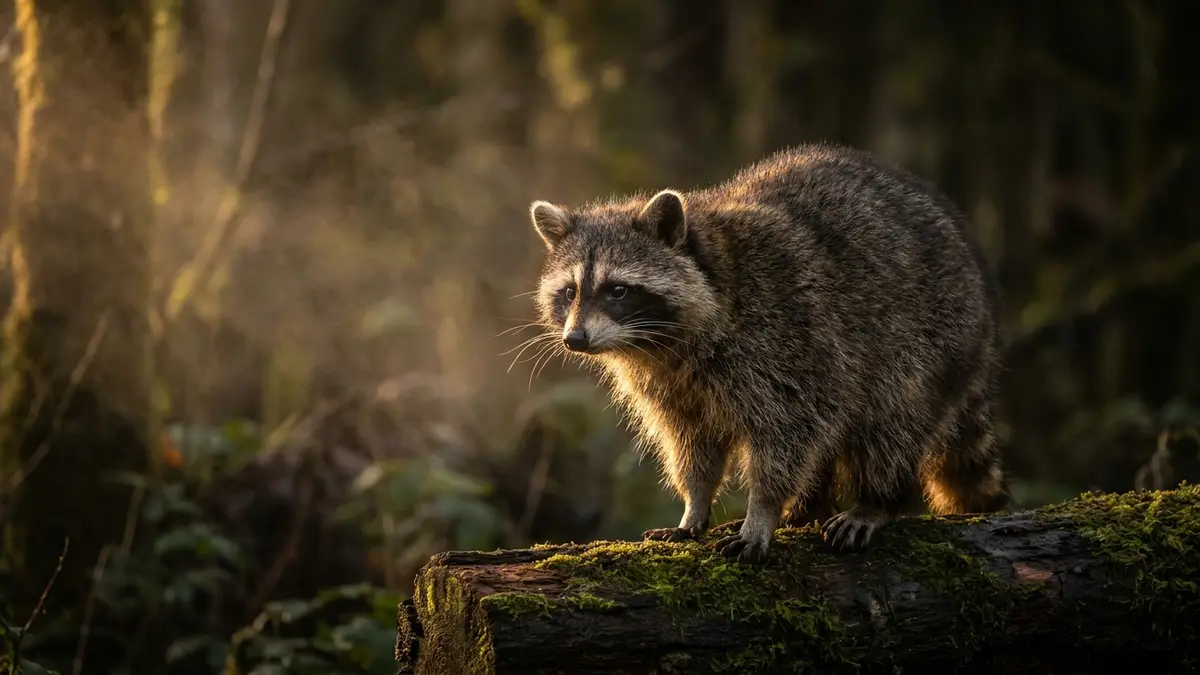
Raccoon is a symbol of adaptability, resourcefulness, and cleverness, and for many is the "spirit-animal" of choice. As "totem" or "power animal", raccoon might be a sign for you that being curious and quick-minded will help you overcome any obstacles in your path. If you often have dreams that feature raccoons in them, this might mean that an important truth may soon come out about someone you know. For example, maybe the person isn't being honest with you; or perhaps your dream was a warning to yourself to not put off facing some important truth.
An almanac
- Core message
- Adapt and improvise with what's on hand
- Spirit animal
- Signals change and the need to adapt
- Totem for
- Reserved but warm, endlessly curious people
- Power animal
- Cracking stuck problems, finding your role
- In dreams
- Hidden truths or something you're avoiding
- Watch for
- Concealing something from others or yourself
- Scientific name
- Procyon lotor — 'before-dog washer'
The Raccoon's reputation as a mischievous little bandit is spot on, but its playful cleverness extends to many aspects of life. It doesn't bother to think about rules that don't serve it. Instead it focuses on whatever job needs doing next.
Raccoons are nocturnal critters, so they're most active at night. Their searching paws are made for finding food in the dark. The Raccoons' key lesson is to be resourceful and adaptable in the face of obstacles and uncertainty.
Raccoon Symbolism & Meaning
Raccoons are a resourceful bunch. They rely on their deft fingers, sensitive whiskers, and sharp hearing to get what they need. Some people say they have a bit of a trickster in them; others claim they're excellent troublemakers.
This animal is like an outlaw: it will do what it needs to do, but it doesn't hurt anybody. It's not picky about where it lives or eats — as long as it has food and shelter, it's happy. It knows how to take care of itself, which is an important lesson for humans.
While they're nocturnal (meaning they do most of their work at night), raccoons are not dirty scavengers like many people believe. They're actually pretty clean and tidy, especially when they find something good.
If you see a raccoon wandering around your house or yard at night, be careful — that could mean you'll have visitors soon! If you see one somewhere unexpected during the day, travel with caution.
Raccoon Spirit Animal
In your life, if you see Raccoon, you should realize that although a lot may change in your life, it will usually all happen slowly and quietly. Humans who don't adapt will eventually be left behind. Those who change to match their surroundings do better.
Raccoon also reminds you that even people you think you know well usually wear masks to hide parts of themselves. That's why so many cultures use costumes and disguises for theater, as a way of hiding people's real selves.
Raccoon wants you to face the possibility that this happens even to people closest to you. You should look at how these things affect your relationships and be honest with yourself about what strengths and weaknesses you have. That way, when something's holding you back, you can get rid of it.
It's also a good idea to keep being curious about problems until everything is clear. Even when you feel stuck in a situation, Raccoon says that if you keep working on something then the answer may show up anyway.
Does Raccoon fit you?
Tap the ones that sound like you — 6 traits, no right answer.
0 of 6 Nothing picked yet — start tapping.
Raccoon Totem Animal
People born under a Raccoon Totem tend to come across as reserved at first, but as they get to know you, you'll find a warm, friendly side. They enjoy quiet meals with friends, and they don't care much about public praise. Once they've solved a puzzle, they're already on to the next one, which is why they're so good at problem-solving but also end up in situations that were unnecessary.
Those with this totem tend to be quick on the uptake and figure things out fast. They have an eye for detail and pay attention to things like appearance, style, and presentation. If you visit their home it will be clean and the furniture will be arranged just so.
They tend to work best after sundown when their best thinking tends to happen. If their ideas pop into their head in the middle of the night, then it's good to keep a notebook close.
Raccoon Power Animal
Feeling frustrated or unsure about your role at work? Or wishing you could find a new community in your neighborhood? If so, lean on the help of raccoon.
Raccoon has skills to help you figure out who you are and the roles that make sense for you in different situations.
Raccoon also helps when you're stuck. It is like a private detective who helps find new options and solutions to things that were unclear.
When creativity dries up or your mind feels dull, the quick mind of raccoon can help break through. And when life is moving too slowly or you are settling into complacency, raccoon can help to nudge you into action with its boundless energy.
If you start a new project or pick up one you had set down, don't worry about making it perfect. Let yourself move forward with the momentum that raccoon gives.
Across cultures
2 traditions — pick one to read its take.
Native American Raccoon Symbolic Meanings
Raccoon appears throughout North America in traditions in which it is a trickster, often depicted as comical. Among the Lenape and Iroquois nations, stories and dances feature the animals as a tricky character. The characteristic behaviors of raccoons include scavenging food, which can be interpreted to indicate resourcefulness and the ability to survive even when confronted with great adversity. Children's tales feature raccoons as clever protagonists. Raccoons are used by some Native American tribes as clan symbols and by the Sioux to represent access to power from the spirit world. In some Native American ceremonies, animals have been used to teach wisdom — which are displayed on ceremonial masks that serve as bridges between this world and other worlds — and tradition has many connections with wise female figures.
Raccoons' masks often involve disguise. Raccoons were considered by many Native American traditions to be magical creatures and among Aztec tradition was considered special because it was connected to wise female figures.
Far Eastern Raccoon Symbolic Meanings
In Japan, folklore gives us Tanuki, the "raccoon dog"—a real canid that looks a lot like a raccoon but belongs to the dog family, and is known for being more clever than it lets on. Stories about Tanuki range from merely humorous to downright mystical. For instance, Japanese lore says that Tanuki turns human during the spring purely to sing; a mysterious Tanuki stalks rainy roads, luring passersby into its circle and leading them away to another world altogether. Other stories picture this animal as a trickster who skulks beneath bridges, playing mischief on travelers who try to cross.
These tales show off Tanuki's personality in a nutshell: joyfully playful, delighting in illusion and disguise, and favoring a light touch over a heavy hand.
Raccoon in Folklore: The Bee Tree Tale
A widespread story explains why Raccoon likes to wash before eating. Noticing he was hungry, Raccoon went foraging along a waterway; waterfowl shrieked their warnings as he approached, so he settled for cracking open mussel shells instead.
When a skunk family yelped their fright at his shadow, Raccoon apologized and fled the scene — only to come up short when a squirrel burrow refused to let him or anyone else close enough.
Then, moving on, a sweet aroma drew him to a tree oozing honey. He gorged himself completely, making matters stickier by the minute.
As he fell from the tree in panic from bee stings, he rolled through leaves hoping to soothe his pain, then emerged in tatters coated head-to-toe and unrecognizable even to his kin.
Looking back later at the mess of it all, Raccoon realized that rinsing himself off in the nearest body of water was the answer. So he does this today before eating food or anything else.
Raccoon in Dreams
Seeing a raccoon in dreams can be interpreted as a caution to face the truth head-on. A clever thief is scurrying around, and you might find yourself hiding facts that would serve you better out in the open. It's worth taking a moment to pause and re-evaluate what might be lurking unseen.
- If you spot a raccoon sneaking about, chances are you've been holding back some secret, perhaps even from yourself. Honesty is a more sustainable path forward.
- A raccoon with its young suggests an aspect of your life where you are playing a role akin to caretaker or protector.
- A more aggressive raccoon could mean negativity is creeping in and needs to be addressed.
- On the flip side, if the raccoon seems playful, it might be time to unwind and let go of some of your stress.
- A dead raccoon could suggest that you're moving on from something deceitful or repetitive; perhaps it's time to shed the mask.
- If the raccoon is roaming inside your house, it might indicate that something you have been avoiding has now reached critical mass and needs immediate attention.
- If there's a group of raccoons gathered together, it might suggest an evaluation of those close to you – are they still worthy of the trust they hold?
- Conversely, if you're feeding them, it might suggest new collaborations or ventures in which you must choose partners wisely – only those worthy deserve your trust.
Raccoon Spiritual Meaning
The raccoon's lesson is that flexibility lets you survive and evolve, even in difficult circumstances. When you're living in balance with your instincts, it's okay to adapt your outward image and to keep some of your interests and accomplishments private.
It's okay to trust your curiosity and instincts rather than overthinking things. Don't be afraid to experiment and make mistakes; it's okay to play with life's mysteries rather than forcing life into a perfect, clean box.
More Raccoon Trickster Tales Across Nations
Raccoons are not only tricksters but storytellers, showing up in entire cycles of trickster tales across Algonquian-speaking nations. One Abenaki tale has Azban the Raccoon make the mistake of challenging a waterfall to a shouting match and losing badly. A series of tales among the Potawatomi follow Raccoon through his many scrapes and mishaps. Another tale has the animal playing a prank on two blind men, only to come to regret it when he fails to consider that they can't see him coming.
However, not every raccoon story is focused on making fools of people. In one Lenape teaching story, Raccoon's quiet and deliberate movements through the forest serve as a meditation on how to live in community with others. Raccoon notices everything around him while leaving as little trace as possible. He trusts what he senses over what he assumes or hears from others. When read together, these stories widen understanding of Raccoon from just being someone who gets in trouble and has pranks played on him, into being someone who knows when it's right to show up when he needs to and knows how to listen as well as talk.
Frequently Asked Questions
What does Raccoon symbolize spiritually?
Raccoons are known for their ability to adapt to different environments. When dealing with changes and challenges in life, it's important to think like a raccoon: keep one eye on the main chance, stay resourceful, and find new solutions by thinking creatively. The raccoon spirit animal is also reminding you that it's good to understand the different ways you can present yourself to the world—sometimes it's best to draw back from the spotlit centre stage, and observe life in secret.
What does it mean if a Raccoon is your spirit animal?
A raccoon is a curious animal that forages for food, so it's often symbolic of change and the need to adapt or see what's ahead. It also asks you to consider whether the masks you wear are ones that you still need or whether they serve you. Raccoons are problem solvers who tend to be adaptable and clever, so this animal helps you see all sides of a problem in order to think outside the box.
What does seeing a Raccoon in a dream mean?
When you see a raccoon in a dream, it usually means that someone is trying to hide things from you or that you’re hiding something from yourself. The raccoon’s behavior in your dream can add more detail, like whether it’s sneaking around or being aggressive.
What is the raccoon's scientific name, and what does it mean?
The raccoon's scientific name, Procyon lotor, literally means "before the dog washer." This describes the raccoon's habit of dunking food and objects. As for its spiritual reputation, it is based almost entirely on those same sensitive hands.
Where does the word 'raccoon' come from?
The English word comes from Powhatan, a language spoken in Virginia. A Powhatan word meaning something like "animal that scratches with its hands" turned into "raccoon." The term's current meaning, which has stayed remarkably literal for centuries, matches the root meaning. Raccoons are really good at rubbing their hands together.
What does it mean to see a white or albino Raccoon?
Many people see an albino raccoon as a gentler omen than they would the typical raccoon. This is because they tend to read it as a sign that good news or a peaceful resolution are on their way instead of the caution that usually comes with seeing a raccoon.
Another possibility is that because the coloring strips away the mask that normally hides the raccoon’s eyes, it could also mean nothing should be hidden now. Whatever truth surfaces is going to be easier to sit with than you had expected.
Raccoon also represents
Sources
Claims on this page were checked against these published sources.
- Resurrecting Virginia Algonquian from the Dead: The Reconstituted and Historical Phonology of Powhatan
162. RACCOON … arathkone "beast like a fox" (H2) … The source of this is uncertain (p. 370)
Read the source → - Waschbär
Wortzerlegung: waschen + Bär … der seine Nahrung vor dem Fressen ins Wasser taucht
Read the source → - Raccoon
The full name Procyon lotor means, in Latin, 'before-dog washer.' The genus name, Procyon, derived from the Greek προ- (pro) 'before' and κύων (cyon) 'dog.'
Read the source → - Native American Indian Raccoon Legends, Meaning and Symbolism from the Myths of Many Tribes
Azban the Raccoon: Abenaki Raccoon story in which the trickster loses a shouting match with a waterfall. / The Adventures of Raccoon: A series of Potawatomi trickster tales about Raccoon. / Raccoon Learns A Lesson: Algonquian stories about Raccoon playing a trick on two blind men. / The Last Track: Story from a Lenape man sharing his grandfather's words of wisdom about the meaning of a raccoon's life.
Read the source →