Mammals · Spirit animal
Lynx Spiritual Meaning & Symbolism
The silent watcher who sees through illusion and trusts what it senses before it can be proven.
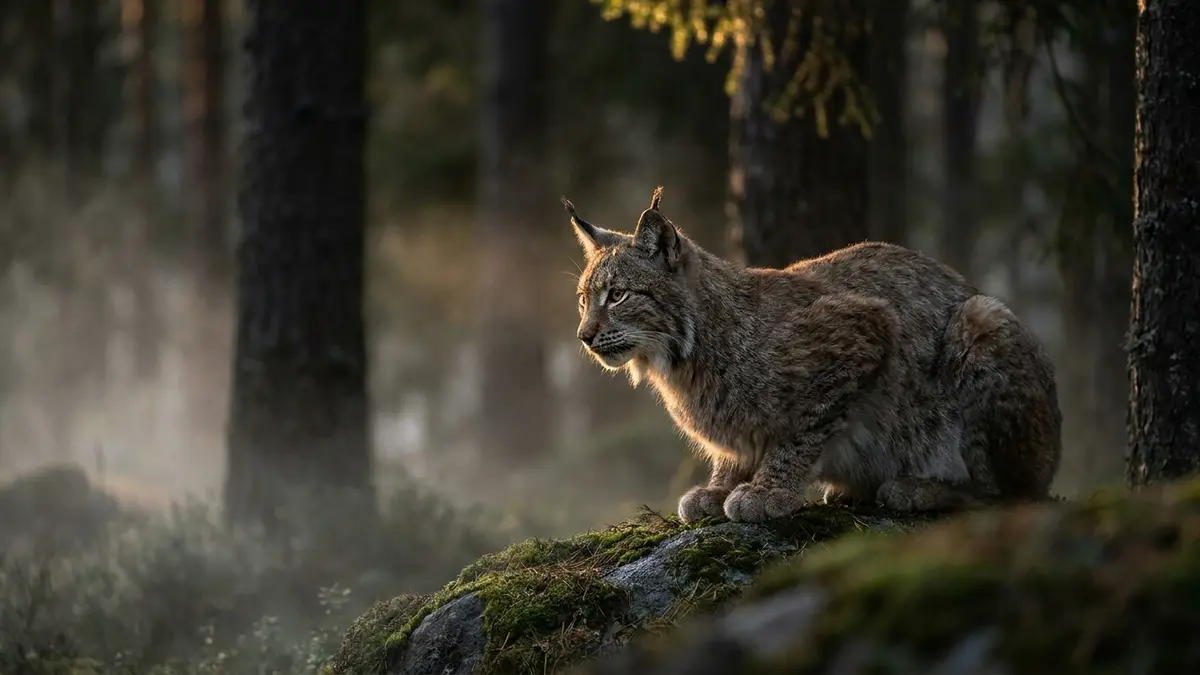
Lynx is a spirit animal that teaches you about the difference between surface appearances and your own gut feelings. One way this can work is to come as a caution. It might remind you to trust your gut about something. Another way is to use your senses keenly, whether sight, hearing or even intuition.
An almanac
- Core message
- Trust your instincts before you can prove them
- Spirit animal
- A caution to look past illusion and deception
- Totem for
- Patient, intuitive, playful, deeply perceptive people
- Power animal
- Trusting first psychic impressions and instincts
- In dreams
- Secrets about to come to light
- Element
- Water and air
- Lynx-stone myth
- Believed to be lynx urine hardened into amber-like gems
- Real-world recovery
- Iberian Lynx: 62 wild adults (2001) → 648+ (2022)
The lynx isn't common, and people don't see it often. It's one of the few wildcats that glows with an inner knowledge. Its eyes and its mystique shine. They've been called a sign of perception beyond the ordinary senses. The message is more about watching than talking.
Lynx Symbolism & Meaning
The lynx’s name comes from a word that means moonlight.
It has the best night vision of any land mammal, and tradition nicknamed it “the quiet witness” for its gift for hunting in silence. Its large ears help it feel the world around it, and that has made it a symbol of psychic abilities such as hearing what others cannot.
Unlike most cats, the lynx is built for climbing and leaping. Some people say this ties it to air.
In the wild, young lynxes play together. This phase sharpens their skills and teaches them how to take care of themselves.
Lynxes breed in spring, when nature begins to be reborn. Females pick a mate for that season and commit fully. It’s natural to focus your energy on one goal.
The lynx has hypnotic eyes so some people think it’s tied to persuading others and getting attention. Plus, its sharp eyes can see things others can’t see. There is even a constellation named after it.
A 17th-century group called The Academy of Lynxes used the animal as an emblem. The academy had members who wanted to understand everything there is to know about the world seen and unseen.
Lynx Spirit Animal
The Lynx spirit animal is a warning to sharpen your awareness of what's going on around you. This powerful feline teaches the importance of stillness, to keep yourself safe by staying quiet and not reacting too quickly. It often appears when you've been too generous in your view of a person or situation: the Lynx tells you to stop filtering reality through rose-tinted glasses.
Even in peaceful silence, the Lynx sees more than meets the eye. Watch body language and tone for what people aren't saying.
If you're under stress or haven't had much fun lately, this spirit guide reminds you that clear thoughts and fresh perspective are right around the corner.
Does Lynx fit you?
Tap the ones that sound like you — 6 traits, no right answer.
0 of 6 Nothing picked yet — start tapping.
Lynx Totem Animal
Those who have the lynx as their totem tend to be patient: they understand that speed is not always the most important factor, and so they are very good at waiting and watching before acting. When the time is right, they will seize an opportunity.
Lynx totem people tend to be very good at looking deep within people; they have this way of seeing inside someone else and understanding the true meaning of things, often well past what is implied by their words.
Those with the lynx as a totem have a deep reliance on their gut feelings; this is because early in life, they learned that when you ignore your gut instincts, you get yourself into trouble. They trust what they feel, without wavering. So when it comes to relationships, people with this totem tend to be very playful and flirtatious; others can gravitate toward them because of their ability to lighten even serious situations.
As for emotional intelligence, children with the lynx as a totem often seem wise beyond their years; this trait only becomes deeper as these people age.
Those who have this totem desire an inner knowing that is very certain and dependable when it comes time to make decisions.
Lynx Power Animal
Call on the lynx as a power ally when you're navigating your intuition. This animal has an uncanny ability to trust its instinct without hesitation, and it can help you do the same.
The lynx's legendary sight and hearing make it a great ally when you're trying to communicate more effectively or listen more closely. Its heightened senses can make it easier for you to pick up on cues that others may be missing, so you can read between the lines and really connect with what someone is saying.
If you're trying to build empathy with someone else, the lynx's energy can help you feel what they're experiencing rather than just understanding it intellectually. As your connection deepens, it tends to bring out a similar response in others, making them more likely to trust and confide in you.
Native American Lynx Symbolism
When the indigenous people of North America saw a lynx they thought of true sight, because lynxes see so well they can notice details that other animals don't notice. They usually thought highly of the lynx as a strong and skilled hunter, but some tribes in the eastern part of the continent saw it as scary instead. Lynxes were rare, so when people saw a bobcat instead, they sometimes said that the bobcat was an especially strong version of a lynx. If you dream of a lynx, that means you have an unusual talent for hunting according to the tradition of a tribe called Mohave.
The native people who lived around the Great Lakes saw them as something more. They called them "water lynxes," and they thought this animal was like a dragon and cougar at the same time. They usually described them as having shiny copper-colored tails. Water lynxes protect all living creatures that live in water. They protect all copper under water in those lakes too.
Norse, Himalayan & Egyptian Lynx Symbolism
The Norse goddess, Freya, rode a chariot pulled by cats in the old sagas. But not lynxes. The Lynx was related to the domestic cat, and some modern retellings of the legends include it as one of the goddess's charioteers. But when you read the earliest sources, you only see cats.
In Himalayan folklore, the Lynx got nicknamed "Ghost Cat," because it was so rarely seen in those mountains. Its pale grey and white winter coat let it vanish completely against the snow. And that helped connect it to things like illusion and concealment that slip just out of reach.
In Ancient Egypt, you saw a cheetah, leopard, or serval on statues of Mafdet, who protected the sun god Ra from evil and dangerous creatures. Mafdet was a feline goddess who stood for mastery over chaotic forces like snakes and demons — especially Apep.
Lynx in Dreams
Lynx dreams usually point to some sort of secret. If you're hiding things, it may be telling you to confess what you're keeping to yourself; if other people are hiding things from you, it may mean the secrets will soon be coming to light. It may also be a warning about kind words that cover ulterior motives; if other people are so nice to you, you need to watch for signs that what they say doesn't match what they do.
The behavior of the Lynx in your dream can shift the meaning:
- If it's running away, it means fortune is coming your way.
- If it's restless, that means you need to be more patient - just wait and good things will happen.
- If it's watching silently, that means someone is about to let something important slip.
- If it approaches calmly, that means your intuition is helping you find the right path.
- If it attacks, it may mean there is something in your own actions or thoughts that needs to change.
- And if it seems peaceful, then you're probably already on the right path, so just let yourself follow that.
Lynx in Astrology & Zodiac
The Lynx does not anchor a zodiac sign the way animals like the Ram or Scorpion do, but it lives on in the sky as its own faint constellation, added by 17th-century astronomer Johannes Hevelius, who reportedly named it Lynx because only observers with lynx-like eyesight could make out its dim stars. That fits the creature's earthly reputation: subtle, easy to miss, and rewarding only careful, patient attention.
For those drawn to Lynx energy in a personal or astrological sense, it's tied most to water and air qualities — the intuitive depth of water signs paired with the mental sharpness of air signs. If you feel a pull toward this creature, it may point to a need to trust quiet inner signals over loud external noise, regardless of your actual sun sign.
Lynx Spiritual Meaning
If you've ever felt like there was more to something than meets the eye. This cat, associated with wisdom and discernment, often shows up when you need to pay attention to little details that others might overlook.
Lynx can also act as a guardian of your inner truths and secret thoughts. They encourage you to trust your instincts and keep quiet about what you know but aren't ready to share.
Since quick judgments aren't always right, Lynx is a reminder that real wisdom comes from time and reflection. When a Lynx appears in your life, take it as an invitation to look past surface appearances and get comfortable in your own thoughts.
Greek & Roman Lynx Mythology
The Lynx was once more symbolic than the sleek, independent feline it's become in the modern imagination. In ancient Greece, writers used the animal to tell stories about strange gems that drew iron.
Ovid also made stories about the Lynx. He used a character named Lyncus. Lyncus once tried to steal a gift that Triptolemus, a hero who brought farming to mankind, offered to all people.
He offered this gift out in the world until one day he stumbled into the land of Scythia where Lyncus was king.
Lyncus invited Triptolemus into his home when Triptolemus fell asleep under the king's roof, Lyncus drew out his sword and tried to seize the grain for himself. At that very moment, Ceres—in whose honor Triptolemus had made his original journey—transformed him into a Lynx as punishment for breaking hospitality and betrayal.
The Iberian Lynx: A Living Emblem of Recovery
Beyond myth, the Iberian Lynx is a quiet lesson in patient renewal. In the early 2000s, it was considered one of the most endangered cat species on Earth. There were just 62 mature animals living in the wild, fighting for survival in Spain and Portugal.
By working to restore natural habitats and boost populations of wild rabbits — a key food source for the Lynx — conservationists slowly reversed that dire trend. Two decades later, in 2022, the wild population had rebounded to roughly 648 mature adults. With cubs and reintroduced animals, the total number of Lynx had surpassed 2,000.
In 2024, recognizing this remarkable recovery, the International Union for Conservation of Nature (IUCN) moved the Lynx from Endangered to Vulnerable on their Red List.
If you feel drawn to Lynx as a totem of patient, unglamorous persistence, their story offers a real-world lesson: it's often in the quiet work of recovery.
Frequently Asked Questions
What does it mean when Lynx is your spirit animal?
It usually means you're not seeing some situation fully yet. You might be deceived, unsure of people's motives, or avoiding some truth. The spirit of the lynx wants you to be patient and look closely. Trust your instincts even when things aren't clear on the surface.
What does dreaming about a Lynx symbolize?
Dreaming about a Lynx often symbolizes secrets, either yours or somebody else's, that you may soon learn about. The Lynx's specific actions in the dream — running away, pacing, or just standing still — determine if this dream indicates good fortune, impatience, or hidden truths.
Is the Lynx a totem of patience or intuition?
Lynx people know how to wait for the right moment to act and can trust their instincts even when things aren't crystal clear. Patience and intuition: that's what the Lynx totem is all about.
Is there a myth about a magical 'Lynx-stone'?
Does a myth exist about a magical gemstone called a Lynx-stone? Yes, it does. Ancient Greek and Roman writers described it as a gemstone that was said to form when the urine of a Lynx hardened into a gem. People who had one of these supposed stones would notice that it would attract straw, leaves, and even thin metal objects the way amber would. This story appears in a book written by the Greek philosopher Theophrastus around the 4th century BCE, and many centuries later an author named Pliny the Elder repeated this story in another of his books, even though he suspected that the truth was probably simpler: It was just normal amber that people called something more mysterious. This legend persisted for about two thousand years, and it has cemented Lynx's reputation.
What's the difference between a Lynx and a Bobcat spirit animal?
A Lynx's symbolism is similar to that of a Bobcat, but with an additional mystical charge. Lynx is tied to lunar intuition and psychic perception, whereas Bobcat symbolism leans more towards adaptability in everyday situations.
In some traditions, where it was not often seen in the wild, the Bobcat adopted Lynx's reputation. You'll often see them blended together in symbolism.
Lynx also represents
Sources
Claims on this page were checked against these published sources.
- Lynx
The name originated in Middle English via Latin from the Greek word lynx (λύγξ), derived from the Indo-European root *leuk- ('light', 'brightness'), in reference to the luminescence of its reflective eyes.
Read the source → - Accademia dei Lincei
The name 'Lincei' 'the lynx-like (i.e., lynx-eyed, sharp-eyed) ones' came from Giambattista della Porta's book Magia Naturalis. The first Accademia dei Lincei was founded in 1603 by Federico Cesi... Galileo was inducted to the exclusive Academy on April 25, 1611, and became its intellectual centre.
Read the source → - Lynx (constellation)
only the lynx-eyed (those with good sight) would have been able to recognize it — Polish astronomer Johannes Hevelius formed the constellation in 1687.
Read the source → - Lynx in Native American Legends
The Blackfoot name for lynx means 'powerful bobcat'... dreaming of a lynx would bring a man special hunting powers
Read the source → - Mishipeshu
Mishipeshu is known for guarding the vast amounts of copper in Lake Superior and the Great Lakes Region... Mishipeshu translates into 'the Great Lynx'... By that time, taking copper from the region was extremely taboo and forbidden by the Ojibwe tribe.
Read the source → - Lyngurium
carved into signets and is hard as any stone, [and] has an unusual power. For it attracts other objects just as amber does
Read the source → - Lyncus
As he attempted to pierce the youth's breast, Ceres turned the king into a lynx, then ordered the Athenian youth to drive the sacred yoke back through the air.
Read the source → - Iberian lynx rebounding thanks to conservation action - IUCN Red List
The population increasing exponentially from 62 mature individuals in 2001 to 648 in 2022.
Read the source →