Mammals · Spirit animal
Porcupine Spiritual Meaning & Symbolism
Gentle self-protection, boundaries and playful innocence
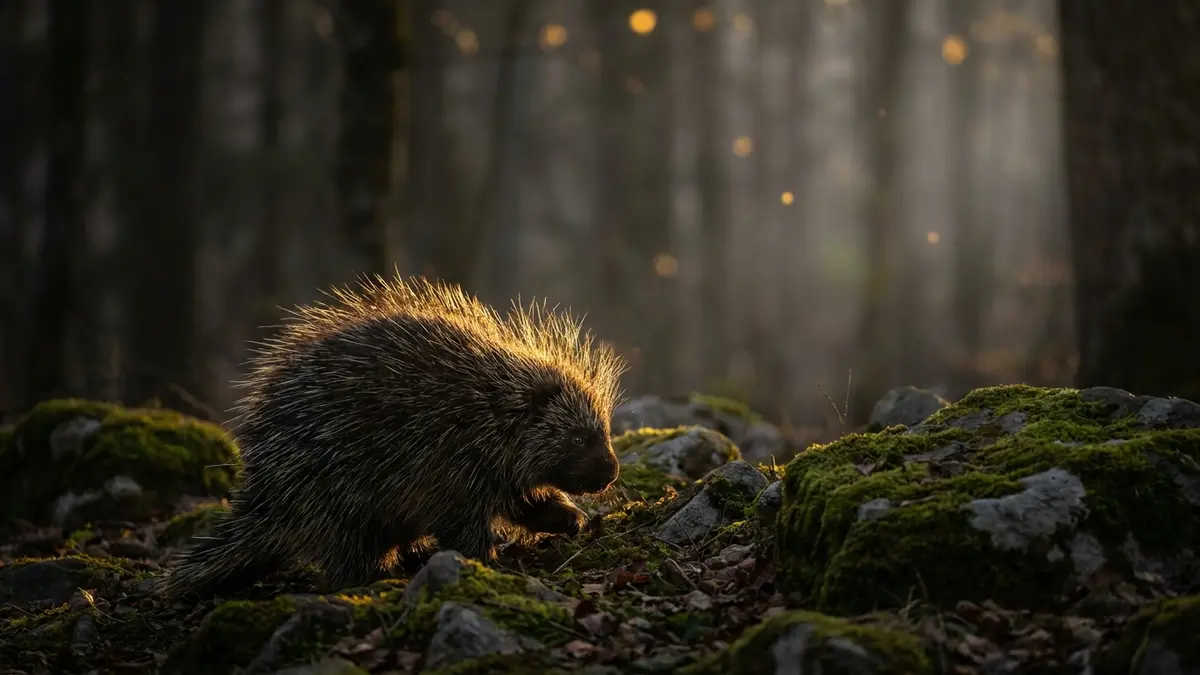
It's a great animal to have around as a gentle reminder of what's most vulnerable right here: setting boundaries, staying discerning in relationships, and choosing ever so slowly the mate you'll share with each season. You can create an armor to protect that deep internal softness and tenderness.
An almanac
- Core message
- Protect yourself without losing your softness
- Spirit animal
- Assess your vulnerabilities, defend through stillness
- Totem for
- Childlike, loyal, quietly guarded people
- Power animal
- Restores confidence, simplifies, softens old walls
- In dreams
- Meaning shifts with the Porcupine's posture
- Cultural roots
- Native American, Irish, and Far Eastern lore
- Signature craving
- Real porcupines gnaw tools just for the salt in human sweat
- Craft legacy
- Quills have adorned Native art since roughly 1300 AD
Porcupines, despite being only the size of a housecat, typically have around 30,000 quills to defend themselves. They have no desire to use these quills, preferring instead to avoid conflicts entirely and hide in the underbrush. As a spirit animal, the porcupine embodies a combination of pacifism and self-protection — it wants to protect what's valuable to it without having to resort to violence.
Porcupine Symbolism & Meaning
Only real danger prompts a porcupine to curl up and fan out its quills. Porcupines hope to slip away before a threat arrives. That's why they keep their quills down all the time. A porcupine's spiny exterior is a strong defense. Quills are hollow, which means they don't weigh much and the porcupine can move around easily.
Even if you can get past those spikes, it's hard to avoid being pricked by one of its barbed quills because the tip becomes almost impossible to remove. In fact, this detail landed porcupines in coats of arms as a warrior's symbol in French heraldry.
Porcupines don't just want to look tough. Although they're not the most nimble or fierce creatures, they do know how to let off steam when necessary. Only if someone gets close enough will a porcupine lash out with its tail.
People see that intimidating appearance and think a porcupine must be quick on its feet to be successful. But in fact, it is often alone and typically very cautious about what it does.
For this reason, some shamans think of porcupines as a quiet messenger.
Unlike many other animals that mate for life, for instance, female porcupines choose new partners every year after mating season has ended.
They may consider more than one male before making up their mind. They may take time to decide whether he is a good match for her before allowing him near. Then again, some may not even want to consider sharing space with him.
And Porcupines are picky about who they hang out with because they live alone most of the time.
Porcupine Spirit Animal
When Porcupine shows up as your spirit animal, it can mean you need to take an honest look at what's vulnerable and unprotected in your life. Maybe you're the prey hiding in the forest waiting to be ambushed, maybe it's your heart you need to patch up, or maybe the defenseless thing needs a light for you to see it. Take stillness time to think about how you're exposed and look for opportunities to get some strength and reinforcement.
You can have prickly spines all over and still be tender at your center; they're just there to keep things that aren't good for you out. It's the same with armor. If you don't let it protect you, that isn't good armor. It can get in the way of what's best for your heart or what's strong for your soul.
Being a modern person means stuff gets tangled up in your life really fast and that stuff steals small joys you wouldn't notice otherwise. It's easy to fill life with busyness that burns away all the little happinesses of wonder and fun until you realize none of them are left. By easing off and slowing down, you can see again.
Porcupine spirit also reminds you that if something isn't safe naturally, you'll have to be proactive about making it safe. There are many risks in the world; self-defense is as important now as ever. But here's where a Porcupine lives: even if people aren't nice, not trusting anyone is also a choice — maybe an easier one now but a terrible one forever.
Think about whether old longings need time before they're ready again, especially dreams that were pushed aside under pressure so they could be taken back up later.
With this spirit guide pay attention when prickly feelings start to happen between you and someone else, or between two people who share a space together: resentment is probably there and should probably come out into the open. This can be true both at home between people who live together and with relationships that are drifting off course because trust has been damaged. So many things could cause issues like these: too much pain unspoken or too little gentle openness sometimes makes people guarded instead.
Does Porcupine fit you?
Tap the ones that sound like you — 6 traits, no right answer.
0 of 6 Nothing picked yet — start tapping.
Porcupine Totem Animal
These people are all about enjoying life. They're playful, easy to get along with, and they have a great sense of humor. And they're often very shy, but when they find people they love to be with, they stay in those relationships a long time.
They'd rather keep the peace, so when something upsets them they often get quiet first and see what happens. It can make them look standoffish sometimes, but that's not their intent. They don't want to offend people and don't like fighting with them.
They usually don't like trouble — or those who create it — so they tend to just walk away from people who harm others. But inside themselves, these folks are willing to be mischievous and childish — even when it's not proper for grown-ups to do that — as long as they enjoy it.
When it comes to love, these people just want one person to share their life with: Their mate and children tend to get all the time and affection. If there are multiple kids, they may give extra attention to one of them, instead of sharing around equally.
Porcupine Power Animal
Porcupines walk with boldness. When you're worried about your own self-defense or about standing up for yourself, Porcupine can be an ally for that.
They can show you how to check that your defenses are strong and give you the courage to keep using them. If things are getting out of control in your life, they can help you get organized and reduce all the clutter so it feels simpler.
They're really good at facing things head on and making choices when it's important, so when that situation arises again, this power animal will give you the help you need to make a firm decision that no one can sway.
Across cultures
3 traditions — pick one to read its take.
Native American Porcupine Symbolism
Native Americans think of porcupines as somewhat unspecial but important figures tied to being cautious. The Hopi in their culture look at the porcupine as a symbol for modesty, and many others have even seen porcupines as lucky signs for hunting purposes. The Innu has a story of a spirit called the Porcupine Master which would help children escape from harms way. The Arapaho natives would give more attention to a star story which tells the story of a woman who would marry Porcupine and be carried into the skies to become one of the stars. In some Ojibway traditions, there is an animal trickster hero named Wenabozho, who would end up giving the porcupine its quills. Porcupine had always been frightened by Bear and decided to hide in a tree and got an idea from a Hawthorn bush because it was so sharp on its branches. It strapped some branches to its back and scared Bear badly with this extra protection.
Wolf ran away howling after finding this out, but Bear never had to do that again, which is why Porcupine has quills today.
Porcupine as a Celtic Animal Symbol
Celtic lore is largely silent about porcupines, except for one obscure Irish story which tells about a giant porcupine of iron quills who rolls through the orchards of farmers who don't go to church on Sunday, neatly gathering up their crop of fallen fruit. It's a bit of moral folklore more than it is a symbolic tradition.
Far Eastern Porcupine Symbolism
In China and some other parts of East Asia, people used to think that the crystals that sometimes form in porcupine intestines can cure poison. This might be because porcupines can eat plants that contain poisons. The belief in these crystals grew into Chinese medicine, which thought that porcupine stones could treat pain and fever and strengthen the immune system.
In Chinese feng shui, when you see a porcupine, you know your house is safe inside and dangerous outside.
Porcupine in Dreams
If you see a Porcupine resting in its den, it may mean that you’ve been hiding too long and maybe it’s time to come out of your shell. When Porcupines stick their quills up, it’s a sign that they’re ready to defend themselves. So if the porcupine is raising its quills at you, it might be a sign that there’s something that you need to be prepared for in real life. Or it might mean that you have to be more alert.
Now, if the porcupine in your dream is striking with its tail, this could mean that you have an area in your life where you’ve been injured or caused an injury. Something emotional, physical, or even spiritual.
But if its tail is relaxed and all the quills are down, this symbolizes an invitation for you to drop your guard and be open to new ideas and opportunities.
When the porcupines are young and they’re nursing or clinging, this can represent a new tenderness beneath your defenses. A realization that something very personal is beginning to get very close to you.
And when the porcupine is swimming or floating in water, this symbolizes an emotional need surfacing from deep within. It's letting you know that sometimes it's better to relax rather than brace yourself against these feelings.
Finally, seeing a dead porcupine could mean that your boundaries or fears have crumbled down and now it's time to rebuild them stronger than before.
Porcupine Spiritual Meaning
When a porcupine shows up in your life, let its message tell you that protecting yourself doesn't have to mean closing your heart. Setting healthy boundaries isn't the opposite of being kind—it's what makes possible those genuine closenesses with people you trust. Only let folks get through your defenses when they're earned. And be ready to raise those defenses if someone is causing harm.
But remember that porcupines don't put all their energies into preparing for attack. Rather, they're incredibly curious and playful, feeding that inner child that keeps them light on their feet despite all those heavy quills. If you stay playful and curious, you'll stay light on your feet too.
Porcupine Quillwork: Armor Turned Into Art
Before European traders brought glass beads, Native peoples in North America had already made something beautiful out of the animal: armor turned into art. Dating back at least to 1300 AD, the earliest example of quillwork was used to decorate a pair of moccasins. The technique quickly spread across the continent to appear on birch-bark boxes, knife handles, and clothing.
Like this animal, quillwork asks patience from the worker. First, quills are plucked from the Porcupine's back, then sorted by size, next drawn between the teeth to soften them; all before being flattened and stained to create desired colors.
Eastern Woodlands quillworkers were adept at creating flowing floral designs; Plains traditions tended towards bold geometric bands. Among Blackfeet peoples, the work was a sacred tradition only practiced by those initiated into it.
The craft passed almost exclusively from mother to daughter through generations. This tradition linked generations together with each quill strung together between ancestors past and present. It carried not just an animal's legacy, but those of its people.
Porcupine's Hidden Hunger for Salt
Porcupine doesn't get enough salt from its mostly plant-based diet. Most plants are very high in potassium, while Porcupine needs sodium and potassium in closer balance to keep its nerves and muscles firing properly. It seeks out salt anywhere it can find it: along the sides of rivers where salt licks have built up, or on the salts left behind by human hands on axe handles or canoes. Its thirst is highest in the spring and summer, but it slows down through the winter, when it hunts for sodium-filled hemlock and white pine bark to eat.
In spite of being as heavily armored as a creature can be, Porcupine still has a real need. It's never meant to be completely self-sufficient. Naming your hunger and going directly for what you're after is honest — not a flaw in the armor.
Frequently Asked Questions
What does a Porcupine symbolize spiritually?
When porcupine appears to you, it reminds you to remain open and loving while keeping firm boundaries. Porcupine likes to be alone, so it symbolizes discernment and the healthy distancing that's necessary in relationships. It represents both playful innocence and the ability to defend oneself. It suggests that you choose safety over aggression and self-protection over vulnerability.
What does it mean when Porcupine appears as your spirit animal?
Porcupine may show up if you're feeling vulnerable or in need of strengthening your boundaries. Porcupine is often followed by a call to simplicity, self-protection, and reviving lost or neglected aspects of your life, such as long-dormant relationships or broken routines.
What does a Porcupine mean in a dream?
It depends on the context. A porcupine who's hunkered down and all buttoned up suggests you are too withdrawn and need to reconnect socially. Porcupines with raised quills suggest that trouble is coming your way. When they drop their quills, you know it's time to relax. If they're attacking, look around for where the harm is coming from.
Is it a good sign to see a Porcupine?
Yes. In most traditions, it's a good sign.
The folklore says that if you see a porcupine, it's a sign that your path is safe.
But some people take this in the opposite way.
They think the porcupine is a gentler warning: be careful of what you're currently protecting, and make sure it's actually worth protecting.
So either way, porcupines are a sign for paying attention.
What does a dead Porcupine symbolize?
A dead porcupine is usually a caution: a warning that something that you've relied on for safety has let you down. It may mean that the way you use your defenses is ineffective, or that it's the wrong kind of protection. It often points to a need to rebuild your defenses more intelligently, with better judgment about how to protect yourself.
Porcupine also represents
Sources
Claims on this page were checked against these published sources.
- North American porcupine
An adult porcupine has approximately 30,000 quills covering its body except the underbelly, face, and feet.
Read the source → - Order of the Porcupine
established by Louis de France, Duke of Orléans, in 1394... Louis I probably chose the porcupine as symbol to show to the Duke of Burgundy, Philip the Bold, that he would revenge of his braving him, as the porcupine points his quills to its enemies.
Read the source → - Native American Porcupine Mythology
The Hopi and other Southwestern peoples view them as symbols of humility and modesty.
Read the source → - Bezoar
O comércio, uso e falsificação dos bezoares de porco-espinho na Época Moderna [The Trade, Forgery and Medicinal Use of Porcupine Bezoars in the Early Modern Period (c.1500–1750)]
Read the source → - Porcupine Salt Cravings (The Outside Story)
porcupines and other herbivores need both sodium and potassium to activate nerves and muscles, but must maintain a 1:1 ratio... Plants contain potassium to sodium ratios as high as 500:1
Read the source → - Quillworking at the National Museum of the American Indian
Surface decorating with porcupine quills is a beautiful and challenging technique that has been practiced in North America since at least 1300 AD... Quillwork styles vary greatly from the floral, curvilinear styles of the Eastern Woodlands... to the bold, geometric, and fully covered bands and plaits found throughout the Plains.
Read the source →