Birds · Spirit animal
Pheasant Spiritual Meaning & Symbolism
The dazzling ground-walker who blends earthy patience with sudden bursts of brilliance.
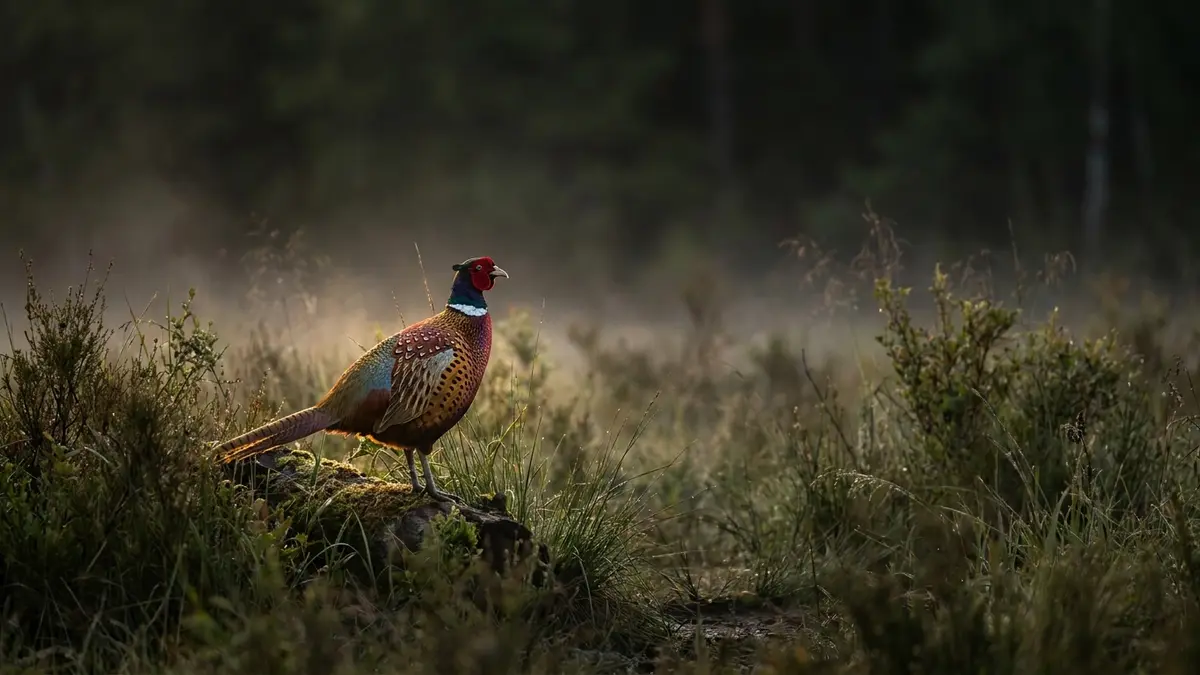
A Pheasant is a beautiful bird with an elaborate head and tail that's balanced by the quiet reliability and contentedness of its ground-level life. This makes Pheasant symbolize a place between showy beauty and steady endurance. It encourages you to live openly and express yourself fully, as well as to look outward toward new experiences, while staying firmly grounded in your inner strength. In a dream, Pheasants usually represent your creative and emotional state: a single bird symbolizes this individual quality, while several of them signify abundance and coming prosperity.
An almanac
- Core message
- Balance beauty with groundedness
- Spirit animal
- Courage to expand and champion others
- Totem for
- Creative, magnetic personalities
- Power animal
- Restores vibrancy and confidence
- In dreams
- Creativity and self-nurturing
- Element
- Air and Earth
- Ground speed
- 8–10 mph sprint
- Flight speed
- Up to 60 mph burst
The pheasant is a bird that combines showy color with a humble, low-profile lifestyle. It usually prefers to run rather than to fly. When startled, it flies abruptly upward. This combination of flamboyance and humble self-reliance is the key to what this bird can teach you.
Pheasant Symbolism & Meaning
Pheasants aren't built for long flights. When threatened, they take off with loud flapping of wings and then drop back to earth. Their colorful feathers attract attention, but after a predator gets close, they rely on instinct rather than their feathers to protect them.
Because they're usually found foraging for seeds and berries on the ground, they're good symbols of balance between reaching for high goals and having practical aims that keep you grounded. They also have sharp eyesight and hearing which can help them be very aware of danger. This intuition carries over into people's psychic gifts.
Even though pheasants are strong enough to survive in harsh winters, they usually don't migrate. This speaks to the strength of staying home and being content with where you are. A pheasant's endurance can also relate to contentment in what you're doing right now.
Pheasant Spirit Animal
You might be stuck in a rut. The Pheasant Spirit Animal shows up to nudge you out of your comfort zone and into the new experiences you crave. If you're feeling worried or doubtful about your abilities, the Pheasant reminds you that you've got what it takes. The people around you can count on you, too. But remember: try not to worry too much — hovering out of anxiety doesn't help anyone.
Does Pheasant fit you?
Tap the ones that sound like you — 6 traits, no right answer.
0 of 6 Nothing picked yet — start tapping.
Pheasant Totem Animal
If a Pheasant is your totem, then you're destined to be the creative type! You've always got a restless energy, though you channel it into work which you find satisfying. You love color, and there's a dash of flamboyance about you. First impressions are important to you: A bit of something special goes a long way in your world. But you know how to strike the perfect balance of flash and substance.
You consider decisions carefully and exude magnetic energy. This lets you draw people and opportunities to yourself — though only if your feet are firmly on the ground. Creativity is key for you. And sensuality too! An admirer or two may come easily, but restraint is required here — the richest connections come from companions who aren't here just for your magnetism.
You value space. Drab colors sap your strength, so surround yourself with bright colors. Intimate gatherings give off more "power" than large ones do.
Pheasant Power Animal
Call on the pheasant when you've lost your spark and the world feels flat and colorless. This power animal restores a sense of vibrancy and beauty to ordinary life, prompting you to pause and take a moment to acknowledge your daily wins instead of rushing past them.
The pheasant is especially helpful if you're chasing grand achievements and don't allow yourself to notice your successes on a smaller scale. When you do need to step up and use your gifts, the pheasant reminds you to discern which situations merit a full showing of those talents. It can also help if you struggle with taking new risks, encouraging you to stay authentic, show off your true colors, and take that leap.
Far Eastern Pheasant Symbolism
The Japanese believe that the pheasant is the messenger of the radiant Sun Goddess, Amaterasu. That's why the pheasant is considered to be a symbol of power, promise, and abundance.
According to Japanese folklore, pheasants can sense earthquakes in advance.
In China, the fenghuang bird is a mythical creature said to live only in virtuous and peaceful places. This mythological bird has a head like a golden pheasant and a body like a mandarin duck, with crane-like legs and a peacock tail. It's an important symbol of grace and virtue in China.
During the Qing dynasty in China, the golden pheasant was used as a symbol to show power among civil officials. Specifically, it signified that beauty and power went hand-in-hand.
Pheasant in Astrology & Zodiac Signs
The Pheasant is connected to the White Tiger within the tradition of Asian astrology, and that's tied to the fall season. In Chinese astrology, Pheasants are associated with the Rooster, and both of those birds are tied to harvesting and self-reliance.
Pheasant in Dreams
Dream imagery involving Pheasant tends to center on self-care, creativity, and how grounded you feel in your own path. Pay attention to the bird's posture and behavior for the clearest reading:
- A Pheasant holding its feathers close, almost like an embrace — signals self-nurturing and comfort; something you have poured care into is finally coming to fruition.
- A Pheasant in flight — suggests you are ready to launch new ideas and reshape your approach to life.
- A dead Pheasant — points to a creative spark that has gone out and needs to be rekindled.
- Someone killing a Pheasant — reflects a block in your creative thinking.
- A Pheasant pecking at the ground — counsels you to stay grounded and balance heart with head, especially as a new relationship develops slowly.
- A Pheasant crossing your path left to right — means ambitions are becoming real, so let them unfold without rushing.
- Multiple Pheasants together — a classic sign of abundance, providence, and prosperity headed your way.
- Feeding a Pheasant — points to nurturing a connection or idea that isn't quite ready yet; be patient rather than forcing it along.
- Hunting or shooting at a Pheasant — often reflects a decision you're second-guessing, worth revisiting before you commit further.
Pheasant Spiritual Meaning
Beauty and grounding aren't opposites, and you can have both. You can let yourself enjoy your dreams while still paying attention to the steady ground beneath your feet.
Let this bird remind you to let people know about your good qualities, pay attention to the roots of what's going on in your life, and deal with dangerous situations calmly and confidently rather than frantically.
Pheasant Facts & Natural History
Strip away the mysticism for a moment and the Pheasant's biology tells its own quietly dramatic story. Phasianus colchicus was long assumed to be a close relative of the chicken, but genetic studies now place the two in separate subfamilies, their lineages splitting more than twenty million years ago — kinship closer to distant cousin than sibling. Even so, the family resemblance in temperament holds: ground-loving, alert, unwilling to waste energy on flight unless it truly must.
Its diet is far hungrier than the seeds-and-berries reputation suggests. Alongside fruit, grain, and leaves, the Pheasant hunts slugs, earthworms, caterpillars, grasshoppers, and other insects, and will occasionally take a lizard, vole, small mammal, or small bird when the opportunity presents itself. That quiet opportunism is a physical echo of its spiritual lesson — patience paired with a readiness to seize what is actually in front of you, rather than waiting for a grander chance.
The numbers behind its two gears are just as telling. On the ground, a Pheasant sprints at roughly 8 to 10 miles per hour, weaving through cover instead of breaking into the open. Startled into flight, that same bird can rocket up to 60 miles per hour in a short, explosive burst. Composure and sudden, decisive action are not opposites in this bird's world — they are partners, each one waiting its turn.
Pheasant Feather Meaning
The bronze, copper, and green iridescence catches light differently depending on your angle and the amount of light you let in, representing your own brilliant nature that isn't fixed but shifts depending on where you stand.
Barred or mottled feathers are found along hens' backs and a cock's flank; they represent the wisdom of knowing when understatement serves you better than spectacle. A Pheasant feather isn't usually interpreted as a warning; instead, it can be kept as an altar object or tucked away somewhere noticeable to remind you about what you've been neglecting lately.
Frequently Asked Questions
What does a Pheasant symbolize spiritually?
A Pheasant represents the balancing act between beauty and practicality. The bird combines elements of Air, representing imagination and inspiration, with elements of Earth, promoting practicality and survival instincts.
What does it mean to see a Pheasant in a dream?
If you see a pheasant in your dream, it's generally about how you're feeling creatively or emotionally. If the pheasant is flying, it's a good time to launch new ideas. If it has its feathers close together, it shows that focusing on taking good care of yourself will benefit you. Seeing several pheasants shows a coming abundance and prosperity.
What does the Pheasant totem say about personality?
Pheasants tend to be both creative and practical, drawn to beauty as well as grounded in reality. They value genuine connections rather than flashy charm.
What does it mean when a Pheasant crosses your path in real life?
Unlike in a dream, in waking life encounters with a bird are usually seen as messages that things you've been planning are soon to happen, and you should keep on your chosen path or continue making the decision to which you have already committed. The bird's association with harvest time means that it often signals you are about to see your efforts rewarded,
Why does the Pheasant appear on Chinese imperial rank badges?
The Qing Dynasty lasted from 1644 to 1911. During that time, the ceremonial robe for a second-rank civil official was embroidered with a golden pheasant. The pheasant was higher status than the lower rank but lower status than the crane, reserved for top-level officials. The pheasant was chosen for two reasons. For one thing, its bright colors suggest wealth and nobility. For another, its grounded and watchful nature corresponds to the qualities of judgment required of second-level officials.
Pheasant also represents
- Other animals that represent strength →Alongside Lion, Bear, Tiger, Elephant
- Other animals that represent resilience →Alongside Cockroach, Camel, Salmon, Turtle
- Other animals that represent luck →Alongside Ladybug, Rabbit, Cricket & Grasshopper, Koi
- Other animals that represent intuition →Alongside Owl, Cat, Wolf, Raven
Sources
Claims on this page were checked against these published sources.
- Common pheasant
they can suddenly burst upwards at great speed, with a distinctive 'whirring' wing sound and often giving kok kok kok calls
Read the source → - Phasianus colchicus
Common pheasants are strong fliers; they are able to flush nearly vertical in take-off. ... They take flight when threatened.
Read the source → - Green pheasant
In Japan, many people claim that green pheasants are scared by earthquakes and 'scream'.
Read the source → - Birds in Shinto and Japanese Culture
the green pheasant is depicted as a messenger of deities such as Amaterasu
Read the source → - The Four Symbols of Chinese Astrology
the seven asterisms of the West—including Wei (Earth Pheasant)—form a shape resembling a tiger, thus the Western Palace is called the White Tiger
Read the source → - Can Pheasants Fly? Flight Speed, Distance, Height & More
On the ground, a pheasant can sprint at a respectable 8 to 10 mph (13 to 16 km/h)... During a typical flight, a pheasant cruises at speeds between 38 and 48 mph (61 to 77 km/h)... When actively chased by a predator or aided by a strong tailwind, they can reach top speeds of up to 60 mph (96 km/h).
Read the source → - Rank Badge with Golden Pheasant for Civil Official (Second Rank)
Qing dynasty (1644–1911); Silk, decorated in satin stitch; second half of the 18th century; China
Read the source →