Insects · Spirit animal
Bee Spiritual Meaning & Symbolism
Tireless community, sweet abundance, and a miracle that defies the odds
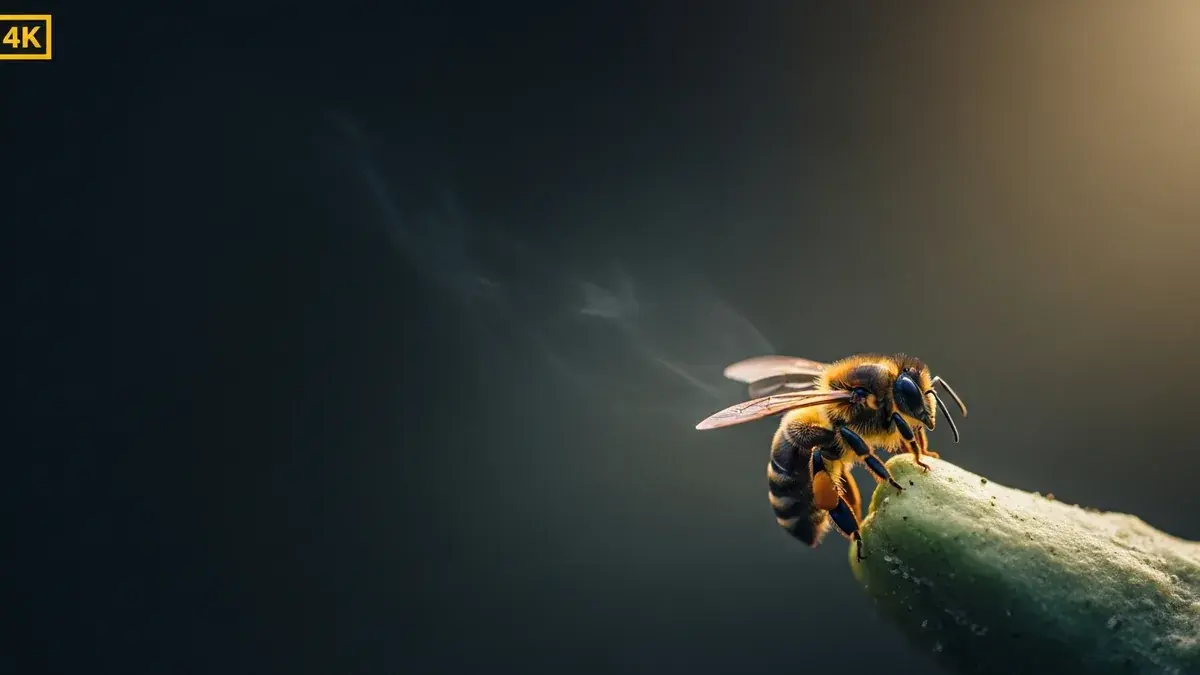
Bee signifies a tension between labor and reward: keep working, but don't forget the goal. Bees embody a life of teamwork, diligence, and stability.
But this isn't all sour work and no fun. They also bring messages about sweetness, plenty, and that nothing is impossible.
An almanac
- Core message
- Balance hard work with genuine enjoyment
- Spirit animal
- Audit your commitments and reconnect with others
- Totem for
- Natural builders devoted to home and community
- Power animal
- Abundance, persistence, cooperation, fruitfulness
- In dreams
- Sweet resolution, rising luck, quiet suspicion if stung
- Cultural roots
- Egypt, Celtic Ireland, Greece, Native American lore
- Pollinator's gift
- At least 75% of Earth's flowering plants depend on pollinators like Bee
- Queen's output
- Up to 1,500 eggs laid daily, the hive's entire future in her hands
Bees are small and strong flyers against all odds, which makes them impressive heroes. Many religions honor bees as links between humans and gods on Earth. Bees seem both solitary workers — single-mindedly striving toward a goal no matter what obstacles block their path — and community-driven. They remind us not to neglect ourselves just because we're in service to others. It seems fitting that bees ask us to remember the delicate balance of making and having fun — which requires us to take time away from productivity in order to stay sane.
Bee Symbolism & Meaning
Bee represents two extremes at once: diligence and pause, work and play. No matter how some say it can't happen, Bee shows us how our existence insists that we defy impossibilities again and again. Bees pollinate entire food systems, produce honey and wax, and keep us humming along with their poignant purpose
Bee Spirit Animal
If bee shows up as one of your spirit animals, it may be telling you to look at what keeps you busy. If you've bit off more than you can chew, you might need to turn down some extra responsibilities. If a passion project has become just another chore on your list, it may also be time to reevaluate how much you want to take on, since otherwise it's too easy to burn out without enjoying yourself. Otherwise, keeping things in balance is also important.
Like humans, bees always have company—never work alone. So if you have been feeling lonely, maybe it's time to reach out. And when the odds seem impossible, remember honey bee's triumph. It turns out bees can fly quite well whether people support them or not!
Does Bee fit you?
Tap the ones that sound like you — 6 traits, no right answer.
0 of 6 Nothing picked yet — start tapping.
Bee Totem Animal
People born with a bee totem may be sensitive to managing their own energy. They know when it is time to work and when it is time to take a break. Their homes tend to be very well organized. They value beauty along with function, and they keep things in place.
Bee-people are sociable while still being able to fend for themselves in terms of their personal needs. When there is real need, such as on an emergency basis or to spread joy, these people will step up to help.
However, these people do not readily give out trust because they haven't forgotten instances of betrayal. They therefore do not easily forgive double crosses.
People with this totem can build long-lasting careers and put together enjoyable gatherings of good friends.
Bee Power Animal
When you want more abundance, persistence, collaboration, and productivity in your work and community affairs (even just the kind that happens outside your regular job), draw upon bee's powerful side. Your adaptability may be getting stressed out at this time of change; follow your natural tendencies now, and everything seems to flow more smoothly.
Our main take-home for today has been _interdependence_: we have our part of a grander system, and bees help us identify how to fit in there. Their potency connects well to worship practices associated with the Sun (which helps energize blocked-up ventures) and makes fiery goddess worship slightly easier, because their comfort zone of fertility eases tensions over simple success and emotional generativity.
Across cultures
5 traditions — pick one to read its take.
Native American Bee Symbolism
Native Americans considered the behavior of the bee to be meaningful; different groups understood it differently. For some South American tribes, bees were fearsome warriors and for others they stood for hard work, respect for the earth, and being fertile.
According to one group called the Ira-tapuya, however, bees represent something much deeper—ancestors!
Other cultures have also drawn parallels between bees and water serpents using them in dances and other activities. They can also make fun appearances during ceremonies and dances as honorable messengers and members of the group who act selflessly towards their peers.
One famous tale comes from the Cherokee tribe that tells how bees gained their stingers in the first place. God sent bees to Earth, sharing their sweet honey freely until greed got the better of man, who then sought more than they could handle without thoughtfulness, grabbing the hives!
Celtic Bee Symbolism
Celtic people considered Bees sacred creatures, using their honey to make mead, a drink said to be on offer in heaven. A Bee came to stand for intermediaries between gods and humans; stories held that farmers must inform Bees when someone died. Those who listened out for Bees' droning might hear them telling the farmer in advance that visitors were coming or promising him good luck when one flew indoors.
Treating Bees badly was seen as risking losing an entire colony, since Celtic lore counted Bees as household kin. Druids linked Bee to female deities, associating Bees with queens. One well known tradition gave Bees the task of spreading the news of Christ's birth.
Bee in Christian & Biblical Symbolism
The bible uses the image of bees often, with many layered meanings. In some parts of the bible a crowd swarming together is compared to bees and signifies strength found through helping others. Other parts compare honey to the nourishing powers of strength in people but warn of the temptations surrounding things that look nice but are harmful.
A beautiful promise of the future talks about the land with lots of milk and honey — like being in heaven where there will always be enough good food and drink. Writers over the ages have imagined how bees' helpful self-sacrificing work could show Jesus Christ who shows love to everyone and gives help and comfort without complaining about what we must give back.
St. Ambrose wrote that churches should act like hives: always busy with work and helping each other. An example of this use can also be read in scripture when a man named Samson kills a bad creature, finds nearby bees that live off the dead body, grabs their stuff and uses it to make a clever trick question: This reminds us how God's teachings can come out of darkness, just like pure honey made of pollens and flowers from all types of plants growing through cracked streets and buildings destroyed during war.
Bee in Greek & Roman Mythology
Few societies valued Bees more highly than ancient Greece and Rome. Stories abound of Bees flocking around newborn philosopher Plato.
Zeus, for instance, had been fed honey as an infant himself, and later granted all Bees a rich amber-golden coloration. Likewise, Greek god Dionysus, god of wine, is generally recognized as being the father of apiculture (beekeeping) himself.
The fabled Muses—the sisters in charge of poetry—were intertwined so closely with Bee symbolism that Bees have occasionally been referred to as "the birds of the muses" ever since. Indeed, these Goddesses of wisdom and eloquence had a particular affection for honeydew which some felt imparted poetic lyricism and divine inspiration onto those who tasted it.
Bee also played an important role in the worship of Demeter (also known as Ceres)—goddess of agriculture—and her daughter Persephone. In this regard, Priestesses serving Demeter took the name Melissae
Bee Around the World
Most cultures see Bee not just as a creature but as a kind of messenger between worlds. Some make the relation more formal with established deities like Bee gods and goddesses, but the stories show respect across many cultures.
In Hinduism, Bee is seen as a link to nature, holding people together. Later on, another bee god is pictured as part of a goddess's body. That goddess can summon thousands of bees, forming them into something fierce. In other Hindu beliefs, bee goddess Bhramari looks after people. Her name means bee goddess too.
Islam teaches that other creatures work together better than some humans do. One story says Honeybee has pure spirit. An important Koranic section that shows how insects get along stays called Chapter of Bee because of its theme.
Some Egyptians think souls come out during death as swarms of bees. People there have long associated the afterlife with these little creatures.
Chinese legend says having a lot of bees flying around your house means money. They represent hard workers who never stop.
Bee Folklore & Superstition
Bee folklore stretches far beyond mythology into everyday omens. People used to say a dead bee meant a problem had passed.
A queen bee was thought to represent motherhood, fertility and power; focusing on making sure the hive succeeds. Bees also communicate direction by wagging to show where food was growing
Bee Tattoo Meaning
A bee tattoo tends to hold personal meaning even if the wearer doesn't fully understand why they feel the urge to get it. It might be their connection to work or mission, with the reminder to stay humble even in the pursuit of goals. Since bees can be both sweet and ferocious, the tattoo may also function as a commitment to defend the values they care about while still enjoying life's rewards. For those with an affinity for goddesses like Demeter and Persephone, it may mark love of or identification with those deities' qualities.
Bee in Dreams
Dreaming of bees often indicates a positive outcome approaching, either through good fortune, innovative thinking, or simply relishing the success of those close to us.
- A solitary bee predicts favorable results related to ongoing efforts
- Being stung alludes to latent mistrust regarding someone dear, demanding genuine contemplation
- When many bees surround a figure, it serves as a warning that this individual isn't entirely trustworthy at face value
- Observing a queen implies one is ready to embrace motherhood roles or take leadership positions
- A beehive draws focus towards cooperation benefits within familial communities
Bee Spiritual Meaning
Bees labor hard and eat honey, so their symbolism lies in striking that balance — knowing when it’s time to work and when it’s time to enjoy what you’ve already created. In spite of their small size, bees can fly, reminding us how seemingly impossible things may become possible once we decide to ignore limitations. In bee imagery, we also find service with no sense of self-aggrandizement; those guided by Bee will often offer healing, teaching, or even just support and assistance, celebrating their successes but not at the expense of their love or well-being. Historically linked to sun symbols, light and rebirth, and the Divine Feminine, Bee emphasizes how much good we can bring into our communities if we don’t lose touch with that which gives living a positive spin.
Queen, Worker & Drone: What the Hive Teaches About Roles
A lot of Bee's teaching can come straight from how a honeybee colony actually works. They have three types of bees doing their jobs:
One type, the queen, lays eggs — sometimes more than 1500 eggs a day. A second type, workers, tend baby bees, construct comb, and guard the hive's entrance. Workers make up the majority of the hives' population. * And the last type, the males, are called drones. Their sole job is to mate with future queens.
But reading this symbolism another way, instead of some kind of neat hierarchy (like how one person is better than another), we get a model for specializing each individual task within a group. Each bee lives to play its small part that's needed as a piece of the whole project.
If Bee is showing up for you as a guide, maybe it's questioning what duties have gone dormant for you — or wondering which of those chores best suits you right now. None is better than the others — just important. Do any of those aspects go missing and the entire hive starts losing ground fast.
One place this symbolism surfaces pretty often is for moving into more visible leadership. The reason is because the queen bee specifically gets her power by virtue of steady egg-laying. In other words, she leads via not directly commanding anybody. She simply becomes whatever thing everyone focuses on in order to make sense of the wider problem — even without saying anything at all.
A Bee in Your House: What the Old Reading Says
So the story goes, where you have one bee inside your home, there is someone coming for a visit. More precisely, if you see a solitary bee indoors, you know a friend will drop in very soon. Or that’s how the good old traditional folklore reads it. There are other interpretations, however, so take them all into account when dealing with bees.
You never want to kill a lonely bee who strayed somewhere inside your home, since that can bring bad luck. In many areas, doing that also brought along rough weather conditions. From here, if you expand the interpretation, it turns out that the bee message means receiving a visitor. Even better the solitary bee will show which side the visitor will come from.
One more interesting perspective regards household hives whose owners didn’t want to tell those bees about important things happening in their families. Somehow, they assumed such actions (failure to spread the news) might cause the bees to leave – or even to perish. Perhaps we now understand why solitary bees became symbolic figures somehow connected to human messages. On top of that, this understanding implied people must treat the little creatures respectfully enough, just like neighbors. Finally, a big visitor in shape of several swarming bees symbolizes quite serious warnings…
What Does It Mean When a Bee Lands on You?
By most accounts, if a bee alights on a human being and neither kills nor threatens them, the result is interpreted as bestowing trust and auguring benefit because the possible threat is there but not realized. Regardless of the circumstances of this gift — which are rarely recorded — and any intended ritual meaning, it expresses luck earned through patience, willingness and hard work rather than random bounty. Bees are frequently understood as symbols of industrious community cooperation.
Frequently Asked Questions
What does the Bee spirit animal mean?
Bee energy teaches us balance between hard work and pleasure, leaning toward community involvement and teamwork. It comes out more strongly if your style is to be a little too stretched thin, not getting enough done to make a difference to yourself or others; or if your tendency has been to sit back and be passive. Its advice is for finding that middle ground where you get things done while also feeling connected with the rest of the world.
Is seeing a bee a sign of good luck?
Yes, in some folkloric traditions. In certain parts of Europe — mainly areas where old myths have survived intact — people often take the appearance of a bee in their house or next to a window or door as a sign that good things lie ahead. It might also mean that a new visitor is expected. However, because bees are known to sting people, being stung is sometimes treated as a sign not to ignore potential trouble.
What does it mean to dream about bees?
Bee dreams usually mean that some hard work will soon pay off. Bee stings indicate feeling suspicious of someone. And seeing a queen bee could suggest you're feeling called to be in charge.
Is a swarm of bees ever considered a bad omen?
Do bees have a negative reputation? Mostly no — a swarm is generally regarded as lucky, an indication of wealth, or that someone important will pay you a visit. Certain ancient peoples did see the placement of a swarm a little differently, however: for example, some Celts viewed swarms perched on dead branches with suspicion, associating them with bad omens like death among the members of the household. Similarly, in Cherokee lore, the fiercely protective sting of a honeybee may symbolize the consequences human beings face if they plunder another species' home.
What does it mean to kill a bee, in life or in a dream?
Killing a bee in your dreams usually means you’re scared to commit or so overwhelmed that you’re tempted to push new connections aside before anything good comes out of them.
Encounters with bees in waking life have a gentler tone overall: most people say accidentally killing one is just unfortunate, not the end of the world, like – stop paying so much attention to what could go wrong and pay a little more attention to how tender we need to be around these furry bugs.
What does it mean when a Bee comes into your house?
Traditionally, seeing or having bees fly in through open windows is said to foretell visitors are on their way. In one old belief, it means news or guests will soon arrive at your house, whereas another says they're coming from a certain place or direction. It's considered very important not to kill any bees that stray into the house, since killing them was thought to bring bad luck to those inside and sometimes even to the local area.
Is it lucky if a Bee lands on you?
Yes, and it’s considered particularly lucky because it means you’ve done so well in your life you deserve recognition (when compared with another interpretation that simply sees it as luck being randomly granted to you).
This bee won’t usually sting, which sounds plausible enough - after all, worker bees do die when they sting - so this seems like a reliable superstition too.
Bee also represents
- Other animals that represent peace →Alongside Dove, Crane, Deer, Elephant
- Other animals that represent resilience →Alongside Cockroach, Camel, Salmon, Turtle
- Other animals that represent healing →Alongside Snake, Deer, Dog, Frog
- Other animals that represent family →Alongside Elephant, Wolf, Penguin, Ant
Sources
Claims on this page were checked against these published sources.
- Bees in mythology
In Egyptian mythology, bees grew from the tears of the sun god Ra when they landed on the desert sand.
Read the source → - Ah-Muzen-Cab
Ah Muzen Cab (also Ah Musen Kab) is the Maya god of bees and honey.
Read the source → - An-Nahl
An-Nahl (النحل) translates to "The Bee" in Arabic ... it is the 16th chapter (surah) of the Quran, containing 128 verses. The surah is named after honey bees mentioned in verse 68.
Read the source → - Bhramari
Bhramari means 'the goddess of bees', or 'the goddess of black bees'. She is an incarnation of the goddess Mahadevi in Shaktism.
Read the source → - About Pollinators - What Is a Pollinator?
At least 75% of all flowering plants on Earth are pollinated by insects and animals!
Read the source → - Judges 14 (NIV)
When he went back to marry her, he turned aside to look at the lion's carcass, and in it he saw a swarm of bees and some honey. He scooped out the honey with his hands and ate as he went along... Out of the eater, something to eat; out of the strong, something sweet.
Read the source → - Bee Colony Life
A queen's primary duty is to lay eggs. In order to maintain a large colony a honey bee queen lays on average 1500 eggs per day. Young honey bee workers first do tasks inside the nest like take care of the queen and young larvae... The male's only job is to spread the genes of their colony.
Read the source → - How the Honey Bee Got Their Stinger — A Cherokee Legend
The Creator was also annoyed at the behavior of the people, so he told the Flower People to create some 'briar bushes' and for the Bees to eat the briars... these were transformed into stingers.
Read the source →