Insects · Spirit animal
Praying Mantis Spiritual Meaning & Symbolism
The still hunter who teaches patience, focus, and quiet spiritual power.
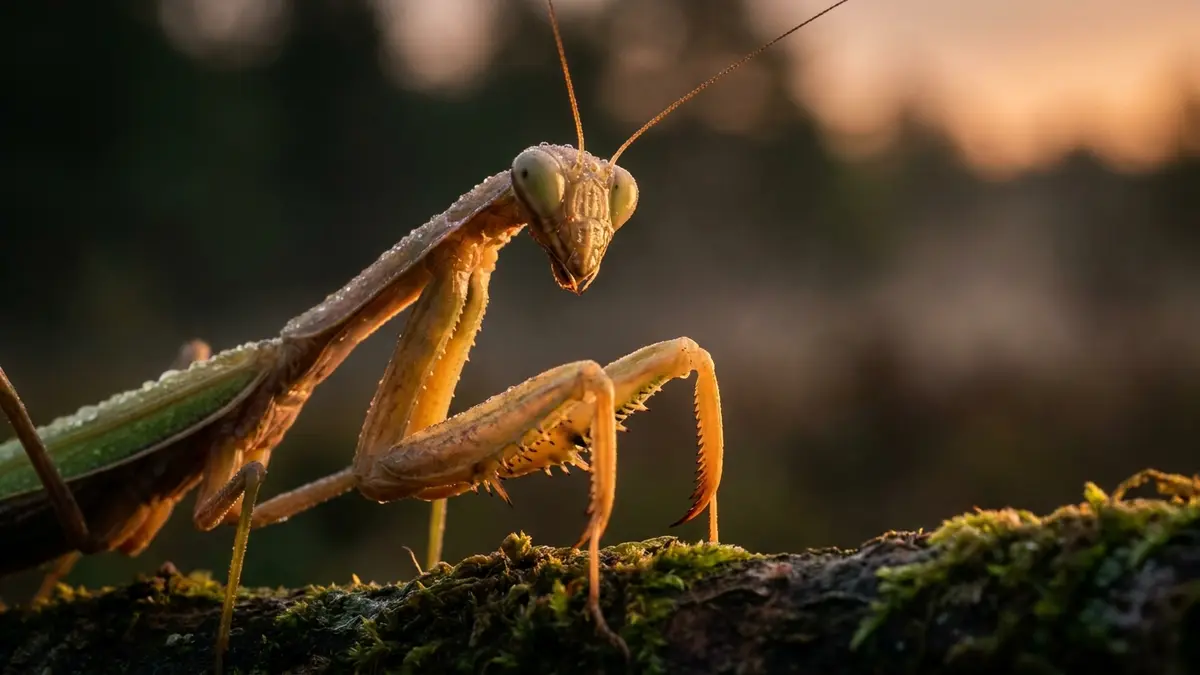
The praying mantis embodies patience, stillness, and precision. As a spirit animal or totem animal, it can encourage you to slow down, listen to your instincts, and pay more attention to what you focus your energy on. When you dream about praying mantises, the messages can differ depending on how they appear. They can signify your own focus and watchfulness. They may also indicate your own balancing of priorities.
An almanac
- Core message
- Stillness is the source of power, not its absence
- Spirit animal
- A nudge toward prayerful stillness and focused attention
- Totem for
- Patient, composed, intuitive people
- Power animal
- Releasing draining ties and sharpening focus
- In dreams
- Mirrors your need for patience, vigilance, or reassessment
- Cultural roots
- San (African) creation myth; Chinese Kung Fu; Japanese haiku
The praying mantis is a small but striking insect. It almost always holds its front limbs outwards and upwards, as if it is constantly in prayer. Long ago, people called the mantis a prophet. Anyone who gazes upon this insect sees something very different from what they expect.
Praying Mantis Symbolism & Meaning
The praying mantis owes its nickname to its front legs, which fold together as if clasped in prayer. Seeing one is considered good luck in many traditions, and having one land on you is treated as a sign of favor from the heavens.
Its courtship can be the stuff of drama: the male, trying to win a mate, will put on an elaborate dance, sometimes culminating with the female munching down her would-be mate. Some scientists think this might help raise stronger offspring with more eggs—though other researchers disagree.
The praying mantis has two big eyes and three smaller ones surrounding them, giving it an eagle-eye view that allows it to see almost instantaneously in all directions. This quick and wide view has made the mantis an ideal harbinger of personal intelligence or heightened intuition.
The mantis has two tiny inner ears, perched just inside its wings. These let it hear ultrasonic bat calls in order to dodge and hide. Certain species even pretend they're flowers or leaves, becoming trick artists of disguise and ambush. The mantis's best defense comes when facing hunters who have outmaneuvered it: it doesn't run away.
It unfolds its limbs and holds its ground. That confidence gives many people a feeling that the praying mantis stands for patience, quiet awareness, powerful intuition.
Praying Mantis Spirit Animal
When you see a praying mantis, it probably means you need to slow down and focus on living in the moment. The praying mantis is a very still creature which observes what's going on around it before moving.
The praying mantis is telling you that you should be observing and living more in the moment. You may not be getting everything you need out of life if you're always rushing through things without paying attention.
Since this insect can lie perfectly still for long periods of time, that's the lesson you should learn: move more slowly and carefully, pay more attention, notice what's going on around you.
Finally, the praying mantis is saying that if you don't take care of your spiritual needs, other parts of your life will suffer too. In other words, if your mind isn't being fed with interesting experiences or nourishing thoughts then eventually other areas will suffer.
Does Praying Mantis fit you?
Tap the ones that sound like you — 6 traits, no right answer.
0 of 6 Nothing picked yet — start tapping.
Praying Mantis Totem Animal
If your totem animal is a praying mantis, you know the importance of patience and planning. And while these can be hard lessons for some people, you've mastered them. You can weigh a situation carefully, keep your cool when chaos is swirling around you, and then act decisively once you've analyzed the risks.
You're probably good at meditation or other spiritual practices that let you know things before they happen. Many people who carry a mantis as their totem can become oblivious to the world around them. At these times, they'll often seem rude to outsiders.
Calm environments suit them best.
Praying Mantis Power Animal
The praying mantis can be a good power animal to have around when you need to break free from a painful or destructive relationship. This animal's energy can help you identify who is truly trustworthy and devoted in your life, and who deserves to stay close.
Invoke the praying mantis for clarity when you can't see the situation for what it is. Maybe there's something confusing or unhealthy in one of your relationships, and the praying mantis can help you see this. The praying mantis can also give you clarity if you're learning a new intuitive practice and need help understanding it.
Across cultures
2 traditions — pick one to read its take.
African Praying Mantis Symbolism
The praying mantis symbolizes patience, resourcefulness, and observing and understanding the world. It was one of the oldest representations of the divine among the San (Bushman) peoples in Southern Africa, who considered it to carry immense power. Among these groups, when a person encountered a mantis it was treated as a message from somewhere else.
In Khoisan cosmology, the praying mantis is Kaggen, a shape-shifting demiurge with trickster aspects. According to Namibian tales about him, Kaggen has a wife made of rock hyrax and various other animal relatives. In one telling of these myths, he tricks an ostrich into releasing fire from underneath its wing.
Praying mantises often get cast as heroes in these myths because they use patience, understanding, and clever trickery for the benefit of others.
Far Eastern Praying Mantis Symbolism
Chinese tradition sees it as a lucky sign, and its fighting stance inspired an entire martial art style, Praying Mantis Kung Fu, known for decisive strikes that don't waver.
Legend holds that the technique sprang from the fighting style's founder, Wang Lang. Beaten in a ring bout, he watched a mantis strike with precise and aggressive strikes at the wheel of passing cart. This impressed Lang so much he changed his style. Some martial arts historians doubt the story has to do with Wang Lang existing as a single historical figure.
This symbolism can be considered two ways:
• The first is ferocious and fearless. • The second is tranquil and passive.
The mantis appears in Japanese haiku poems, often mentioned as being watched and alert to the changes of life.
The stillness and attention it gives make it seem likely to mention in poetry about time's changing.
Praying Mantis in Dreams
If you're dreaming about a mantis right now, it's probably because your subconscious is trying to give you some advice about your current situation in life. But it doesn't always mean the same thing!
A dream mantis is like a little mirror of you! Take a look at what it's doing:
If it's just sitting there and isn't moving much at all, that means you're probably feeling like you need to slow down. Maybe things aren't going as fast or as well as they were before, and the mantis is telling you to "stop pouring energy into causes that won't pay off."
The mantis might be wearing lots of flowers or it might look all soft and fuzzy. That's a sign that someone around you might have dangerous intentions, and that you need to "blend in until the risk passes."
But if the mantis is chasing other bugs, then maybe somebody else is giving you trouble. It could also mean that something you need to do in real life seems way too hard. If that's the case, the mantis is telling you to "reassess" what you need to do.
Finally, if you get bitten by a mantis in your dream, that usually means that you've taken on too much responsibility! But instead of feeling bad about it, try delegating something or getting some extra help.
Praying Mantis in Astrology & Zodiac
The praying mantis isn't tied to any formal zodiac system in astrology, but its symbolism closely aligns with the contemplative, Earthy signs of the zodiac. These signs love introspection and analysis. They also value timing and observation. And they prefer these above rushing into action.
Some people take note of the number five. Others, too, see it in the praying mantis's two large eyes and three small ones. This is something that comes up in mystical traditions. The number five is linked to mysticism and a desire for deeper awareness.
If you resonate with the symbolism of the praying mantis, it may signal a need for patience and trust. You might need to be patient about things that involve timing or trying to make an informed decision when you are ready.
Praying Mantis Spiritual Meaning
The mantis symbolizes patience as a tool, not an escape from needing to exert power. The mantis only moves when it needs to. A key lesson is that you can survive by focusing your energy and standing patiently even though you may sometimes feel like your energy is scattered.
One could interpret the image of the mantis as an invitation to pray or meditate or even just to have a moment of quiet if that's what your practice looks like.
The mantis is telling you that one reason they're successful is they wait for their targets. If they go around looking for trouble, they're going to spend a lot of time wasting time, but if they hide and keep their eyes open and wait until their target comes to them, then they'll be much more efficient. It's telling you that you can use the same approach.
A significant lesson from this image may be an invitation to look carefully at your commitments so that you can balance things in a way that works better for you.
Is a Praying Mantis Ever a Bad Omen? (The Shadow Side)
For every source in the world that associates mantises with good luck, there are at least a few more that find them unsettling.
The raised forelegs and stocky body of a mantis resemble those of a praying human — hence the name. The species' slow, deliberate movements suggest patience and vigilance. In many folk traditions, this devotion inspires feelings of reverence and blessing.
But not everyone is as comfortable with that side of mantis symbolism.
In the Ozarks region of the United States during the early 1900s, people just called them Devil's horses — a much more unsettling association.
Read through this shadow lens, and some parts of mantis symbolism seem to shift: Patient devotion becomes destructive passion; courtship shifts from sacrifice to consumption; an emblem for vigilance becomes an emblem for avoidance.
No one's advice says stop looking out for good things when you cross paths with something that feels lucky. Good advice asks you to take these instincts seriously.
If you're hearing mantis symbolism as distrustful or angry rather than reassuring or cautious, let your own reaction carry weight.
Most likely, what you're feeling isn't a flaw but perfectly well attuned to what your soul wants right now.
The Praying Mantis Egg Case (Ootheca) in Folklore
Before the mantis nymphs are born, their mom has already left something to consider: the ootheca, a hard case made of proteins and tanning agents that surrounds her eggs. The eggs are protected by this case from microorganisms and predators. It also keeps them warm in the winter and helps them survive in all sorts of climates and conditions. Finding one is like a wish—protection, patience, or a reminder to be ready for anything.
Green, Brown and White Praying Mantis: What the Colour Changes
A praying mantis changes its colour from time to time based on where it lives, and as its skin hardens after moulting. Because the colour is linked to its environment rather than a fixed trait, traditional readings of mantis colours don't focus on character but instead deal with whether the mantis is appropriately set up for what it needs to do.
In general, a green praying mantis means that an environment is safe and things are in a good state. The usual reading attached to that is the idea of purposeful stillness that can achieve anything it wants.
If a praying mantis is brown, it's sometimes a hint that it's late in the season, which means things are good in a general sense but perhaps require more time before they reach maturity. It's not taken to be a bad sign.
A praying mantis that has just moulted is often pale because its hard outer layer hasn't had time to form. This is obviously part of a process of growth and strength.
One common reading of seeing a pale praying mantis is that there's something about that moment specifically which requires people be extra careful and aware of their surroundings because they're particularly vulnerable right then. This may happen because they've been through quite a lot in getting ready for the opportunity but isn't any indication that anything bad will happen so much as an idea that things need to work out perfectly for success at this point to be assured.
Sometimes someone sees a praying mantis of the wrong colour — for example, finding one on smooth wood rather than plant matter — which can mean they've made an error in placing themselves around important creatures or opportunities. Readings then turn to the questioner themselves: What have they done wrong? Where has their judgement failed?
A Praying Mantis Indoors, Seen at Night, or Found Dead
If you see a praying mantis in your home, especially if it's dark, that means you need to be patient with whatever is happening there. In other cultures, some people believe it would be bad luck to kill a mantis because its posture — as if it is in prayer — would bring bad luck to the person who killed it.
When you see one inside at night, it might mean something you've been keeping in the dark — perhaps a problem or issue that you haven't been talking about — is about to become visible.
Mantises are most commonly seen in late summer. After mating, adult male mantises die soon after. So, if you see a dead mantis inside, it could mean the waiting is over and whatever was bothering you is now resolved.
There's also something called an ootheca (a word from Greek meaning "egg case"). When an ootheca is found near where the mantis died, this might mean that the egg case will overwinter there and hatch in the spring.
Frequently Asked Questions
What does it mean when a praying mantis visits you?
It's normally seen as a good omen, or as a quiet encouragement to move more slowly, focus better, and trust your instincts before you make your next move.
Is the praying mantis a good luck symbol?
Yes, the praying mantis is considered a positive omen in most cultures that reference it. A mantis landing on you is usually seen as a good omen, not something to be feared.
What does a praying mantis symbolize spiritually?
The praying mantis is traditionally associated with patience, stillness, and disciplined awareness. As a still and silent observer, it encourages you to use quiet observation over rushed action. It can help you strengthen your spiritual connection.
Is it extra lucky if a praying mantis lands on your head?
Do mantis landings on the head have extra significance for people who view the insect as a good-luck sign? There is no universal or predetermined answer. Different traditions have different ideas, and opinions can vary within the same tradition. The explanations for why some traditions hold this opinion focus not on the head itself but on the closeness of the landing spot. The more "up-close-and-personal" the landing, the more urgent or significant it seems.
What does a brown Praying Mantis mean compared to a green one?
If you see a mantis that is brown, this indicates that it's out of season. This can mean it's in waiting mode for longer than it needs to be. In general, the mantis is a patient and purposeful insect.
Is it bad luck to kill a Praying Mantis?
The rule against killing a Praying Mantis is one of the strongest superstitions about any insect. People living in parts of southern Europe and much of Africa believe that killing a mantis causes bad luck because of its posture when it prays. If you find one indoors, you can carry it outside instead of removing it in any other way.
Praying Mantis also represents
- Other animals that represent peace →Alongside Dove, Crane, Deer, Elephant
- Other animals that represent determination →Alongside Salmon, Ant, Beaver, Falcon
- Other animals that represent patience →Alongside Turtle, Heron, Spider, Ant
- Other animals that represent intuition →Alongside Owl, Cat, Wolf, Raven
Sources
Claims on this page were checked against these published sources.
- Mantis (Wikipedia)
The name mantodea is formed from the Ancient Greek words μάντις (mántis) meaning 'prophet', and εἶδος (eîdos) meaning 'form' or 'type'.
Read the source → - ǀKaggen (Wikipedia)
ǀKaggen...is a demiurge and folk hero of the San people of southern Africa... ǀHúnntuǃattǃatteṉ (also spelled 'Coti') is represented as a marmot or rather a Cape hyrax and is known as the mother of bees. Their adopted daughter is represented as a porcupine.
Read the source → - Northern Praying Mantis (Wikipedia)
According to common folk stories, it was created by Wang Lang (王朗) and was named after the praying mantis, an insect, the aggressiveness of which inspired the style... The style emphasizes speed and continuous attacks... its fighting style involves the use of whip-like/circular motions to deflect direct attacks, which it follows up with precise attacks to the opponent's vital spots.
Read the source → - Ootheca
The ootheca protects the eggs from microorganisms, parasitoids, predators, and exposure. Oothecae are made up of structural proteins and tanning agents that cause the protein to harden around the eggs, providing protection and stability.
Read the source →