Insects · Spirit animal
Scarab Beetle Spiritual Meaning & Symbolism
Khepri's beetle, rolling the sun into each new day: decay turned patiently into life.
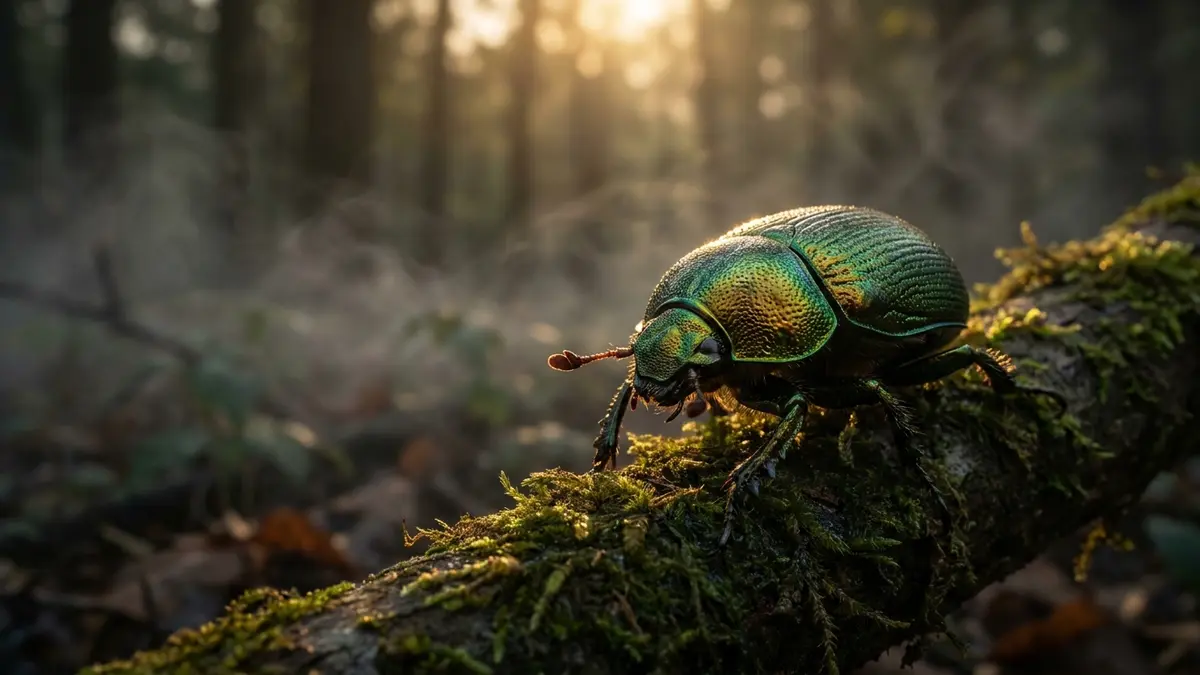
The scarab beetle is symbolic of rebirth, protection and transformation because of its ancient Egyptian role in which it was seen as the god Khepri, the aspect of Ra. They bring decay into life, pairing perseverance and teamwork with a highly developed intuition. When you see it in your spirit animal, this usually signifies a change is coming. Continue holding on to your values and be in touch with your community, they will guide you through.
An almanac
- Core message
- Turn decay into renewal
- Spirit animal
- Change and transformation are underway
- Totem for
- Intuitive, resourceful problem-solvers
- Power animal
- Spiritual replenishment and momentum
- In dreams
- Community ties and capacity to rebuild
- Cultural roots
- Ancient Egyptian sun god Ra (Khepri)
- Sacred relic
- Heart scarabs guarded the heart in judgment
- Living ritual
- Visitors still circle Karnak's scarab statue for luck
Beetles are found almost everywhere.
The scarab beetle is the best known of them because they roll balls of dung. For ancient Egyptians, this turned decay into renewal, which earned a legendary reputation for the beetles.
Understanding what scarab beetles mean starts with watching them roll their own dung.
Scarab Beetle Symbolism & Meaning
The beetle is actually quite underrated when it comes to spiritual symbolism, but really, almost any creature can be a guide. There's a lot more to this little bug than you might expect!
A lot of beetles are very strong. They can sometimes drag or lift things that are hundreds of times their body weight. This quality gives them strength and perseverance symbolism. They also live together in groups, helping each other build and defend their homes. So they're symbols of teamwork and community.
Many kinds of beetles eat rotting things, which makes them good at recycling stuff. So they're also symbols of renewal and purification. Lots of them can fly, so they also have air connections that give them association with higher awareness. And they can really endure anywhere except the most awful cold.
In Egypt, the dung beetle became very sacred. This gave it lots of extra meaning to people there—like rebirth, protection, good luck and continuity.
And around the world people believe that if a beetle crosses your path or shows up where you didn't expect it, you should be especially grateful or careful about that thing.
Scarab Beetle Spirit Animal
Seeing the scarab beetle as your spirit animal is a sign that big changes are coming to your life. This insect is telling you not to worry about what other people think of you, but instead to focus on your own values and beliefs.
A circle of supportive friends can help you feel grounded and centered during these big changes. Pay attention to the details of your daily life, like new people you meet or opportunities that come your way.
If the scarab beetle has red coloring, it might be connected to matters of the heart. If the beetle has green coloring, it might be connected to finances or resources.
This is a sign that you need to balance your responsibilities with your personal priorities. The scarab beetle is urging you to adapt to change in a positive way, instead of resisting it.
Does Scarab Beetle fit you?
Tap the ones that sound like you — 6 traits, no right answer.
0 of 6 Nothing picked yet — start tapping.
Scarab Beetle Totem Animal
Like the scarab beetle, those with this totem tend to combine instinct with intuition, resulting in a knack for problem solving. People like this tend to see situations from multiple angles, and never waste anything. They tend to be conscious of the environment and often money-conscious. People with this totem often feel like their lives are changing but that they manage to focus on positive aspects and grow from their circumstances.
Beetle-totem people tend to feel deeply connected to their mind, body, and spirit. They have a very strong sense of cause and effect and karma. Some call it karma. Intentional living is something that tends to come naturally to these people. Even the subtlest of signs or opportunities are spotted easily by them.
Scarab Beetle Power Animal
Calling on scarab beetle energy can help you feel spiritually replenished, emotionally centered, and sensitive to subtle energies. This powerful ally offers resilience and determination to help you overcome obstacles like a beetle using its own body to push its burden forward. People turn to scarab beetle energy when they want to be more focused, productive, and clear-minded.
Scarab beetles have long been symbols of the sun god Ra and the rising of the sun. When you call on scarab beetle energy, you may experience renewed patience and enthusiasm for your journey as it provides a steady, life-giving force that supports your journey through life. Those experiencing fertility challenges or a transformative experience can use this energy to help them tap into their inner strength
Across cultures
2 traditions — pick one to read its take.
Scarab Beetle in Native American Symbolism
In Native American traditions, the meanings of scarab beetles vary widely. Sometimes they're viewed as symbols of sickness and harmful magic, but in other cases they're revered and celebrated. The Navajo consider the corn beetle a fertility symbol, while Hopi legend says a black beetle taught them their first rain dance. Some nations even regard the beetle as a creator figure, much like the Egyptian Khepri.
Scarab Beetle as a Celtic Symbol
Beetle lore isn't as rich in Celtic cultures as in others. Still, a few strands remain. One goes something like "it takes one to know one".
In some Celtic cultures, a particular species is tied to purgatory, and you often find them near burial grounds. This is a melancholy sort of connection, since it has to do with liminal — or between worlds — areas.
Some German culture ties beetles to predicting the weather. It says if they show up, rain is coming tomorrow.
Scarab Beetle in Dreams
When you see a scarab beetle in your dream, it generally means that you feel well-connected to the people around you. It also means that you can rebound from any setbacks, which is usually a good sign.
The meaning of this symbol changes based on context, though.
- If the beetle is moving quickly, it's a good sign and means that good luck will soon cross your path.
- The presence of multiple beetles in the dream suggests a theme of family or friendship.
- A dying beetle implies that there will be conflict or delays in your relationships.
- And if the beetle's color stands out, then it relates to an area of your life related to its typical symbolic meaning.
Scarab Beetle in Astrology & Zodiac Traditions
A New Age system calls the twelve beetle signs the Entomozodiac. It claims this system is Pre-Incan, but no one has ever produced any proof of it.
The beetle sign overlaps Libra, from late September through late October.
People who believe they were born under this sign are described as slow to anger, kind, and good at making friends. They want harmony in their lives and in the world.
Being idealistic, even-tempered, fair-minded, and interested in other people is also considered typical of those born under the beetle sign.
Scarab Beetle Spiritual Meaning
The scarab beetle is transparent about what transformation looks like from the outside: it's hard, repetitive work. It rolls and digs, gathers and reuses. It's through these simple but ongoing actions that nature renews itself, just as you can transform your life.
When you meet a scarab beetle on your path, be reminded that by continuing steadily toward the light, connecting with your community, and recognizing setbacks as opportunities for growth, you'll continue to improve and evolve.
The Heart Scarab & the Weighing of the Heart
A heart-shaped scarab amulet with a spell for the dead was placed on a mummy's chest, usually wrapping the heart itself. So this spell convinced your heart to shut up, which would also keep it from testifying against you.
This was meant to protect not only royalty in their tombs, but later everyone from priests to peasants. It's about your conscience and intentions and what you carry inside. This myth isn't only about renewal of life in nature, but also your self's intactness in death. So if you're into scarabs as totems or power animals, it's probably more about your own conscience holding up against other people's attitudes than about armoring yourself with sunshine.
The Living Ritual: Karnak's Sacred Scarab Statue
The scarab's symbolic power persisted even after the demise of ancient Egypt. Even today you can still find it in Karnak, where an enormous rose-granite scarab, sculpted during the reign of Amenhotep III during the 18th Dynasty, sits at the edge of the Sacred Lake. Hatshepsut and Thutmose III raised obelisks that flank it on either side.
Tourists and locals alike still walk laps around it, but they do it for a different purpose than the statue's original meaning. People make their way around the statue in three circles hoping for good luck. Seven circuits lead to proposals and nine lead to babies.
Whether or not this tradition arose in antiquity is hard to say. Still, many visitors note how naturally people still seek out that promise of renewal and luck.
So if you feel drawn to an impulse like this — walking a sacred ritual, repeating it with your intention — let yourself acknowledge that this symbol speaks for people. Nothing's changed on that point in three millennia.
Frequently Asked Questions
What does a scarab beetle symbolize spiritually?
The scarab is linked to renewal, protection, and transformation. The reasons for these are connected with ancient Egypt and its ancient sun god Ra. The Egyptians believed that the sun's daily rebirth was a sign of spiritual rebirth and renewal.
What does it mean if a scarab beetle is your spirit animal?
It suggests that you are about to face a period of change, during which maintaining your authenticity is more important than trying to please everyone else. When you need help finding your balance, reach out to your community.
What does it mean to dream about a scarab beetle?
Dreaming of a scarab beetle often points to your connection to the community around you and your ability to adapt and rebuild. Dreaming of a dead or fallen scarab points instead to sadness or delays.
What is a heart scarab?
A heart scarab was a scarab-shaped amulet the ancient Egyptians placed on the chest of a mummy. It was inscribed with a spell that was believed to keep the dead person's heart from testifying against them during judgment after death. The heart, rather than being protected by a hard shell, was protected from itself, so that the deceased would have a clear conscience in the afterlife.
Why do people walk around the scarab statue at Karnak Temple?
Some people say that if you walk around the giant scarab statue at Karnak Temple in Egypt, you can have good luck, find a husband or wife, or have a baby. But there is no record of this custom from ancient times. This shows that people today are still interested in the promise of new life given by the scarab.
What does it mean to dream of a beetle that feels trapping or overwhelming?
If your dream of a beetle feels claustrophobic or swarming, you probably feel cornered or outpaced in waking life. If you don't yet know what's wrong, the dream is a nudge to pause and identify what's crowding you. Then you can get back to steadier ground.
Scarab Beetle also represents
- Other animals that represent death →Alongside Raven, Crow, Buzzard & Vulture, Owl
- Other animals that represent rebirth and change →Alongside Butterfly, Snake, Dragonfly, Frog
- Other animals that represent protection →Alongside Bear, Wolf, Dog, Elephant
- Other animals that represent resilience →Alongside Cockroach, Camel, Salmon, Turtle
Sources
Claims on this page were checked against these published sources.
- Khepri
Often, Khepri and another solar deity, Atum, were seen as aspects of Ra: Khepri represented the morning sun, Ra was the midday sun, and Atum represented the evening sun.
Read the source → - Scarab (artifact)
Heart scarabs were often hung around the mummy's neck with a gold wire and the scarab itself was held in a gold frame.
Read the source → - Beetle
The Coleoptera, with about 400,000 described species, is the largest of all orders, constituting almost 40% of described arthropods and 25% of all known animal species.
Read the source → - Native American Indian Beetle Legends, Meaning and Symbolism from the Myths of Many Tribes
cornbeetles are associated with fertility... the corn beetle is the symbol of female generative power, and is associated with fertility and the ripening of corn
Read the source → - Heart scarab
usually inscribed with Chapter 30B of the Book of the Dead... placed directly above a person's heart and wrapped into their bandages... The first known depictions of heart scarabs are found in the Sixteenth Dynasty or Seventeenth Dynasty circa 1690 B.C.
Read the source → - heart-scarab
The function of the heart scarab was to bind the heart to silence whilst it was being weighed in the underworld, to ensure that the heart did not bear false witness against the deceased, or to act in its place if necessary.
Read the source → - Colossal Khepri
Rose-hued granite... Amenhotep III, 18th Dynasty... at the edge of the Sacred Lake of Karnak, flanked by two obelisks of Hatshepsut (right) and Thutmose III
Read the source → - Tourists encircle scarab statue in Luxor for good luck
Ancient Egyptians believed that going around the statue three times brings good luck, while going around it seven times brings marriage for those who did not marry and going around nine times causes pregnancy for an infertile wife... tour guides confirm that the ritual has no scientific base
Read the source →