Insects · Spirit animal
Earthworm Spiritual Meaning & Symbolism
The quiet ground-worker: unseen effort is still sacred work.
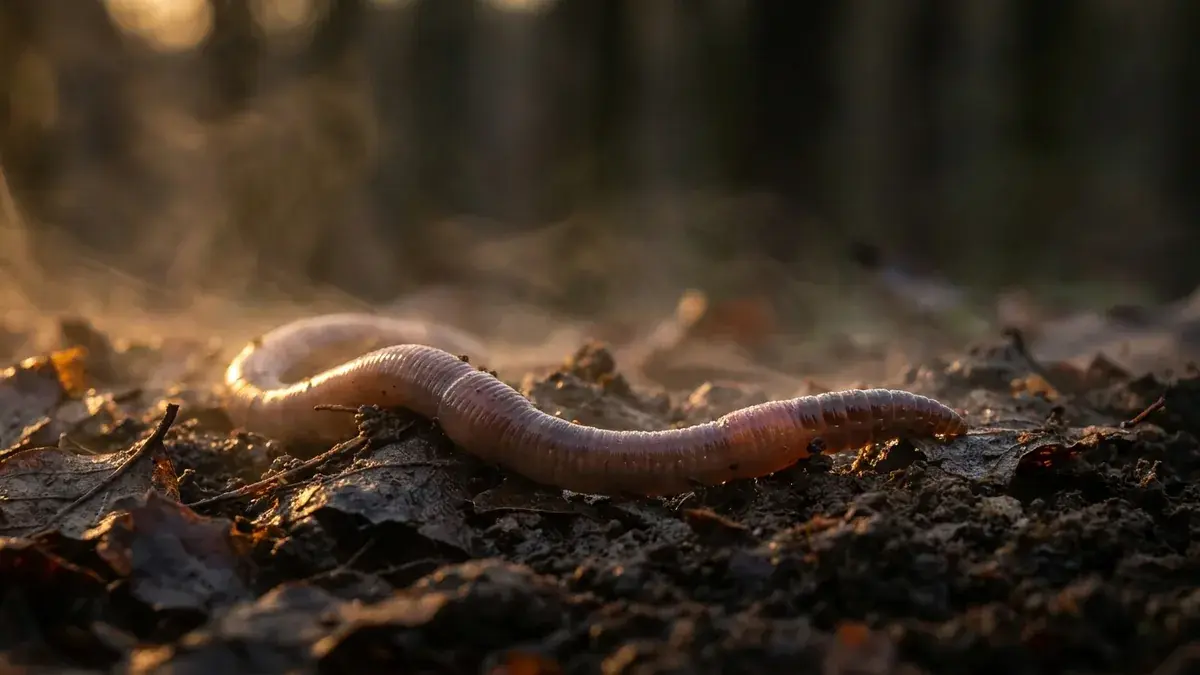
If the Earthworm shows up in your dreams, or you see it as a spirit animal, it may mean you need to slow down and look beneath the surface for what is really important to you. Or maybe you are already grounded in some way that benefits you but you don't see how or why. In either case, be patient with yourself.
An almanac
- Core message
- Unseen effort is still sacred work
- Spirit animal
- Dig beneath the surface, stay rooted
- Totem for
- Deeply intuitive, sensitive souls
- Power animal
- Regeneration and self-care
- In dreams
- You're missing important details
- Cultural roots
- Norse serpent-worm myth; Feng Shui chi symbol
- Chinese name
- Dì Lóng — the "Earth Dragon"
- Darwin's verdict
- "More important... than most would suppose"
It's easy to overlook them, and impossible to replace them: Earthworms have been rebuilding the soil beneath our feet for centuries. For many years, scientists have praised their ecological value, and long before them cultures across the world have sensed something deeper in these blind, boneless travellers between darkness and light.
Earthworm Symbolism & Meaning
Darwin said it was up to Earthworms more than most creatures in reshaping the planet, and because they don't stand out, almost no one really notices them. With no eyes, ears, or bones and just looking harmless, their highly sensitive touch can sense even faint vibrations underground. That's why a lot of traditions have linked Earthworms to being clairsentient and psychic.
In Old Norse they called Earthworms "dragons" too, because of how buried treasure might seem magic and hidden away. Since Earthworms have both male and female parts, they're also a symbol of fertility.
These worms are famous all over folklore — often standing in for maggots or serpents or caterpillars — and straddling some big-line-in-the-sand: life and death, good health vs. Sickly ones. When they come up from underground after rain, it feels like these same creatures are slipping between two worlds — earth on the ground and water in the wet soil.
The Greek philosopher Aristotle called Earthworms the "intestines of the earth." And he hinted that their crucial power was all about nourishment and taking care of where you live. Darwin studied them for decades before writing The Formation of Vegetable Mould, Through the Action of Worms. In his book he revealed his shock that worms have buried so much stuff below us: from old walls to coins or even ruins — plus just eating at everything all around.
Earthworm Spirit Animal
When you're doing some serious self-reflection, paying close attention to what's going on inside and figuring out how things are connected, an earthworm might appear as a spirit animal. It could show up when you're feeling kind of low or when things are uncertain. The message might be that you're taking life slowly and deeply — quietly doing the work to get somewhere better.
Another way to see it is that this animal means every moment counts. That change can come slowly — maybe a lot slower than you want. It might also mean it's worth working hard on your future, but don't start living big dreams before you've got a solid plan for how to make them happen. This spirit animal can be reminding you to do the things first so they are there ready for your dreams.
Does Earthworm fit you?
Tap the ones that sound like you — 6 traits, no right answer.
0 of 6 Nothing picked yet — start tapping.
Earthworm Totem Animal
Most have known people like Earthworms: wiggle worms in childhood, full of restless energy. As they grow up, the restlessness stays, but they learn to take their own sweet time at the path they choose.
They warn others when danger is near. They dig into difficulties, find understanding, and feel strongly. They go for it all! You might sense tension in a room or in people, or you might be good at psychometry.
They know when to react and when to keep low, if need be. They learn to walk their own path.
Earthworm Power Animal
If you've been neglecting some aspect of your physical, mental, or spiritual health, Earthworm offers help in reviving what has been neglected.
Earthworm is a powerful ally when it comes to regeneration and restoration. If you're exhausted, overwhelmed, or feeling stagnant, ask for Earthworm's assistance in restoring balance to your life.
Norse Earthworm Symbolic Meanings
Mythology of the Norse tells of Jörmungandr, a giant serpent-worm that curls around the world, gripping its own tail in its mouth with coils from the ocean depths. When that grip breaks, the world will perish. This picture matches closely the Ouroboros, an ancient symbol showing a serpent devouring itself. It stands for infinite cycles, rebirth, and unending universe.
Far Eastern Earthworm Symbolic Meanings
In Feng Shui, earthworms are known as movers of energy through the soil beneath a space. It is said that when more of this energy is present in an environment, the area feels more enlivened and vibrant. In addition, earthworms are considered by Feng Shui practitioners to symbolize fertility both for people and for the land, as well as representing energy in the top-left corner of a room.
Earthworm in Dreams
Dreaming about earthworms usually reflects your awareness of subtle or overlooked aspects in your life — you might see something that seems off or worry about what's just under the surface. What's happening in the dream can change the meaning:
- If a worm is burrowing easily through soil, it could mean you're well prepared and know what you need to succeed.
- In dreams where an earthworm is out in the sun, it can suggest you might be overexposed or be putting yourself out there more than is comfortable.
- If worms are appearing in the rain, it's a positive sign; some gain or profit is likely headed your way.
- A single worm often means a new friendship is on the way.
- Watching someone use an earthworm as bait or catch something with one could mean success is near.
- Stepping on a worm suggests you might have neglected a friend, and they'll feel hurt by it.
- Dreaming you're the worm reflects genuine kindness and compassion towards others — people might see that aspect of you.
The dream might also reflect inner conflicts around gender roles, or even feelings related to identity. According to Arabic dream traditions, earthworms often represent other people.
Earthworm Spiritual Meaning
Earthworms teach a valuable lesson about visibility. They work completely out of sight, deep below the soil. And yet all their activity beneath the surface supports the growth of plants above it. Spiritually, just as with earthworms, worth can't be measured simply on the surface.
Worse than that, perhaps — because people keep telling other stories about earthworms. Did you know that if you cut an earthworm in half it turns into two new worms? That is a neat metaphor for endless renewal, but it's not actually true. In fact, only some species can regrow their tail from their head. If you cut an earthworm at the middle it can't really regenerate itself — one part loses its head, and another part loses its tail.
Earthworm as the "Earth Dragon" in Chinese Medicine
Way before Western scientists took Earthworms seriously, Chinese physicians had already grounded them up to make medicine, and they called the remedy Dì Lóng — which translates as "Earth Dragon." The term is mentioned in a book written by Ming-dynasty scholar Lang Ying. By the time the Bencao Gangmu, an important encyclopedia of herb lore, was compiled in 1578, the Earth Dragon had become an official preparation.
The word "dragon" didn't just come from poet's inspiration. Ancient belief held that Earthworms could influence the weather: they'd surface right before rain showers and disappear into the ground again afterward. They seemed to know when it was about to rain or not.
Just like this small creature, the Norse dragon myths named creatures that were both grand and humble. Two cultures on opposite ends of Earth agreed that a seemingly small creature could hold awesome power.
Ancient lore didn't see humility and power as opposites. Something small enough for people to overlook underfoot could still carry a name as powerful as "Earth Dragon" or "Norse dragon" (aka serpent).
Frequently Asked Questions
What does an Earthworm symbolize spiritually?
Grounding. Quiet renewal. Unseen effort.
Also: fertility, psychic sensitivity, and moving between worlds.
What does it mean when Earthworm is your power animal?
The Earthworm comes to support you in healing and self-care. When the Worm appears, it may be that you need healing, a fresh start, or a reminder that steady, humble effort will lead to real progress.
What does seeing an Earthworm in a dream mean?
Seeing an earthworm usually means you’re overlooking important details in your waking life. The context of the dream matters. For example, a worm digging easily suggests that an opportunity will be easy to grasp. A worm in the sunlight warns against overexposure, and a worm in the rain hints that gains are coming.
Why do earthworms come to the surface after it rains?
Earthworms don't come to the surface when it rains because they're trying to escape floodwaters, although that's what a lot of people used to think. The more recent scientific consensus is that either (1) the wetness allows earthworms to travel farther and faster to find food or a mate, or (2) the vibrations in the wet earth may be a signal of impending danger from a predator such as a mole. Either way, it's happy news if you see worms coming out of the ground after a rainstorm.
Is it true that cutting an earthworm in half creates two worms?
You might have heard about the myth that if you cut an earthworm in half, you get two earthworms, but that's not really how it works. When you cut an earthworm in half, the part with the head can usually grow a new tail. But the tail part can't regrow a head, so it dies.
There are some species of earthworms that can grow a new head at the tail end when cut, but they don't regenerate fully enough to be called two earthworms.
As for what this means spiritually, it's still pretty neat: Sometimes you just have to take what works.
Earthworm also represents
- Other animals that represent rebirth and change →Alongside Butterfly, Snake, Dragonfly, Frog
- Other animals that represent healing →Alongside Snake, Deer, Dog, Bee
- Other animals that represent luck →Alongside Ladybug, Rabbit, Cricket & Grasshopper, Koi
- Other animals that represent intuition →Alongside Owl, Cat, Wolf, Raven
Sources
Claims on this page were checked against these published sources.
- Earthworm
It may be doubted whether there are many other animals which have played so important a part in the history of the world, as have these lowly organized creatures.
Read the source → - ormr
legless slithering animal (worm) ... serpent, snake ... dragon ... worm, maggot
Read the source → - Escape and avoidance learning in the earthworm Eisenia hortensis
In many ways earthworms are little more than 'the intestines of the earth,' as Aristotle described them in his Historia Animalium (353 BCE/1910).
Read the source → - Jörmungandr
There the serpent grew so large that he was able to surround the Earth and grasp his own tail. ... one sign of the coming of Ragnarök is the violent unrest of the sea as Jörmungandr releases its tail from its mouth.
Read the source → - Ouroboros
an ancient symbol depicting a snake or dragon eating its own tail ... eternal cyclic renewal or a cycle of life, death and rebirth.
Read the source → - Dilong
Dilong first means 'earthworm' in the Qixiu Leigao (七修類稿) written by the Ming dynasty scholar Lang Ying 郎瑛 (1487–1566 CE).
Read the source → - Dilong: Food for Thought and Medicine
The medicinal use of earthworms in China dates back over two thousand years, with the substance first recorded in the Shen Nong Ben Cao Jing... under the name 'Qiu Yin'
Read the source → - Worms | Darwin
worms have played a more important part in the history of the world than most persons would at first suppose
Read the source → - How many times can a worm be split in half and still grow back?
their tails usually die when severed... for many other species the head portion (down to the 'saddle') can re-grow a tail – although often a stunted one
Read the source → - Why do earthworms surface after rain?
Another possibility is that earthworms confuse the sound of rain with a predator, such as a mole, and so make their way upwards to the surface to escape.
Read the source →