Mythical Creature
Thunderbird Symbolism & Meaning
The great sky-being of Northwest Coast tradition who summons storms and carries the power of both creation and destruction in its wings.
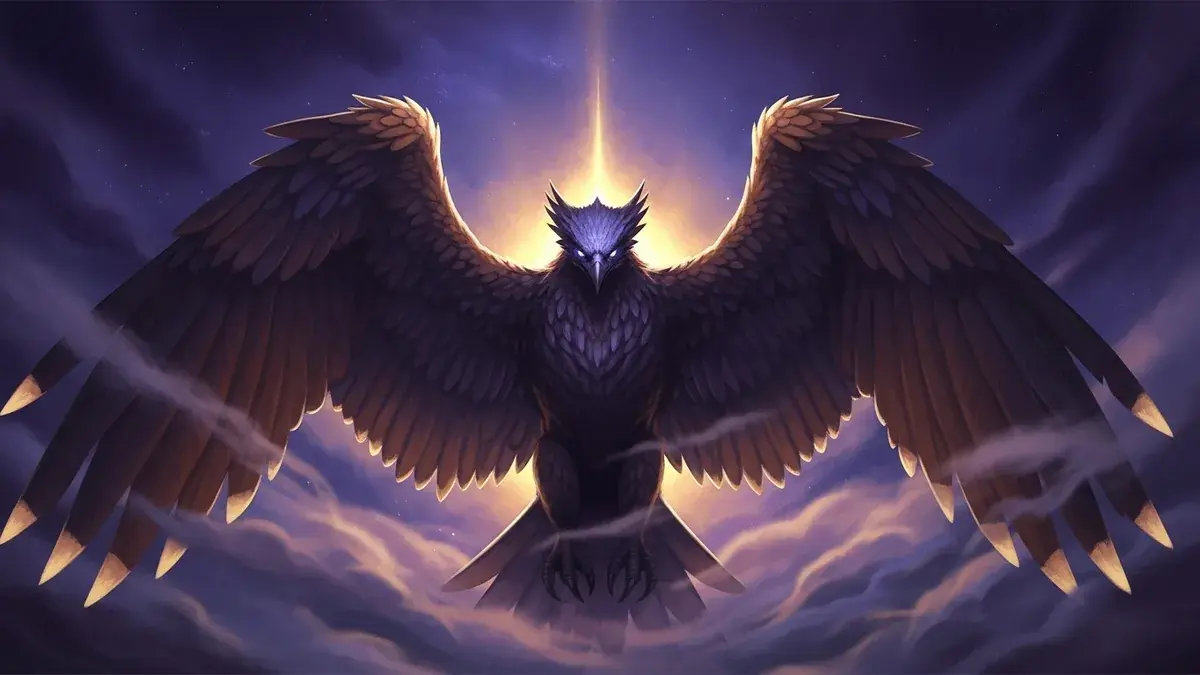
The Thunderbird symbolizes immense natural power paired with protection and generosity: creation and destruction move together in its nature. As a spirit animal, it signals a need to step into your own authority, use resources with care, and trust your ability to transform amid upheaval. It comes from Northwest Coast Indigenous tradition and ties closely to the element of Air, though its storms also draw in water and earth.
An almanac
- Core message
- Power tempered by protection and generosity
- Spirit animal
- Claim your authority and use resources wisely
- Totem for
- Born leaders shaped by personal trials
- Power animal
- Decisive authority called on for the greater good
- In dreams
- Unpredictable change; trust your inner resources
- Element
- Air, with ties to water and earth
- Known names
- Wakinyan, Animikii, Bha'a
- Mythic rival
- Underwater Panther (Mishibizhiw)
Few beings in North American storytelling carry as much weight in their wingbeats as the Thunderbird. Indigenous peoples of the Pacific Northwest revere it above all others: an immense bird-being said to dwell high in the mountains, stirring up storms and commanding lightning at will. Part animal, part something far greater, the Thunderbird is a symbol of nature's raw force and of its capacity for both ruin and renewal.
Origins & Mythology
The Thunderbird appears throughout the oral traditions of numerous Indigenous nations, especially those along the Northwest coast. Elders described it as an enormous bird capable of shifting into human shape, its true form so vast that when it spread its wings, serpents shaped like lightning bolts were said to slip out from beneath its feathers.
Other tellings hold that bolts of lightning shot directly from its eyes, and that thunder itself was the sound of those great wings beating against the sky.
One well-known account centers on a leader named Namoquayalis, whose name is translated as "Only One," who lived on the mountain called Klaskis near Cape Cook, on the west coast of Vancouver Island. As floodwaters rose to swallow the coastline, thunder is said to have rolled four times before the Thunderbird descended to the Chief.
It offered him a way to safety, but rather than save himself first, the Chief asked the Thunderbird to search out and rescue the other survivors still stranded by the rising water. The Thunderbird agreed, and generations of leaders passed the story onward, honoring the being afterward through ceremonial dance and carved art.
Stories like this shaped the Thunderbird into a figure tied to guardianship and generosity as much as to the fury of storms, bound up with the responsibilities carried by those entrusted with power.
The Thunderbird also runs through Northwest Coast heraldry, well beyond any single legend. Crests carved into totem poles were never purely decorative — they identified a family's lineage and standing, much like a coat of arms passed down through generations. The Thunderbird, wings outstretched at the top of a pole, became one of the most widely recognized of these crest figures — recognizable enough that the Kwakwaka'wakw-style pole with spread thunderbird wings has been copied far beyond its origins and is now a global icon of Native artistry.
Thunderbird Symbolism & Meaning
The Thunderbird is widely regarded as the most formidable of all mythical creatures in the traditions that honor it, yet its power is inseparable from protection. People turned to it in hopes of abundance as much as out of fear, asking it to nourish the soil, encourage harvests, and feed those who were hungry.
- Power tempered by care – though thunder's crash can feel threatening, the Thunderbird is not simply a thing to fear; it reflects nature's many moods.
- Creation and destruction intertwined – a lightning strike can split a tree, yet the rain that follows a storm lets crops flourish. In the Thunderbird, ruin and growth move together, the way they often do in nature.
- Transformation – legends describe the Thunderbird slipping out of its feathered form the way a person might set aside a blanket, revealing a human shape underneath. This shedding of one form for another makes the Thunderbird a symbol of adaptability and change.
- Status and hierarchy – because it was said to appear only before the most respected members of a community, only the wisest and most capable leaders were traditionally seen as fit to bear the Thunderbird as part of their crest. It was never treated as a casual emblem.
- Immense strength – some stories claim the Thunderbird was powerful enough to lift a full-grown orca out of the ocean in its talons, a detail meant to show just how much strength it carried.
The Thunderbird is closely linked to the element of Air, given its home in the sky and its identity as a bird tied to thunder. But its story reaches further than one element. Lightning is understood as a meeting of fire and air, and the Thunderbird also brings heavy rains that soak into the earth and awaken seeds — so its influence touches water and earth as well, not just air.
Thunderbird Spirit Animal
When the Thunderbird arrives as a Spirit Animal, it often signals a need to step into your own authority or claim independence you've been putting off. Its appearance can also point toward matters of abundance, a nudge to use money, food, or other resources with care.
The Thunderbird tends to surface during moments of upheaval, when life feels like it's shifting faster than you can track. In these moments, it's a reminder that transformation is possible even when the chaos around you feels out of your hands.
It can help guide you toward clarity when major decisions loom, and in traditional belief, it was thought to arrive during times of deep crisis to help humanity find its footing again — showing up during periods of shared, community-wide hardship as often as during personal struggle.
Thunderbird Totem Animal
Those who carry the Thunderbird as a Totem Animal are often described as marked for leadership, though rarely without first facing considerable personal trials that prepare them for that role. Because the Thunderbird is so tightly bound to the natural elements and their push-and-pull between creation and destruction, people connected to this totem may notice a heightened awareness of shifting weather or approaching storms.
Carrying this totem can feel like being handed a powerful calling, but it also asks for a willingness to stand apart from the crowd so your instincts and viewpoint stay unclouded by outside noise. In some tellings, the Thunderbird is also associated with a warrior spirit and triumph in conflict; those who hold this totem may occasionally need to walk directly into confrontation before peace and stability can follow.
Thunderbird Power Animal
Calling on the Thunderbird as a Power Animal is not something to take lightly — it asks for genuine reverence. When invoked with the right intention, it can lend you a sense of authority and the resolve to act decisively in moments that call for it.
The key lies in knowing when this power should be summoned at all. Working with the Thunderbird means being honest with yourself about the difference between wanting personal recognition and acting for a purpose bigger than yourself. Traditionally, this power was meant to be called on for the good of the wider community, not for private ambition or glory.
Thunderbird Dreams
A Thunderbird appearing in a dream often hints that change is on its way, and that the direction it takes may not be easy to predict. Even so, its presence isn't meant only as a warning. Rather, it's a reminder that you can stay grounded and draw on your own inner resources as you move through whatever comes next.
Dreaming of the Thunderbird can be an invitation to trust your instincts and let your truest self take the lead, even as the path ahead remains uncertain.
Thunderbird Across Native Nations
While the Thunderbird's most famous stories are anchored on the Pacific coast, its wingspan reaches far beyond that shoreline. Sioux, Arapaho, Wichita, Anishinaabe, Salish, Gros Ventre, Potawatomi, Menominee, Iroquois, Lenape, Cherokee, Ho-Chunk, Quileute, Ojibwe, Shawnee, Crow, and Choctaw nations have each carried a version of this sky-being into their own oral traditions, and shaped it around their own landscapes and needs.
The names shift from nation to nation even as the core image holds steady. The Dakota and Sioux call it Wakinyan, roughly "winged one"; the Anishinaabe know it as Animikii; the Gros Ventre call it Bha'a, and in their tradition the Thunderbird is remembered as a giver of sacred gifts, credited with bestowing the sacred pipe on the people rather than only stirring up storms.
Color carries meaning too. In Great Plains tradition, the Thunderbird is often painted in four colors — red, blue, green, and yellow — each tied to one of the cardinal winds, while nations further from the Plains favored a simpler emblem: a single jagged red zigzag standing in for lightning itself. Arapaho tradition set the Thunderbird opposite the White Owl, pairing it with summer the way its owl counterpart carries winter — one more sign that this being's meaning shifts depending on who is telling the story.
Thunderbird & the Underwater Panther
Not every tradition casts the Thunderbird as the sole power over the natural world. Among the Ojibwe and other Algonquian peoples, the sky-being meets its match in the Underwater Panther, known as Mishibizhiw — a horned, scaled creature said to rule the depths of lakes and rivers the way the Thunderbird rules the storm-heavy sky.
The two are described as locked in ongoing tension, with the Thunderbird casting lightning down at the water to keep the Panther's power in check. This rivalry was never framed as a fight for one side to win outright — it was a balance to be maintained, sky against water, each keeping the other from overtaking the world. As recently as the 1950s, the Prairie Band of Potawatomi Indians performed a ceremony specifically meant to placate the Underwater Panther and preserve that balance with the Thunderbird. For the people who hold these stories, cosmic order isn't fixed once and left alone; it takes ongoing care.
For anyone drawn to the Thunderbird as totem or spirit guide, this duality is worth sitting with. Power rarely operates alone; it exists in relationship with whatever would check or complicate it, and honoring that opposing force is part of what keeps power from tipping into excess.
The Thunderbird & Whale Legend
Among the Quileute, Kwakwaka'wakw, Nuu-chah-nulth, and Comox peoples along the outer coasts near Vancouver Island, one of the most enduring Thunderbird stories tells of its battle with a monstrous Whale that threatened to starve the people of the sea's bounty. Accounts describe a clash violent enough that the ocean receded and rose again, flinging canoes into the trees and costing many lives before Thunderbird prevailed.
Geologists have since found something remarkable underneath the story: evidence of a massive earthquake along the Pacific Northwest coast around the year 1700, powerful enough to send a tsunami all the way to Japan. Some researchers now read the Thunderbird and Whale legend as an oral record of that very disaster, carried forward through generations of storytelling long before any written account could capture it.
Frequently Asked Questions
What does the Thunderbird symbolize?
The Thunderbird symbolizes immense natural power paired with protection and generosity. Creation and destruction move together in it, along with themes of transformation, leadership, and status among those wise enough to carry its image.
Where does the Thunderbird come from in mythology?
The Thunderbird appears throughout the oral traditions of Indigenous peoples of the Northwest coast of North America, where it was believed to live in the mountains, cause storms, and take on human form. Its stories, including the well-known account of Chief Namoquayalis, have been passed down through generations and honored in dance and art.
What does it mean if the Thunderbird is your spirit animal?
If the Thunderbird resonates with you as a spirit animal, it may point to a need for personal authority, wise use of resources, and the strength to embrace transformation during periods of upheaval, whether that turmoil is personal or shared by your wider community.
What colors are traditionally associated with the Thunderbird?
In Great Plains tradition, the Thunderbird is often depicted in four colors — red, blue, green, and yellow — each linked to one of the cardinal wind directions. Nations further from the Plains commonly simplified this to a single red zigzag symbol standing in for lightning.
What is the Thunderbird called in other Native American languages?
Names vary widely by nation: the Dakota and Sioux call it Wakinyan, meaning roughly 'winged one'; the Anishinaabe know it as Animikii; and the Gros Ventre call it Bha'a. Each name carries its own weight within that nation's stories, even where the core image of a storm-bringing sky-being stays consistent.
Does the Thunderbird have a rival or opposite in mythology?
In Ojibwe and other Algonquian traditions, yes — the Thunderbird is locked in ongoing tension with the Underwater Panther (Mishibizhiw), a horned creature said to rule the depths of lakes and rivers. Their rivalry is treated less as a battle to be won and more as a balance to be maintained between sky and water.
Sources
Claims on this page were checked against these published sources.
- Thunderbird (mythology)
creates lightning by flashing its eyes in both Algonquian and Iroquois tellings ... creates thunder by flapping its wings in Algonquian tellings
Read the source → - Thunderbird Cape (MOA 863/2) item record
Lightning flashed four times, and a Thunderbird transformed himself into a human being and came to the rescue of the Great Chief.
Read the source → - The Thunderbird: Native American Myths and Legends (Thunder-Birds)
Sioux, Arapahoe, Wichita, Anishinaabe, Salish, Gros Ventre, Potawatomi, Menominee, Iroquois, Lenape, Cherokee, Kwakiutl, Ho-Chunk, Quileute, Ojibwe, Shawnee, Crow, and Choctaw tribes all feature Thunderbird in their traditions.
Read the source → - Thunderbird Mythology: Key Facts
Called "Wakinyan" in Dakota language, meaning "winged one," and "Bha'a" among Gros Ventre peoples.
Read the source → - Underwater panther
Underwater Panthers are seen as an opposing yet complementary force to the Thunderbirds, and they are engaged in eternal conflict. ... As late as the 1950s, the Prairie Band of Potawatomi Indians performed a traditional ceremony to placate the Underwater Panther and maintain balance with the Thunderbird.
Read the source → - Thunderbird and Whale
the ocean receded and rose again. Many canoes were flung into trees and many people were killed. ... In the 1980s, geologists found evidence that an earthquake, powerful enough to send a tsunami all the way to Japan, hit the American Pacific Northwest in 1700.
Read the source → - Totem Poles (text only)
Crests depict animals or supernatural beings that identify the owners and are symbols of noble families. ... The Kwakwaka'wakw-style pole with outstretched thunderbird wings has been widely imitated.
Read the source →