Mythical Creature
Basilisk & Cockatrice Symbolism & Meaning
The serpent-crowned king of venom whose gaze forces you to face what you've buried.
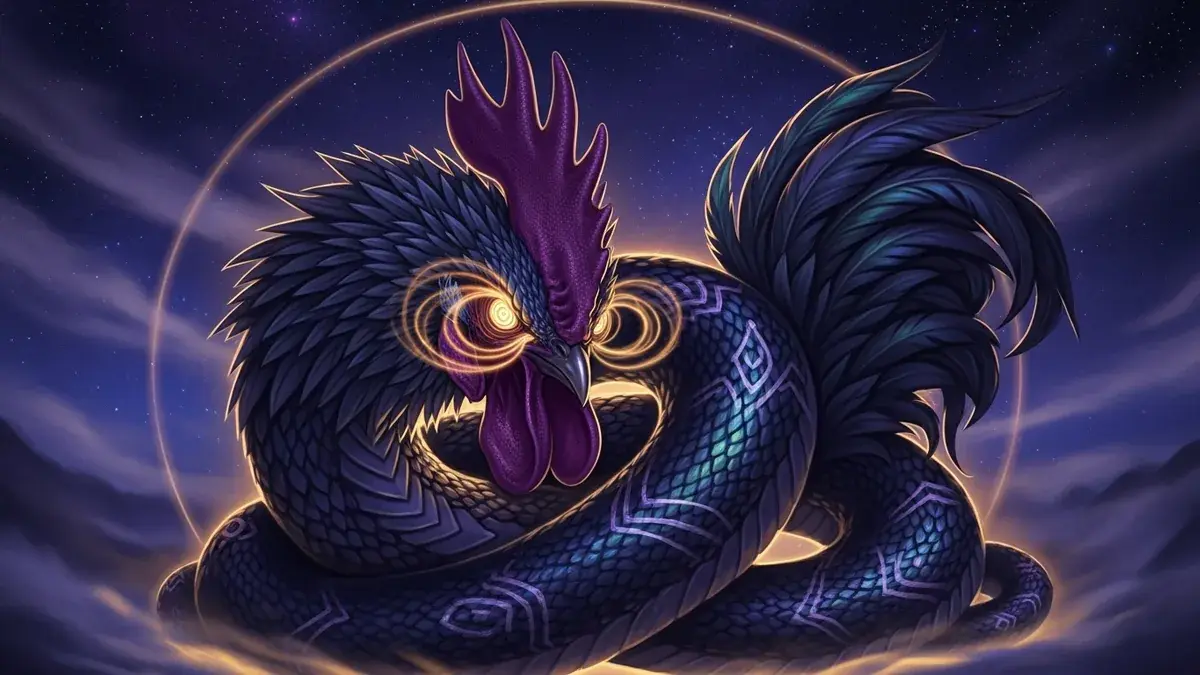
The Basilisk symbolizes destructive emotion and the Evil Eye, sovereignty (its name literally means "Little King"), the shadow self, and the tension between our darker impulses and our higher nature. As a spirit animal, it appears when you've been neglecting that shadow self: it pushes you to set firm boundaries and bring your baser instincts into balance with your higher aspirations. As a totem, it belongs to bold, regal, independent leaders who need to watch their words and keep their pride in check.
An almanac
- Core message
- Face your shadow self before it works against you
- Spirit animal
- Set firm boundaries, balance instinct with higher self
- Totem for
- Bold, regal, independent natural leaders
- Power animal
- Burns away obstacles and negative energy
- In dreams
- Unresolved emotion or a habit of avoidance
- Watch for
- Sharp words and unchecked pride
- Real counterpart
- Genus Basiliscus, the water-running "Jesus Christ lizard"
- Civic symbol
- Heraldic guardian beast of Basel, Switzerland
The Basilisk is a legendary hybrid of serpent and rooster that slithers through European folklore as a creature so venomous that a single glance from it could end a life. Its close cousin, the Cockatrice, shares its origin story and its lethal reputation, and the two names are often used for the same fearsome being. Past the horror, the creature carries real symbolic weight: sovereignty, boundaries, the shadow self, and the uneasy line between destruction and self-mastery. Below is what the Basilisk has to teach as a spirit guide, a totem, and a power animal, plus what it means when it slips into your dreams.
Basilisk & Cockatrice Symbolism & Meaning
The Basilisk is described across European tradition as part rooster, part serpent, and has picked up a string of regional names over the centuries, including Basiliscus, Sibilus, Basiliscu, and Baselicoc. Its Latin name, Regulus, translates to "Prince," and that in turn descends from the Greek Basiliskos, or "Little King" — a title that hints at the creature's supposed dominion over every other serpent.
What truly sets the Basilisk apart is its killing stare: a single look is said to be fatal, a trait that puts it in the same company as the gorgon Medusa. It's easy to imagine the old phrase "if looks could kill" tracing back to stories like this one.
The Basilisk represents destructive emotion and the Evil Eye, the idea that a glance loaded with envy or malice can wound. Its breath is said to scorch like a Dragon's flame, so the creature is tied to fire as much as to venom.
The Cockatrice's origin story is its mirror image: where the Basilisk hatches from a serpent's own egg, the Cockatrice comes from a rooster's egg incubated by a toad or serpent — an inversion folklore treats as unnatural.
Among real animals, people have long compared the Basilisk's fearsome scale to giant snakes like the anaconda or the extinct titanoboa.
Pliny the Elder's account
The Roman naturalist Pliny the Elder gave one of the earliest written accounts in his Natural History, describing a small serpent scarcely a foot long, marked with a crown-shaped pale patch on its head, that poisons the ground it crosses and scorches the plants and stone around its den.
According to Pliny, the only creature that can undo it is the weasel — though the weasel dies from the encounter too, a detail he frames as nature turning against itself.
Later legends and powers
By the early 1200s, the English scholar Alexander Neckam argued the Basilisk killed by poisoning the air rather than through its stare. A century later, it had picked up an alchemical reputation, with legend (dubiously) crediting Hermes Trismegistus with using it to convert silver into gold.
Over time the myth kept adding new powers: a fiery breath, a voice that could kill outright. These pulled the Basilisk further into association with the elements of Fire and Air. The Renaissance-era occultist Heinrich Cornelius Agrippa insisted the Basilisk was always male and called it the fitting vessel for such a poisonous, destructive nature.
Basilisk & Cockatrice Spirit Animal
The Basilisk shows up as a Spirit Animal when you've been neglecting your own shadow self. Left unacknowledged, that hidden part of you can quietly work against you — the Basilisk's presence is a nudge to give it room to be seen and expressed rather than letting it fester.
If someone in your life means you harm, this guide lends you the resilience to hold steady and outlast the threat. When you've been treated without respect, it helps you set firm, unmistakable boundaries that others won't dare test. It's also a guide for balance: if you're trying to reconcile your baser instincts with your higher aspirations, the Basilisk can help you bring the two into alignment.
- Offers strength to endure people who wish you ill
- Helps you draw clear boundaries after disrespect
- Supports merging your lower and higher nature into harmony
- Steps in when someone tries to pressure or corrupt you, so you can hold to your principles
Basilisk & Cockatrice Totem Animal
People with the Basilisk as a Totem Animal tend to be natural leaders with a regal bearing. You draw attention wherever you go, and while you often prefer working solo, you're perfectly capable of guiding a group toward success when called upon.
This totem makes you bold, self-assured, and independent, moving through life on your own timetable rather than anyone else's. Summer tends to be your favored season. The caution that comes with this totem is about restraint: your words carry more weight and sting than you may realize, even unintentionally, so it pays to choose them carefully.
The same goes for your actions — unchecked pride, taken too far, can undo the very success you've built.
Basilisk & Cockatrice Power Animal
Call on the Basilisk power animal whenever you need to clear a path forward and burn away whatever obstacles stand in the way. If independence and achievement are the goal, invoking this creature brings the stamina and drive to get there.
It's also the one to petition when you're wrestling with your own darker impulses and want mastery over them — the Basilisk may be dangerous to everything around it, but it's never undone by its own venom. And when you need a shield against negative energy, this power animal simply scorches it away.
Greek Basilisk & Cockatrice Symbolic Meanings
In the older Greek strand of the legend, the Basilisk hatches when a rooster tends a toad's or serpent's egg, and its truest form is serpentine — later European art is what began blending in rooster features. Its hiss alone is said to be enough to send every other snake nearby fleeing in fear.
Pliny records its venom as so potent that even a mounted rider who managed to spear the creature would find the poison travel up the weapon shaft, killing both the rider and the horse beneath him.
Cantabrian Basilisk & Cockatrice Symbolic Meanings
Pre-Roman Celtic tradition from the Cantabrian region tells of the Basiliscu, hatched from an egg an aging rooster lays just before dying. The shell that forms is soft and leathery rather than hard, offering the creature inside almost no protection — a detail folklore reads as a symbol of the vulnerability, physical or emotional, that needs tending before it can be resolved.
Only a fully grown Basiliscu can safely open the egg to free the newborn; any other living thing that looks upon it dies instantly from its fiery gaze. The newborn itself can be undone only by the weasel's scent or the crowing of a rooster.
The hatching is said to happen at midnight on a clear night under a full moon, a detail that ties the myth to themes of illusion and mystery. Some later tellings add that the star Sirius — called the "Chieftain's Star" in Sanskrit — must be rising for the birth to occur; that link ties the Basiliscu to the scorching height of summer.
A few versions echo the Medusa myth directly, claiming the creature can be killed by forcing it to see its own reflection. Because the Basiliscu is born at midnight and perishes at the rooster's dawn call, its whole life plays out as a symbol of extremes, thresholds, and the moment light overtakes darkness.
Basilisk & Cockatrice Dreams
- A Basilisk staring at its own reflection — a signal to face your shadow self and surface emotions you've been suppressing.
- A Basilisk retreating into a hole — points to a habit of avoidance, burying your head in the sand instead of confronting problems directly.
- A newly hatched Basilisk — suggests you're in a vulnerable stretch, physically or emotionally, and need to raise your awareness.
- A Basilisk glaring straight at you — hints that the answer you're searching for in waking life has been in plain sight all along.
Basilisk & Cockatrice in Biblical & Christian Symbolism
Long before it became shorthand for the shadow self, the Basilisk had already earned a place in scripture. The Douay-Rheims translation of Psalm 90:13 promises, "Thou shalt walk upon the asp and the basilisk: and thou shalt trample under foot the lion and the dragon" — naming it as one of four dangers that faith is said to overcome underfoot.
The Church Fathers ran with that image. Saint Augustine drew the comparison outright, calling the Basilisk "the king of serpents, as the devil is the king of wicked spirits" — reading its crown-shaped mark and "Little King" title as signs of Satan's own claimed dominion. Medieval art absorbed this reading wholesale and used the creature's lethal gaze as visual shorthand for corruption and sin.
Even so, the tradition left room for hope. Saint Isidore of Seville, cataloguing the Basilisk's terrors, added the reassurance that "the Creator of nature sets forth nothing without a remedy" — a line that sits comfortably alongside the weasel, the rooster's crow, and the mirror that already undo the creature elsewhere in this myth. However dark the shadow gets, the old stories insist, there's always a counterweight.
The Basilisk as a City's Guardian: Basel's Heraldic Beast
One European city took the Basilisk as an identity rather than a warning. Basel, Switzerland — whose Latin name, Basilea, echoes the creature's own — folds a basilisk into its civic coat of arms as a heraldic guardian, standing alongside the bishop's crozier rather than lurking as an omen of doom. Tradition ties the symbol to hard history: the 1356 earthquake and the upheavals of the Protestant Reformation both left their mark on Basel's relationship with its basilisk mascot, and the creature still appears across the city's identity today.
Heralds of the era did draw a fine line between the two names this page covers: in formal blazon, a basilisk's tail ends in a second dragon's head (sometimes called an "amphysian cockatrice"), while a plain cockatrice simply tapers into a serpent's tail — a technical distinction that let heraldry keep the two straight even while everyday storytellers happily conflated them.
There's something fitting in a city claiming the "Little King" as its emblem rather than shrinking from it. The same instinct shows up when the Basilisk arrives as a personal totem: it asks you to wear your fierce, self-possessed nature openly instead of apologizing for it.
Basilisk & Cockatrice in Literature
Shakespeare returned to this creature more than once. In Romeo and Juliet, Juliet reaches for it while grieving over poison. In Richard III, the Duchess of York uses it to condemn her own grandson before he's done anything at all: "A cockatrice hast thou hatch'd to the world, / Whose unavoided eye is murderous" — naming a newborn monstrous purely for what he might become.
That line is worth sitting with. Shakespeare uses the myth to dramatize the danger of judging potential as though it were already fate — a caution that rhymes with this totem's real lesson about watching your words and your pride before they calcify into someone else's story about you.
The image never really left circulation after that; it just changed uniforms. The Langleys of Agecroft Hall in Lancashire bore a cockatrice on their family crest as far back as the 14th century, and in the twentieth century, Royal Air Force No. 3 Squadron adopted the cockatrice as its official emblem — proof that a creature born to represent destructive pride can just as easily be repurposed as a badge of fierce pride worn on purpose.
Frequently Asked Questions
What is the difference between a Basilisk and a Cockatrice?
In most tellings they're treated as the same creature under two names, but their origin stories differ: the Basilisk hatches from a serpent's own egg, while the Cockatrice comes from a rooster's egg incubated by a toad or serpent — an inversion of the Basilisk's birth.
What does the Basilisk symbolize?
The Basilisk represents destructive emotion and the Evil Eye, sovereignty (its name literally means "Little King"), the shadow self, and the tension between one's darker impulses and higher nature.
What does it mean to dream about a Basilisk?
It often points to unresolved emotions or a habit of avoidance. Seeing the creature stare at its reflection suggests it's time to face your shadow self, while watching it hide in a hole suggests you've been avoiding a problem instead of confronting it.
Is the Basilisk mentioned in the Bible?
Yes — the Douay-Rheims translation of Psalm 90:13 promises "Thou shalt walk upon the asp and the basilisk," naming it as one of four dangers faith can overcome. Saint Augustine later compared it directly to Satan, calling it "the king of serpents" just as the devil is king of wicked spirits, which cemented its place in medieval Christian symbolism.
Is there a real animal called a basilisk?
Yes — the genus Basiliscus covers real lizards native to Central and South American rainforests, nicknamed the "Jesus Christ lizard" because they can sprint upright across water on specialized foot scales to escape predators. Beyond the name and a crested, crown-like head, they share nothing with their mythical namesake.
Sources
Claims on this page were checked against these published sources.
- Basilisk
The term originates from Greek basilískos (βασιλίσκος), meaning "little king" or "little prince." The word combines βᾰσῐλεύς (basileús, "king") with the diminutive suffix -ῐ́σκος.
Read the source → - Cockatrice
the basilisk (basiliscus) was the product of an egg laid by a rooster and incubated by a toad
Read the source → - The Basilisk's Biblical and Christian Significance
Thou shalt walk upon the asp and the basilisk: and thou shalt trample under foot the lion and the dragon.
Read the source → - Basilisk
Basel, Switzerland incorporated the basilisk into its heraldry by blending the Bishop's coat of arms with the creature. Following the Protestant Reformation and a subsequent earthquake, these misfortunes became associated with the basilisk symbol, which persists in Basel's identity today.
Read the source → - Basilisk heraldry meaning search summary
In heraldic art, the basilisk differs from the cockatrice primarily by the addition of a dragon's head on the end of the tail, and is occasionally blazoned an "amphysian cockatrice."
Read the source → - Green Crested Basilisk
The creature earned the Spanish nickname "Jesûs Cristo" or "Jesus Christ" lizard due to its extraordinary ability to traverse water surfaces while escaping predators and hunting.
Read the source →