Mythical Creature
Amarok Symbolism & Meaning
The solitary giant wolf-spirit of Inuit legend, a symbol of fierce boundaries and fearless self-reliance.
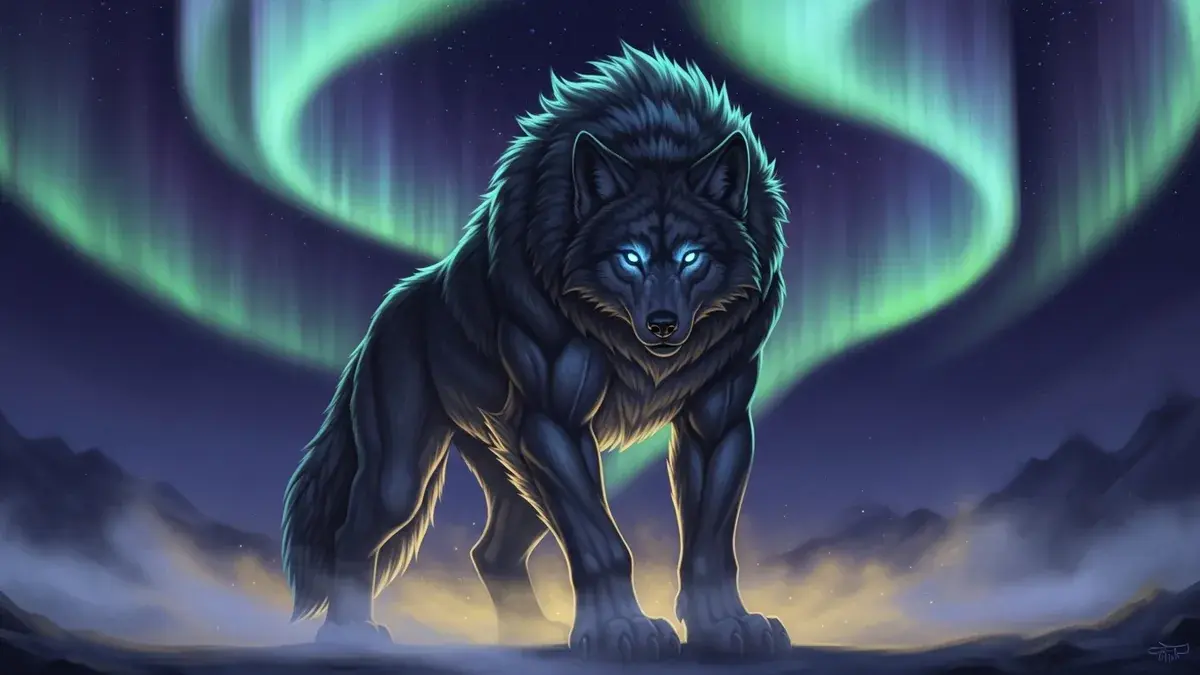
As a spirit animal, the Amarok stands for fierce personal boundaries, fearless self-reliance, and comfort with solitude. The image comes from the Inuit legend of a giant wolf that hunts alone and defends its own territory without apology. Its lessons are sharpened awareness, persistence through hardship, and the courage to stand your ground rather than back down. Those who take the Amarok as a totem tend to value independence, quiet or nighttime reflection, and trust in the hidden truths they sense beneath the surface.
An almanac
- Core message
- Guard your boundaries, embrace solitude
- Spirit animal
- Boundaries, solitude, fearless self-reliance
- Totem for
- Independent, intuitive, nighttime thinkers
- In dreams
- Solitude, boundaries, hidden truths
- Best qualities
- Standing your ground, sharpened awareness, persistence
- Cultural roots
- Inuit oral tradition
- First documented
- Rink's 1875 Eskimo tales
Deep in Inuit oral tradition prowls a wolf unlike any other: the Amarok, a colossal, solitary hunter said to stalk anyone reckless enough to wander alone at night. It's more than an oversized predator — the old stories built around it are really about boundaries, self-reliance, and the courage to stand apart from the crowd. Below: where the Amarok comes from, what its size and coloring mean, and what lessons its stories still hold.
Origins and Appearance
The name Amarok simply means "wolf" in Inuit tradition, though it refers to something far grander than any ordinary pack animal. The Amarok is described as a massive, solitary wolf-like being that towers over real wolves in size and menace, with dark gray or black fur, a heavy jaw, and claws built for bringing down anything unfortunate enough to cross its path.
Some tellings describe an all-white Amarok, a rarer and more striking variation:
- Dark gray or black coats blend into nighttime woodland, which fits the creature's role as a stealthy nocturnal hunter
- A pale or white coat, though it would seem to work against camouflage, marks the Amarok in some accounts as a survivor against the odds
Some writers compare the Amarok to the now-extinct dire wolf, a Pleistocene-era canine roughly the size of today's largest gray wolves with one of the strongest bite forces recorded among canids. The comparison is speculative rather than a documented encounter: the dire wolf died out roughly 10,000 years ago, long before Inuit ancestors emerged, and rarely ranged into Arctic territory.
The Amarok also shares story-space with other Inuit beings, including Amaguq, a trickster wolf spirit, and the Waheela, a hulking, bear-like canine. But the Amarok differs from the pack-hunting Waheela in one key way: it hunts alone, never running with companions, and that solitude is central to its symbolic meaning.
Symbolism of Solitude and Color
Where real wolves and beings like the Waheela move in groups, the Amarok hunts by itself. That single trait shapes much of what the creature represents: the value of solitude, quiet reflection, and the inner work that only happens away from the crowd.
The Amarok's coloring adds to this:
- Gray or black fur speaks to boundaries, in-between states, and transition, the neutral space where the Amarok's trickster-like nature operates
- Black specifically points toward mystery, intuition, the unseen world, and the parts of the self a person tends to keep hidden
- A white coat, standing out rather than blending in, marks the Amarok in some accounts as a survivor that defies the odds
Because of this in-between quality, storytellers cast the Amarok as a kind of guardian of boundaries: a figure that marks the line between worlds and points those who encounter it toward truths that aren't obvious on the surface.
Amarok Versus the Werewolf
It's tempting to lump the Amarok in with the werewolf of European legend, but the two part ways on a fundamental point. A werewolf begins life as a human and only becomes wolf-like through a curse, a bite, or a deliberate transformation, usually reverting again once dawn breaks.
The Amarok never goes through any such change. It is born a beast and remains one, growing only larger and fiercer with age rather than shifting between human and animal forms. That difference matters: the Amarok isn't a cautionary figure about losing one's humanity, but a being whose wild nature was always, fully, its own.
Amarok in Inuit Storytelling
Across Arctic tradition, the word Amarok sometimes names one specific giant wolf and sometimes stands in for wolves generally, but the stories built around the figure carry recurring warnings and lessons.
Several threads run through these tales:
- A cautionary hunting tale warns that anyone reckless enough to hunt alone at night, especially within the Amarok's territory, risks being stalked and devoured
- A trickster tale tells of two men who find the Amarok's pups and harm them; when the Amarok returns, it cannot be outwitted, and one man loses his life for the offense — a lesson about the danger of underestimating others and overstepping one's pride
- A balance tale shows the Amarok culling the sick and weak from an overabundant caribou herd, leaving the strongest to thrive, and frames the creature as an enforcer of natural equilibrium rather than pure menace
- A healing tale describes a disabled boy calling on the Amarok as a source of strength; after a grueling wrestling match that shakes loose his "bad bones," the boy gains the power to overcome three great bears
Taken together, these stories cast the Amarok as equal parts danger and teacher: a being that punishes recklessness and arrogance while also rewarding those who call on it honestly for strength.
The Beast of Gévaudan Connection
Outside Inuit tradition, the Amarok is often compared to La Bête du Gévaudan, the real historical wolf-like predator that terrorized south-central France's Margeride Mountains for roughly three years in the 1760s, linked to roughly 210 recorded attacks and an estimated 113 deaths.
The two share some surface traits: great size, formidable teeth, thick tails, and similar coat coloring, along with a shared reputation for hunting people rather than avoiding them.
The key difference is territory and motive. The Beast of Gévaudan was pushed out of its natural range by expanding human settlement and kept hunting land that had once been its own. The Amarok, by contrast, stays within its own territory and hunts mainly to defend it, sometimes even acting with benevolence toward humans who seek its help.
Both figures point to the same underlying tension: the pull between humanity and the natural world, and what it costs to ignore the boundaries nature sets.
Spirit Guide Lessons
As a spirit or guiding presence, the Amarok's intensity is a sign to take its message seriously rather than brush it aside. Its ferocity isn't random aggression: the Amarok famously stays within its own territory and never hunts beyond it, which makes it a fitting symbol for anyone learning to define and defend their own boundaries without apology.
Key teachings associated with the Amarok include:
- Standing your ground rather than backing down when you need to assert your values
- Sharpened awareness: the Amarok's keen night vision and sense of hearing point to noticing details others miss
- Comfort with solitude: alone time becomes a chance for reflection, heightened intuition, and a clearer read on the truth of a situation
- Persistence through hardship: the Amarok's raw resilience is a reminder to keep going when circumstances feel inescapable
Those drawn to this figure as a totem tend to value independence, prefer quiet or nighttime hours for their own thinking, and adapt well when situations turn chaotic or unpredictable, often spotting the hidden opportunity inside a difficult moment.
Amarok in Dreams
A dream featuring the Amarok often points toward themes of solitude, boundaries, or hidden truths in waking life; the exact meaning depends on the dream's context.
Common dream scenarios and their possible meanings:
- A lone Amarok may suggest an upcoming period of isolation, whether it's restorative alone time you need or a warning about creeping loneliness and disconnection from people you care about
- Grabbing or being near the Amarok's teeth or body can point to being caught off guard by something wild or unexpected, or a hint that you're taking on more than you can handle
- An Amarok on the hunt is often a nudge to guard your boundaries, since someone nearby may be trying to push you toward a decision that mainly benefits them
- A searching or wandering Amarok may reflect your own quest in waking life, raising the question of whether the path you're on is genuinely worth its cost
Across these variations, the Amarok in dreams tends to come back to the same core message: sharpen your perception, trust what you sense beneath the surface, and hold firm to the boundaries that keep you safe.
Amarok and Fenrir: Kindred Giants
Across world mythologies, oversized wolves tend to carry outsized meaning, and the Amarok has a striking cousin in Norse legend: Fenrir, the monstrous wolf-son of the trickster god Loki. Where Inuit storytellers cast the Amarok as a guardian of its own territory, the Norse gods raised Fenrir among themselves and watched him grow at a terrifying rate, until his jaws alone seemed capable of swallowing the sky. Fearing what he would become, the gods bound him with a magical fetter called Gleipnir, forged from impossible things like the sound of a cat's footfall and the breath of a fish. Fenrir still strains against those chains, and will until Ragnarök, the day he's fated to break free and kill Odin.
The contrast says something about what each wolf represents. Fenrir's story is one of betrayal and consequence: a being bound pre-emptively for a fate it never chose, whose fury at being caged becomes the very prophecy that dooms the gods. The Amarok's fury, by comparison, is earned and self-contained: it hunts only within its own bounds and only against those who invite trouble. Set side by side, the two wolves make the same point in different ways: how a boundary gets set, and why, decides whether a wolf ends up a guardian or a threat.
Amarok's Modern Namesakes
The Amarok's reputation for toughness and independence has carried well beyond Inuit oral tradition into the modern world, most visibly in Volkswagen's Amarok pickup truck, a commercial vehicle line the automaker introduced in 2010 and named directly for the legendary wolf's strength and endurance.
Musicians have reached for the name too. English composer Mike Oldfield titled his 1990 album Amarok, and the free, open-source Amarok music player later borrowed its name from that album rather than from the myth directly, a small chain of naming that shows how far the wolf's legend has traveled from the Arctic tundra where it began.
None of these modern uses capture the full weight of the original legend, but they explain why the name has stuck: over a century and a half after it was first written down, it still reads as shorthand for something solitary, powerful, and not to be underestimated.
Frequently Asked Questions
What does the Amarok symbolize?
The Amarok symbolizes strong personal boundaries, comfort with solitude, and fearless self-assertion. Its massive size and solitary hunting style tie it to strength, independence, and standing firm in one's own territory and convictions.
Where does the Amarok legend come from?
The Amarok comes from Inuit oral tradition, where it's described as a giant, solitary wolf-like being far larger and fiercer than an ordinary wolf. Some researchers connect the legend's origins to ancient Inuit encounters with the now-extinct dire wolf, a real prehistoric canine known for its size and powerful bite.
Is the Amarok the same as a werewolf?
No. A werewolf starts out as a human who transforms into a wolf-like form, often reverting back at dawn. The Amarok is born a beast and stays that way, never shifting between human and animal, which sets it apart from werewolf lore even though the two figures share a fearsome reputation.
Who first wrote down the Amarok legend?
Much of what's known about the Amarok today traces back to the Danish scholar Hinrich Rink, who documented Inuit tales and beliefs in his 1875 book Tales and Traditions of the Eskimo, drawn from accounts gathered in Greenland. Rink noted that Greenlandic Inuit reserved the name Amarok specifically for this legendary giant wolf, while other Arctic communities used the same word more loosely for wolves in general.
Is the Amarok related to Fenrir from Norse mythology?
Not directly: the two come from entirely separate cultures and story traditions, but they're often compared as kindred giant wolves. Fenrir, the monstrous offspring of the trickster god Loki, was chained by the Norse gods after growing too large and dangerous, and is fated to break free and kill Odin at Ragnarök. The Amarok never faces that kind of pre-emptive punishment; its power stays contained to its own territory, which makes it a guardian rather than a world-ending threat.
Sources
Claims on this page were checked against these published sources.
- Amarok (wolf)
An Amarok, or Amaroq, is a gigantic wolf in Inuit religion, said to stalk and devour any person foolish enough to hunt alone at night... Unlike wolves who hunt in packs, amaroks hunt alone.
Read the source → - Dire wolf
the bite force at the canines (in newtons/kilogram of body weight) was greatest in the dire wolf (163), followed among the modern canids by the four hypercarnivores that often prey on animals larger than themselves: the African hunting dog (142), the gray wolf (136), the dhole (112), and the dingo (108).
Read the source → - Beast of Gévaudan
the former province of Gévaudan (consisting of the modern-day department of Lozère and part of Haute-Loire), in the Margeride Mountains of south-central France... between 1764 and 1767... 210 attacks, resulting in 113 deaths and 49 injuries; 98 of the victims killed were partly eaten.
Read the source → - Fenrir
Earthquakes will set Fenrir the Great Wolf free, and he will open his mouth so wide that his upper jaw captures heaven and his lower jaw the Earth, and he will rampage through all the nine worlds... The wolf ultimately kills Odin, and is then killed by Odin's son Vidarr.
Read the source → - Amarok (disambiguation)
Amarok (Mike Oldfield album) - Released in 1990; Amarok (software) - an open-source audio player named after the Mike Oldfield album; Volkswagen Amarok - a pickup truck
Read the source →