Mythical Creature
Big Foot Symbolism & Meaning
The elusive giant who teaches you to stand your ground and trust what your senses tell you.
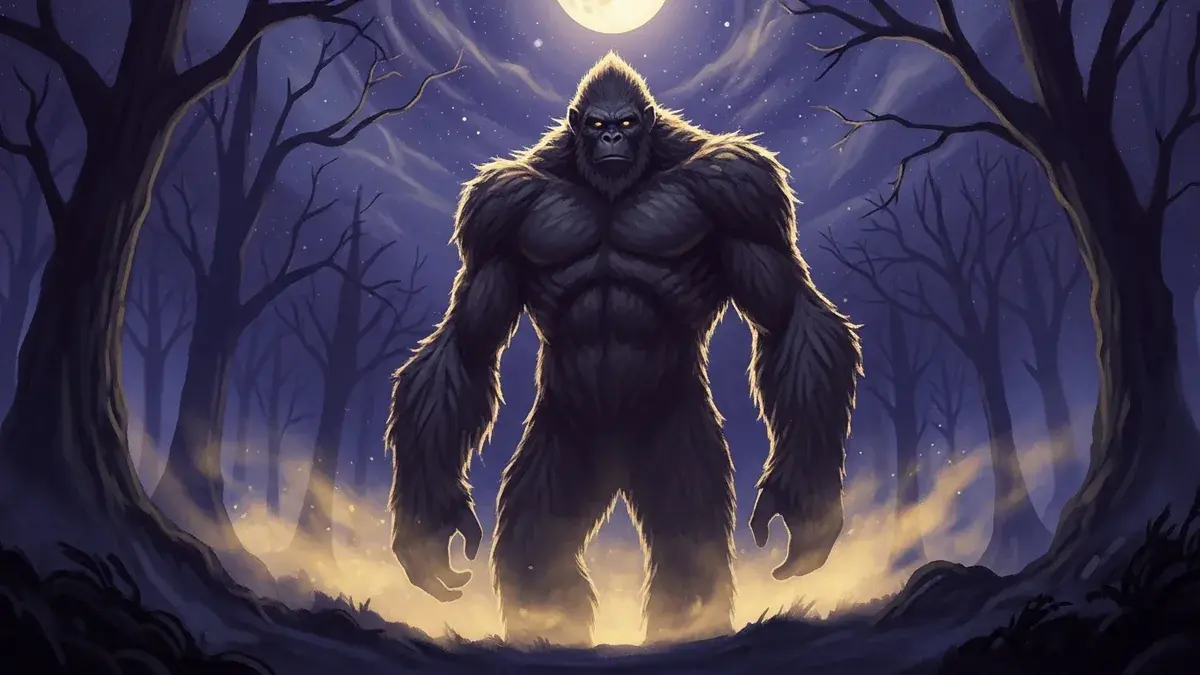
Bigfoot, Sasquatch, and Yeti symbolize the hidden and unproven, fierce independence, and the courage to stand your ground rather than be crowded out. As a spirit animal, this figure tends to appear when you feel cornered, worn down by other people's energy, or stuck despite your best efforts. It asks you to trust your instincts, retreat into solitude long enough to recover, and hold your own path even when no one else understands it.
An almanac
- Core message
- Stand your ground and trust your instincts
- Spirit animal
- Confidence when you feel cornered or crowded
- Totem for
- Truth-seekers drawn to mystery and the unexplained
- Power animal
- Cutting through deception to reach the truth
- In dreams
- A big, unforeseen change is heading your way
- Cultural roots
- Indigenous "Wild Man" legends across North America
- Himalayan name
- Yeh-teh (Sherpa) or Migoi (Bhutanese)
- Most famous evidence
- The 1967 Patterson-Gimlin film, Bluff Creek, CA
Few legendary beings capture the imagination quite like the towering, hair-covered wanderer known across the world by many names — Bigfoot, Sasquatch, and Yeti. Whether glimpsed at the edge of a forest or debated around a campfire, this figure stands for everything that resists easy explanation. Its meaning runs deeper than a blurry photograph or an oversized footprint in the mud: this creature speaks to hidden truths, fierce independence, and the courage to hold your ground when the world tries to crowd you out.
Bigfoot, Yeti & Sasquatch Symbolism and Meaning
Picture an enormous, ape-like figure covered in shaggy hair, moving upright on massive feet. That image alone has been enough to generate reported encounters across nearly every U.S. state and Canadian province. It is little wonder the creature has become shorthand for anything oversized or larger than life.
The name "Sasquatch" traces back to the Halkomelem language, where it was a broad label for the many "Wild Man" stories told across numerous Indigenous nations. The word "Bigfoot" came into popular use decades later, after outsized tracks were discovered and attributed to the creature.
Although often lumped together, the Yeti is technically a separate legend: it belongs to icy alpine terrain rather than the temperate forests favored by Sasquatch. The two share a build and a reputation, but not a homeland.
Across the many descriptions, a few features repeat: a two-legged gait, a towering frame anywhere from six to nine feet tall, a weight that can reportedly reach 1,000 pounds, and a coat that ranges from white to reddish, brown, or black. Many accounts also mention an overpowering odor that announces the creature before it's ever seen.
The color of its coat carries meaning too. Red suggests stamina, passion, and raw strength. Brown points to grounded simplicity and stability. Black carries an air of mystery, secrecy, and detachment. White speaks to purity and calm.
Because no specimen has ever been conclusively proven to exist, the creature has become a symbol of the hidden and the unproven. Its preference for solitude over the crowd makes it a symbol of fierce individuality and resistance to herd thinking as well.
Bigfoot, Yeti & Sasquatch as a Spirit Animal
When Bigfoot shows up as a spirit guide, it tends to arrive during moments when you feel small, cornered, or pushed around by people or circumstances. Bigfoot avoids conflict by nature and prefers distance to confrontation, but it will not be backed into a corner. Its lesson is simple: stand up for yourself.
Sasquatch tends to surface as a guide when you're worn down by the emotional noise of everyone around you. This is a fitting guide for empaths and highly sensitive people who struggle to filter out other people's feelings, since Sasquatch is a master of slipping away unnoticed. It shows you how to step back into temporary solitude and let your depleted energy recover.
The Yeti tends to appear after a long stretch of effort that hasn't yet paid off — when your best attempts keep falling short of your goal. Rather than push harder, Yeti energy points you toward new angles and unexpected openings, so you finally get a foothold where none seemed to exist.
Bigfoot, Yeti & Sasquatch as a Totem Animal
Those born under Bigfoot as a totem tend to have a built-in radar for dishonesty — you're rarely fooled, and you have little patience for people who aren't being genuine with you.
A Sasquatch totem points to a restless curiosity about the unexplained. People with this totem are natural students of the fringe — drawn to esoteric subjects, mysteries, astrology, numerology, or metaphysics — and they never lose their appetite for the thrill of discovery.
Those carrying the Yeti as a totem tend to be self-reliant survivalists who lean on instinct more than instruction. Time spent in nature, whether a brief hike or a more permanent retreat from modern comforts, tends to feel like home.
Bigfoot, Yeti & Sasquatch as a Power Animal
Call on Bigfoot as a power animal when you need to cut through deception and get to the plain truth. If a conflict is tangled up in half-truths or outright lies, Bigfoot's instincts help you sense when something is off and push past the noise to the hard facts.
Lean on Sasquatch energy when you're ready to grow beyond your current limits but need a nudge to actually move. Sasquatch roams without boundaries, and that same untamed confidence can help you take the bold step outside your comfort zone.
Invoke the Yeti when you want permission to simply be yourself. Nobody dictates terms to the Yeti — it lives entirely on its own path. As a power animal, it helps you discover who you are and walk tall as your true, unfiltered self.
Native American Symbolic Meanings
Long before the term "Bigfoot" entered mainstream vocabulary, countless Indigenous nations already told their own versions of the towering "Wild Man." The temperament of the being differed from community to community, even where the physical description stayed remarkably consistent.
- Pacific Northwest tribes such as the Salish, Chinook, and Bella Coola describe a large, hair-covered forest dweller called Boqs or Skoocum. The Bella Coola regard it as a dangerous, human-eating being, while the Salish and Chinook generally see it as harmless.
- The Ahtna of southern Alaska tell of the Kol'eni (or Ts'et'eni), a bogeyman-like figure said to snatch and consume children across the tundra.
- The Chickasaw of the southeastern woodlands speak of the Lhofa (or Lhonfa), an ogre-like being whose name translates to "Skinner" or "Flayer" — a hint at its most gruesome habits, including abducting women.
- The Choctaw share tales of a nearly identical figure, The Shampe, so foul-smelling that no one dares approach it.
- The Dakota and Lakota describe the Chiye-Tanka (or Chiha-Tanka), whose name — "Big Elder Brother" — hints at a spiritual or even ancestral kinship between the creature and the people who tell its story.
- The Wenatchee people of Washington State speak of the Choanito, or "Night People," mountain- and cave-dwelling beings known for their Trickster streak; some tales describe them holding humans captive for a season before releasing them unharmed.
- The Lummi and Salish tell of the Stick Indians, forest spirits whose exact appearance shifts from tribe to tribe but who share the same unsettling traits as other Wild Man legends — luring victims with laughter or eerie whistling, then leading them astray, and even holding the power to hypnotize or paralyze. The name itself is a substitute term, used out of a belief that speaking the creature's true name might summon its attention.
Bigfoot, Yeti & Sasquatch in Dreams
A Bigfoot appearing in a dream often signals that a big, unforeseen turn of events is heading your way — for better or worse, depending on the tone of the dream itself.
If you dream of Sasquatch fleeing or hiding from people, it may point to a situation in waking life you feel you cannot escape, or it may be a nudge to avoid a direct clash with someone until you have the full picture.
When a Yeti turns up in a dream, it may reflect a fear that others doubt your abilities, or it may be a caution against being too trusting: watch for people or promises that sound better than they really are.
The Yeti in Himalayan Tradition
Long before Western expeditions went hunting for it, the Yeti already had names and a role in the communities living beneath the Himalayas. Sherpa tradition calls it the Yeh-teh, meaning roughly "small, man-like animal," while a related term, Metoh-kangmi, gave the West its "Abominable Snowman" nickname. In Bhutan, it is known as the Migoi, or "strong man." These are not interchangeable labels for one Western idea — they are the names a people gave to a being that already belonged to their own cosmology.
In Tibetan and Sherpa belief, the Yeti was never purely a monster to be feared. It was both a guardian of sacred ground — said to protect monasteries and holy sites and ward off negative influences — and a cautionary figure, the kind of story parents told to keep children from wandering too far into avalanche country. Some monasteries went further, keeping relics said to be Yeti remains: the monastery at Pangboche, Nepal, held a hand and scalp displayed during ritual ceremonies, treated as sacred objects rather than scientific specimens. When DNA testing was finally done on a smuggled finger from that hand in 2011, it matched human DNA. To the monks, the relic's power lay in the reverence it commanded as a boundary-keeper between the human world and the wild peaks, regardless of the DNA result.
That dual identity — dangerous and protective in the same breath — sets the Himalayan Yeti apart from its North American cousins. Where Bigfoot and Sasquatch stand for fierce independence, the Sherpa and Tibetan Yeti is about guardianship earned through distance: a power that watches over a threshold precisely because it stays on the far side of it.
Regional Cousins Across North America
"Bigfoot" and "Sasquatch" are the names most people reach for, but nearly every region of North America has told its own version of this story under its own name — and the local details often say something about the character of the place itself.
- Skunk Ape (Florida and the greater Southeast) — a shorter, stockier cousin of the northern Bigfoot, standing roughly five to seven feet tall, best known for a stench so strong it gave the creature its name.
- Fouke Monster (Fouke, Arkansas) — tied to a widely reported 1971 incident in which residents said the creature reached through a window of a rural home; the story inspired the 1972 docudrama The Legend of Boggy Creek, which became one of the highest-grossing films of that year.
- Momo (rural Missouri, notably Louisiana, Missouri) — reported most heavily in 1972, described by witnesses as roughly seven feet tall with a strong odor and, in some accounts, a strange, pumpkin-shaped head.
- Ohio Grassman — the Midwest's version of the same wild-man archetype, associated with the wooded hill country of eastern Ohio.
Each regional name tells the same story in different words: this isn't one legend but a pattern that repeats wherever deep woods meet small, close-knit communities that need a way to talk about what might be watching from the treeline.
Frequently Asked Questions
What does Bigfoot symbolize?
Bigfoot represents the hidden, the unproven, and the larger-than-life. Because no physical evidence confirms its existence, it has become a symbol of mystery and secrecy. Its preference for solitude over crowds also makes it a symbol of individuality and resistance to herd mentality.
What's the difference between Bigfoot, Sasquatch, and Yeti?
Sasquatch is the broader term, rooted in the Halkomelem language, used for the "Wild Man" figure described across many Indigenous traditions; Bigfoot came into popular use later after oversized footprints were attributed to the same creature. The Yeti is a related but separate legend tied to cold, mountainous regions, whereas Bigfoot and Sasquatch are typically associated with warmer, forested terrain.
What does it mean to see Bigfoot or Sasquatch in a dream?
Dreaming of Bigfoot often points to a big, unexpected change on the horizon. Seeing Sasquatch hiding or fleeing may reflect a situation you feel unable to escape, or a nudge to avoid confronting someone before you know all the facts.
Is there any famous footage or physical evidence of Bigfoot?
The most famous piece of purported evidence is the Patterson-Gimlin film, shot on October 20, 1967, along Bluff Creek in California's Six Rivers National Forest. The roughly minute-long, 16mm clip shows a large, hair-covered, bipedal figure walking through a clearing, and it remains the most scrutinized and debated piece of Bigfoot evidence more than five decades later — supporters point to its gait and proportions, while skeptics call it a costume. No conclusive physical specimen of Bigfoot, Sasquatch, or Yeti has ever been produced.
Do any monasteries claim to have Yeti relics?
Yes — for generations, a monastery in Pangboche, Nepal, kept a hand and scalp said to belong to a Yeti, displaying them during ritual ceremonies as sacred objects. When a smuggled fragment was finally DNA-tested in 2011, it matched human DNA rather than any unknown primate. To the monks, though, the relic's value lay in the Yeti's standing as a guardian spirit of the mountains, regardless of what science later found.
Sources
Claims on this page were checked against these published sources.
- Bigfoot
Burns coined the term "Sasquatch," believed to be the "anglicized version of sasq'ets (sas-kets), roughly translating to 'hairy man'" in the Halq'emeylem language.
Read the source → - Yeti
said to inhabit the Himalayan mountain range in Asia... The Yeti is commonly compared to Bigfoot of North America as the two subjects often have similar physical descriptions.
Read the source → - Native American Bigfoot Characters of Myth and Legend
Boqs (Bella Coola Bigfoot); Skookum (Chinook Indian Bigfoot)
Read the source → - Ahtna Legends, Myths, and Traditional Indian Stories
Bush Indians often feature as bogeymen in Athna stories told to children, sometimes kidnapping or even eating unwary kids.
Read the source → - Lofa: Name and Behavior (Native-Languages.org)
His name literally means 'flayer' or 'skinner'... In some legends he attempts to abduct Chickasaw women.
Read the source → - Chiye-Tanka (Chiha Tanka), mythical being of the Sioux
His name literally means 'Big Elder Brother.'
Read the source → - Native American Legends: Stick Indians
Stick Indians are malevolent and extremely dangerous forest spirits... with specific mention of the Lummi... In some traditions Stick Indians have powers to paralyze, hypnotize, or cause insanity... they merely lead people astray by making eerie sounds of whistling or laughter... saying the actual Salish names of these beings in public is considered to be provoking their attacks in some tribes.
Read the source → - Pangboche Hand
The artifact was held at a Buddhist monastery in Pangboche, Nepal. Supporters claimed it belonged to a yeti... Pangboche monastery preserved the hand as a sacred relic, reportedly parading it during village fertility rituals according to local Buddhist tradition.
Read the source → - Patterson–Gimlin film
Date: October 20, 1967. Location: Along Bluff Creek tributary in Northern California's Six Rivers National Forest... Film Length: 23.85 feet (954 frames, approximately 59.5 seconds at 16 fps).
Read the source → - Skunk ape
The skunk ape inhabits forests and swamps in the southeastern United States, most notably in Florida... standing approximately 1.5-2.1 meters (5-7 feet) tall... Reports consistently describe a stench similar to that of a skunk.
Read the source → - Fouke Monster
The creature inspired the 1972 docudrama horror film The Legend of Boggy Creek... The monster allegedly attacked the home of Bobby and Elizabeth Ford on May 2, 1971.
Read the source → - Momo the Monster
A large, hairy mythical humanoid creature... reportedly sighted in rural Missouri... Most prominent in 1972... approximately 7 feet tall, bipedal, and covered in dark hair.
Read the source →