Mythical Creature
Amphisbaena Symbolism & Meaning
The two-headed serpent of Greek and Roman legend, a symbol of balance between opposing paths.
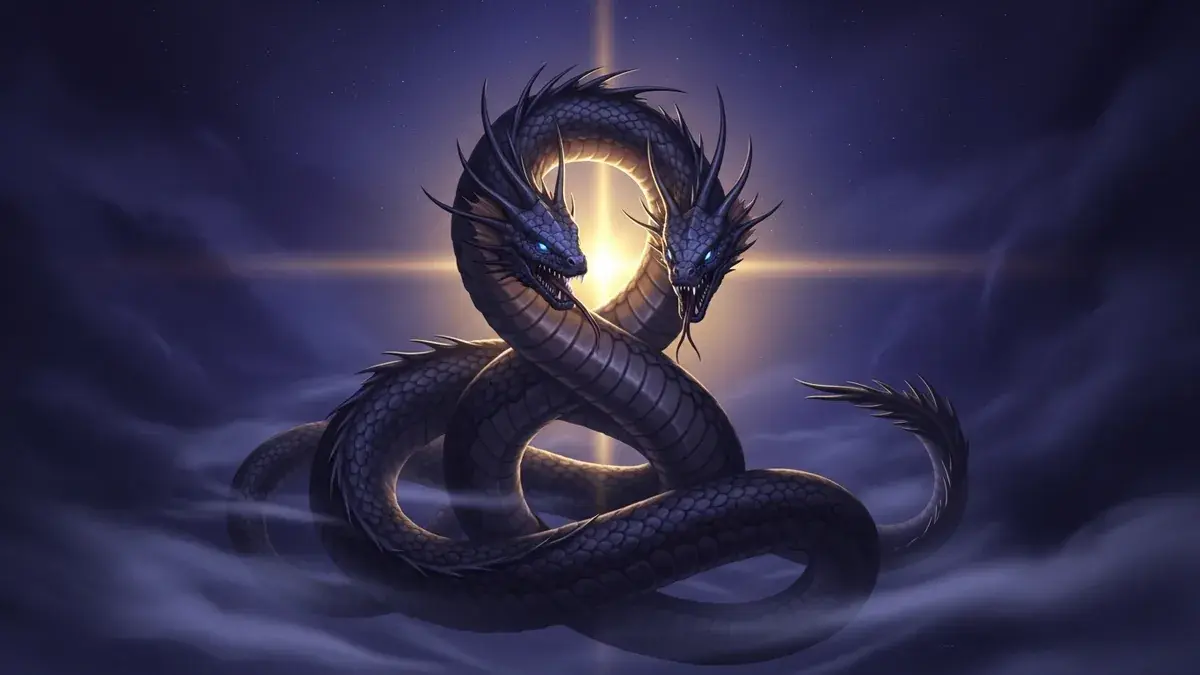
The Amphisbaena, a two-headed serpent from Greek and Roman legend, symbolizes duality and balance — the tension between opposing paths and the cooperation needed to move forward together. As a spirit animal it appears when you're torn between choices, asking you to weigh every option before taking the smoothest route ahead. It's also tied to adaptability, healing, and renewal, since legend credits it with regenerating after injury.
An almanac
- Core message
- Weigh both sides before moving forward
- Spirit animal
- Appears when you're stuck between choices
- Totem for
- Composed, open-minded communicators
- Power animal
- Adaptability, healing, and harmony
- In dreams
- Balance settling in, or unresolved inner conflict
- Element
- Earth and Air
- Real-world kin
- Namesake of 100+ real burrowing worm lizard species
- Bestiary detail
- Eyes described as glowing "like lamps"
Few creatures in classical legend look as strange as the Amphisbaena — a serpent with a working head at each end of its body. It first appears in the writings of ancient Greece and Rome, and this double-headed creature has turned up in natural histories, medieval bestiaries, and epic poetry for more than two thousand years. Its odd anatomy made it a symbol of duality, balance, and the tension between opposing choices.
Origins & Symbolic Meaning
Stories about the Amphisbaena go back to the first century BCE. The Roman naturalist Pliny the Elder was among the first to describe it: a scaly, colorful serpent, doubly venomous because it carried two mouths that could both strike.
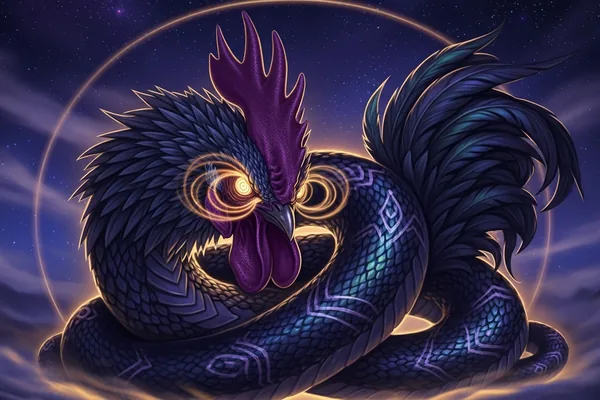
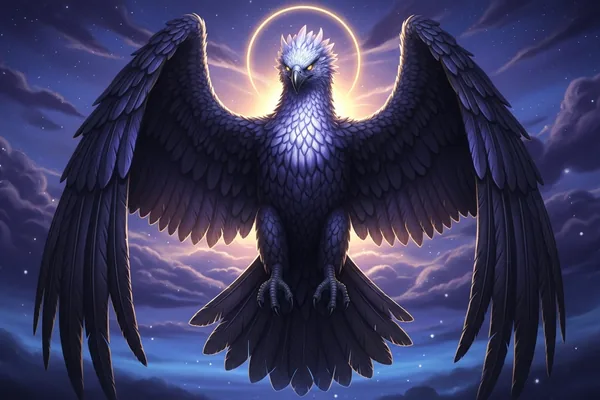
Medieval illustrators later gave it a rooster's clawed, feathered feet or an eagle's talons and wings, and sometimes drew one head as a dragon's. The two heads so often mirror each other that many depictions make it hard to tell which end is the tail — a visual riddle that gave the creature its reputation as a symbol of unusual perception and the blending of contrasting ideas.
Legend placed the creature equally at home in freezing climates and the parched Libyan desert, so it also stands for adaptability and resilience. The poet Nicander of Colophon connected the legend to a real, limbless lizard whose blunt-ended body can look headless at both ends, reading that resemblance as a caution about illusion and deceptive appearances.
Nicander also claimed its shed skin, wrapped around a walking stick, warded off other serpents. That image echoes the caduceus carried by Hermes and ties the creature to healing arts.
The Amphisbaena's shape itself speaks to symmetry, equilibrium, and agreement, and its mirrored form fits naturally with Carl Jung's idea of synchronicity, the theory that meaningful events echo one another. Its reported diet of ants ties it to virtues like modesty, community spirit, and industriousness. Its supposed ability to regrow a severed half, or a lost head after decapitation, connects it to renewal and rebuilding.
The name comes from the Greek amphis ("both ways") and bainein ("to go"). To travel quickly, legend says it tucks one head into the other's mouth and rolls like a wheel — an image of cooperation and coming full circle that recalls the ouroboros.
Because each head has its own mind, both must agree before the creature moves, a reminder of shared responsibility. When they disagree instead, the Amphisbaena comes to represent deadlock and stalemate. The Roman writer Aelian offered a tidier version, with one head always leading and the other trailing as a tail, an image of efficiency and mastery.
People in the ancient world treated the Amphisbaena as practical magic: pregnant women wore it as a protective amulet, its shed skin treated colds, and its dried, powdered remains were used on broken bones and arthritis. With at least eight recorded spelling variants of its name, it also came to symbolize shifting identity and the search for one's true path.
In tarot, its doubled nature echoes the twos of each suit: weighing viewpoints, uniting opposites, staying balanced. It is associated with the Earth and Air elements, grounded in its movement yet linked through its twin heads to thought and intellect.
Medieval writers added more color. The scholar Isidore of Seville wrote that the creature's eyes "glow like lamps," and legend held it was the first serpent to appear each spring, braving the cold before any other snake dared to stir — a detail that turned the Amphisbaena into a small emblem of courage in early beginnings, the nerve to step into a new season before anyone else will. Pliny went further, claiming that its shed skin or dried body, fastened to a tree about to be felled, kept woodcutters from feeling the cold at all — one more thread tying the creature to comfort and endurance. Not every ancient reader took the two heads literally, either: the medieval naturalist Albertus Magnus argued that its equal-sized ends and habit of moving in both directions only created the illusion of twin heads — a skeptic's reminder that the Amphisbaena's oldest lesson may be about how easily perception mistakes symmetry for something stranger than it is.
Amphisbaena as a Spirit Animal
When you feel stuck — unsure which way to take a project, a relationship, or a spiritual path — the Amphisbaena may appear as a spirit guide urging patience. It asks you to weigh every option before committing, then shows you the smoothest, most efficient route forward.
If you've made a choice but still feel uneasy, it arrives to steady your nerve, often a sign that meaningful coincidences are confirming you're on the right track.
The Amphisbaena also surfaces when indecision itself is the problem, or when a disagreement with someone else has stalled communication. Its sidewinding motion becomes a lesson: get everyone moving in the same direction again. Because it's cold-blooded, it makes a fitting companion for keeping a level head when strong emotions threaten to boil over.
Amphisbaena as a Totem Animal
Those who claim the Amphisbaena as a totem tend to be composed and sensible even amid surrounding chaos. An open mind is one of your greatest strengths — you can view a situation from multiple angles and reach the broadest possible perspective, and your communication and intellect tend to stand out.
The flip side of having "two heads" is that they can just as easily clash as cooperate. Totem-holders can be prone to stubbornness, a hot temper, or head-butting conflicts. The creature's venomous reputation is a further warning: sharp words spoken in anger can wound as deeply as a bite, and people with this totem sometimes have to work at curbing a habit of speaking before thinking.
Amphisbaena as a Power Animal
Call on the Amphisbaena when you're stepping into unfamiliar territory and need to adapt quickly, or when you want harmony to prevail at work or in a relationship. Its heightened perception is useful for reading people more clearly and steering social situations toward peace rather than conflict.
Invoke this power animal, too, when you want to support someone else's healing or sharpen your own skill in the healing arts, or when you need fresh insight. If you're rebuilding your life or searching for what will make you feel whole, the Amphisbaena helps power that inner search — and when a moment calls for staying alert instead of burying your head in the sand, it lends the awareness needed to secure lasting peace.
Greek & Roman Legends of the Amphisbaena
One of the most vivid origin tales ties the Amphisbaena to the hero Perseus. After beheading Medusa to satisfy King Polydectes of Seriphos, Perseus flew over the Libyan desert carrying the Gorgon's severed head. Drops of her blood fell to the sand, and from them the Amphisbaena was born.
Because it springs from Medusa's blood, the creature became linked to knowledge that is both dangerous and dazzling, and to how quickly such knowledge can spread once loosed on the world.
Another strand of legend describes the Amphisbaena as blind and dependent on ants for food, which is how it earned the titles "King of Ants" and "Mother of Ants." Other tellings cast it as so venomous that it wasn't content unless both heads delivered a bite. That reading turns it into a fearsome ally when you need to shore up your own defenses.
Some versions also claim one head sleeps while the other stays awake. That's read as an image of the conscious and subconscious mind working in shifts, and a reminder to stay alert to protect yourself.
The legend even made its way into English literature: in John Milton's Paradise Lost, the angels who backed Satan's rebellion are transformed into Amphisbaenae upon his return to Hell — a fitting shape, since Satan took the form of the serpent to tempt Eve, and the creature's split nature naturally mirrors the pull between good and evil, or between listening to temptation and resisting it.
Dreaming of the Amphisbaena
Seeing an intact, two-headed Amphisbaena in a dream tends to signal balance and satisfaction settling into your waking life. If the creature appears injured or missing a head instead, it can reflect inner conflict, confusion, or an emotional imbalance you're currently trying to untangle.
- Crawling through desert sand — a nudge to step back and do some quiet inner reflection.
- Appearing in a cold climate — a hint that you, or a partner, may be feeling emotionally distant or shut out.
- Indistinguishable head and tail — trouble "making heads or tails" of someone, often due to a communication breakdown.
- Moving toward you — a sign you'll need to face a challenge head-on rather than retreat.
- Moving away from you — a suggestion to hold off on a commitment you aren't ready for.
- Rolling with one head inside the other's mouth — a coming face-to-face reckoning where differences need to be worked out, or a warning that trouble is brewing.
The Real Creature Behind the Legend
Long before bestiaries dressed it in feathers and dragon wings, the Amphisbaena's name was already borrowed for something entirely real. The amphisbaenians, often called worm lizards, are a family of legless, burrowing reptiles — the genus Amphisbaena alone holds over a hundred recognized species — found underground across the Americas, Africa, the Middle East, and parts of Europe.
Their bodies explain the legend better than any myth could. A worm lizard's tail is blunt, ringed with the same scale pattern as its skull, and truncates in a way that genuinely looks like a second head. Because its skin sits loosely over its body, the creature can travel backward through a tunnel using the same accordion-like ripple it uses to move forward — a trick so convincing that ancient naturalists could be forgiven for believing two separate minds steered one body. Life spent entirely underground has also reduced their eyes nearly to nothing, a detail early writers folded into their own stories about a creature that could barely tell head from tail.
Symbolically, the worm lizard is a strange gift: proof that a legend of duality grew out of an animal that navigates total darkness by trusting both of its ends equally. If the Amphisbaena calls to you as a totem, it's worth remembering that its wildest myth and its quiet biological reality point at the same lesson — that moving confidently in either direction can matter more than insisting only one way is truly "forward."
Frequently Asked Questions
What does the Amphisbaena symbolize?
The Amphisbaena's two heads make it a lasting symbol of duality and balance — the ability to weigh opposite viewpoints, merge contrasting ideas, and settle into equilibrium. It's also tied to adaptability, illusion versus reality, healing, and renewal, since legend credits it with regenerating after injury.
Where does the Amphisbaena come from in mythology?
The creature first appears in Greek and Roman writing from around the first century BCE, described early on by Pliny the Elder. One popular legend traces its birth to drops of Medusa's blood falling on the Libyan desert as Perseus flew overhead.
What happens if the Amphisbaena's two heads disagree?
Because each head has its own mind, legend says both must agree before the creature can move. When they don't, the Amphisbaena comes to represent deadlock, stalemate, and no-win situations — a caution about what happens when cooperation breaks down.
Is the Amphisbaena based on a real animal?
Yes — its name was later given to the amphisbaenians, a family of legless, burrowing reptiles known as worm lizards. Their blunt, ring-scaled tails genuinely resemble a second head, and they can travel backward through their tunnels almost as easily as forward, a trait that likely helped inspire the ancient legend.
Why does legend say the Amphisbaena appears before all other snakes?
Medieval naturalists, including Isidore of Seville, described the Amphisbaena as uniquely resistant to cold, braving the chill of early spring before any other serpent dared to stir. That detail made it a small emblem of courage in new beginnings — stepping into a fresh season while everything else is still waiting it out.
Sources
Claims on this page were checked against these published sources.
- Amphisbaena
The amphisbaena has a twin head, that is one at the tail end as well, as though it were not enough for poison to be poured out of one mouth.
Read the source → - Amphisbaena - Etymology, Origin & Meaning
from Greek, from amphis "both ways" (see amphi-) + stem of bainein "to go, walk, step,"
Read the source → - Amphisbaena (lizard)
These creatures are 'legless, with ring-like scales, and highly reduced eyes.' ... 'subterranean predators' ... 'native to South America and the Caribbean,' with 102 recognized species.
Read the source → - Amphisbaenia
The tail truncates in a manner that vaguely resembles the head. ... Amphisbaenians are found in North America, Europe, Africa, South America, the Middle East, and the Caribbean.
Read the source → - Amphisbaena
Its eyes glow like lamps ... This serpent alone 'trusts itself to the cold' and appears before all other serpents, even preceding the cuckoo's call (Pliny, Isidore).
Read the source →