Mythical Creature
Sphinx Symbolism & Meaning
The riddling guardian that pairs beastly strength with human insight, testing whether you're ready for what comes next.
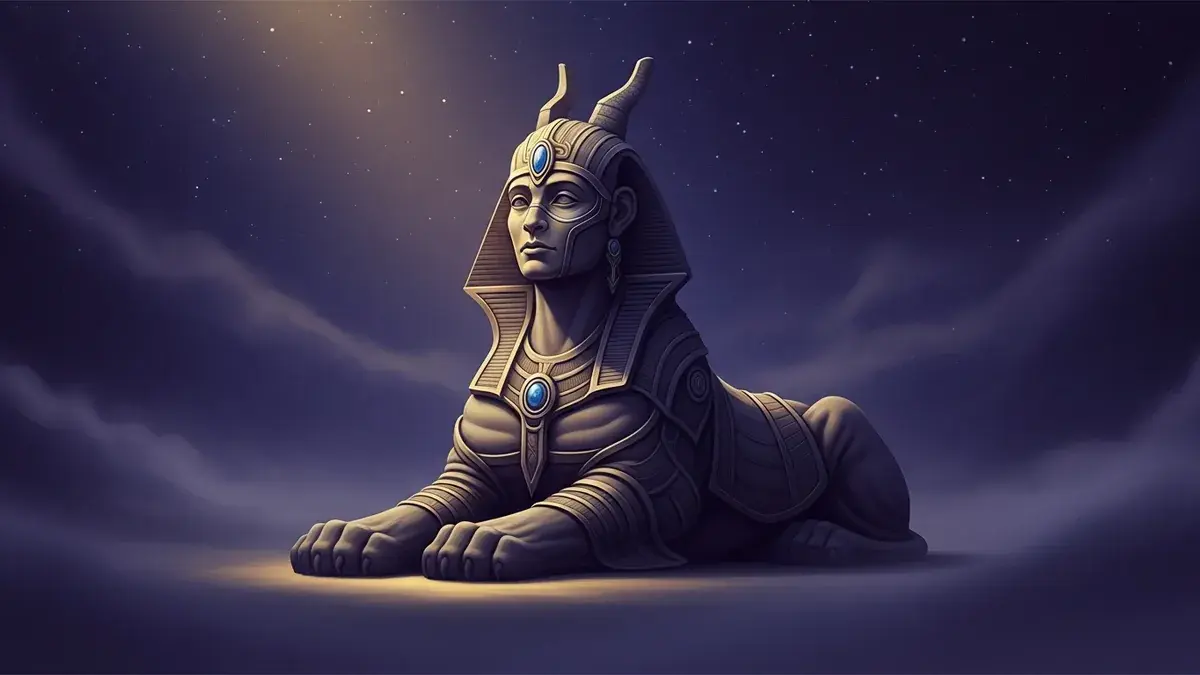
As a spirit animal, the Sphinx pairs raw strength with sharp intellect. It shows up for people who are actively looking for answers, self-knowledge, or a new position of respect in their community, and it guards sacred thresholds and hidden wisdom: you earn passage by proving you're ready, not by forcing your way through. Its presence tends to bring confidence along with humility, and a renewed connection to the knowledge held by ancestors and elders.
An almanac
- Core message
- Guardian of thresholds who tests wit before granting passage
- Spirit animal
- Seekers of answers, self-knowledge, or a new role of respect
- Totem for
- Mentally sharp, secret-keeping protectors with a playful edge
- Power animal
- Protecting something valuable or uncovering hidden treasure
- In dreams
- Facing an unfaced truth, sudden clarity, or reclaiming independence
- Cultural roots
- Egyptian, Greek, Arab, Asian, and Celtic traditions
- Great Sphinx size
- 240 ft long, 66 ft tall, carved from Giza limestone
- Famous riddle
- Walks on 4 feet, then 2, then 3 — answer: man
Few legendary beings carry the weight of a question quite like the Sphinx. Half animal, half thinking human, this composite figure has stood at thresholds for thousands of years, demanding that anyone who wants to pass prove their wit first. The stone guardian at Giza and the riddling menace of Greek legend are the same idea wearing different faces: strength and intellect held together, and the unknown earned rather than forced.
Where the Name Comes From
The word Sphinx traces back to an ancient Egyptian phrase often rendered as "shesep-ankh," meaning something close to living image or living statue. That fits: the great carved figure resting near the pyramids has sat in the desert for thousands of years, largely unchanged, while everything around it kept shifting.
Egypt is where the Sphinx first rose to prominence, but the figure traveled well beyond it, picking up new details and new symbolic jobs in each place it landed. Some cultures treated it mainly as a guardian; others folded it into the idea of a personal totem describing someone's character. Egypt is still where the image reached its largest, most monumental form.
A Body Built From Two Symbols
In its classic Egyptian form, the Sphinx joins the body of a lion to the head of a human. Each half contributes something the other lacks:
- The lion's body supplies raw power and authority.
- The human head supplies reasoning and judgment.
Together, the two halves were understood as a bridge between people and the divine — a being strong enough to act in the physical world and wise enough to carry sacred purpose. Its placement at the entrance to the Giza necropolis reinforces this: sitting where it does, the Sphinx reads as a sentinel over everything the ancient Egyptians held most sacred.
The Greek Sphinx and Her Riddle
Greek tradition reshaped the figure, giving it a lion's body paired with a woman's head rather than a man's. The most famous story tied to this version is the myth of Oedipus, where travelers could only pass a particular route if they answered the Sphinx's riddle correctly. Fail, and there was no safe passage.
That single story built the Sphinx's reputation as a keeper of mystery and hidden wisdom: rather than simply blocking the way, she tested whether your mind had earned the right to continue.
The riddle itself has survived intact: "What walks on four feet in the morning, two in the afternoon, and three at night?" Oedipus answered correctly — man, who crawls as an infant, walks upright in the prime of life, and leans on a cane in old age. Upon hearing the answer, the Sphinx is said to have thrown herself from her rocky perch to her death, unable to bear being outwitted at her own game. Her power lived entirely in the unsolved question, and once it was answered, her reign over that threshold simply ended.
The Sphinx Beyond Egypt and Greece
Egypt and Greece may dominate the popular image of the Sphinx, but the figure shows up well beyond those two traditions:
- Ancient Arab storytellers called the Sphinx the Father of Terror and, much like the Egyptians, treated it as a protective presence.
- Artists across parts of Asia frequently gave the Sphinx wings, giving the design a more celestial quality.
- In India, the Sphinx's presence was linked to clearing wrongdoing from someone who approached in need.
Given this reach, wearing or displaying a Sphinx image has long been treated as a way to ward off ill will and negative influences, a small piece of that ancient guardianship carried into everyday life.
Sphinx as a Spirit Animal
When the Sphinx shows up as a spirit animal, it tends to be drawn to people actively seeking something: answers, self-knowledge, or a deeper sense of purpose. It carries old memories and dormant skills, and its presence can bring back abilities you'd long forgotten you had. It also strengthens your connection to ancestors and elders, the keepers of knowledge who came before you.
A second common reason the Sphinx appears is a looming shift in status: a promotion, a new position of respect within your community, or some other step into a more visible role. As a creature tied strongly to the sun, the Sphinx lends confidence for that new responsibility while keeping you grounded and humble.
For those walking a spiritual path, it also teaches devotion and the gradual release of purely personal wants in favor of serving something larger than yourself.
Sphinx as a Totem Animal
People born with the Sphinx as a totem tend to be formidable in any contest, favoring mental sharpness but perfectly capable of physical effort when it's required. As children, they're often clever and hard for parents to keep up with, drawn to strategy games, planning, and competitive sports that let them burn off that fiery drive.
Sphinx-totem people tend to carry a distinctive, slightly mischievous sense of humor: agree to help you, and there's a fair chance they'll attach some small condition first, whether that's a puzzle, a clever pun, or a playful test. Underneath the game, though, is something they take seriously: a natural talent for guarding secrets. If you need someone trustworthy to hold a confidence, a Sphinx-totem person is a strong choice.
This totem also favors the arts, adventure, and any pursuit that gives the mind real exercise. Because of its associations with the goddess Hathor, people carrying it may feel pulled toward solar practices of one kind or another, and they tend to dislike cold, dreary environments, doing better wherever there's warmth and light instead. They're also fiercely protective of the people they love, especially those less able to look after themselves.
Sphinx as a Power Animal
Calling on the Sphinx as a power animal works best once you recognize there isn't just one version of this being. Three distinct forms exist, and each lends itself to a different kind of request:
- The Criosphinx has the head of a ram, linking it to the ram-headed god Amun.
- The Androsphinx carries the human head paired with a lion's body described above.
- The Hieracosphinx has a hawk's head on a lion's body, associated with the sky-ruling Egyptian god Horus.
As a general rule, working with the Sphinx helps most when you're trying to protect something valuable, or hoping to uncover a hidden treasure of some kind, though be prepared for twists along the way, since nothing this being does is without purpose.
Folklore also casts the Sphinx as a mediator capable of carrying messages between realms, and even as a healer in its own right.
Native American Symbolic Echoes
Native American storytelling includes accounts of a distant past when people and animals could move fluidly between forms — shapeshifting figures that show up especially often in the folklore of Eastern Woodlands and Central Plains tribes. One notable example is Deer Woman, a being who moves between a woman's form and a deer's form rather than a lion's.
The details differ from the Sphinx we know from Egypt or Greece, but the underlying idea is the same: a fused creature carrying the best qualities of two beings into one sacred form.
Sphinx as a Celtic Symbol
Within Celtic tradition, Sphinx imagery mostly survives through Etruscan burial sites, likely inherited from the Egyptian and Greek habit of casting the Sphinx as a guardian watching over the dead. Centuries later, the Renaissance brought a fresh wave of interest in the figure: sculpture and painting once again gave the Sphinx a prominent place in decorative art.
What Sphinx Dreams May Mean
A dream featuring the Sphinx can point to a few different things, depending on what's happening in your waking life:
- It may represent a question you already know the answer to, but haven't wanted to face.
- It can mark a stretch of sudden realizations, the kind of moments that hand you real clarity.
- If someone in your life is exerting too much control, the Sphinx appearing in a dream can be a nudge to reclaim your independence, possibly alongside a warning to move carefully, since trust has to be earned rather than assumed.
Far Eastern Sphinx Symbolism
South and East Asia both developed their own composite figures pairing a human head with a lion's body, sometimes described as a man-lion or man-cat. What distinguishes these Far Eastern versions is that the tradition never really faded the way it did elsewhere; it kept going as a living artistic practice.
Buddhist art, shaped in part by Hellenistic influence likely carried along trade routes, features Sphinx-like figures much as Egyptian and Greek architecture once did, with statues placed at temple entrances. As devotees approach, passing the figure is treated as a moment of spiritual preparation before entering meditation, while the Sphinx itself keeps watch against harmful forces from within.
In India, depictions blend the human, lion, and bird into a single form and were connected to Shiva in his role of restraining violence and protecting his followers.
The Scale of Stone: Size and the Mystery of the Missing Nose
The Great Sphinx at Giza is not just symbolically massive, it's physically enormous. Carved from a single outcrop of limestone bedrock left over from quarrying stone for the nearby pyramids, the monument stretches roughly 240 feet from paw to tail and rises about 66 feet from its base to the crown of its head, with a body some 62 feet wide at the haunches. Nothing else that survives from the ancient world comes close to that scale.
One detail draws visitors' eyes more than any other: the missing nose. Popular legend blames Napoleon's soldiers, who supposedly used the face for cannon target practice during the 1798 Egyptian campaign, a tidy story, but a false one. Drawings made decades before Napoleon ever set foot in Egypt already show the Sphinx without its nose. The more credible account comes from the medieval historian al-Maqrizi, who recorded that a Sufi ascetic named Muhammad Sa'im al-Dahr defaced the face in 1378 CE, angered that local farmers were leaving offerings to the statue in hopes of a good harvest. Whatever the exact truth, the damage feels fitting for a guardian whose whole identity rests on what can't quite be known.
A Disputed Age: The Water-Erosion Theory
Mainstream Egyptology dates the Sphinx to the reign of Pharaoh Khafre, roughly 2500 BCE, and ties its face to his likeness. But a minority of researchers have argued for a far older origin. Geologist Robert Schoch and writer John Anthony West pointed to the deep, rounded weathering patterns on the Sphinx's enclosure walls, arguing that the grooves look like the work of heavy rainfall rather than the wind and sand erosion typical of Egypt's dry climate — evidence, they claimed, of a much wetter period reaching back as far as 9700 BCE.
Most archaeologists and Egyptologists reject this dating, pointing out that the Sphinx enclosure fits neatly into the layout of the rest of the Giza complex, and that limestone quarried from that same enclosure was reused in neighboring Old Kingdom structures — a hard detail to explain away if the Sphinx already existed millennia earlier. The theory remains fringe, but it persists precisely because the Sphinx invites that kind of question: a figure built to guard secrets will always attract people determined to find one more.
Frequently Asked Questions
What does the Sphinx symbolize across different cultures?
Across Egyptian, Greek, Arab, and Asian traditions, the Sphinx is consistently tied to guardianship, hidden wisdom, and testing those who approach a sacred or important threshold. Its lion-and-human form pairs raw strength with intelligence and leadership.
Why does the Sphinx ask riddles in mythology?
The riddling Sphinx comes from Greek tradition, most famously in the story of Oedipus, where travelers had to answer correctly to pass safely. That role made the Sphinx a figure who tests the mind rather than simply blocking a path by force, and it's why the Sphinx is still linked to mystery and deeper wisdom.
What might it mean if the Sphinx appears as a spirit animal?
The Sphinx often appears to people actively seeking answers or self-understanding, or to those approaching a shift into a bigger role at work or in their community. It carries old memories and dormant skills, strengthens ties to ancestors and elders, and encourages confidence paired with humility.
What is the answer to the Sphinx's riddle?
In the myth of Oedipus, the Sphinx asked what walks on four feet in the morning, two in the afternoon, and three at night. The correct answer is man, crawling on all fours as an infant, walking upright in adulthood, and leaning on a cane in old age. Unable to bear being outwitted, the Sphinx is said to have thrown herself to her death once the riddle was solved.
What does it mean to dream about a Sphinx chasing you?
Being chased by a Sphinx in a dream often points to a truth or responsibility you've been putting off rather than any real danger; the dream dramatizes avoidance as pursuit. It can be a nudge to stop outrunning the question and face it instead, since the Sphinx traditionally rewards those who stop and answer rather than those who flee.
What does it mean to solve the Sphinx's riddle in a dream?
Successfully answering a riddle posed by the Sphinx in a dream is generally read as a strong, positive sign: proof that you already hold the insight a waking situation requires, even if you haven't consciously recognized it yet. It often shows up just before a breakthrough or a long-delayed decision finally clicks into place.
Sources
Claims on this page were checked against these published sources.
- Sphinx
The word sphinx comes from the Greek Σφίγξ, associated by folk etymology with the verb σφίγγω (sphíngō), meaning 'to squeeze', 'to tighten up'. ... The historian Susan Wise Bauer suggests that the word 'sphinx' was instead a Greek corruption of the Egyptian name 'shesepankh', which meant 'living image'.
Read the source → - Great Sphinx of Giza
The document does not contain any discussion of 'shesep-ankh' or similar etymological terms related to 'living image.' The etymology section focuses on the Greek origin of the word 'sphinx' from the verb meaning 'to squeeze.'
Read the source → - Oedipus and the Sphinx
What walks on four feet in the morning, two in the afternoon and three at night?... Man: as an infant, he crawls on all fours; as an adult, he walks on two legs and; in old age, he uses a walking stick... the Sphinx was astounded and killed herself by throwing herself into the sea.
Read the source → - Sphinx water erosion hypothesis
The Great Sphinx of Giza and its enclosing walls show erosion consistent with precipitation... Schoch later estimated the Sphinx to have been created before 5000 BC, later pushing his minimum estimate further back to 9700 BC... Most archeologists and egyptologists have rejected the idea of an earlier construction of the Sphinx, instead attributing it to pharaoh Khafre... the Sphinx enclosure fits into the overall layout of the Giza complex... limestone from the Sphinx enclosure was used in the construction of nearby buildings.
Read the source →