Mythical Creature
Sleipnir Symbolism & Meaning
Odin's eight-legged steed who gallops between the nine worlds, carrying the dead and the divine alike.
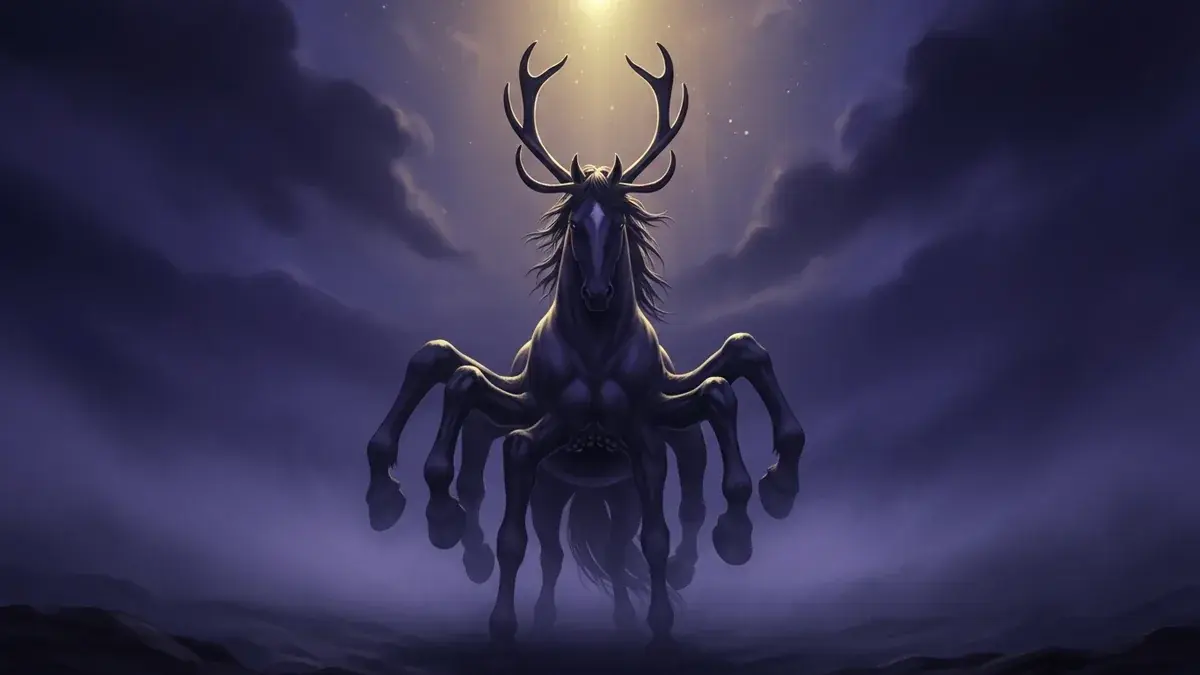
As a spirit animal, Sleipnir represents strength, prophecy, and the courage to cross into new territory, whether that's a literal journey or a bold step outside your comfort zone. Its eight legs and role as Odin's steed tie it to speed, superiority, and a living connection between the human and divine worlds. When Sleipnir appears, it often signals a coming journey, a hidden talent ready to be claimed, or reassurance that you're linked to something greater than yourself.
An almanac
- Core message
- Strength to cross between worlds
- Spirit animal
- Time for a journey or bold leap
- Totem for
- Natural boundary-crossers and travelers
- Power animal
- Courage for new beginnings, swift action
- In dreams
- Approaching journey or breakthrough
- Watch for
- Numbers eight and nine
- Saga family
- Half-brother to Fenrir, Jörmungandr, Hel
- Descendant
- Grani, Sigurd's legendary horse
Few figures in Norse mythology capture the imagination quite like Sleipnir, the extraordinary eight-legged horse who serves as Odin's personal mount. Born of an unlikely union between the trickster god Loki and the stallion Svaðilfari, Sleipnir stands apart from every other creature in the Norse pantheon, a being who moves as easily between worlds as ordinary horses move between fields. This page unpacks what Sleipnir represents, where the legend comes from, and how its symbolism has been understood across Norse tradition.
Origins & Mythology
Sleipnir's story begins with one of Norse mythology's stranger tales: Loki, shifting into the shape of a mare, lured away the stallion Svaðilfari and later gave birth to a foal with eight legs. That foal became Sleipnir, gifted to Odin and prized above every other horse in the Norse world.
The name itself, drawn from Old Norse, is generally translated as "the slippery one" or "the slipper," a nod to how effortlessly this horse could glide across any terrain.
The richest surviving account of Sleipnir comes from the 13th-century Prose Edda, compiled by the Icelandic scholar Snorri Sturluson, where the horse is described as Odin's chosen mount. Sleipnir's history reaches back much further than that text, though — carved images believed to depict the horse have been traced to artifacts from as early as the 8th century, showing how deeply this figure was woven into Norse storytelling long before it was written down.
Sleipnir even left a mark on the physical landscape: folklore ties the horse to the formation of Ásbyrgi, a horseshoe-shaped glacial canyon in Iceland, said to have been shaped by one of Sleipnir's massive hoofprints.
Sleipnir Symbolism & Meaning
According to legend, Sleipnir was considered a match for Odin's own greatness, and it was said that runes were carved into the horse's teeth — a detail that links Sleipnir directly to prophecy and divination. Because of this, Sleipnir carries meaning well beyond simple transportation; the horse is a symbol of insight as much as motion.
This pairing of horse and prophecy is older than the sagas themselves. Writing in the 1st century CE, the Roman historian Tacitus described how Germanic peoples kept sacred white horses in groves, never put to ordinary labor, and read the will of the gods in their neighing and snorting — a practice he called the most trusted of all their omens. Sleipnir's rune-carved teeth carry that same old instinct forward into myth: the horse as a living oracle, not just a means of travel.
As a horse built with double the usual number of legs, Sleipnir naturally represents:
- Strength and the capacity to push past obstacles that would stop an ordinary creature
- Superiority and distinction — being extraordinary rather than merely capable
- Travel between realms, since Sleipnir was said to move freely among the nine worlds of Norse cosmology
- A bridge to the afterlife, given the belief that Sleipnir carried souls to their final resting place
- Speed, thanks to a reputed ability to cover vast distances near-instantly
Sleipnir's dual nature as a creature who could travel over land or through the sky ties the horse to both the Earth element (the grounded, practical world) and the Air element (imagination and intellect). The number eight associated with Sleipnir's legs also invites numerological associations, such as the eight points of the compass, reinforcing the horse's connection to completeness and cyclical movement.
Color associations follow from these elemental ties: yellow for Air, brown and green for Earth. In some modern symbolic traditions, Sleipnir is also linked to red and the element of Fire, echoing Odin's fierce, warrior energy.
And as the offspring of the trickster Loki, Sleipnir is traditionally pictured as a grey horse, adding grey to the list of symbolic colors.
Ultimately, Sleipnir's role ferrying Odin between the world of the gods and the realm of humans makes this horse an emblem of humanity's connection to the divine — a living link between the sacred and the everyday.
Sleipnir as a Spirit Animal
When Sleipnir appears as a spirit animal, it often signals that it's time to pack up and set out on a journey — sometimes a literal trip, sometimes a leap far outside your usual comfort zone. Sleipnir's presence can also be a nudge to own your strength and step into your convictions rather than hold back.
This spirit guide is especially suited to helping you recognize and use a rare talent or gift, the kind that makes you stand out the way Sleipnir stands out among horses. Because of the animal's deep ties to Odin and the passage to the afterlife, Sleipnir may also show up when you need reassurance of your connection to something larger than yourself. If you're drawn to divination work, particularly with runes, that pull may be Sleipnir's influence at play.
Sleipnir as a Totem Animal
People who carry Sleipnir as a totem animal often have a natural gift for crossing boundaries — social, cultural, or otherwise — and connecting with all kinds of people. A love of travel and an ease in unfamiliar settings tend to come with this totem, along with a quiet, regal presence that never tips into arrogance.
Those aligned with Sleipnir tend to let their abilities speak for themselves, and they often feel a pull toward helping others through major life transitions. A number of Sleipnir totem-carriers find themselves drawn to healing work or to divination practices such as rune casting.
Despite wielding real strength, they use it responsibly rather than for show, and they tend to meet hard moments with courage, focus, and agility — plus, quite often, a genuine kinship with horses.
Sleipnir as a Power Animal
Turn to the Sleipnir power animal whenever you're about to begin something new and need extra courage to expand your horizons. Sleipnir's energy is well suited to moments that call for swift, decisive action, helping you find the nerve to respond when a situation feels urgent or intimidating.
Sleipnir power animal work can also support clarity of mind and strengthen budding gifts of prophecy or intuition. Consider calling on this energy specifically:
- During a move or major life transition
- Before making an impression on influential people, such as in your career
- When you want to connect with ancestors in spirit, since Sleipnir is known for crossing between realms
- While facing a big transformation that requires unusual courage
- When you feel cornered and are hoping for a stroke of luck to shift your circumstances
Sleipnir in Dreams
A dream featuring the eight-legged horse of Odin may point to power you haven't yet tapped into, or to a journey approaching on your horizon. Sleipnir in dreams often shows up around moments of breaking through limits or crossing boundaries you once thought were fixed.
Pay close attention to numbers in these dreams. The number nine may reflect movement through nine stages of a larger process, echoing Sleipnir's travels through the nine worlds. The number eight, tied to Sleipnir's legs, might hint at a timeline — an event arriving in eight weeks or months — or suggest that a cycle of growth and renewal will unfold across eight distinct stages.
Sleipnir may also appear in a dream to mark an advance in status or career, much as the horse carried Odin among the realms of power. Even amid challenges, a Sleipnir dream can be a reminder that leaning on trusted allies — rather than trying to go it alone — is often the wiser path.
And while Sleipnir can help you recognize and share your own remarkable gifts, the horse's appearance is also a gentle nudge to stay humble even as those talents shine.
Sleipnir's Adventures in the Sagas
Beyond his birth and his bond with Odin, Sleipnir appears in a handful of specific tales scattered across the Old Norse sources, each one adding a different texture to his legend.
In the Prose Edda's Skáldskaparmál, Odin wagers his own head that no horse in Jötunheimr can outrun Sleipnir. The giant Hrungnir takes the bet, mounting his golden-maned horse Gullfaxi to prove otherwise — and ends up chasing Odin so hard that he barrels straight through the gates of Asgard itself, setting up the confrontation that later costs Hrungnir his life at Thor's hands.
Sleipnir's most solemn appearance comes after the death of Baldr, Odin's beloved son. Baldr's brother Hermóðr borrows Sleipnir for a nine-night ride through valleys so dark he could barely see, heading toward Hel's realm — and when he reaches her gate, Sleipnir clears it in a single leap so powerful that the Prose Edda says he came nowhere near touching it. There, Hermóðr pleads with Hel herself to release Baldr back to the world of the living.
These sagas also reveal how tangled Sleipnir's family tree really is. Through Loki, Sleipnir shares blood with some of Norse mythology's most fearsome figures — the wolf Fenrir, the World Serpent Jörmungandr, and Hel, ruler of the dead — while his own bloodline lives on through Grani, the legendary horse later given to the hero Sigurd and said to descend directly from Sleipnir's line.
Frequently Asked Questions
What does Sleipnir symbolize in Norse mythology?
Sleipnir symbolizes strength, prophecy, and the ability to cross between the nine realms of Norse cosmology. As Odin's mount, the horse also represents the connection between the world of the gods and the human world, along with speed, superiority, and a role in carrying souls to the afterlife.
Why does Sleipnir have eight legs?
Sleipnir's eight legs come from the myth of his birth: Loki, disguised as a mare, mated with the stallion Svaðilfari and gave birth to Sleipnir. The eight legs set Sleipnir apart from ordinary horses and are tied symbolically to the eight compass directions and the eight seasonal festivals, reinforcing themes of completeness and constant movement.
What does it mean to dream about Sleipnir?
Dreaming of Sleipnir often points to an approaching journey or to breaking through a barrier in your life. It's worth noting any appearance of the numbers eight or nine in the dream, since both are tied to Sleipnir's mythology and may hint at stages or timing in a process of growth.
What is the riddle about Sleipnir in Old Norse literature?
In the Hervarar saga, Odin poses a riddle describing 'twain that on ten feet run, three eyes they have, but only one tail.' The answer is Odin himself riding eight-legged Sleipnir — their legs, eyes, and single shared tail combining into one puzzling silhouette.
Who are Sleipnir's half-siblings?
Through their shared parent Loki, Sleipnir is kin to the wolf Fenrir, the World Serpent Jörmungandr, and Hel, ruler of the underworld. It makes Sleipnir part of one of Norse mythology's strangest and most fateful families.
Is Sleipnir connected to any other legendary horses?
Yes. In the Völsunga saga, the hero Sigurd is guided by an old man, widely understood to be Odin in disguise, to choose a grey horse described as being of Sleipnir's kin. That horse, Grani, goes on to become one of the most celebrated steeds in Norse legend.
Sources
Claims on this page were checked against these published sources.
- Sleipnir
Loki had 'such dealings' with Svaðilfari that 'somewhat later' Loki gave birth to a grey foal with eight legs; the horse Sleipnir.
Read the source → - Cornelius Tacitus, Germany and its Tribes, Chapter 10
Kept at the public expense, in these same woods and groves, are white horses, pure from the taint of earthly labour; these are yoked to a sacred car, and accompanied by the priest and the king, or chief of the tribe, who note their neighings and snortings. No species of augury is more trusted, not only by the people and by the nobility, but also by the priests, who regard themselves as the ministers of the gods, and the horses as acquainted with their will.
Read the source →