Mythical Creature
Bunyip Symbolism & Meaning
The shapeshifting water-guardian that separates truth from illusion
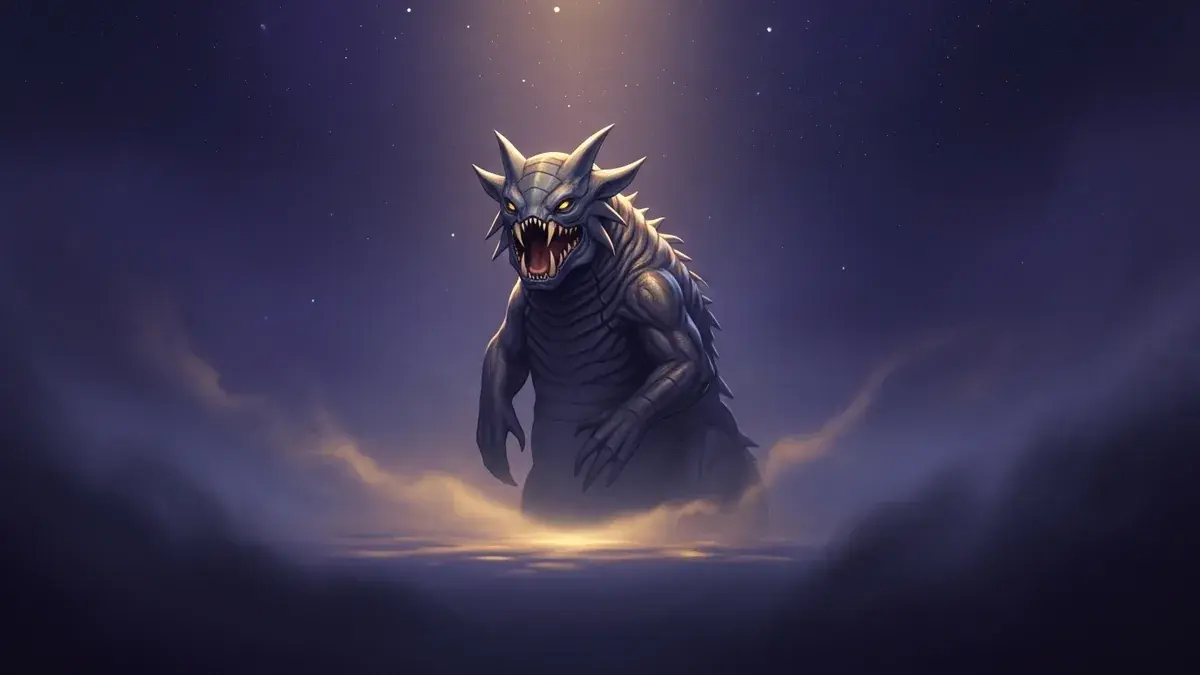
As a spirit animal, the Bunyip represents the space between land and water, truth and illusion — a guide for moments of uncertainty who helps you move through deep emotions while separating honesty from deception. It's linked to transformation and adaptability, moving fluidly between different states of being, and it protects personal boundaries against dishonesty. For those who feel a lasting kinship with it, the Bunyip points to sharp instincts for spotting dishonesty, paired with deep loyalty to a close inner circle.
An almanac
- Core message
- Separating truth from illusion
- Spirit animal
- Guide through uncertainty and emotional depths
- Totem for
- Cautious, perceptive, water-drawn people
- Power animal
- Protecting boundaries, exposing deception
- In dreams
- Water clarity reflects your emotional state
- Cultural roots
- Aboriginal Australian oral tradition (Wemba-Wemba people)
- First written record
- 1812, Sydney Gazette ('bahnyip')
- Language legacy
- Slang for a fraud or pretender since the 1850s
The Bunyip is a shadowy resident of Australian billabongs, swamps, and river bends, and nobody quite agrees on its exact shape. Because it moves so easily between water and land, it has come to stand for transformation, hidden emotion, and the blurry line between truth and deception. Here's where the legend comes from, how it's been described over the centuries, and what its symbolism might offer if it shows up in your imagination, dreams, or personal reflection.
Origins and Description
The Bunyip belongs to the oral traditions of Aboriginal Australians, with early accounts tracing back to the Wemba-Wemba people of the Riverina and Mallee regions and parts of New South Wales and Victoria. Because the stories were passed down long before written record, no single physical description has ever won out.
- In the 1840s, the Moorundi people described a fearsome creature with a body like an oversized starfish living in the Murray River.
- Many accounts liken the Bunyip to a large Dog or Seal, with a dark brown or black coat, whiskers like an otter, a bulldog-shaped head, prominent ears, no tail, and a body reaching up to six feet.
- Other tellings describe a long-necked variant: five to fifteen feet in length, a maned neck roughly three feet long, and a head resembling an Emu or Horse complete with tusks and oversized ears.
- An 1845 account combined features of a bird and an alligator — a long bill, reptilian legs and body, a bird-like head, and jagged ridges reminiscent of a stingray's spine.
Whatever its shape, the Bunyip is remembered for a deep, rolling roar that announces its presence long before it's seen. The earliest documented sightings date to the early 1800s, and the name itself carries weight: "Bunyip" translates roughly to "evil spirit" or "devil," and the word has also been used to call out fakers and frauds — a detail that shapes much of its symbolic meaning.
Theories Behind the Legend
Where the Bunyip legend actually came from is still debated among researchers. A few leading ideas:
- Misidentified wildlife — some scholars point to real encounters with Elephant Seals or Leopard Seals, animals well outside their usual range that could easily read as monstrous to an unfamiliar eye.
- Ancient bones — others connect the tale to fossils of extinct giant marsupials such as the Palorchestes, Nototherium, Zygomaturus, and Diprotodon, whose remains may have inspired stories of a huge, otherworldly beast.
- The Southern Cassowary — writing in Australian Birdlife in 2017, researcher Karl Brandt argued that many sightings match encounters with this large, powerful bird, pointing to an 1845 description of a Bunyip with an Emu-like head, colorful chest, strong legs, and sharp claws as supporting evidence.
Whichever theory holds the most water, the throughline is the same: the Bunyip is remembered as a creature of the in-between — not fully one thing or another, much like the ambiguous evidence behind it.
Symbolism and Meaning
The Bunyip is a "between creature." It's most at home in water, but it moves onto land with ease, and some tellings even have it walking upright like a person. That dual nature sits at the heart of its symbolism.
- Its bond with water ties it to dreams, imagination, emotion, and the subconscious mind.
- Its ability to stand and move on land links it to grounding, power, and turning ideas into reality.
- Moving constantly between the two states makes it a symbol of transformation — proof that a state of mind can shift as easily as the creature itself does.
Its name is bound up with fakery and false appearances, so the Bunyip also carries a strong association with discernment: the ability to separate what's real from what's merely convincing.
Bunyip as a Guide
When the Bunyip shows up as a guiding presence, it tends to arrive at moments of uncertainty — when your direction in life feels unclear or your sense of purpose has gone quiet. It can navigate murky water without losing its way, so it's often read as a companion for finding your footing again and for moving through the subconscious toward a clearer sense of self.
Being at home in both land and water also makes it a natural companion for inward work: meditation, trance, or any practice that asks you to shift your state of awareness. When emotions feel like they're pulling you under, the Bunyip's presence is often read as encouragement to work through old patterns instead of letting them drag you down.
Bunyip as a Totem
For those who feel a lasting kinship with the Bunyip, a few traits tend to recur:
- A preference for quiet, nighttime hours, when ideas flow more freely and solitude feels comfortable.
- A tendency to trust cautiously, extending real openness only to a close inner circle.
- A sharp instinct for spotting dishonesty, paired with high expectations for loyalty in relationships.
- Difficulty letting go once a relationship or connection has ended.
- A natural pull toward water, sometimes expressed through swimming or other water-based pursuits.
- An ease with adapting to change, moving between environments or situations without much friction.
- A comfort with speaking up and expressing whatever needs to be said.
Bunyip as Protector
The Bunyip is remembered as fiercely territorial, defending its waters against intrusion without hesitation. In that light, it's often called on as a symbol of protecting what matters most — your space and the people or things you hold dear.
It's also associated with seeing through disguises. Given its reputation as a shapeshifter and its name's link to "impostor," the Bunyip is frequently invoked as a symbol for recognizing dishonesty, sensing hidden agendas, and trusting a gut feeling that something isn't quite right.
In this role, it's about surrounding yourself with sincerity and steering clear of people or situations built on pretense.
Aboriginal Folklore and Regional Legends
Traditional stories describe the Bunyip lying in wait near the water's edge, ready to ambush anyone who lingers too long at the bank. Some researchers believe the more menacing versions of the tale served a practical purpose — keeping children safely away from dangerous waterways.
Other versions of the legend paint a gentler picture, describing the Bunyip as a shy, plant-eating creature that avoids people altogether rather than hunting them.
No confirmed sighting has been recorded in over a hundred years, and most researchers treat historical reports as legend or mistaken identification. Still, the story persists in the cultural record — notably in ancient rock art found in a cave in the Mount Difficult Range, where four Bunyip figures appear painted in red ochre.
Regional traditions add their own layers to the story. In Ngarrindjeri dreaming, a water spirit called the Mulyawonk plays a closely related role, said to punish people who take more fish than they need or children who stray too close to the water's edge. Read this way, the Bunyip and its regional counterparts work as a form of intergenerational guardianship: they tie respect for sacred waterways and natural boundaries to consequences serious enough to be remembered for generations.
Bunyip in Dreams
When a Bunyip appears in a dream, the details of how it looks and acts are worth paying attention to:
- An alligator-like body may point to a need to protect your feelings in an upcoming situation.
- An Emu-like head can suggest a burst of sudden insight or a rush of new ideas on the way.
- A howling Bunyip often reads as a wake-up call — something in waking life may be getting overlooked or unheard.
- Swimming in clear water suggests emotional ease, with nothing significant weighing you down.
- Murky water points to mixed or unresolved feelings about a person or situation.
- Dark water suggests deeper, unresolved issues that need attention before you can move past them.
- Being ambushed by a Bunyip can indicate that you're overthinking a situation as a way of avoiding your actual feelings about it.
Historical Eyewitness Accounts
The written record of the Bunyip stretches back further than most people realize. The word first reached print as "bahnyip" in the Sydney Gazette in 1812, when a settler named James Ives used it to describe "a large black animal like a seal, with a terrible voice which creates terror among the blacks." That single sentence set the tone for decades of unease to follow.
- William Buckley, an escaped convict who lived for thirty years among the Wathaurong people, recorded his own account in 1852, describing "a very extraordinary amphibious animal" that local people called Bunyip living in Lake Moodewarri (now Lake Modewarre) and other inland waters.
- Artist Edwin Stocqueler claimed to have observed six separate Bunyips along the Murray and Goulburn rivers in 1857, sketching a long, swan-like neck and a dog-like head — though he later disputed some of the newspaper descriptions built on his sketches.
- The strangest episode came in 1846–47, when a peculiar skull pulled from the Murrumbidgee River near Balranald was displayed at the Australian Museum and drew crowds convinced it belonged to a real Bunyip. Naturalists eventually identified it as a deformed foetal skull of a foal or calf, but the display triggered a wave of new "sighting" reports across the colony.
Taken together, these accounts show the Bunyip less as a single sighting and more as a rolling, decades-long argument between what people saw, what they feared, and what they wanted to believe.
Bunyip in Language and Culture
The Bunyip has left an unusually strong mark on everyday Australian language. By the mid-1800s, Australians were already using the word as slang for a fraud, pretender, or humbug — someone putting on a show that didn't match reality. That usage produced the term "bunyip aristocracy," first coined in 1853 to mock Australians who aspired to aristocratic titles they hadn't earned, and it stuck around long enough to be revived by Prime Minister Paul Keating in the early 1990s as a jab at his political opponents.
The association with fakery ran deep enough that a newspaper founded in Gawler, South Australia in 1863 took the name The Bunyip outright, chosen by its founders — the self-described Gawler Humbug Society — because, in their words, the Bunyip was "the true type of Australian Humbug."
Long before anyone talked about the Bunyip as a totem or spirit guide, everyday Australians had already turned it into shorthand for spotting a fake.
Frequently Asked Questions
What does the Bunyip symbolize?
The Bunyip symbolizes the space between states — water and land, truth and illusion. That dual nature is why it's associated with emotional depth, transformation, adaptability, and seeing past deception.
Where does the Bunyip legend come from?
The Bunyip comes from Aboriginal Australian oral tradition, with early accounts linked to the Wemba-Wemba people of the Riverina and Mallee regions. Descriptions vary widely, from Dog- or Seal-like beasts to long-necked, tusked creatures, reflecting generations of retelling rather than one fixed source.
What does it mean to dream about a Bunyip?
A Bunyip dream often reflects your emotional state, especially through the water around it — clear water suggests ease, murky water points to mixed feelings, and dark water signals unresolved issues. A howling Bunyip can serve as a nudge to pay attention to something you've been avoiding.
Is the Bunyip based on a real animal?
No single animal fully accounts for it, but several natural candidates likely fed the legend. Naturalist Charles Fenner proposed in 1933 that elephant seals or leopard seals wandering inland up the Murray and Darling rivers could look and sound monstrous to unfamiliar eyes, while others have linked the myth to fossils of extinct giant marsupials or to encounters with the Southern Cassowary. The Australasian bittern, a marsh bird with a deep booming call, is even nicknamed the "bunyip bird" for the same reason.
What does 'bunyip aristocracy' mean?
It's an old Australian political put-down, coined in 1853, for people who put on airs of nobility they never actually earned. The phrase leans on the word's older meaning of impostor or humbug, and it resurfaced as recently as the early 1990s when it was used to criticize political opponents. The Bunyip's link to fakery has clearly outlasted the monster stories themselves.
Does the Bunyip have other names in Aboriginal tradition?
Yes — because the stories come from many distinct language groups across Australia, names and details shift from region to region. One well-documented example is the Mulyawonk, a water spirit in Ngarrindjeri tradition said to punish people who take too many fish or children who wander too close to the water, carrying the same protective, cautionary role found in Bunyip stories elsewhere.
Sources
Claims on this page were checked against these published sources.
- Bunyip
The word "bunyip" originates from the Wemba-Wemba or Wergaia language of Victoria's Aboriginal people in South-Eastern Australia.
Read the source → - Get to Know the Ancient Artists of Australia's Grampians
In 2016, park ranger Jake Goodes was marking part of the trail that would later become part of the Grampians Peak Trail when he stumbled upon the discovery of the red-ochre bunyip drawings... in a shallow sandstone cave in the Mt. Difficult Range in northwestern Victoria.
Read the source →