Animal Facts
Whale Facts & Trivia: Records, Brains and Recovery
The largest animal that has ever lived, and the century that nearly ended it.
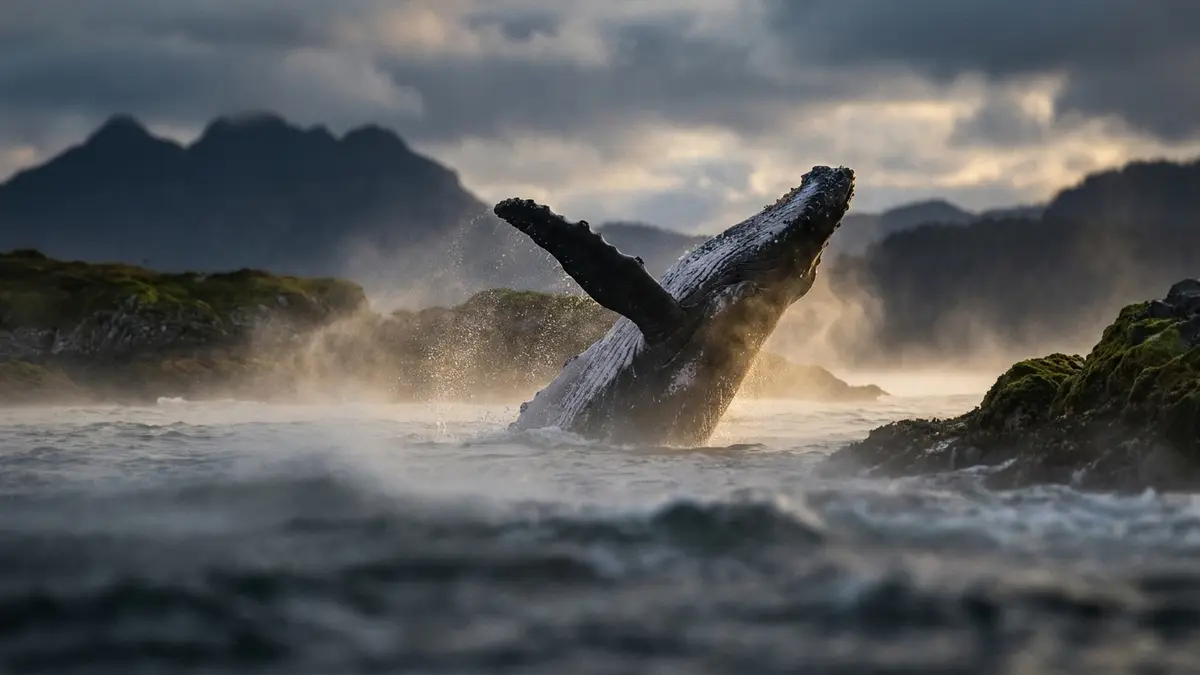
A blue whale reaches about 31 metres and a nursing calf gains almost 200 pounds a day. The deepest dive ever recorded by any mammal belongs to a Cuvier's beaked whale: 2,992 metres, on one breath, for 137 minutes. Industrial whaling killed 2.9 million whales between 1900 and 1999.
An almanac
- Lifespan
- 80–90 years for blue and humpback whales; the bowhead exceeds 200, the longest of any mammal
- Size
- Blue whale up to 100 ft and 160 tons — the largest animal known; killer whales top out near 32 ft
- Range
- Every ocean. Gray whales run a roughly 10,000-mile round trip each year, up to 14,000
- Diet
- Baleen whales strain krill and small fish through keratin plates; toothed whales hunt squid and fish
- Conservation status
- Blue whale listed endangered under the US Endangered Species Act; only ~380 North Atlantic right whales remain
- Deepest dive
- 2,992 m and 137.5 minutes — a Cuvier's beaked whale, the mammal record
- Standout number
- 2.9 million whales killed by industrial whaling between 1900 and 1999
Whales hold more superlatives than any other group of animals, and most of them are real. The deepest dive by any mammal, the largest brain of any animal alive, the longest-lived mammal known — all whales, all measured.
What sits underneath the records is a century of slaughter. Between 1900 and 1999 industrial whaling killed 2.9 million whales, two million of them in the Southern Hemisphere. The Southern Ocean before that was eating twice as much krill as exists there at all today.
The famous misconceptions — the spout of seawater, being swallowed whole, the whale shark — are answered directly below.
Whale Facts Worth Knowing
- A blue whale can reach 31 meters (100 feet) — about the length of a basketball court — and individuals have been weighed at up to 160 tons.
- A blue whale's heart weighs about 400 pounds and pumps roughly 60 gallons of blood with every beat. The popular version inflates it. NOAA itself publishes two conflicting figures — 'about 400 pounds' on one page and 'more than 1,000 pounds' on another. The only blue whale heart ever actually preserved (Royal Ontario Museum, from a whale that died in Newfoundland ice in 2014) weighs about 400 pounds, so that is the number anchored to a real specimen. The widely repeated 'heart the size of a small car, big enough for a person to swim through the aorta' is embellishment, not measurement.
- A nursing blue whale calf can gain almost 200 pounds per day.
- Before industrial whaling, baleen whales in the Southern Ocean ate about 430 million tonnes of Antarctic krill every year — roughly twice the total krill biomass that exists there today.
- The bowhead whale's maximum lifespan exceeds 200 years — longer than any other mammal. The 200-year figure belongs to one Arctic species, not to whales in general. NOAA estimates blue whales and humpbacks at roughly 80 to 90 years, gray whales at 75 to 80, and killer whale females at about 50 in the wild. 'Whales live for centuries' is true of bowheads and essentially nothing else.
- Bowhead whales carry a blubber layer 17 to 19 inches thick — thicker than any other whale — and use their heads to break through sea ice; whalers have seen them surface through two feet of it.
- A typical sperm whale dive reaches about 2,000 feet and lasts around 45 minutes, hunting squid in total darkness by echolocation.
- A narwhal tusk spirals counter-clockwise, can grow to 9.8 feet, and can weigh over 20 pounds.
- Gray whales travel roughly 10,000 miles round-trip each year, and in some cases upwards of 14,000. Almost every listicle calls this 'the longest migration of any mammal'. NOAA deliberately says 'one of the longest' — humpbacks in some populations swim about 5,000 miles each way, putting them in the same league, and the record is not formally settled.
- Baleen is not bone and not teeth — it is keratin, the same material as human fingernails.
- Industrial whaling killed 2.9 million whales between 1900 and 1999, more than two million of them in the Southern Hemisphere.
- Whale earwax builds up in layers and preserves a chemical diary of the animal's life; cortisol measured in earplugs peaked in the 1960s, when whaling harvests hit about 150,000 whales a year.
- Hippos are the closest living relatives of whales — but they are not whales' ancestors; both descend from a shared land-dwelling ancestor, and the first whales evolved over 50 million years ago.
What People Get Wrong About Whales
“Whales spray a jet of seawater out of their blowholes.” The spout is breath, not water. A whale exhales warm, humid air from its lungs; hitting cooler air outside, it condenses into a visible cloud — the same physics as seeing your own breath on a cold morning. Nothing is being pumped out of the sea and squirted skyward.
“A whale could swallow a person whole, like Jonah or Pinocchio.” Almost none could. A humpback's throat is about the width of a clenched fist and stretches to roughly 15 inches at most — a baleen whale that engulfs a swimmer physically cannot get them past the gullet. The one exception is the sperm whale, whose esophagus is built for whole giant squid.
“The whale shark is a kind of whale.” It's a fish — a shark, with gills, cartilage and no need to surface for air. It picked up the name because it is whale-sized and filter-feeds the way baleen whales do. The convergent feeding style is why the confusion sticks.
“Killer whales are man-eaters — the name is a warning.” There is no documented case of a wild orca killing a person. Every human fatality on record involved a captive animal, most infamously Tilikum at SeaWorld. Researchers who spend their careers on the water with wild orcas report no attacks at all; the name comes from old whalers calling them 'whale killers' for hunting other cetaceans.
In Culture
Whales carry more cultural weight than almost any animal. Herman Melville's Moby-Dick (1851) set the template — filmed by John Huston with Gregory Peck in 1956 — and Disney's Pinocchio (1940) gave children Monstro, the whale that swallows you whole. Star Trek IV: The Voyage Home (1986) built an entire blockbuster around the premise that an alien probe was hailing extinct humpbacks and only two whales from a 1986 San Francisco aquarium could answer it. Free Willy (1993) turned one captive orca into a global campaign, and Blackfish (2013) turned the same industry into a scandal that ended SeaWorld's orca breeding programme. Whale Rider (2002) put Maori whale lore on the Oscar ballot. Musically, the 1970 album Songs of the Humpback Whale is probably the most famous nature recording ever made; it was added to the Library of Congress National Recording Registry in 2010, and a humpback "greeting" recorded off Bermuda was launched aboard the Voyager Golden Record in 1977 — whale song is currently leaving the solar system. Online, the 52-hertz "loneliest whale" became a meme of isolation before becoming a 2021 documentary.
Notable Individuals
Mocha Dick, a scarred white sperm whale off Chile, survived decades of whaleboats before being killed around 1838; Jeremiah N. Reynolds published his story in The Knickerbocker in 1839, and Melville read it. Tilikum was caught off Iceland in 1983 aged two, was involved in three human deaths — a trainer in 1991, a trespasser in 1999, and Dawn Brancheau on 24 February 2010 — and died in Orlando in January 2017 at about 36; Blackfish made him the face of captivity. Migaloo, the all-white humpback, was first sighted in 1991 and has been seen off Australia more than fifty times since. In 2018 the orca J35, called Tahlequah, pushed her dead newborn for at least 17 days and 1,000 miles. And "52 Blue", first detected in 1989 and tracked by WHOI's William Watkins, sings at a frequency no other whale answers.
Frequently Asked Questions
Do whales spray water out of their blowholes?
The spout is breath, not water. A whale exhales warm, humid air from its lungs; hitting cooler air outside, it condenses into a visible cloud — the same physics as seeing your own breath on a cold morning. Nothing is being pumped out of the sea and squirted skyward.
Could a whale swallow a person?
Almost none could. A humpback's throat is about the width of a clenched fist and stretches to roughly 15 inches at most — a baleen whale that engulfs a swimmer physically cannot get them past the gullet. The one exception is the sperm whale, whose esophagus is built for whole giant squid.
Is a whale shark a whale?
It's a fish — a shark, with gills, cartilage and no need to surface for air. It picked up the name because it is whale-sized and filter-feeds the way baleen whales do. The convergent feeding style is why the confusion sticks.
Are killer whales dangerous to humans?
There is no documented case of a wild orca killing a person. Every human fatality on record involved a captive animal, most infamously Tilikum at SeaWorld. Researchers who spend their careers on the water with wild orcas report no attacks at all; the name comes from old whalers calling them 'whale killers' for hunting other cetaceans.
How deep can a whale dive?
The record belongs to a Cuvier's beaked whale: 2,992 metres down and 137.5 minutes on a single breath — the deepest and longest dive ever recorded for any mammal. A sperm whale's typical working dive is about 2,000 feet and around 45 minutes.
How long do whales live?
It depends entirely on the species. Bowhead whales exceed 200 years, longer than any other mammal. Blue whales and humpbacks are estimated at roughly 80 to 90 years, gray whales at 75 to 80, and wild female killer whales at about 50.
More about the Whale
More from Animal Facts

Sources
Claims on this page were checked against these published sources.
- Fun Facts About Wonderful Whales
Blue whales can grow up to 31 meters (100 feet)—roughly the length of a basketball court.
Read the source → - The Big-Hearted Blue Whale
The heart of a blue whale weighs about 400 pounds, the weight of studio piano.
Read the source → - Baleen whale prey consumption based on high-resolution foraging measurements
pre-whaling populations of mysticetes annually consumed 430 million tonnes of Antarctic krill (Euphausia superba), twice the current estimated total biomass
Read the source → - Evidence for improved DNA repair in the long-lived bowhead whale
At more than 200 years, the maximum lifespan of the bowhead whale exceeds that of all other mammals.
Read the source → - Bowhead Whale
Some Alaska Native whalers have even reported whales surfacing through 2 feet of ice
Read the source → - Sperm Whales: Revealing the Mysteries of the Deep
Most of their dives reach depths up to 2,000 feet and last about 45 minutes.
Read the source → - Narwhal
The tusk is spiraled to the left (counter-clockwise) and may grow up to 9.8 feet long and weigh over 20 pounds.
Read the source → - Gray Whale
Gray whales make one of the longest annual migrations of any mammal, traveling about 10,000 miles round-trip and in some cases upwards of 14,000 miles.
Read the source → - Whale Anatomy
The plates are made out of fingernail-like material called keratin. It makes the baleen strong, but still flexible.
Read the source → - World's Whaling Slaughter Tallied at 3 Million
The researchers estimate that, between 1900 and 1999, 2.9 million whales were killed by the whaling industry: 276,442 in the North Atlantic, 563,696 in the North Pacific and 2,053,956 in the Southern Hemisphere.
Read the source → - Baylor Professors Use Whale Earwax to Reconstruct Whale Stress Levels Spanning More Than a Century
During the 1960s when whaling was at its peak with 150,000 whales harvested, cortisol peaked to a maximum and was the highest average in whales in the 20th century
Read the source → - The evolution of whales
The first thing to notice on this evogram is that hippos are the closest living relatives of whales, but they are not the ancestors of whales.
Read the source →
Not sure which animal is yours?
Consult the quiz