Animal Facts
Turkey Facts: What's True and What Isn't
Wild turkeys fly at 88.5 km/h; farm turkeys can't fly, and can't breed unaided.
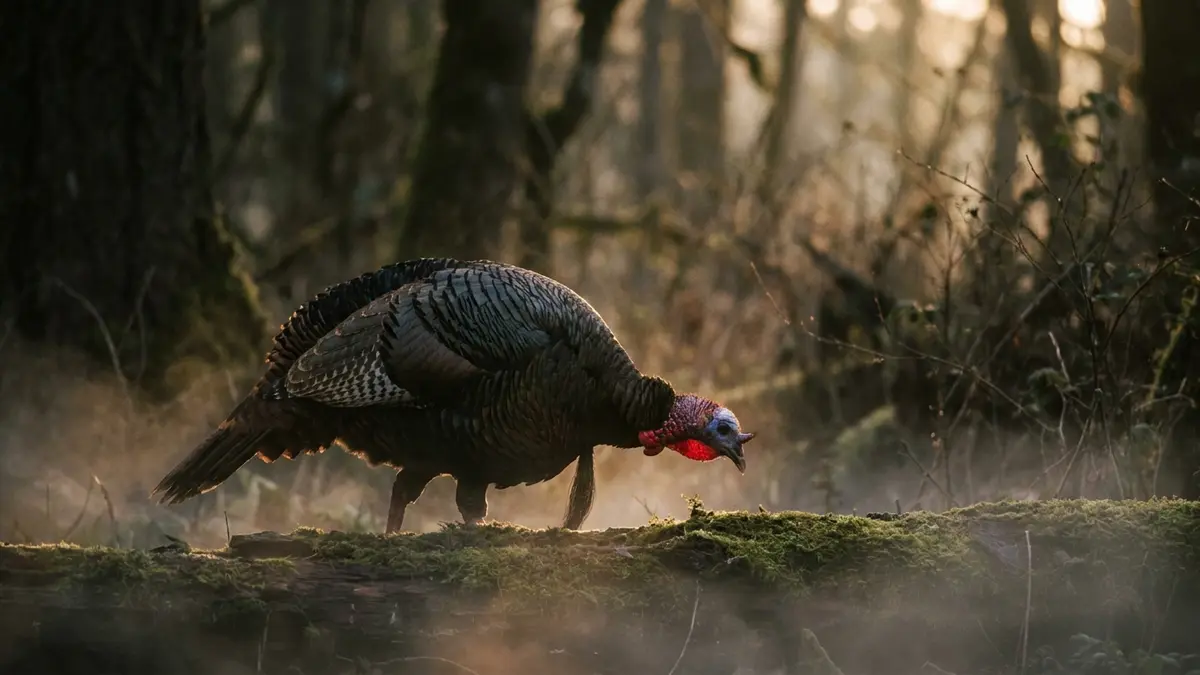
The wild turkey, Meleagris gallopavo, has six recognised subspecies; toms weigh 6.8–11 kg and have been recorded flying at 88.5 km/h in short bursts. A male's gobble carries more than 1.5 kilometres, roughly a mile. The continental population fell to about 30,000 birds in the early 1930s and now stands at around 7 million.
An almanac
- Scientific name
- Meleagris gallopavo (wild and domestic turkey); Meleagris ocellata (ocellated turkey)
- Family
- Phasianidae, order Galliformes — the pheasant and grouse family
- Size
- Toms 6.8–11 kg (15–24 lb); body length 110–115 cm (43–45 in) bill to tail, wingspan 125–144 cm
- Top recorded flight speed
- 88.5 km/h (55 mph), in short bursts only
- Range
- 49 US states (all but Alaska), parts of southern Canada and Mexico
- Population
- ~6.9 million global breeding population (Partners in Flight), scored 7 out of 20 on the Continental Concern Score — low conservation concern
- Subspecies
- Six subspecies of Meleagris gallopavo
Most of what people repeat about turkeys comes from the wrong bird. The wild turkey roosts in trees, runs, swims, and flies hard enough to have been clocked at 88.5 km/h. The broad-breasted bird sold at Christmas and Thanksgiving is a different animal in everything but name: too heavy to fly, and too heavy to breed without human help.
The wild version is also one of the better documented birds in the fossil record, one of only two domesticated birds that came out of the Americas, and the subject of a recovery that took the continental population from roughly 30,000 in the early 1930s back to around 7 million.
What follows separates the checked facts from the stories. The Franklin letter, the tryptophan coma, the turkeys drowning in the rain — each has a real detail buried under it, and each is smaller and stranger than the version that circulates.
Turkey facts
- Six subspecies. There are six subspecies of Meleagris gallopavo, spread across 49 US states, southern Canada and Mexico.
- There is a second turkey species. The ocellated turkey (Meleagris ocellata) of the Yucatán is named for the eye-shaped markings on its tail: the feathers are bluish-grey with blue-bronze eye spots on the ends, and oculus is Latin for eye.
- The gobble carries about a mile. The gobbles of male wild turkeys can be heard more than 1.5 kilometres away.
- The 55 mph figure is a burst, not a cruising speed. Turkeys have been recorded flying at 88.5 km/h, but only in short dashes — up to a roost or away from a predator. They mostly walk. The number does not apply to supermarket turkeys, which are far too heavy to fly at all.
- Only two domesticated birds came from the New World. The wild turkey and the Muscovy duck are the only two domesticated birds native to the Americas.
- The fossil record is unusually good. Because of their large size, compact bones and long-standing popularity as a dinner item, turkeys have a better known fossil record than most other birds. Turkey fossils have been unearthed across the southern United States and Mexico, some dating from more than 5 million years ago.
- They swim. Turkeys can swim by tucking their wings in close, spreading their tails, and kicking.
- Males do no parenting whatsoever. Newly hatched chicks follow the female, who feeds them for a few days until they learn to find food on their own. Broods then band together with several hens, and winter groups sometimes exceed 200 turkeys.
- The name is probably a shipping accident, and even that is hedged. Cornell says the English name "may be" a holdover from early shipping routes that passed through the country of Turkey on the way to European markets. That is the leading explanation, not a settled fact. The bird is North American and has never been native to Turkey; Turkish calls it hindi.
- The population fell to about 30,000 and came back. Wild turkey populations reached a nadir in the early 1930s, with a continental population of about 30,000 birds. After more than 200,000 birds were trapped and trucked to empty habitat, the total continental population is now around 7 million (Audubon) — a different measure from the 6.9 million global breeding population estimated by Partners in Flight.
- Domestication happened at least twice. Mitochondrial DNA from 149 turkey bones and 29 coprolites at 38 archaeological sites in the US Southwest (200 BC–AD 1800) points to at least two occurrences of turkey domestication in precontact North America — one in the Southwest and a separate Mesoamerican one.
- Pueblo turkeys were kept for feathers first, meat later. In the earliest era (Basketmaker II, 400 BC–AD 500) ancestral Pueblo people bred turkeys largely for feathers — one blanket could require 12,000 feathers. By the late 1100s, as deer were hunted out, turkeys became a major meat source; at larger sites they supplied the majority of the meat.
- Hens choose males by snood length. In a controlled mate-choice experiment with 23 hens, the only trait they obviously cared about was the length of the male's snood — and long-snooded males carried fewer coccidia parasites.
- The bare head is partly a radiator. The colour-changing head is usually explained as pure sexual ornament, but insulating it experimentally raised oxygen consumption and body temperature and cut cooling capacity at 35°C. At 0°C and 22°C the insulation made no significant difference, so the cooling role only shows up in heat.
- Some males give up breeding to help a relative. In Krakauer's study population, subordinate helper males did not reproduce, and their indirect fitness via close relatives (mostly siblings) more than offset the cost of helping under Hamilton's rule.
- The US turkey crop is shrinking. USDA forecast 195 million turkeys raised in the US in 2025, down 3 percent from 2024, with Minnesota the largest producing state at 32.0 million.
- Every commercial turkey is the product of artificial insemination. Broad-breasted commercial turkeys are so large they can no longer breed naturally with any efficiency, so the entire commercial supply is produced by artificial insemination.
- The beard grows about five inches a year, and hens grow them too. Turkey beards — bundles of hair-like feathers — start sprouting at five months old and keep growing for life, at a rate of nearly five inches a year. How many hens have one is disputed: Audubon reports nearly 10 percent, the Virginia Department of Wildlife Resources roughly four to five percent. Either way, a beard is not a reliable way to sex a turkey.
Myths about turkeys
"Benjamin Franklin campaigned for the turkey to be America's national bird instead of the bald eagle." Franklin did write a letter mocking the bald eagle as "a Bird of bad moral Character" and praising the turkey as "a Bird of Courage", but he never proposed it as a national symbol. The private 1784 letter to his daughter disparaged the bald eagle as the national representative and said the eagle on the Society of the Cincinnati's membership badge looked more like a turkey.
"Turkeys are so stupid they look up during rainstorms and drown." Some turkeys have a genetic condition called tetanic torticollar spasm that makes them look at the sky for anywhere from 5 seconds to a full minute, which is probably where the story started. No turkey is known to have died from drowning during a spasm episode.
"Turkeys can't fly." Wild turkeys fly perfectly well in short bursts — they fly up into trees to roost every night and have been recorded at 88.5 km/h. It is the selectively bred farm turkey, engineered for breast meat, that is grounded.
"The tryptophan in turkey is what makes everyone sleepy after Thanksgiving dinner." Turkey does not have significantly more tryptophan than other common foods like chicken, beef, nuts or cheese. The drowsiness comes from the volume of carbohydrates and calories eaten in one sitting.
"Harry Truman started the presidential turkey pardon in 1947." The White House Historical Association's account of the tradition does not begin there. Presidents Kennedy and Reagan, and First Ladies Pat Nixon and Rosalynn Carter, spared individual birds on occasion; the pardon became an annual ritual only under George H.W. Bush, who in 1989 said the bird "is presented a Presidential pardon as of right now."
Turkeys in pop culture
The most famous turkey moment in American television is an episode about turkeys that never appear on screen. "Turkeys Away", the seventh episode of the first season of WKRP in Cincinnati, aired on 30 October 1978. Station manager Arthur Carlson drops live turkeys from a helicopter as a Thanksgiving promotion, then staggers back into the studio with the closing line, "As God is my witness, I thought turkeys could fly." Series creator Hugh Wilson based it on a real radio promotion he had encountered at WQXI in Atlanta, and TV Guide has since ranked it among the greatest episodes in television history.
Hollywood tried the turkey's-eye view in Free Birds, released on 1 November 2013 by Relativity Media, in which two turkeys voiced by Owen Wilson and Woody Harrelson travel back in time to get their species off the Thanksgiving menu. Critics disliked it; it grossed roughly $110 million on a $55 million budget.
The steadiest turkey ritual is the televised White House pardon, an annual photo opportunity since 1989. In bowling, three consecutive strikes is a "turkey" — a term whose prize-bird origin story gets repeated far more often than it gets documented.
Famous turkeys
The best-documented individual turkeys are the birds spared at the White House. On 25 November 2024, President Joe Biden pardoned Peach, at 41 pounds, and Blossom, at 40 pounds, on the South Lawn. Both had been raised in Northfield, Minnesota by National Turkey Federation chairman John Zimmerman, and both retired to North Carolina State University's Prestage Department of Poultry Science.
A year later, on 25 November 2025, President Donald Trump pardoned Gobble and Waddle. The names change annually; the format has not shifted much since the ceremony became a fixture in 1989.
Frequently Asked Questions
Can turkeys fly?
Wild turkeys can. They fly up into trees to roost every night and have been recorded at 88.5 km/h, though only in short bursts — they mostly walk. Commercial farm turkeys, bred for breast meat, are too heavy to fly at all.
Did Benjamin Franklin want the turkey to be the national bird?
No. He wrote a private letter in 1784 calling the bald eagle "a Bird of bad moral Character" and the turkey "a Bird of Courage", and said the eagle on the Society of the Cincinnati's badge looked more like a turkey, but he never proposed the turkey as a national symbol.
Why is it called a turkey if it comes from America?
The leading explanation is that the English name is a holdover from early shipping routes that passed through the country of Turkey on the way to European markets. Even Cornell hedges with "may be". The bird has never been native to Turkey, where it is called hindi.
Does eating turkey actually make you sleepy?
Not because of tryptophan. Turkey does not contain significantly more tryptophan than chicken, beef, nuts or cheese. The post-dinner slump comes from the volume of carbohydrates and calories eaten at once.
How many turkeys are raised in the US each year?
The USDA forecast 195 million turkeys raised in the US in 2025, down 3 percent from 2024. Minnesota is the largest producing state at 32.0 million birds.
Do turkeys really drown by looking up in the rain?
No turkey is known to have drowned that way. Some birds do have a genetic condition, tetanic torticollar spasm, that makes them look at the sky for anywhere from 5 seconds to a full minute, which is likely where the story came from.
More about the Turkey
More from Animal Facts
Sources
Claims on this page were checked against these published sources.
- Meleagris gallopavo (wild turkey)
There are six subspecies of Meleagris gallopavo.
Read the source → - Wild Turkey Overview
The Wild Turkey and the Muscovy Duck are the only two domesticated birds native to the New World.
Read the source → - Wild Turkey on the Rocks?
wild turkey populations reached a nadir in the early 1930s, with a continental population of about 30,000 birds.
Read the source → - Ancient mitochondrial DNA analysis reveals complexity of indigenous North American turkey domestication
This study points to at least two occurrences of turkey domestication in precontact North America
Read the source → - How Do Lady Turkeys Pick Their Guys?
the only trait they obviously cared about was the length of the male's snood
Read the source → - Thermoregulatory Role of the Unfeathered Head and Neck in Male Wild Turkeys
Head insulation resulted in significantly increased rates of oxygen consumption, higher body temperatures, and decreased cooling capacities at 35°C, but had no significant effect at the other temperatures tested.
Read the source → - Kin selection and cooperative courtship in wild turkeys
Subordinate (helper) males do not themselves reproduce, but their indirect fitness as calculated by Hamilton's rule more than offsets the cost of helping.
Read the source → - Modern Turkey Industry
The modern hybrid turkeys are so large they can no longer naturally breed efficiently. All modern turkeys are artificial insemination.
Read the source → - Meleagris ocellata (ocellated turkey)
The tail feathers are bluish-gray with blue-bronze eye spots on the ends, which give this bird its name, as oculus is Latin for eye.
Read the source → - Let's Talk Turkey Beards
Turkey beards start sprouting when youngsters are just five months old and continue to grow throughout a bird's life, at a rate of nearly five inches a year.
Read the source →
Not sure which animal is yours?
Consult the quiz