Animal Facts
Seal Facts & Trivia: Whiskers, Dives and Misnamed Diets
The most abundant large seal on earth eats no crabs and lives on krill.
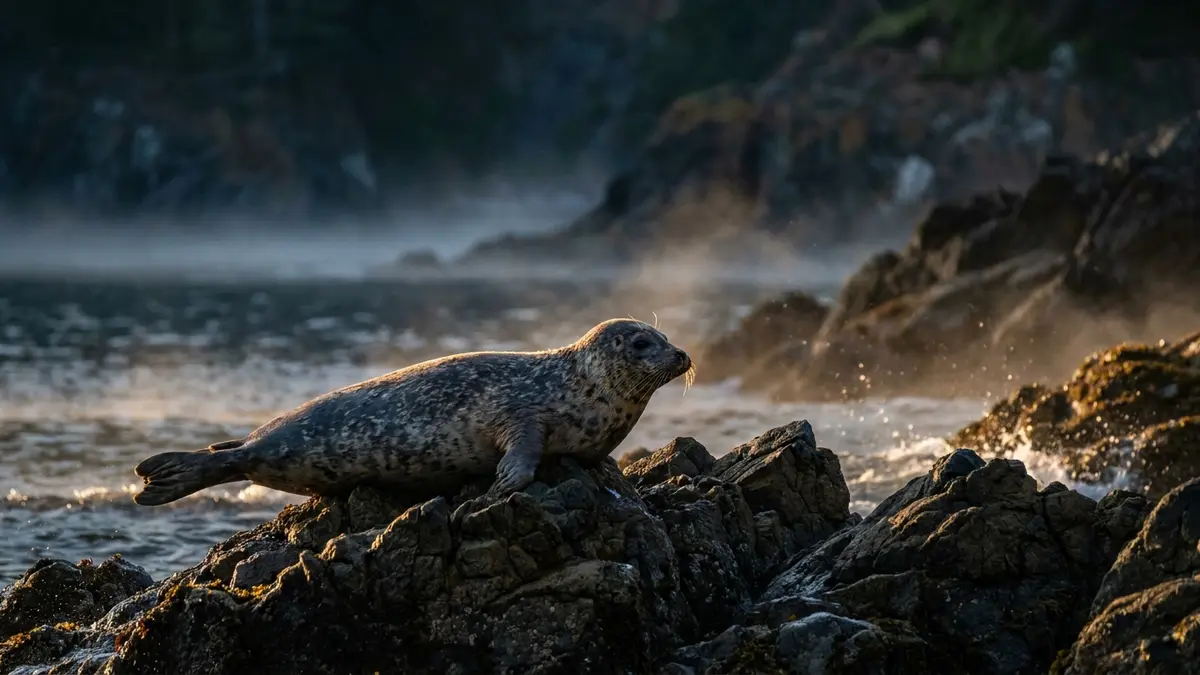
A seal's whiskers are sensitive enough to follow the wake a fish left behind seconds earlier, in the dark. The crabeater seal — the most abundant large seal on the planet — eats almost no crabs. And the animal balancing a ball at the aquarium is usually a sea lion, not a seal.
An almanac
- Lifespan
- Harbor seal about 25–30 years; Hawaiian monk seal maximum over 30 years; Baikal seal over 50 years
- Size
- Ringed seal 4–4.5 ft and 110–150 lb, up to southern elephant seal bulls of 3,000 kg
- Range
- Every ocean from Antarctic fast ice to Hawaii — plus Lake Baikal, Siberia, the only all-freshwater seal population
- Diet
- Fish, squid and crustaceans; crabeater and leopard seals strain Antarctic krill through specialised teeth
- Conservation status
- Hawaiian monk seal ESA Endangered with about 1,600 animals; ringed seal subspecies listed Threatened or Endangered
- Deepest dive
- Over a mile, by a northern elephant seal (routine dives are 300–800 m)
- Most abundant
- About 7 million harp seals in the Northwest Atlantic stock, and roughly 15 million crabeater seals in the Southern Ocean
Almost everything the public knows about seals belongs to a different animal. The barking performer at the aquarium is a sea lion. The crabeater seal, the most abundant large seal on earth, eats krill. And the pup lying alone on a beach is not abandoned.
What is genuinely remarkable about seals is harder to see: their whiskers can detect and follow the hydrodynamic trail a fish left behind seconds earlier, which is how they hunt in water too dark to see through.
The rest, sourced, is below.
Seal Facts Worth Knowing
- Northern elephant seals average just 2 hours of sleep a day during months-long foraging trips at sea — among the least sleep of any mammal.
- A diving harbor seal drops its heart rate from 75–120 beats per minute to just 4–6 beats per minute.
- Each seal whisker carries roughly 1,500 nerve endings — about 7.5 times more than a cat's whisker, which has around 200.
- Weddell seals stay under for up to 45 minutes and reach 720 m, and they are the southernmost mammal that lives on the Antarctic continent year-round.
- Weddell seals grind their own teeth down to the pulp cavity sawing breathing holes in sea ice; the resulting infections are a documented cause of adult death, rising sharply after age 8–9.
- Southern elephant seal bulls reach 3,000 kg, and the species has been recorded diving 2 km down and holding its breath for 2 hours. The headline '2 km deep, 2 hours' figures are extreme records, not routine behaviour. The same source says most dives are about 30 minutes at 300–800 m. And it is only the southern elephant seal that hits 3,000 kg — a harbor seal tops out near 285 pounds.
- Every northern elephant seal alive today — over 170,000 animals — descends from a surviving group of roughly 20 to 100 individuals after 19th-century hunting left the species presumed extinct.
- The famous fluffy white 'whitecoat' of a harp seal pup is a temporary coat called lanugo that is shed by 3 to 4 weeks of age.
- The Baikal seal of Siberia is the only seal whose entire population lives in fresh water, and it can live more than 50 years.
- About 1,600 Hawaiian monk seals remain — roughly 1,200 in Papahānaumokuākea and 400 in the main Hawaiian Islands — making it one of the most endangered seals on Earth.
- Wild grey seals clap their fore-flippers underwater to produce a gunshot-like crack; the behaviour was first published in Marine Mammal Science in February 2020, after a diver spent 17 years trying to film it.
- Puijila darwini, a roughly 20–24 million-year-old fossil from Devon Island in Arctic Canada, shows what seal ancestors looked like before flippers: four walking legs with webbed toes.
What People Get Wrong About Seals
“The barking animal balancing a ball on its nose at the aquarium is a seal.” That is a sea lion — an eared seal. True seals have no external ear flaps, cannot rotate their hind flippers to walk, and are markedly quieter, communicating with grunts rather than barks. The circus 'seal' act is almost always an otariid.
“Crabeater seals eat crabs.” They eat almost nothing but Antarctic krill, straining it through multi-lobed teeth. The name comes from a German word for crustaceans generally, not crabs. There are no crabs in their Antarctic range to speak of.
“A seal pup alone on a beach has been abandoned and needs rescuing.” Mothers routinely leave pups ashore for a day or two while they forage. Crowding or picking up the pup is what actually causes abandonment, because the mother will not come ashore to a beach full of people. Stay 100 yards back.
“Seals cry real tears when they are frightened or sad.” Seals have no tear ducts to drain fluid into the nose, so the thick tears that lubricate their eyes on land simply spill down the face. The 'weeping' look is plumbing, not emotion.
“Leopard seals are penguin specialists that live on penguin meat.” Stable-isotope work on the Antarctic Peninsula found spring diets dominated by krill and fish, with penguins roughly a quarter of intake. Individual seals specialise — big females do hunt penguins and fur seal pups — but the species as a whole is closer to a krill-eater than a penguin hunter.
In Culture
Seals carry Irish and Scottish selkie folklore into modern animation. John Sayles filmed The Secret of Roan Inish in 1994, and Tomm Moore's Cartoon Saloon released Song of the Sea in 2014, in which a girl called Saoirse turns out to be the last seal-child; it earned an Academy Award nomination for Best Animated Feature. Also in 1994, Paramount released Andre (19 August 1994), a family film with Tina Majorino based on the real Rockport, Maine harbour seal — with the twist that the title seal was played by a California sea lion named Tory. George Miller's Happy Feet (17 November 2006) gave a generation of children their leopard-seal nightmare in an underwater chase scene that ends with Mumble losing tail feathers. On the internet, the seal emoji 🦭 (U+1F9AD) arrived with Unicode 13.0 in 2020, and Neil the Seal, a southern elephant seal in Tasmania, became a TikTok phenomenon covered by NPR in December 2023 for flattening fences and blocking roads.
Notable Individuals
Hoover, a harbour seal orphaned at Bethel Point, Maine in 1971 and raised by George Swallow, learned to imitate human speech in a broad Maine accent at Boston's New England Aquarium, saying "hello there" and "come over here"; he died in 1985 and remains the best-documented case of vocal learning in a seal. Andre, born May 1961 in Penobscot Bay and adopted by Rockport harbourmaster Harry Goodridge, wintered at the New England Aquarium and swam home to Rockport each spring until his death on 19 July 1986; his stone likeness still stands at the harbour. Rocky (RH58) delivered the first Hawaiian monk seal pup ever recorded on Waikīkī Beach on 29 June 2017 — the pup was named Kaimana. Freddie Mercury, a Thames seal near Hammersmith Bridge, was euthanised in March 2021 after a dog attack.
Frequently Asked Questions
Is that a seal or a sea lion at the aquarium?
That is a sea lion — an eared seal. True seals have no external ear flaps, cannot rotate their hind flippers to walk, and are markedly quieter, communicating with grunts rather than barks. The circus 'seal' act is almost always an otariid.
Do crabeater seals eat crabs?
They eat almost nothing but Antarctic krill, straining it through multi-lobed teeth. The name comes from a German word for crustaceans generally, not crabs. There are no crabs in their Antarctic range to speak of.
Should you help a seal pup alone on a beach?
Mothers routinely leave pups ashore for a day or two while they forage. Crowding or picking up the pup is what actually causes abandonment, because the mother will not come ashore to a beach full of people. Stay 100 yards back.
Do seals cry?
Seals have no tear ducts to drain fluid into the nose, so the thick tears that lubricate their eyes on land simply spill down the face. The 'weeping' look is plumbing, not emotion.
Do leopard seals only eat penguins?
Stable-isotope work on the Antarctic Peninsula found spring diets dominated by krill and fish, with penguins roughly a quarter of intake. Individual seals specialise — big females do hunt penguins and fur seal pups — but the species as a whole is closer to a krill-eater than a penguin hunter.
More about the Seal
More from Animal Facts
Sources
Claims on this page were checked against these published sources.
- Elephant Seals Drift Off to Sleep While Diving Far Below the Ocean Surface
they average just 2 hours of sleep per day when they are at sea on months-long foraging trips
Read the source → - Harbor Seal Species Profile
Harbor seals can dive for extended times because they slow their heart rate from 75-120 beats per minute to only 4-6 beats per minute.
Read the source → - Adaptations of the Deep: Seal Whiskers and Eyes
Each seal whisker has about 1,500 nerve endings gathering and relaying vital sensory information about the animal's environment.
Read the source → - Weddell seal
Weddell seals are very capable divers, remaining under water for up to 45 minutes and reaching depths as great as 720 m in search of prey.
Read the source → - Tooth Wear as a Mortality Factor in the Weddell Seal, Leptonychotes weddelli
This results in the tooth wearing away to the pulp cavity and subsequent infection and abscessing.
Read the source → - Elephant seal
Most dives are about 30 minutes in duration and to depths of between 300 m and 800 m
Read the source → - Northern Elephant Seal
all individuals of the current population, which has grown to over 170,000, are relatives of these few survivors.
Read the source → - Harp Seal
Harp seal pups have long, wooly, white fur known as lanugo, that lasts until about 3 to 4 weeks old.
Read the source → - Baikal seal
It is the only seal species with all the populations living in freshwaters.
Read the source → - Hawaiian Monk Seal
We estimate the population to be around 1,600 seals—nearly 1,200 seals in Papahānaumokuākea, and 400 seals in the main Hawaiian Islands.
Read the source → - Grey seals discovered clapping underwater to communicate
Depending on the context, the claps may help to ward off competitors and/or attract potential mates
Read the source → - Puijila, the walking seal – a beautiful transitional fossil
The bones of its toes were somewhat flattened, which strongly suggests that they were webbed.
Read the source →
Not sure which animal is yours?
Consult the quiz