Animal Facts
Parrot Facts & Trivia: Speech, Rhythm and Intelligence
It talks without vocal cords, and at least one of them can dance.
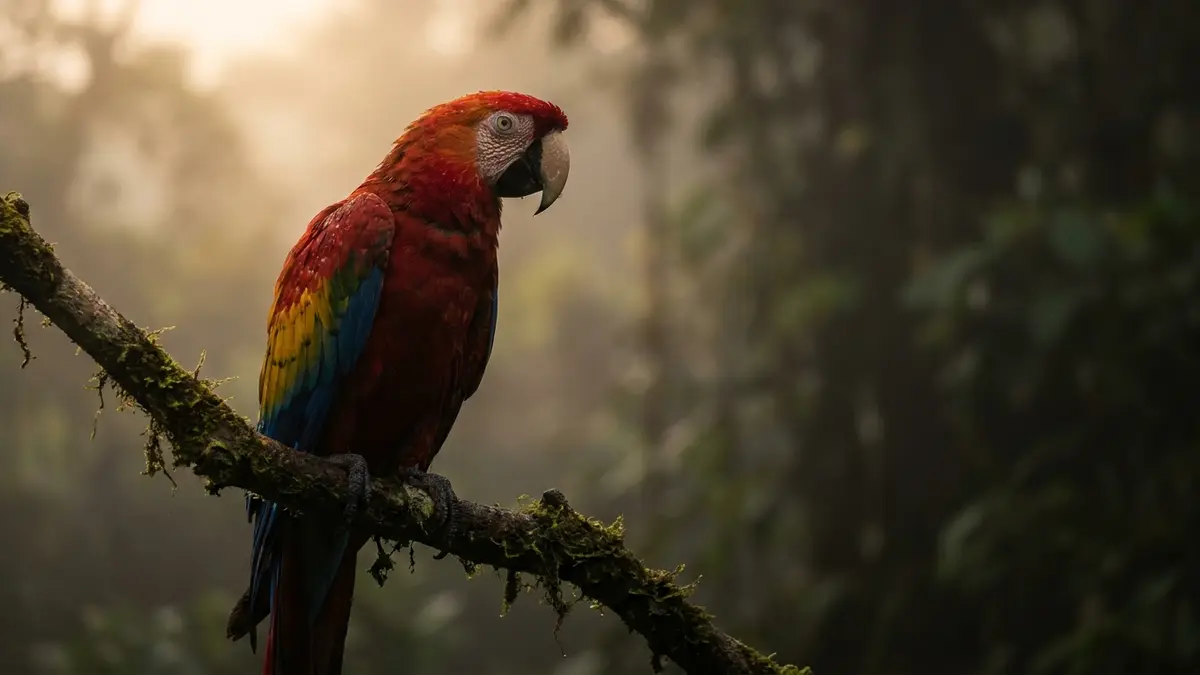
A parrot has no vocal cords. It shapes sound with a syrinx and its tongue, which is why the voice can be so precise. Alex, an African grey studied for thirty years, used more than a hundred labels and grasped the concept of zero — but the research was about concept use, not conversation.
An almanac
- Lifespan
- Wildly species-dependent. Record: 92 years (salmon-crested cockatoo) in a 260-species zoo dataset; only 11 other parrot species topped 50 years.
- Longest
- Hyacinth macaw — about 40 inches (100 cm) nose to tail, with a five-foot wingspan, but only ~42 oz (1.2 kg).
- Heaviest
- Kākāpō — males up to 4 kg, and flightless, which is why it can afford the bulk.
- Range
- Tropical and southern-hemisphere, but not only jungle: the kea lives in New Zealand's Southern Alps, and 25 escaped-pet species now breed wild across 23 US states.
- Diet
- Mainly seeds, nuts and fruit; hyacinth macaws specialise on acuri and bocaiuva palm nuts, kākāpō feed heavily on rimu, and some kea eat fat off live sheep.
- Conservation status
- 27% of parrot species are threatened with extinction — roughly double the one-in-eight rate for birds as a whole.
- Standout number
- A parrot brain carries about twice as many neurons as a primate brain of the same mass.
Parrot intelligence is the most over- and under-sold thing in popular biology at once. The overselling is the idea that a talking parrot understands conversation. The underselling is that people assume mimicry is all there is.
What the research actually shows is stranger and more specific. Alex, an African grey worked with for three decades, handled more than a hundred labels and demonstrated a grasp of zero — a concept most animals never show. Snowball, a cockatoo, keeps time to music, which for a long while was thought to be uniquely human.
And none of it involves vocal cords, because a parrot does not have any.
Parrot Facts Worth Knowing
- Parrots have zygodactyl feet — two toes point forward and two point backward — which lets them grip and manipulate food like a hand.
- Gram for gram, parrot brains are packed with about twice as many neurons as a primate brain of the same mass.
- Parrots have a brain structure no other bird has: a 'shell' vocal-learning system wrapped around the 'core' system songbirds and hummingbirds share — and the kea's rudimentary shell implies parrots evolved vocal learning at least 29 million years ago.
- The kākāpō of New Zealand is the world's heaviest parrot, with males reaching 4 kg — and it cannot fly.
- A male kākāpō digs a bowl in the ground, inflates a thoracic air sac and 'booms' from it for up to eight hours a night, every night, for two or three months.
- Parrot reds, oranges and yellows come from psittacofulvins — pigments the bird manufactures inside the growing feather itself, not from carotenoids in its food the way a flamingo's pink does.
- Budgerigar plumage reflects ultraviolet light that humans cannot see, and in experiments females consistently chose males whose UV reflectance had not been filtered out.
- The United States had a native parrot: the Carolina parakeet, whose range ran from southern New England to Florida and as far west as Colorado.
- The last Carolina parakeet died in captivity at the Cincinnati Zoo in 1918; the birds' habit of circling their shot flockmates let hunters wipe out whole flocks at once.
- Escaped pet parrots have re-colonised the United States: 25 species now breed in the wild across 23 states, with 56 species recorded in 43 states between 2002 and 2016.
- The hyacinth macaw is about 40 inches (100 cm) long with a five-foot wingspan, yet weighs only around 42 ounces (1.2 kg). It is routinely called 'the biggest parrot in the world', which is true only for length and wingspan. By weight the flightless kākāpō beats it roughly threefold — males reach 4 kg against the macaw's 1.2 kg.
- Alex, an African grey studied by Irene Pepperberg, learned to identify 50 objects, 7 colours and 5 shapes, count quantities up to 6, and grasp a zero-like concept before his death on 6 September 2007 at age 31.
- The Puerto Rican parrot fell to just 13 wild birds in 1975; captive breeding at El Yunque and Río Abajo has since supplied birds for release back into the forest.
What People Get Wrong About Parrots
“A talking parrot is just a tape recorder — it mimics sounds with no idea what they mean.” Thirty years of controlled work with Alex the African grey showed referential use of words: he labelled, requested, refused and categorised objects, and answered questions about colour, shape and number. Mimicry is real, but it is not the ceiling.
“Parrots live 80 to 100 years, so getting one is a lifetime commitment whatever the species.” A study of 83,212 zoo records covering 260 parrot species found one bird at 92 years — a salmon-crested cockatoo — and only eleven other species with a maximum recorded lifespan above 50 years. Most parrots, especially small ones like budgies and cockatiels, live nothing like a century.
“Parrots are the most threatened group of birds on Earth.” Parrots are badly hit — 27% of species are threatened, well above the one-in-eight average for birds overall — but BirdLife's own figures put albatrosses (68%) and cranes (67%) far higher. 'Among the most threatened' is accurate; 'the most threatened' is not.
“A bag of parrot seed mix is a proper diet for a pet parrot.” Seed mixes are fat-heavy and short on vitamins, minerals and amino acids, and birds pick out the fatty bits and leave the rest. Vitamin A deficiency is among the most commonly diagnosed nutritional disorders in seed-fed parrots; formulated pellets plus vegetables are the veterinary recommendation.
“Budgies, cockatiels and cockatoos are parakeets or 'cage birds' — not true parrots.” They are all parrots. Budgies, macaws, cockatoos and parakeets sit inside the same parrot family, and every one of them shows the family's diagnostic zygodactyl foot and hooked bill.
In Culture
The shoulder-parrot cliché starts with one book: Robert Louis Stevenson's Treasure Island (1883), where Long John Silver's bird Captain Flint screams "Pieces of eight!" Comedy's most famous parrot is dead on arrival — Monty Python's "Dead Parrot" sketch, written by John Cleese and Graham Chapman for episode eight of Flying Circus, "Full Frontal Nudity", first broadcast 7 December 1969, invented a species (the Norwegian Blue) purely to sell it back to a customer as pining for the fjords. Animation's biggest parrot is Blu in Rio (2011), directed by Carlos Saldanha for Blue Sky Studios and voiced by Jesse Eisenberg; the film took over $470 million worldwide, and Blu's species, the Spix's macaw, was declared Extinct in the Wild by the IUCN in 2019 before captive-bred birds were released in Bahia, Brazil, in June 2022. On the internet, two clips did the heavy lifting: Snowball the head-banging cockatoo, and the 2009 Last Chance to See footage of a kākāpō enthusiastically mating with zoologist Mark Carwardine's head while Stephen Fry lost it beside him — over 30 million views.
Notable Individuals
Alex (1976–2007), the African grey at the centre of Irene Pepperberg's research, died on 6 September 2007 aged 31 knowing 50 object labels, seven colours, five shapes and a zero-like concept. Cookie, a Major Mitchell's cockatoo, arrived at Brookfield Zoo in May 1934 as part of its founding collection and died on 27 August 2016 at about 83 — Guinness World Records certified him the oldest living parrot in 2014. Snowball, a sulphur-crested cockatoo, was filmed performing 14 distinct dance movements plus two composites in a Current Biology paper published 8 July 2019. Sirocco, hatched 23 March 1997, is a hand-reared kākāpō appointed New Zealand's Official Spokesbird for Conservation by Prime Minister John Key in 2010. Puck, a budgerigar from Petaluma, California, entered the 1995 Guinness Book with a vocabulary of 1,728 words.
Frequently Asked Questions
Do parrots understand what they are saying?
Thirty years of controlled work with Alex the African grey showed referential use of words: he labelled, requested, refused and categorised objects, and answered questions about colour, shape and number. Mimicry is real, but it is not the ceiling.
How do parrots talk without vocal cords?
A study of 83,212 zoo records covering 260 parrot species found one bird at 92 years — a salmon-crested cockatoo — and only eleven other species with a maximum recorded lifespan above 50 years. Most parrots, especially small ones like budgies and cockatiels, live nothing like a century.
How long do parrots live?
Parrots are badly hit — 27% of species are threatened, well above the one-in-eight average for birds overall — but BirdLife's own figures put albatrosses (68%) and cranes (67%) far higher. 'Among the most threatened' is accurate; 'the most threatened' is not.
Can parrots really dance to music?
At least one can, and it was studied properly. Snowball, a sulphur-crested cockatoo, synchronises movement to a musical beat and adjusts when the tempo changes — behaviour previously thought to be uniquely human.
What did Alex the African grey actually demonstrate?
Alex worked with more than a hundred labels and showed a grasp of zero, a concept most animals never demonstrate. The research was about concept use — categories, quantities, sameness and difference — not about conversation.
More about the Parrot
More from Animal Facts

Sources
Claims on this page were checked against these published sources.
- Hawk-headed parrot
Members of the Psittacidae family have zygodactyl feet, meaning two toes point forward and two toes point back, giving them greater dexterity to move and hold food items.
Read the source → - Birds have primate-like numbers of neurons in the forebrain
the brains of parrots and songbirds contain on average twice as many neurons as primate brains of the same mass
Read the source → - Core and Shell Song Systems Unique to the Parrot Brain
The parrot brain uniquely contains a song system within a song system.
Read the source → - Kākāpō: New Zealand native land birds
the heaviest parrot species, with males weighing up to 4 kg
Read the source → - Behaviour: Kākāpō
His serenade can last for eight hours, every night for two or three months.
Read the source → - Carotenoid pigments and the selectivity of psittacofulvin-based coloration systems in parrots
we presume that these pigments are locally synthesized by growing feathers within the follicular tissue.
Read the source → - Ultraviolet vision, fluorescence and mate choice in a parrot, the budgerigar Melopsittacus undulatus
females consistently prefer UV-reflecting males
Read the source → - How humans killed off the only parrot native to the continental U.S.
The country's only native parrot species ranged from southern New England down to Florida and as far west as Colorado
Read the source → - Escaped pet parrots are now naturalized in 23 U.S. states, study finds
25 species are now breeding in 23 different states
Read the source → - Hyacinth Macaw
The typical length of a hyacinth macaw is about 40 inches
Read the source → - Alex the African Grey parrot
Dr. Pepperberg's pioneering research resulted in Alex learning elements of English speech to identify 50 different objects, 7 colors, 5 shapes, quantities up to and including 6 and a zero-like concept.
Read the source → - Science Projects — Protecting the Puerto Rican Parrot
had their population reduced to just 13 wild parrots in 1975
Read the source →
Not sure which animal is yours?
Consult the quiz