Birds · Spirit animal
Ostrich & Emu Spiritual Meaning & Symbolism
The grounded wanderer who trades flight for endurance, instinct, and unstoppable forward motion.
For strength, endurance, resilience, and adaptability as you move through life, call on the spirit of the ostrich and emu. This totem embodies the power of steady forward motion — as you carefully prepare and make your way through whatever challenges may arise. Do not allow indecision to slow or stop you. Keep a strong hold on your vision and goals for yourself, even when resources are low. Create steadiness through commitment and care of those who depend upon you.
In dreams, the presence of these animals may indicate that plans in need of completion or action have been delayed. Balance your need for steady progress with self-care and rest.
An almanac
- Core message
- Power without flight; steady progress over dramatic leaps
- Spirit animal
- Forward motion, community engagement, protective caregiving
- Totem for
- Perfectionists, natural leaders, solo parents
- Power animal
- Single-minded focus and disciplined follow-through
- In dreams
- Delayed plans, family life, need for play
- Cultural roots
- Aboriginal Dreaming lore & Milky Way sky-lore
- Ancient Egypt
- Ma'at's feather of truth & justice
- Common myth
- Head-in-sand — biologically false
Ostriches and emus can't fly, yet they're both big birds with big personalities. This one lesson from the Ostrich & Emu spirit animal: true power can be just as rewarding—and just as rooted in your strengths—as flying high in life. That strength comes from resilience, adaptability, and a straightforward readiness to accept the challenges of day-to-day living. And while those might not be the most flashy qualities you'll ever find, they'll always get the job done.
Ostrich & Emu Symbolism & Meaning
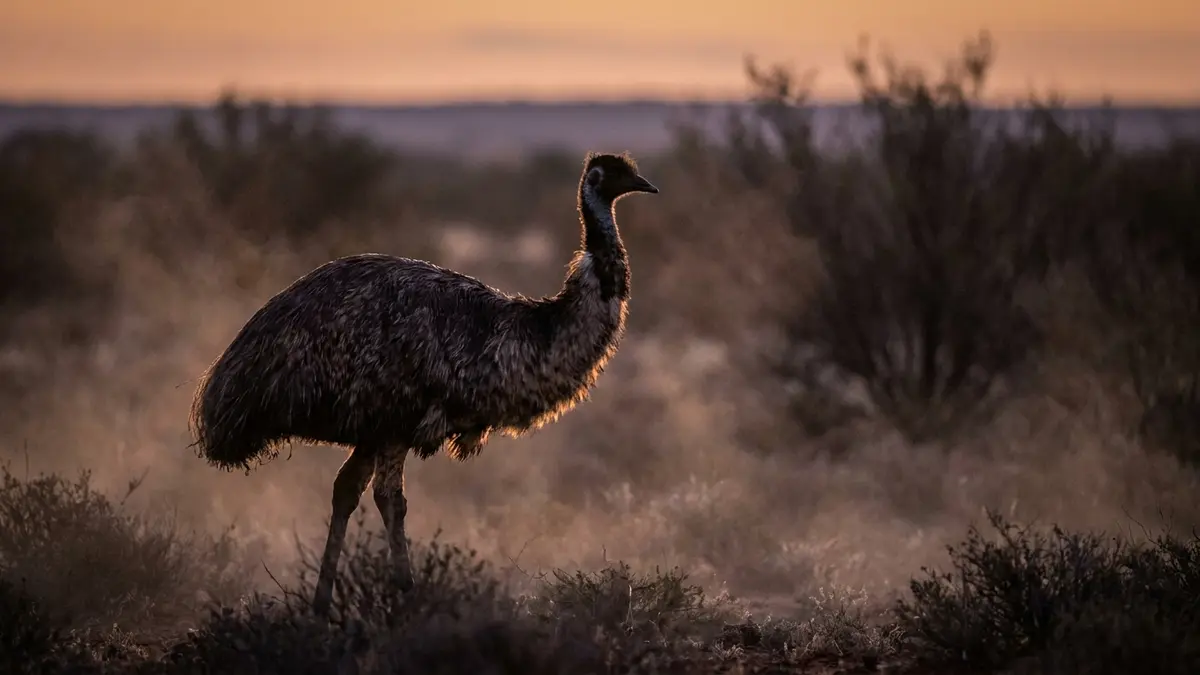
This pairing is the wanderer archetype in bird form. Emus roam wherever conditions favor them, settling briefly before food, weather, or human pressure sends them onward again — a lesson in adaptability and practical survival. Size matters here too: emus are the tallest bird native to Australia (the cassowary is heavier but shorter), standing over five feet and sometimes close to six, and their booming call, produced mostly by females, can travel over a mile and serves both courtship and warning off threats.
Parenting duties flip the usual script. Male emus build the nest, then incubate the eggs alone for roughly two months without eating or drinking, and lose a third of their body weight in the process. Once chicks hatch, he guards them for another half year, pacing his depleted energy like a long-distance runner.
That's where the symbolism of measured effort and devoted fatherhood comes from. Playful curiosity rounds out the picture: emus are drawn to bright, shiny objects and approach strangers without fear, which gives the bird a mischievous, childlike streak alongside its solar associations in Aboriginal sky-lore.
Ostrich & Emu Spirit Animal
When an ostrich or emu spirit animal shows up in your life, you're being called to take action, even though you may not know the direction. It's a reminder that motion is available to you at all times, and that it's important to stop waiting for perfect clarity and just take the next step.
This spirit animal also wants you to know that taking action doesn't just mean taking steps on your own. Rather, it's an invitation to connect with your community — your neighborhood, tribe, or circle of friends — and to show up as a fair, humble, and respectful member. If there's someone who has wronged you or misjudged you in the past, this spirit animal will be a fierce advocate until the situation is made right.
If there's any part of life where your role is that of a parent or caregiver, then this ostrich or emu spirit animal will provide steady guidance and reassurance as you rise to the challenge. They also remind you that it's normal to be nervous about entering new situations or roles; what's important is that you step into those roles anyway and continue moving forward.
Does Ostrich & Emu fit you?
Tap the ones that sound like you — 6 traits, no right answer.
0 of 6 Nothing picked yet — start tapping.
Ostrich & Emu Totem Animal
The ostrich and emu both have powerful symbolic significance: they chase excellence relentlessly, and others turn to them for spiritual guidance. Because of their limited ability to fly, they have developed an unusual way of overcoming this disability, so people with the totem of these birds inherit a problem-solving drive.
Diligence and follow-through are crucial for people with these animal symbols, and anything short of doing their absolute best feels like failure. You might become perfectionists over time, but your natural inclination is to be grateful for every good thing in your life. Your strong sense of gratitude is a benefit to everyone around you.
When you take on a project, you are eager to move quickly, even though this doesn't drain your energy. Solo parents with these animals as totems tend to excel at what they do. You might have a tendency to say things bluntly and loudly — be aware of how you come across.
Ostrich & Emu Power Animal
Look to the ostrich and emu as allies to sharpen your concentration and focus on long-term goals, even when you're out of steam. They lend you the strength and determination to drive through your plan, ignoring distractions and hitting every mark. If you need sustained push toward a goal, they provide power. But when a time crunch is on, they make you quick and agile.
Aboriginal Ostrich & Emu Symbolism & Meaning
In Aboriginal Dreaming traditions, this bird plays a central and complex role. Stories often swap which parent — mother or father — takes on incubation and rearing duties, which mirrors how gender roles shift within the bird's own biology; this made the bird a symbol of comfort for single fathers or men filling roles traditionally seen as maternal.
Not every story is flattering. In one well-known telling, a jealous bustard — sometimes called the "plain turkey" — tricks the emu into believing that giving up its wings will keep it king of the birds. The emu cuts off its own wings, only to watch the bustard fly off with hers intact. That's why the emu remains flightless today, a permanent reminder of what misplaced trust and vanity can cost.
Across regions, the lore shifts from clan to clan, but a common thread treats the bird as an underdog figure worthy of respect.
Its feathers were also believed to let a wearer move without leaving footprints, and in the sky, this bird's shape stretches across the dark patches of the Milky Way — a celestial marker some groups link to the timing of egg-laying season.
Ostrich & Emu Dreams
Symbolic dreams with an ostrich or an emu usually catch your attention to show you that it's time to get up and get moving.
You'll see a bird running toward you and the dream will tell you it's time to do something you've been putting off. Or maybe a bunch of them are gathering in front of you.
Either way, be on the lookout for hints about family life. The birds' mood will signal things are going well, or not so well.
And then there are dreams of birds snatching something, which means it's time to take a break and have some fun. Also dream where several birds dance together. Maybe it means you're open to different romantic connections. Or maybe just that you're a little restless because you're not so sure about settling down.
But if there's a dream where the bird hides its head or refuses to look at you, that probably means something is hiding from your awareness. It's something that maybe you already know deep down.
Either way, pay attention to your dream life and think about the bigger things going on in your life.
Spiritual Meaning of Ostrich & Emu
It asks of you to keep walking and moving forward even when the way ahead isn't entirely clear, to protect what you've nurtured even when your own reserves may have run out, and to stay curious and lighthearted rather than letting effort harden into rigidity.
This is an invitation to trust gradual progress over dramatic leaps, and to keep gratitude and community close by so that they can act as a reminder about who you truly are.
Ostrich & Emu in Ancient Egypt
Long before Aboriginal Dreaming stories carried this bird across the night sky, ancient Egypt had already crowned it sacred. The ostrich feather was the emblem of Ma'at, the goddess of truth, cosmic order, and moral balance — she was depicted wearing a single white ostrich plume rising from her hair, and in some tellings she was the feather itself, truth given form.
In the Hall of Two Truths, that same feather was the final judge of a life well lived. Egyptian belief held that after death, a person's heart was set on one side of a scale and Ma'at's feather on the other; a heart burdened by dishonesty or cruelty sank heavy, while one lighter than the feather passed on to a peaceful afterlife. It's a striking image to sit with: truth weighs less than the guilt of hiding from it.
Ostrich & Emu's spiritual thread connects across cultures here: crowned as Ma'at's emblem in Egypt, woven into Dreaming lore in Australia, the bird keeps surfacing wherever people wrestle with honesty, judgment, and what it costs to live rightly.
The Head-in-the-Sand Myth
Ostriches don't bury their heads in the sand. The idea that they do traces back to Pliny the Elder, a Roman naturalist.
People are still carrying around that myth. Today, even though scientists know better, there's still an enduring perception that ostriches lower their heads into the sand as a denial strategy.
The real ostrich instinct is very different: it's to lower itself, assess what it sees, and then adapt. Ostriches rarely hide if they can run away from a threat; when running isn't an option, they flatten against the earth to blend with the terrain and avoid being noticed as an easy target.
If this bird visits you amid a habit of avoidance — bill collectors you ignore, a conversation you're postponing — remember this: facing what's uncomfortable is the real ostrich way.
Frequently Asked Questions
What does the Emu spirit animal mean?
It brings news of a time of forward motion after being stuck, along with a call to deepen your engagement with your community and assume a steady, nurturing, protective role.
Why is the Emu significant in Aboriginal culture?
The emu sometimes appears in Dreaming stories, where it can be depicted as a flawed shapeshifter. The emu's flightlessness symbolizes humility, and it serves as a seasonal marker and creator-spirit symbol in the night sky, where its outline is traced across the Milky Way.
What does it mean to dream about an Ostrich or Emu?
A dream about an ostrich or emu often indicates delayed plans that require attention, concerns about family, or the need to relax after a period of intense activity.
Do ostriches really bury their heads in the sand?
No. This is a myth that can be traced back to Roman naturalist Pliny the Elder. In fact, ostriches do not bury their heads in the sand. They have a unique egg-laying technique where they lay their eggs in shallow nests of sand and then turn them with their long necks. But when they're threatened, they flatten their necks close to the ground, and thereby make themselves inconspicuous in the landscape. Spiritually, this correction matters: rather than hide from danger, ostriches have an admirable instinct to face it head-on.
What does the ostrich feather symbolize in ancient Egypt?
Ma'at was the Egyptian goddess of truth, balance, and order. She was often shown wearing a single ostrich feather as her symbol. In Egyptian art the judgment of the dead would see a person's heart weighed against a feather: if their heart was lighter than the feather they could pass on to eternal peace, but if it weighed more it meant there was wrong in their life and they didn't get to enjoy the afterlife.
What does the Bible say about the ostrich?
In the Book of Job, we read about ostriches (Job 39:13-18). They leave their eggs on the ground and are very stern with their young. God has deprived them of wisdom, but they can run away from horses and riders.
Ostrich & Emu also represents
- Other animals that represent strength →Alongside Lion, Bear, Tiger, Elephant
- Other animals that represent protection →Alongside Bear, Wolf, Dog, Elephant
- Other animals that represent family →Alongside Elephant, Wolf, Penguin, Ant
- Other animals that represent determination →Alongside Salmon, Ant, Beaver, Falcon
Sources
Claims on this page were checked against these published sources.
- Emu
Emus can grow up to 1.9 m (6 ft 3 in) in height, making them the tallest native Australian bird, though they rank third globally after the common ostrich and Somali ostrich.
Read the source → - Emu vs cassowary: who would win?
Although the emu is taller, the cassowary is the heaviest bird in Australia and the second heaviest in the world after its cousin, the ostrich.
Read the source → - Emu Facts
The male performs all incubation duties alone, without drinking, feeding, defecating or leaving the nest... will lose a third of his weight over the eight-week brooding period.
Read the source → - Emu in the sky
The Yamatji people of Western Australia use the Pleiades constellation (Seven Sisters) to determine egg-harvesting time. When the constellation is close to the horizon as the sun is setting, the people know that it is the right time to harvest emu eggs.
Read the source → - Featherfoot
Special shoes made of feathers (usually emu) and hair are worn and stuck together with human blood... equipped with distinctive shoes constructed from woven grass or netting inserted with emu feathers, kurdaitcha leave no discernible footprints and move silently.
Read the source → - Maat
Her ostrich feather represents the truth.
Read the source → - Ostriches Do Not Really Stick Their Heads in the Sand
This myth originated in ancient Rome... They routinely use their beaks to check on and turn their eggs, which may give the impression of sticking their heads right into the dirt.
Read the source → - Job 39:13-18 (WEB)
For she leaves her eggs on the earth, Warms them in the dust... Because God has deprived her of wisdom, Neither has he imparted to her understanding. When she lifts up herself on high, She scorns the horse and his rider.
Read the source →