Fish & Sea Life · Spirit animal
Octopus Spiritual Meaning & Symbolism
The ocean's shape-shifting strategist, whose intelligence and flexibility carve a graceful way through anything.
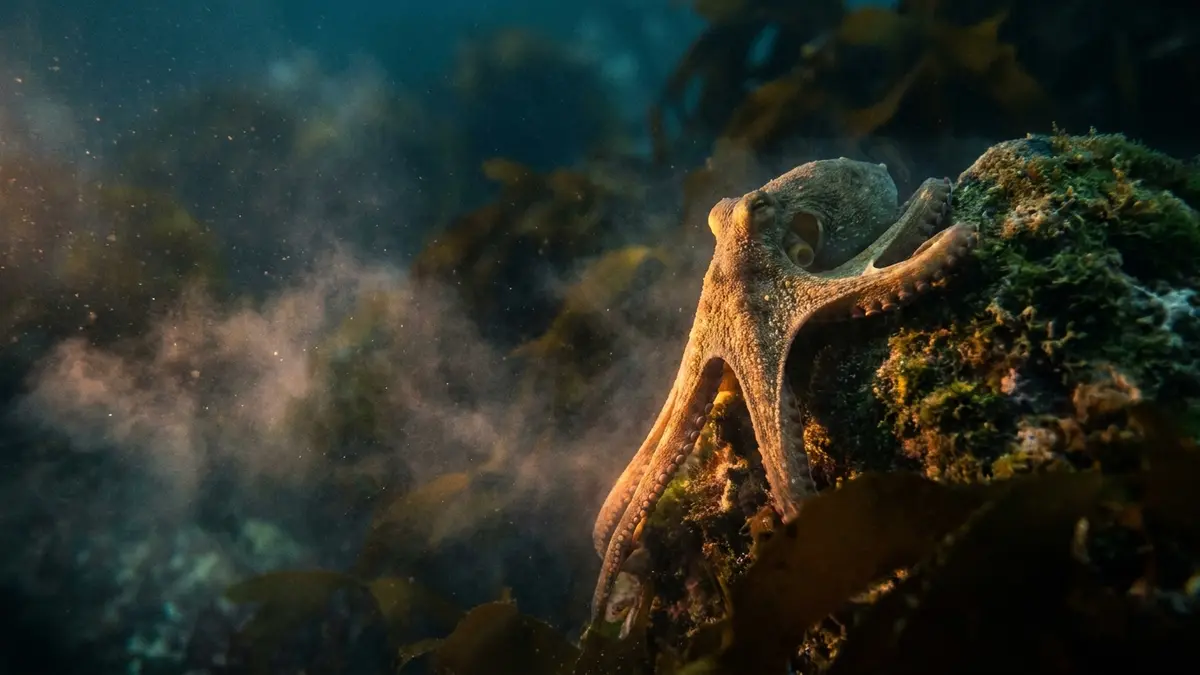
The Octopus is all about intensity of focus and adaptability without limits, instead of forcing through with brute strength. When this animal spirit appears, it's a sign that you're ready for something new, the intuitive insights of your subconscious are bright and vivid, and whatever's been dragging you down needs to go. They often appear in dreams.
An almanac
- Core message
- Adapt with intelligence, not force
- Spirit animal
- A new chapter, sharpened intuition, vivid dreams
- Totem for
- Sharp, adaptable, guarded until trust is earned
- Power animal
- Juggling responsibilities, emotional renewal
- In dreams
- Overextension, or gripping control too tightly
- Element
- Water
- Zodiac ties
- Cancer & Scorpio energy
- Nervous system
- 8 arms, mostly self-steering
The octopus isn't just a survivor in the watery chaos. It out-thinks the chaos, twisting its boneless body into whatever shape it needs. That combination of sharp mind and limitless adaptability wrapped in genuine mystery means the octopus has been misread as one of the water's most mysterious teachers.
Octopus Symbolism & Meaning
Octopus is smarter and more flexible than most sea creatures, and those traits combine to give the animal its own strengths. It means that people who are friends with Octopus can learn how to succeed by working at things instead of giving up.
Octopus is a symbol of water. This connects Octopus to feelings, clearing bad energy, and following a natural rhythm, which is often linked to the energy of women in some cultures. Unlike most animals, an octopus does not have a skeleton, so it is flexible enough to go around obstacles instead of trying to go straight through them.
Octopus can also teach you how to renew or replace bad choices with better ones by letting go of things that are unimportant. Its other image shows that you can appear quiet until the right time when everyone else makes too much noise.
Octopus Spirit Animal
When an octopus starts to shadow your life, take it as a sign that it's time for the next chapter. It's great at helping you think outside the box and strengthening your intuition. When it's nearby, try writing down any startlingly accurate dreams you have, because they might hold a message for you. It loves helping the super-learners of the world, so if it's around you, it might be trying to point out what areas you still need to work on and what kind of wisdom you have gathered so far.
An octopus has eight limbs — which resemble the shape of a never-ending symbol — so maybe it is reminding you of your past experiences or telling you that past chapters of your life are coming back around to help you find a new perspective for things. It's also warning you to be careful about how much you swallow.
In any close relationships, the octopus also encourages you to look more at sensuality and honest partnerships than before.
Does Octopus fit you?
Tap the ones that sound like you — 6 traits, no right answer.
0 of 6 Nothing picked yet — start tapping.
Octopus Totem Animal
People born with an Octopus totem animal are well-read and generous about passing knowledge on, though they keep a part of themselves private until they're able to trust someone. They'll base their decisions on personal experience, instead of theory, but if they don't step back from their work occasionally, this drive may lead to them working too hard.
Octopuses seek something larger in life. People with this totem animal can sense the emotional temperature of a room and raise a shield when negativity gets close. People trust them because they will fix problems without being asked and explain things clearly when necessary.
People who aren't familiar with people born with an Octopus totem can often find them hard to read — the Octopuses prefer it that way, as they are adaptable by nature.
Octopus Power Animal
Octopus can be a handy ally if you've got a lot going on and need to juggle some things without dropping any of them. It can also help you step out of the spotlight, at least temporarily, when you need to do that.
Octopus can help you recover from illness or burnout by helping you let go of false beliefs and rebuild your willpower. It helps you make deliberate choices about how intense your efforts should be at any given time.
It can also help you detach from habits and relationships that have run their course. And if you're trying to untangle a genuine mystery, then Octopus might be able to help you find the answers.
Across cultures
4 traditions — pick one to read its take.
Native American Octopus Symbolism
Octopuses didn't surface often in Native American lore, but the Pacific Northwest coastal tribes gave them a great deal of attention. The Haida, Tlingit, and Nootka tribes all talked about octopuses as healers. Octopuses often appeared in trickster stories against ravens, and elsewhere octopuses guarded treasures beneath the waves.
Farther up the coast, the Kwakwaka'wakw and Nuxalk told of a rich underwater kingdom ruled by Kumugwe, or "Copper-Maker." An octopus guarded the kingdom, and sometimes Kumugwe himself took on the form of an octopus. Masks made in his likeness were unmistakably shaped like suction cups. If people could reach him, he would give them riches and power. Again, Octopuses had no patience for wasted words or empty ritual. They spoke plainly — say what you mean, skip the padding, cut right to the heart of the matter.
Octopus Meaning in Japan
The story goes that the Ainu people and practitioners of Shinto worship Akkorokamui, a huge octopus that fights with deadly efficiency by exploiting the same trick that real octopuses do: regrowing a leg in the middle of a fight. Some claim to leave offerings for Akkorokamui when they're sick or recovering from a broken bone, hoping for rapid healing.
Elsewhere in Japan, red octopus amulets keep watch over personal fortunes, said to bring both peace and quiet motivation toward self-improvement. Folk art often conveys octopuses as funny little creatures, and one recurring legend casts them as personal physicians to Ryujin, the king of dragons in the sea — possibly why traditional Japanese doctors carried small octopus amulets of their own.
Octopus Symbolism in Buddhism
A Buddhist legend that has been passed down in Kyoto's Tako Yakushi Temple tells the story of a monk's internal conflict.
His mother had fallen seriously ill and was craving octopus, believing it would help her recover. Octopus is a comfort food popular in Japan, but this monk had long ago sworn never to take the life of any sentient being — this request tore him up inside.
Love for his mother won out and he went to the market anyway. As he carried home his purchases, which included some octopus, he prayed for a way out of his dilemma. When he got home and opened the box, there was no octopus! Inside was a stack of eight handwritten scrolls known as sutras (ancient Buddhist texts). It transformed into an octopus that began glowing green and jumped into the temple's pool. There it changed into a Buddha and began spreading radiant light throughout the temple.
The radiant light reached and healed his mother! That is why the temple continues to be called "Octopus Temple."
Octopus in Norse Mythology
Scandinavian and Norwegian folklore inspired the Kraken, an enormous sea beast. Sailors believed that it lived in coastal waters, waiting to attack ships. They thought that Krakens could pull down an entire ship and crew with them. The first written description of the Kraken came in an old sailor's journal. In 1729, a missionary reported seeing a Kraken. Bishop Erik Pontoppidan wrote about it in 1753 and described the creature as an Octopus monster. Whether the actual sighting was an Octopus or a giant Squid is still a mystery, but Victor Hugo and Jules Verne cemented its place in popular imagination.
Octopus in Oceanic & Polynesian Myth
The ocean is central to many island cultures, and they have Octopus lore of their own. In the Gilbert Islands, tradition says that Na Kika was a deity who looked like an Octopus, who was part of the beings present at the creation of the world.
One Hawaiian god was named Kanaloa. He had many forms and one of them was an Octopus. People often translate this name as "great stillness" — that is, calmness.
Octopus in Dreams
Dreaming of an octopus can mean you feel like you're stretching yourself too thin. The details in your dream help figure out why. It could be that you're spread too thin, but the dream scene might also tell you that you're holding onto something when you really shouldn't. For example, if the octopus is reaching out in all different directions, maybe you are feeling overextended. If the octopus is clutching something very tightly, maybe you should release your control. The dream scene might also give an idea about what to do next. For example, if the octopus is on the move, maybe an opportunity is coming up and time is short. Or if the octopus is stuck to the ocean floor, maybe slowing down and grounding your plans in reality might be best. If your scene includes one or more tentacles staying behind, maybe a quick and clean break from something unhealthy would be wise. If an octopus changes color in the dream, maybe someone nearby isn't being completely honest with you and it would be best to keep your guard up. Finally, if the octopus releases a cloud of ink, perhaps now isn't the time for confrontation and a more subtle approach might be best.
Octopus Tattoo Meaning
Its visual strength makes the octopus a good choice for a tattoo, one with meanings that are worth exploring: the ability to make quick decisions in changing circumstances. That's why an octopus tattoo can mark deep commitment to something or someone, a commitment to facing the hard truths of life.
Many people who get this tattoo are not afraid of change — change is simply an ally. Others use this ink to mark their ability to handle tough situations, to come out on top even when facing hard times.
Octopus Spiritual Meaning
Octopus, read for its spiritual meaning, turns out to be a creature built around graceful adaptation. Technically it moves on two legs and six arms rather than eight identical limbs, a reminder that diversity within one being is a strength.
That reminder runs deeper than metaphor. Most of an Octopus's neurons live not in its head but out along its arms, each one carrying enough of its own nervous tissue to taste, feel, and steer with real independence from the central brain. Spiritually, it's a striking image of distributed wisdom — proof that intelligence doesn't need to sit in one place to move as a single coordinated whole.
Its color-shifting skin mirrors what many traditions call the human aura: ask yourself honestly what "colors" you're broadcasting right now. Underneath the skin, tiny pigment sacs called chromatophores stretch and relax on command from the nervous system, each one wired straight to its own nerve. It's a literal picture of feeling turning instantly into visible color. Its knack for squeezing through impossibly tight gaps speaks to moving past situations that feel unworkable, and its fluid motion is a model for meeting change with grace instead of resistance.
Octopus also honors anyone who creates or heals with their hands. Its self-sacrificing mother, who starves herself guarding her eggs until they hatch, is devotion that asks nothing in return. Fittingly, it carries among the largest brains relative to body size of any invertebrate.
Octopus in Māori Mythology
The giant octopus Te Wheke is said to be from Aotearoa (New Zealand). Muturangi, a powerful tohunga (priest) from Hawaiki, owned the giant octopus. At some point, the octopus began to steal fish from the local fishing grounds. The navigator Kupe decided to end the theft of fish and tracked the octopus across open water for weeks before cornering it near Cook Strait. In different tribal accounts, either Kupe or the ancestor Tamatea delivered the fatal blow to end its reign.
The long chase was a critical part of the voyage that led Kupe to discover Aotearoa. The octopus wasn't just a passive symbol: it was a worthy adversary that forced him to become a navigator.
Octopus in Biblical & Abrahamic Tradition
Long before marine biology caught up, older Abrahamic texts already singled Octopus out for its strangeness. The dietary law in Leviticus declares that anything living in the water without fins and scales is unclean — Octopus included — unfit to eat under Mosaic law. It's a small footnote in scripture, but it captures something real about how this creature has always unsettled tidy categories: no shell, no scales, no bones, nothing that matches the expected shape of a "fish."
That outsider status is worth holding lightly rather than reading as condemnation. Octopus has never fit the mold, biologically or symbolically, and traditions from the Pacific to Japan treat that same strangeness as a mark of power rather than impurity. However you weigh the old law, it's a fitting reminder that being hard to categorize is often exactly what makes a teacher memorable.
Octopus and Astrology
Octopus does not claim one fixed position in Western astrology, but its energy resonates most naturally with the water signs. Cancer, ruled by the Moon and steeped in intuitive home-keeping instinct, and Scorpio, the sign of regeneration, are both protective and deeply feeling like Octopus.
If Octopus feels like your Animal Ally, consider which of these water signs resonates most strongly with your own chart. If it is Cancer, take advantage of Octopus's camouflage to nurture a network of what you love; if it is Scorpio, use the transformative power of Octopus to reinvent yourself from the inside out.
Frequently Asked Questions
What does an Octopus spirit animal mean?
When an octopus is your spirit guide or totem, you're likely to get accurate hunches. Your mind also becomes more creative and flexible, able to solve problems and see things from different viewpoints. Paying attention to your dreams is extra important.
What does it mean to dream about an Octopus?
It usually means you're trying to do too much, or cling too tightly to something beyond your control. The details make a difference: a moving Octopus means time is running out, while one making an escape suggests freedom is near if you keep flexible.
What does an Octopus tattoo symbolize?
People often choose an Octopus tattoo as a sign of commitment to a cause or relationship, or as a reminder that things may change but you can survive. If you get an Octopus tattoo, people will see this as a sign that you feel safe dealing with the changes that life will throw your way.
What does it mean when an Octopus attacks you in a dream?
An octopus is aggressive toward you in a dream? Usually it's a sign that something or someone is pulling you under—some obligation or emotion or influence you can't shake. It's not a literal warning, it's like being prodded to name what's getting a grip on you and loosen your grip in response.
What does a dead Octopus mean in a dream?
If you see a dead Octopus in a dream, it tends to indicate the end of a phase in your life where cleverness alone was carrying you. After all that maneuvering and strategizing, it’s time for a steadier approach.
Octopus also represents
- Other animals that represent rebirth and change →Alongside Butterfly, Snake, Dragonfly, Frog
- Other animals that represent protection →Alongside Bear, Wolf, Dog, Elephant
- Other animals that represent intelligence →Alongside Crow, Raven, Dolphin, Fox
- Other animals that represent healing →Alongside Snake, Deer, Dog, Bee
Sources
Claims on this page were checked against these published sources.
- Kraken
The kraken legend originates from Norwegian and Scandinavian maritime folklore rather than Norse mythology. The word itself derives from Norwegian, with etymological roots tracing back to Old Norse terms meaning "crooked" or "hook-like."
Read the source → - Octopus
The two rear appendages are generally used to walk on the sea floor, while the other six are used to forage for food.
Read the source → - Cephalopod intelligence
their brain-to-body mass ratio is among the largest of all invertebrates, falling between that of endothermic and ectothermic vertebrates.
Read the source → - Kanaloa
Kanaloa is a god symbolized by the squid or by the octopus, and is typically associated with Kāne... a god of ocean, healing, and long travels
Read the source → - Akkorokamui
Akkorokamui...is a gigantic octopus-like monster from Ainu folklore... characteristically described with the ability to self-amputate...and regenerate limbs... it is believed among followers that giving offerings to Akkorokamui will heal ailments of the body, in particular, disfigurements and broken limbs.
Read the source → - Native American Octopus Mythology
Tlingit and Haida...have Devilfish clans as subclans of the Raven moiety... considered to have formidable powers over the weather or over sickness and health... 'Raven Annoys Octopus,' a Northwest Coast Octopus legend about Raven the trickster
Read the source → - Te Wheke-a-Muturangi
In Māori mythology, Te Wheke-a-Muturangi is a monstrous octopus destroyed in Whekenui Bay, Tory Channel or at Pātea by Kupe the navigator.
Read the source → - Leviticus 11:12 (KJV)
Whatsoever hath no fins nor scales in the waters, that shall be an abomination unto you.
Read the source → - Kumugwe
His world is guarded by the octopus. Sometimes Kumugwe himself is conceived of in octopus form.
Read the source → - Toward an Understanding of Octopus Arm Motor Control
The extensive octopus nervous system harbors most of its neurons in the arms.
Read the source → - How do Octopuses Change Color?
Each chromatophore cell is attached to a nerve, meaning the expansion or contraction of the cells is controlled by the nervous system.
Read the source →