Animal Facts
Manta Ray Facts & Trivia: Brains, Barbs and Value
The largest ray in the ocean, and it cannot sting you.
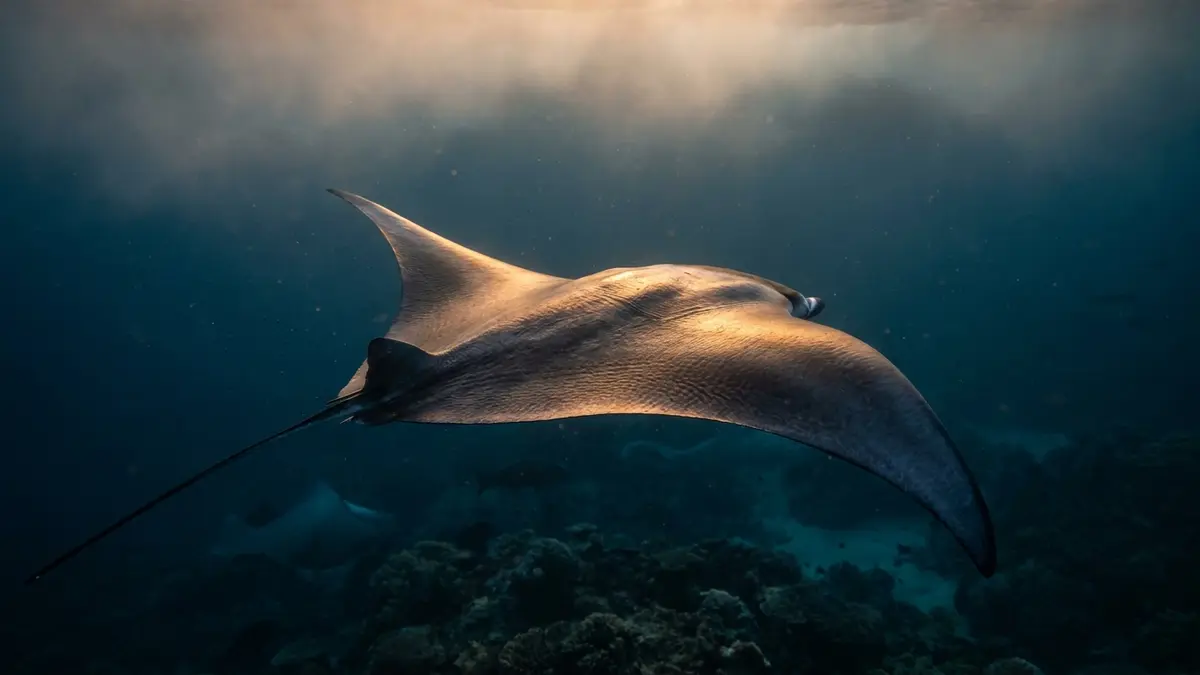
A manta ray has no venomous barb — its tail is a bare whip, unlike a stingray's. It carries the largest brain of any fish, dives past 400 metres, and reproduces so slowly that populations recover very poorly. Manta tourism is worth many times what a dead manta fetches.
An almanac
- Lifespan
- At least 40–45 years; Taurus, a male on the Great Barrier Reef, has been photo-identified since 1982
- Size
- Wingspan up to 26 ft (7.9 m); largest reliably measured disc 6.7 m — the 9.1 m figure is unverified
- Weight
- Up to about 5,300 lb (2,000 kg) for the oceanic manta
- Range & depth
- Tropical, subtropical and temperate oceans worldwide; feeds in under 10 m but dives past 1,000 m
- Diet
- Zooplankton — euphausiids, copepods, mysids, decapod larvae and shrimp, plus occasional small fish
- Conservation status
- Threatened under the U.S. Endangered Species Act since 2018; CITES Appendix II since 2013; some populations down over 90%
- Standout number
- One pup every two to three years — among the lowest birth rates of any shark or ray
A manta ray is the largest ray in the ocean and one of the very few large sea animals that is genuinely harmless to a swimmer. Its tail carries no venomous barb, which is the single most useful thing to know about it and the thing most often got wrong.
It also has the largest brain of any fish, dives far deeper than its surface-gliding reputation suggests, and reproduces at a rate that makes fishing pressure almost impossible to recover from.
The economics have been measured, and they point the same way as the biology.
Manta Ray Facts Worth Knowing
- The giant (oceanic) manta ray is the largest ray on Earth, with a wingspan reaching 26 feet — about 7.9 metres, wider than a giraffe is tall.
- The largest giant manta ray ever properly measured had a disc 6.7 metres (22 ft) across; the often-quoted 9.1-metre (30 ft) figure has never been verified by measurement. Popular articles routinely state mantas 'grow to 29 or 30 feet' as established fact. Museums treat 6.7 m as the largest reliably measured animal and 9.1 m as an unconfirmed upper possibility. NOAA's own figure is 26 ft.
- The giant manta ray has been listed as threatened under the U.S. Endangered Species Act since 2018.
- The two 'horns' on a manta's head are cephalic lobes — flexible paddles that unroll to funnel plankton-rich water into the mouth, and curl up into horn shapes when the animal isn't feeding.
- A manta ray can never stop swimming. It has no way to pump water over its gills, so forward motion is the only thing keeping it breathing — for its entire 40-plus-year life.
- In a 2016 experiment, captive mantas swam back and forth at a mirror, inspected body parts they could not otherwise see, and blew bubbles at their reflection — behaviour otherwise seen mainly in apes and dolphins. This is constantly reported as 'manta rays passed the mirror test' or 'manta rays are self-aware'. They did not pass a mark test. The researcher, Csilla Ari, explicitly said the results are suggestive, not conclusive.
- A third manta species, the Atlantic manta ray Mobula yarae, was formally described in July 2025 in the journal Environmental Biology of Fishes — named after Yara, a water spirit of Brazilian folklore.
- The reef manta ray is named after Prince Alfred, Queen Victoria's son, who survived an assassination attempt in Sydney in 1868 — the same year Australian Museum director Gerard Krefft described the species.
- Hanifaru Bay in the Maldives — a reef inlet just 700 m long and 200 m wide — draws up to 250 reef mantas at once, the largest known manta aggregation on the planet.
- Every manta ray carries a lifelong ID card: the spot pattern on its belly is unique and barely changes. Researchers have catalogued over 10,000 individuals from more than 100,000 photographs across 70+ countries.
- Of all sharks and rays, mantas and their devil ray relatives are recorded leaping clear of the water more often than any other group — and science still hasn't settled why. Aquarium signage and tour operators often assert breaching is 'to shake off parasites' or 'to attract a mate'. A 2024 review found parasite removal is only the most frequently proposed hypothesis, not a demonstrated cause; feeding, courtship and predator escape all remain live explanations.
What People Get Wrong About Manta Rays
“Manta rays sting. People routinely cite the stingray that killed Steve Irwin in 2006 as proof that big rays are dangerous.” A manta ray has no sting at all. Its tail is a bare whip with no venomous barb or spine — mantas physically cannot sting anything. The animal that killed Steve Irwin was a short-tail stingray, a completely different family; stingrays and manta rays are not interchangeable.
“There are two species of manta ray: the giant oceanic manta and the reef manta.” There are three. The Atlantic manta ray, Mobula yarae, was formally described and accepted in July 2025 after fifteen years as a 'putative' species. It ranges from the southeastern United States to Brazil and carries distinctive V-shaped shoulder patches. Almost every article and textbook written before mid-2025 says 'two species'.
“Mantas earned the name 'devilfish' because they attack boats and can wrap their wings around a diver and drown them.” The name comes from their horn-like cephalic lobes and their size, not from any recorded behaviour. Mantas are filter feeders with vestigial teeth and no weapons of any kind; in practice they frequently approach divers of their own accord. There is no documented case of a manta ray killing a person.
“Manta rays belong to their own genus, Manta — hence Manta birostris and Manta alfredi.” The genus Manta no longer exists. A 2018 phylogenetic study in the Zoological Journal of the Linnean Society found mantas nested inside the devil rays and folded Manta into Mobula. The correct names have been Mobula birostris and Mobula alfredi since then, though older labels persist everywhere from dive shops to school textbooks.
In Culture
DC's Black Manta debuted in Aquaman #35 (September 1967), created by writer Bob Haney and artist Nick Cardy, and reached his largest audience when Yahya Abdul-Mateen II played him in Aquaman (2018), a film that grossed roughly $1.15 billion worldwide. At the other end of cinema, Phuttiphong Aroonpheng's Thai feature Manta Ray (Kraben Rahu) premiered at the 75th Venice Film Festival on 7 September 2018 and won the Orizzonti prize; it opens with a dedication to the Rohingya. In music, "Manta Ray" — written by J. Ralph with Antony Hegarty (now Anohni) for the documentary Racing Extinction (2015) — was nominated for Best Original Song at the 2016 Academy Awards; its melody was built from a recording of the last known male Kauai o'o, an extinct bird. Games let you meet them directly: ABZÛ (2016) lets you grab a manta's back and ride it, and Nintendo's Endless Ocean series (Wii, 2007; Blue World, 2009; Luminous, Switch, 2024) logs them as dive encounters. One durable mix-up: Mr. Ray, the singing schoolteacher in Finding Nemo (2003), is a spotted eagle ray, not a manta.
Notable Individuals
Nandi was caught in a shark net off Durban, South Africa in 2007, spent a year recovering at uShaka Marine World, then made a 26-hour, 9,000-mile jumbo-jet flight to Atlanta, going on display at Georgia Aquarium on 25 August 2008 as the first manta ray exhibited in the United States. Her tank-mates Tallulah and Blue later supplied the morphological data used in the 2025 description of Mobula yarae. Taurus, a melanistic male first photographed at Lady Elliot Island on the Great Barrier Reef in 1982 by Peter Allen, is the oldest animal in Project Manta's database and has been resighted over 50 times — always at the same island. Inspector Clouseau, first seen there in 2015, is the world's only known pink manta ray and has been recorded fewer than 10 times since; a 2016 skin biopsy ruled out diet and infection as the cause.
Frequently Asked Questions
Do manta rays sting?
A manta ray has no sting at all. Its tail is a bare whip with no venomous barb or spine — mantas physically cannot sting anything. The animal that killed Steve Irwin was a short-tail stingray, a completely different family; stingrays and manta rays are not interchangeable.
How many species of manta ray are there?
There are three. The Atlantic manta ray, Mobula yarae, was formally described and accepted in July 2025 after fifteen years as a 'putative' species. It ranges from the southeastern United States to Brazil and carries distinctive V-shaped shoulder patches. Almost every article and textbook written before mid-2025 says 'two species'.
Why are manta rays called devilfish?
The name comes from their horn-like cephalic lobes and their size, not from any recorded behaviour. Mantas are filter feeders with vestigial teeth and no weapons of any kind; in practice they frequently approach divers of their own accord. There is no documented case of a manta ray killing a person.
How deep can a manta ray dive?
Far deeper than its surface-gliding reputation suggests. Tagging studies have recorded giant manta rays diving to depths beyond 400 metres, well below the shallow reefs where people usually encounter them.
Is a manta ray worth more alive than dead?
By a wide margin. A 2013 study across 23 countries valued manta ray watching at roughly US$140 million a year, against a fraction of that for the fisheries that kill them — one of the clearest cases where tourism value exceeds extraction value.
More about the Manta Ray
More from Animal Facts
Sources
Claims on this page were checked against these published sources.
- Giant Manta Ray
The giant manta ray is the world's largest ray with a wingspan of up to 26 feet.
Read the source → - Giant Manta Ray, Mobula birostris (Walbaum, 1792)
Disc widths have been reliably measured up to 6.7 m, but this species possibly grows up to 9.1 m disc width.
Read the source → - What are mobulids? Manta & devil ray ecology and biology
Born into a life of perpetual motion, they can never stop moving, as they must keep water flowing over their gills to respire.
Read the source → - Manta Ray Brainpower Blows Other Fish Out of the Water
In a 2016 study, Ari found that captive mantas swam repetitively back and forth in front of a mirror for an unusually long time, while they examined body parts that they otherwise wouldn't see.
Read the source → - A New Manta Ray Species Discovered with Help from Georgia Aquarium
The newly described species gets its name from Yara, a mythical water spirit in Brazilian folklore known as the 'mother of the waters.'
Read the source → - Manta Ray, Mobula alfredi (Krefft, 1868)
The Manta Ray, Mobula alfredi was named after Queen Victoria's son Prince Alfred, who survived an assassination attempt in Clontarf, Sydney in 1868.
Read the source → - Reef manta rays forage on tidally driven, high density zooplankton patches in Hanifaru Bay, Maldives
Upwards of 250 individual manta rays aggregate in Hanifaru Bay during peak feeding events, making it the largest known M. alfredi aggregation site in the world.
Read the source → - MantaBase
Over 10,000 individual reef and oceanic mantas have been identified, through more than 100,000 photographed sightings from over 70 countries.
Read the source → - Sharks and Rays Leap Out of the Water for Many Reasons, Including Feeding, Courtship and Communication
We found that the highest percentage of breaches, measured by the number of studies that described it, occurred in manta rays and devil rays, followed by basking sharks
Read the source →
Not sure which animal is yours?
Consult the quiz