Fish & Sea Life · Spirit animal
Jellyfish Spiritual Meaning & Symbolism
Emotional depth, adaptability, and the healing power of surrender
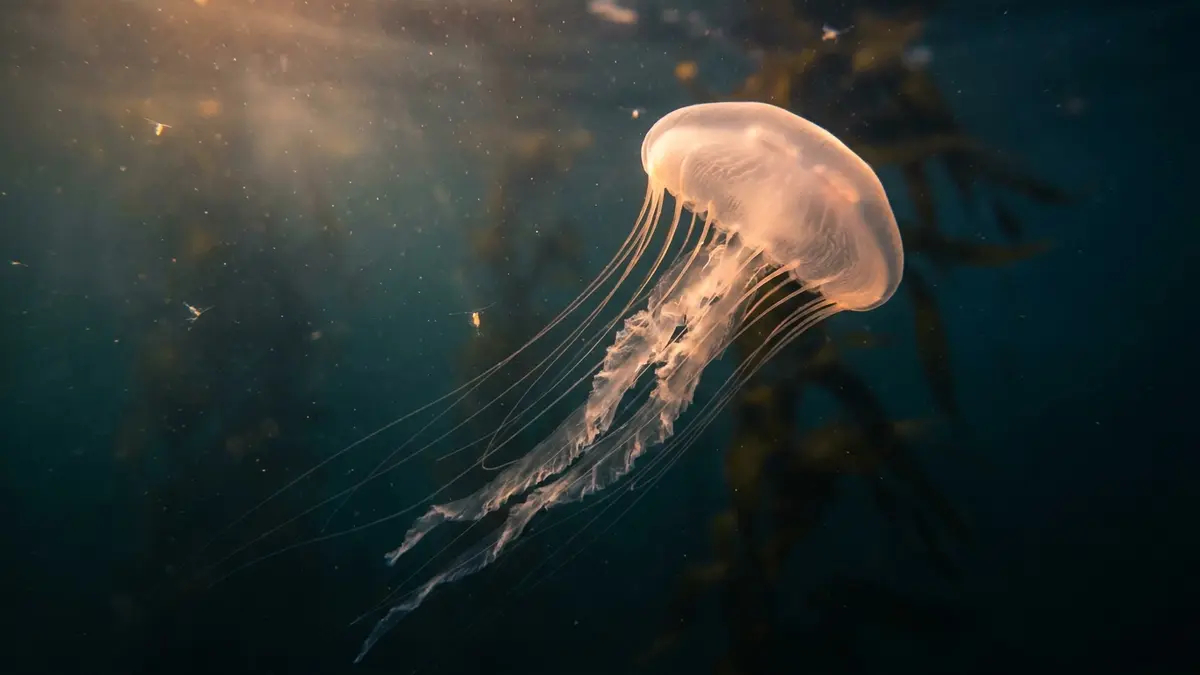
For the Jellyfish, spirit-animal guidance means learning to soften and adapt instead of resisting what you can't control, and trusting your inner compass through emotionally turbulent times. It carries emotional depth, sensitivity, and the healing power of surrender, the same qualities echoed in the Immortal Jellyfish's ability to revert and begin again. In dreams, it mirrors your emotional undercurrents: buried feelings rising to the surface, or a conflict you should either weather or stop fighting.
An almanac
- Core message
- Soften and adapt instead of resisting
- Spirit animal
- A call to release control and heal
- Totem for
- Calm, empathic, deeply feeling people
- Power animal
- Courage to speak up, not stay rigid
- In dreams
- Mirrors your emotional undercurrents
- Cultural roots
- Japan's Ebisu, the Laughing God
- Scientific name
- Medusa, after the Greek Gorgon
- Body & age
- No brain or heart; alive 508M+ years
The Jellyfish glides through the ocean without a single bone in its body, trusting the current instead of fighting it, and there's real wisdom in that surrender. Beneath its translucent bell is a spirit animal built on sensitivity and adaptability, on the quiet courage it takes to stay soft in a hard world. From a boneless Japanese god of good fortune to what it means to see one drifting calmly or struggling in a dream, the Jellyfish's story comes down to feeling everything without letting it break you.
Jellyfish Symbolism & Meaning
A Jellyfish moves through the water with one clever trick and one far riskier habit. It can jet small pulses of water to push itself along, yet for most of its life it drifts at the mercy of tides and currents.
That vulnerability is the whole point: a soft, boneless body that absorbs the ocean's chaos instead of resisting it. Adaptability is its defining gift. It has no set migratory path of its own; tides and currents carry it wherever they lead, which is its own lesson in reading your surroundings instead of fighting them.
Individual species sharpen the meaning further. The Immortal Jellyfish (Turritopsis dohrnii) can revert to an early polyp stage under threat, an image of renewal. The Lion's Mane trails tentacles stretching over a hundred feet beneath its mane-like dome, borrowing its namesake's courage. The glowing Mauve Stinger is read as unapologetic self-expression, and the sharp Sea Nettle as firm boundaries.
Popular spirit-animal lore casts a sting as a warning of financial misfortune and a Man o' War sighting as a sign of loss or an unmendable rift, though these readings trace to modern symbolism rather than documented cultural history. The Man o' War, for that matter, is not a true jellyfish at all but a siphonophore: a colony of specialised zooids drifting under a gas-filled float, with no means of propulsion of its own.
The biology behind the Jellyfish's reputation is almost stranger than the folklore. It has no brain, no blood, and no heart; its whole body is built from a few simple layers wrapped around a jelly-like core that is roughly 95 percent water. And this is no recent experiment: fossil evidence from Canada's Burgess Shale shows swimming jellyfish already gliding through ancient seas more than 508 million years ago, one of the oldest identifiable animal lineages still around today. A creature this old, this simply built, and still this successful makes its own case for the logic of surrender over resistance.
Jellyfish Spirit Animal
When the Jellyfish shows up as your spirit animal, it usually finds you gripping too tightly to a position where a little compromise would serve you far better. It tends to surface right as your inner world feels like a storm at sea, spinning and ruled by fear.
Its message is simple: soften instead of bracing. Just as a body tenses right before it gets hurt, resisting the chaos only makes things worse. You cannot always control what's happening around you, only how you handle it, so resist the pull toward feeling like a victim and stay anchored to your own inner compass.
This spirit animal also nudges you to stop overcomplicating things. A Jellyfish lives without pretense, and your stress is likely inflating small problems into large ones. Tied to the Water element and all it represents about emotion, it often arrives during a season of healing, whether from loss, an ended project, or neglected self-care, and it invites you to reclaim your sense of wholeness.
Does Jellyfish fit you?
Tap the ones that sound like you — 6 traits, no right answer.
0 of 6 Nothing picked yet — start tapping.
Jellyfish Totem Animal
Those born with the Jellyfish as their totem animal tend to be among the calmest, most easygoing people you'll meet, willing to follow where life leads but rarely without caution first. Having this totem also means carrying notably thin skin, in the emotional sense: you absorb more than most, so learning to filter incoming energy matters, or you'll end up hauling burdens that were never yours.
That same sensitivity often makes you a natural empath: deception rarely works on you, and people struggle to keep secrets in your presence, though it can also leave others feeling faintly exposed when you're around. This totem carries a real pull toward the spiritual, and many with it end up doing healing work, energy work, or some form of ministry, carrying a persistent, personal connection to realms beyond the everyday.
You also tend to be an open book: joy and sorrow both show plainly, and your circle trusts that what they see is genuinely what's true. Because you're so easy to read, you often end up teaching the people around you how to sit with their own feelings more honestly.
Jellyfish Power Animal
Call on the Jellyfish as your power animal whenever you've drifted from your truest self. It has a way of clearing out the people and distractions pulling you off your soul's real path and returning you to rhythms you can actually trust.
This power animal also lends you courage to speak up instead of swallowing your words, because even if conflict makes you uneasy, burying certain issues only breeds bigger consequences later. And when you catch yourself locked into a stubborn, rigid mood that won't budge, Jellyfish offers a simple reminder: the tree that bends in the wind survives the storm, while the one that refuses to give eventually snaps.
Far Eastern Jellyfish Symbolic Meanings
Japanese mythology gives the Jellyfish a surprisingly warm home in the story of Ebisu, a god described in legend as having no bones at all. Ebisu watches over fishermen and is credited with bringing good fortune to those who work the sea, and the boneless Jellyfish is counted among his sacred creatures. What makes Ebisu especially endearing is that despite his physical limitations, he's remembered fondly as the Laughing God, a deity whose good humor became as central to his legend as his blessings. In his story, at least, a sense of humor carried people through hardship as effectively as strength did.
A second, older strand of Japanese folklore explains the Jellyfish's boneless body through a harsher tale. In it, Ryūjin, the dragon king of the sea, sent a jellyfish to fetch a live monkey so he could eat its liver. The monkey talked his way free by claiming he'd left his liver drying in a tree, and when the jellyfish returned empty-handed, Ryūjin's fury was absolute. He beat the jellyfish until every bone in its body was shattered and banished it to drift boneless near the surface ever after. Where Ebisu's story frames the Jellyfish's softness as a blessing, Ryūjin's version frames that same softness as a punishment, two readings of the same vulnerability, depending on who's telling the story.
The Japanese word carries the same softness. Kurage is usually written in plain kana, but when it takes kanji at all it is 海月, "sea moon", or the older Chinese compound 水母, "water mother", and in both cases the reading is a special one that ignores the characters' usual sounds.
Jellyfish in Dreams
Dream imagery involving a Jellyfish tends to track closely with what's happening beneath your own emotional surface:
- A Jellyfish near the surface suggests long-buried memories or feelings are rising up; let them, since this is a real chance to clear old wounds and restore your sense of self-worth.
- A Jellyfish tangled in tall grass points to something holding you back from expressing what you honestly feel.
- A Jellyfish stinging another creature warns of a conflict or serious confrontation ahead, though it also holds that you have solid defenses when you need them.
- A Jellyfish drifting calmly through open water signals that turbulent times are easing and real rest is finally within reach.
- A Jellyfish struggling against the current is a cue to ask whether you're waging a fight you were never going to win in the first place.
“- A Jellyfish drifting calmly through open water signals that turbulent times are easing and real rest is finally within reach.”
Jellyfish Spiritual Meaning
The Jellyfish's spiritual message is simple: surrender control without losing yourself in the process. It cannot fight the ocean, so it learns to move with it — absorbing shocks that would break something more rigid and coming out the other side intact.
Let this creature remind you that flexibility is not the same as weakness, and that softness can be its own form of strength. Trust your emotional depths instead of numbing them, protect your tender places without shutting the world out entirely, and remember that even total transformation, like the Immortal Jellyfish reverting to begin again, is sometimes exactly what survival requires.
Jellyfish & the Myth of Medusa
Long before "jellyfish" became the common name, Carl Linnaeus reached for Greek mythology to classify the whole group, naming the class Medusa in his 1758 taxonomy. He borrowed it from Medusa, the Gorgon whose hair writhed with living snakes and whose glance could turn a person to stone.
The comparison wasn't arbitrary. Seen from below, a Jellyfish's trailing tentacles genuinely echo that mythic image, drifting like serpentine hair around a domed, silently staring "face." And where Medusa's gaze froze onlookers in place, the Jellyfish carries its own quiet paralysis in its sting, capable of stunning something many times its size despite having no muscle built for aggression.
Spiritually, that etymology deepens the meaning rather than darkening it. Medusa's Greek name literally traces back to a root meaning "to protect, rule over," and she began as a guardian figure before curse and transformation reshaped her story. Read that way, the Jellyfish's mythic namesake isn't purely a monster. Looking fearsome and being protective are not opposites, and something can carry real defenses while still being made almost entirely of light and water.
Inuit Folklore: The Boy from the Bottom of the Sea
Not every old story frames the Jellyfish as gentle. In an Inuit tale recorded in the 1921 collection Eskimo Folk-Tales, a woman flees a cruel husband into the ocean and gives birth to a boy who unmistakably belongs to that world, a child "whose eyes are jellyfish, whose hair is seaweed, and whose mouth looks like a mussel." Raised beneath the waves, he eventually begs his mother to let him visit the surface, and what follows plays out less like a fairy tale and more like a ghost story, his uncanny sea-born face enough to frighten an entire household.
It's a useful counterweight to the softer symbolism this creature usually carries. The Jellyfish's translucence can read as vulnerability, but it can just as easily read as otherness: anything shaped by something as vast and indifferent as the ocean will always carry a trace of the uncanny. If this spirit animal has been surfacing for you alongside a feeling of being misunderstood, or of unsettling people without meaning to, this older, stranger thread of folklore suggests that discomfort isn't a flaw to smooth over. It may simply be the residue of carrying something genuinely deep.
Frequently Asked Questions
What does the Jellyfish spirit animal mean?
The Jellyfish spirit animal signals a need to soften and adapt rather than resist what you can't control. It tends to appear during emotionally turbulent seasons, when letting go of a rigid stance and trusting your inner compass gives you room to heal.
Is a Jellyfish a good omen or a bad one?
Mostly it's read as a positive sign of flexibility, emotional depth and renewal, especially through species like the Immortal Jellyfish. Older folklore is more cautious, though, warning that a sting can bring financial bad luck and that a Man o' War sighting may hint at loss or a serious falling-out.
What does it mean to dream about a Jellyfish?
It usually reflects your emotional undercurrents. A Jellyfish drifting peacefully points to approaching calm, one struggling against the current suggests you're holding onto a struggle that was never winnable, and one near the surface signals buried feelings ready to be faced and healed.
What does a jellyfish tattoo mean?
A jellyfish tattoo is most often chosen to represent quiet resilience and grace under pressure, a way of wearing the idea that softness and strength aren't opposites. It can also mark a season of emotional healing or work as a personal reminder to stay adaptable rather than rigid, the same themes carried by the Jellyfish as a spirit and totem animal.
Why is the jellyfish's scientific name 'medusa'?
Carl Linnaeus classified jellyfish under the name Medusa in 1758, borrowing it directly from the Gorgon of Greek mythology whose hair was made of snakes and whose gaze turned people to stone. The comparison fit visually, since a jellyfish's trailing tentacles resemble that mythic hair, and functionally, since both the mythic Medusa and the real animal carry a paralyzing, sometimes dangerous, touch.
Do jellyfish really have no brain or heart, and how old are they?
Yes. Jellyfish have no brain, no blood, and no heart; they move instead through a simple, jelly-filled body that's roughly 95 percent water. Despite that simplicity, they're an ancient lineage: fossils from Canada's Burgess Shale show swimming jellyfish already alive more than 508 million years ago, one of the oldest animal groups still around in today's oceans.
Jellyfish also represents
Sources
Claims on this page were checked against these published sources.
- Jellyfish
This is a hollow structure consisting of a mass of transparent jelly-like matter known as mesoglea, which forms the hydrostatic skeleton of the animal.
Read the source → - Turritopsis dohrnii
If the T. dohrnii jellyfish is exposed to environmental stress, physical assault, or is sick or old, it can revert to the polyp stage, forming a new polyp colony.
Read the source → - Lion's mane jellyfish
The tentacles of larger specimens may trail as long as 30 m (100 ft) or more
Read the source → - Pelagia noctiluca
Pelagia noctiluca are bioluminescent, i.e. have an ability to produce a low light that is visible to humans during the night.
Read the source → - Chrysaora quinquecirrha
The jellyfish's sting ranges from 'moderate' to 'severe' and can be noxious to smaller prey.
Read the source → - Ebisu (mythology)
born without bones (or, in some stories, without arms and legs) due to his mother's transgression
Read the source → - Medusa - Etymology, Origin & Meaning
"jellyfish," 1758, as genus name, from Medusa, the name of one of the three Gorgons with snakes for hair, whose glance turned to stone whomever looked upon it... The zoological classification was selected by Linnaeus, inspired by the creature's lengthy tentacles.
Read the source → - Ryūjin
he pulled all of the bones out of the jellyfish's body... Then he banished them from Ryūgū forever. That is why jellyfish must float about near the surface.
Read the source → - Eskimo Folktales (1913/1921 collection)
whose eyes are jellyfish, whose hair is seaweed, and whose mouth looks like a mussel.
Read the source → - Are jellyfish made of water?
Lacking brains, blood, or even hearts, jellyfish are pretty simple critters... Jellyfish are about 95 percent water.
Read the source → - These 508-Million-Year-Old Fossils May Be Earth's Oldest Swimming Jellyfish
Now, researchers have uncovered a 508-million-year-old fossil of a bygone jellyfish, possibly representing the oldest swimming jelly paleontologists have found.
Read the source → - Portuguese man o' war
Although it superficially resembles a jellyfish, the Portuguese man o' war is in fact a siphonophore. Like all siphonophores, it is a colonial organism, made up of many smaller units called zooids.
Read the source → - What is a Portuguese Man o' War?
The Man o' War is a species of siphonophore, a group of animals that are closely related to jellyfish
Read the source → - 水母 (Japanese, Etymology 1)
From Old Japanese. The kanji is an example of jukujikun. [...] a jellyfish, medusa.
Read the source →