Animal Facts
Hamster Facts: 18 Species, One 1930 Burrow
The ordinary pet-shop hamster is an Endangered species with a 4,743 km² wild range.
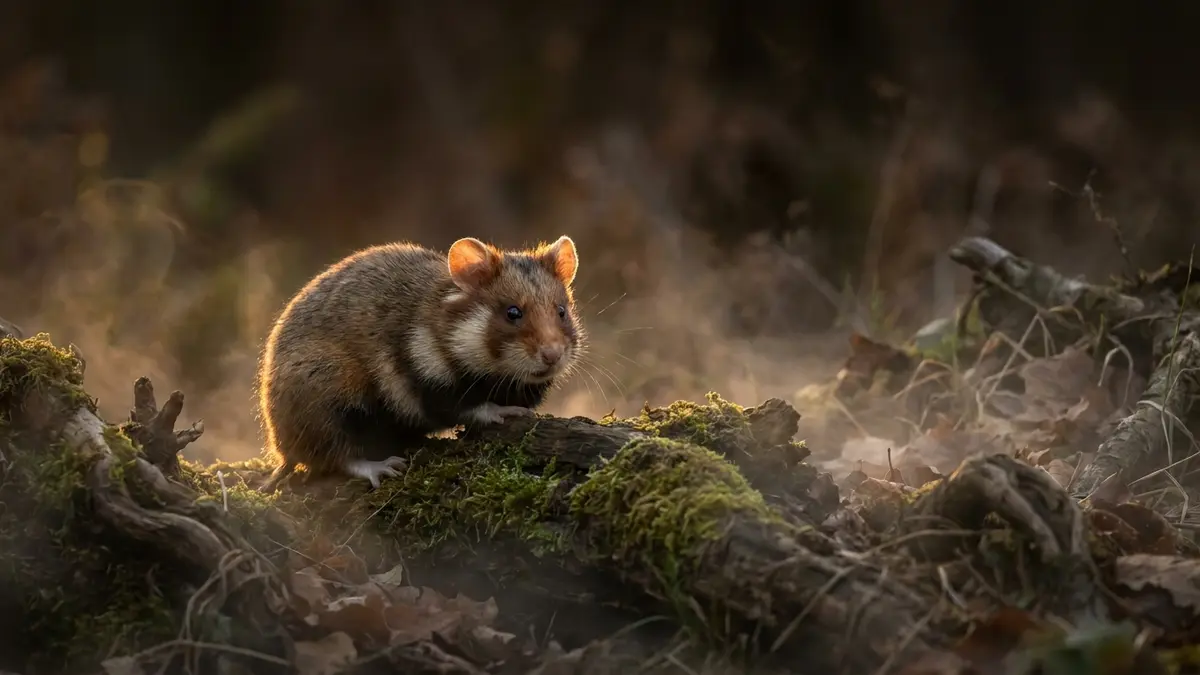
A golden (Syrian) hamster is pregnant for 16 days, the shortest gestation of any placental mammal, and it is Endangered in the wild: the IUCN estimates its extent of occurrence at 4,743 km² on the Turkish/Syrian border. Wild hamsters live alone — when zoologists mapped 30 burrows near Aleppo in 1997 and 1999, no occupied burrow held more than one adult. Europe's separate wild species, the common hamster, is Critically Endangered on the basis of a suspected 50% population reduction per year.
An almanac
- Pet species
- Mesocricetus auratus, the golden or Syrian hamster
- Subfamily
- Cricetinae — nine genera and 18 species, a working figure the 2024 phylogenomic study says needs revision
- Gestation
- 16 days, the shortest of any placental mammal
- Wild range (golden)
- Extent of occurrence estimated at 4,743 km² on the Turkish/Syrian border
- IUCN status
- Golden hamster Endangered; European common hamster Critically Endangered
- Burrow
- 36–106 cm deep (mean 65 cm); tunnel systems averaging 2 m, reaching 9 m
- Social life
- One adult per occupied wild burrow
The hamster is the animal people think they already know: a pocket-sized pet, cheeks full, legs going nowhere on a wheel. Almost every part of that picture is either a different species or a misreading of what the animal is doing.
Start with the word. "Hamster" covers nine genera and 18 species, of which only five reach pet shops in any number. The one in the cage is a golden, or Syrian, hamster — a species listed as Endangered in the wild, with an estimated range of 4,743 km² on the Turkish/Syrian border, and a captive lineage that begins with a single excavation near Aleppo in 1930.
What follows is the checked version: what the field surveys, the IUCN assessments and the laboratory papers actually say, including the places where the popular retelling has quietly changed a number or dropped a caveat.
Hamster facts
- "Hamster" is not one animal. Nine genera and 18 species make up the hamster subfamily Cricetinae, and only a handful of them — golden, Djungarian, Campbell's, Roborovski's, Chinese — ever reach a pet shop. The number 18 is the working figure, not a settled one: the same 2024 phylogenomic study that quotes it goes on to argue the taxonomy needs revision, including two cryptic species hiding inside the genus Tscherskia.
- The standard pet hamster is an Endangered species. The golden hamster is Endangered (B1ab(iii)); its extent of occurrence is estimated at 4,743 km² on the Turkish/Syrian border, and IUCN records 5–10 "locations" in the Red List sense — the assessment says only that there are likely fewer than 10, and that only three localities are known in Turkey.
- The whole pet trade begins with one dig. In 1930 the zoologist Israel Aharoni excavated a female golden hamster and her eleven young from a burrow 2.4 metres below a field near Aleppo, Syria; the survivors were bred at the Hebrew University of Jerusalem.
- Sixteen days from mating to birth. A golden hamster's gestation is the shortest of any placental mammal. Pups open their eyes at 12–14 days and are sexually mature at about one month.
- In the wild, it is one hamster per burrow. When zoologists mapped 30 wild golden hamster burrows near Aleppo in 1997 and 1999, not a single occupied burrow held more than one adult. Burrows ran 36–106 cm deep (mean 65 cm), with tunnel systems averaging 2 m and reaching 9 m.
- Filling a cheek pouch is work, not a reflex. Filmed frame by frame, a Syrian hamster needed between 3 and more than 25 coordinated jaw cycles — mode 6 — to stow one large chow pellet, against a typical two cycles for a sunflower seed.
- The cheek pouch is an immunologically privileged site. It lacks normal lymphatic drainage, so foreign tissue can survive there, and cancer researchers spent decades growing human tumour fragments inside it. Privileged does not mean immune-proof. In the 1971 trials, implants generally needed cortisone conditioning to take at all: 55% of cervical-carcinoma implants in cortisone-conditioned animals showed growth, while "breast cancer gave poor results."
- Hamster incisors never stop growing. In the wild they are filed down by hard, gritty food; in captivity that job falls to gnawing material such as wood blocks, hay or cardboard tubes.
- Wild hamsters are omnivores, not seed-eaters. Excavated burrows have yielded grains, chickpeas, green plant material — and insects.
- Europe's own wild hamster is Critically Endangered. The assessment (assessed 20 June 2019, published 2020) lists the common hamster as Critically Endangered on the basis of a suspected, projected population reduction of 50% per year across large parts of its range — equivalent to at least 99% over the next ten years — inferred from the collapse in reproduction rate.
- A maize diet turns European hamster mothers on their own pups. Only mothers on a wheat-plus-earthworm diet weaned about 80% of their pups. The other three diets — wheat+clover, maize+earthworm and maize+clover — all came in under 12%. The maize diets specifically produced maternal infanticide, with pups eaten or stored alongside the grain hoard; the niacin (B3) deficiency link is the authors' proposed mechanism for the maize groups.
- The larder changes the hibernation. The European hamster is a food-storing hibernator, and the quality of its larder changes how it hibernates: in a 22-female study where hoard size was held constant at 2000 g, hamsters given fat-rich sunflower seeds ran fewer and shorter deep-torpor bouts, and with large stores available only about half the animals in either group hibernated at all.
- The winter white hamster changes colour on daylight, not cold. Shortening photoperiod triggers the moult in the Djungarian dwarf hamster, and over the same switch it drops about 19% of its body weight, from 32.7 g to 26.5 g. Torpor in that study was defined as core body temperature dropping below 32°C for more than 30 minutes; during a bout, body temperature bottomed out at an average of 26.0 ± 2.8°C, with the lowest hourly readings reaching 21.2°C. Of the 60 animals in the torpor analysis, 14 never expressed torpor — and "never torpor" hamsters showed a significantly lower relative body-mass change than torpor-expressing ones, so the winter phenotype is a spectrum.
- The smallest hamster digs the deepest hole for its size. Roborovski's dwarf hamster (53–81 mm head-and-body, 17.5–27.2 g) digs Gobi Desert burrows roughly 90 cm deep — more than ten times its own body length — containing a nest and two or three food caches.
- A hamster cell line sits behind a great deal of modern medicine. Chinese Hamster Ovary (CHO) cells, derived by Theodore Puck in 1957, are the standard production system for recombinant proteins and monoclonal antibodies. The popular version — "your medicine is made in hamster cells" — is right about the ancestry and misleading about the biology: CHO lines have been immortalised, mutagenised and genetically engineered for nearly 70 years and are adapted to serum-free, chemically defined medium. They are no longer ordinary hamster tissue.
- Hong Kong culled more than 2,000 hamsters in January 2022. Two SARS-CoV-2 infections were traced from pet hamsters to people. Testing found viral RNA in 15 of 28 Golden Syrian hamsters — and in none of the 77 dwarf hamsters checked.
- One of Europe's best-studied hamster populations lives inside Vienna. At a single urban study site researchers logged 685 burrows (194 active, 491 inactive), and found that traffic and construction noise had no effect on where hamsters chose to dig.
- Vienna's cemetery hamsters eat grave candles. The wax serves as a source of fat. This is a field observation from University of Vienna researchers running the "Biodiversity at the Cemeteries" citizen-science project, not a controlled feeding study, and it describes the Vienna graveyard population specifically rather than hamsters generally.
What people get wrong about hamsters
"Every pet hamster on Earth descends from a single female caught in 1930." The 1930 Aleppo litter did found the original laboratory and pet lineage, but it is not the only wild stock in captivity. German and Syrian scientists trapped thirteen adults near Aleppo during expeditions in September 1997 and March 1999, and nineteen golden hamsters went to Germany where — with three more from the University of Aleppo — they founded a fresh breeding population.
"All hamsters get lonely and should be kept in pairs." Syrian hamsters are solitary and territorial — no occupied wild burrow near Aleppo held more than one adult, and the RSPCA notes both sexes can be aggressive so they are commonly housed singly. The same guidance adds a caveat worth keeping: male laboratory hamsters have been shown to prefer company, and same-sex groups can work if formed at weaning or before puberty.
"Hamsters hibernate through the winter." Pet Syrian hamsters do not truly hibernate. They drop into torpor — a shallower, shorter energy-saving state — and a cold, sluggish hamster is an animal in trouble rather than one following a natural annual cycle. The genuine hibernator in the family is the European common hamster, which stores food and wakes periodically underground.
"A hamster running on a wheel is a neurotic captive performing a stereotypy — no wild animal would do that." Researchers at Leiden University Medical Centre put running wheels outdoors in a garden and on a dune and filmed them for three years. Wild mice used them repeatedly with no food reward, and their running bouts matched those of caged mice — which fails one of the defining tests for stereotypic behaviour.
"Wild hamsters are common farmland vermin — there are millions of them." They were, and now they are not. The IUCN listed the common hamster as Least Concern as recently as its 2016 assessment; by 2020 it was Critically Endangered, with local extirpations across 13 European countries.
The hamster in popular culture
The hamster's cultural role is to be the small, harmless, faintly ridiculous one: cheeks packed like a shopping bag, legs going nowhere on a wheel. Both images come from real behaviour, and both are usually read wrong.
The wheel is the bigger misreading. It has become shorthand for pointless captive effort, but when Leiden researchers left running wheels outdoors in a garden and on a dune and filmed them for three years, wild mice used them repeatedly with no food reward, and their running bouts matched those of caged animals — which fails one of the defining tests for a stereotypy. The stuffed cheeks are the other. Slow-motion filming shows pouching is a coordinated motor task, not a reflex: three to more than 25 jaw cycles for one large pellet, against a typical two for a sunflower seed. And the pouch itself is odd enough that cancer researchers used it for decades as an immunologically privileged site, growing human tumour fragments in it — though in the 1971 trials the implants generally needed cortisone conditioning to take at all.
The pet-shop animal is stranger than the aisle suggests. It is a golden hamster: a species the IUCN lists as Endangered, with an extent of occurrence estimated at 4,743 km² on the Turkish/Syrian border. In January 2022 the cuddly framing broke down in public, when Hong Kong traced two SARS-CoV-2 infections from pet hamsters to people and culled more than 2,000 animals; testing found viral RNA in 15 of 28 Golden Syrian hamsters and in none of the 77 dwarf hamsters checked.
Famous hamsters
Hamster fame runs through people and lineages rather than named individuals. The founding animal has no name — she is the female golden hamster the zoologist Israel Aharoni dug out of a field near Aleppo in 1930, along with her eleven young, from a burrow 2.4 metres down. The survivors were bred at the Hebrew University of Jerusalem, and that litter stands behind the laboratory and pet stock. The tidy "one female, one dig" version has since been overtaken: expeditions in September 1997 and March 1999 trapped thirteen adults near Aleppo, and nineteen golden hamsters went to Germany where, with three more supplied by the University of Aleppo, they formed a new breeding stock.
The other famous hamster is not an animal at all but a cell line. Chinese Hamster Ovary cells, derived by Theodore Puck in 1957, are the standard production system for recombinant proteins and monoclonal antibodies. The line has been immortalised, mutagenised and engineered for nearly 70 years and is adapted to serum-free, chemically defined medium, so "made in hamster cells" is accurate about ancestry and misleading about biology.
Europe's common hamster has become well known by collapsing. Listed Least Concern in 2016, it was Critically Endangered by 2020, on a suspected reduction of 50% per year across large parts of its range. One of the best-studied surviving populations lives inside Vienna, where a single urban site yielded 685 burrows and traffic and construction noise made no difference to where the animals dug; in the city's graveyards, University of Vienna researchers report hamsters eating the wax candles mourners leave on graves as a source of fat.
Frequently Asked Questions
Do hamsters hibernate?
Pet Syrian hamsters do not truly hibernate. They enter torpor, a shallower and shorter energy-saving state, and a cold, sluggish pet hamster is an animal in trouble rather than one following a normal annual cycle. The real hibernator in the family is Europe's common hamster, which stores food and wakes periodically underground.
Can hamsters live together in the same cage?
Syrian hamsters are solitary and territorial, and the RSPCA notes both sexes can be aggressive towards each other, so they are commonly housed singly. The field data match: of 30 burrows mapped near Aleppo, no occupied burrow held more than one adult. The same guidance adds that male laboratory hamsters have been shown to prefer company, and that same-sex groups can work if they are formed at weaning or before puberty.
Are hamsters endangered?
Some are. The golden (Syrian) hamster, the standard pet species, is listed as Endangered, with an extent of occurrence estimated at 4,743 km² on the Turkish/Syrian border. Europe's common hamster is Critically Endangered, listed on a suspected population reduction of 50% per year — equivalent to at least 99% over ten years.
Why do hamsters stuff food in their cheeks?
The cheek pouches are carrying bags for moving food to a burrow cache, and loading them takes coordinated effort. Filmed frame by frame, a Syrian hamster needed three to more than 25 jaw cycles to stow one large chow pellet, against a typical two cycles for a sunflower seed. The pouches are also immunologically privileged, lacking normal lymphatic drainage, which is why researchers once grew human tumour fragments in them.
How long are hamsters pregnant for?
A golden hamster is pregnant for 16 days, the shortest gestation of any placental mammal. Pups open their eyes at 12 to 14 days and are sexually mature at about one month.
Is a hamster wheel cruel?
Wheel running is not on its own evidence of a disturbed captive animal. Leiden researchers left running wheels outdoors in a garden and on a dune for three years and filmed wild mice using them repeatedly with no food reward, in bouts that matched those of caged mice — which fails one of the defining tests for stereotypic behaviour. Separately, hamsters do need gnawing material such as wood, hay or cardboard, because their incisors never stop growing.
More about the Hamster
More from Animal Facts



Sources
Claims on this page were checked against these published sources.
- Phylogenomic analyses of hamsters (Cricetinae) inferred from GBS data and mitochondrial genomes
nine genera and 18 species of hamsters are recognized worldwide
Read the source → - Mesocricetus auratus (Golden Hamster) — The IUCN Red List of Threatened Species
This species has a small range (its extent of occurrence is estimated to be 4,743 km²) and is restricted to a small, fragmented area on the Turkish/Syrian border.
Read the source → - Your Hamster May Have Surprising Origins
found—at a depth of 8 feet (2.4 meters)—a golden hamster and her 11 young.
Read the source → - Mesocricetus auratus (golden hamster)
Golden hamsters have a gestation period of 16 days, the shortest gestation period among eutherian mammals.
Read the source → - Kinematic analysis of an appetitive food-handling behavior: the functional morphology of Syrian hamster cheek pouches
the number of jaw cycles required to pouch a large pellet ranged from 3 to more than 25, with mode of 6
Read the source → - The Primary Implantation of Human Tumours to the Hamster Cheek Pouch
The hamster cheek pouch is an immunologically privileged site.
Read the source → - Hamsters: Good practice for housing and care
The incisor teeth of hamsters grow continually and are ground down in the wild when hard or gritty food is eaten.
Read the source → - Cricetus cricetus (Common Hamster) — The IUCN Red List of Threatened Species
This species is listed as Critically Endangered under criterion A3ac in view of the rapid decline in the reproduction rate of the Common Hamster which indicates a suspected population reduction of 50% per year throughout large portions of the species distribution (equivalent to a reduction of at least 99% over the next ten years).
Read the source → - Body Temperature and Activity Adaptation of Short Photoperiod-Exposed Djungarian Hamsters (Phodopus sungorus): Timing, Traits, and Torpor
All hamsters changed their light brown summer fur to a dense white winter fur over the course of SP adaptation.
Read the source → - Phodopus roborovskii (Roborovski's dwarf hamster)
Extend deep into the soil (90cm deep), where they contain one nest and two to three food caches.
Read the source → - Establishment of fast-growing serum-free immortalised cells from Chinese hamster lung tissues for biopharmaceutical production
Chinese hamster ovary (CHO) cells are an epithelial-like cell line established by Dr. Puck in 1957
Read the source → - Compellingly high SARS-CoV-2 susceptibility of Golden Syrian hamsters suggests multiple zoonotic infections of pet hamsters during the COVID-19 pandemic
Investigation of these animals revealed SARS-CoV-2 RNA in 15 out of 28 Golden Syrian hamsters, but in none of the 77 analysed Dwarf hamsters
Read the source → - Hamsters in the city: A study on the behaviour of a population of common hamsters (Cricetus cricetus) in urban environment
At the outset of the study, 685 burrows (194 active, 491 inactive) were detected.
Read the source → - Wildlife Watching in Vienna Cemeteries
Many have adapted to graveyard life by eating the candles left out by mourners, with the wax serving as a source of fat.
Read the source →
Not sure which animal is yours?
Consult the quiz