Animal Facts
Gorilla Facts: Chest Beats, Nests and Numbers
Bigger silverbacks beat their chests at a lower pitch, honestly broadcasting body size.
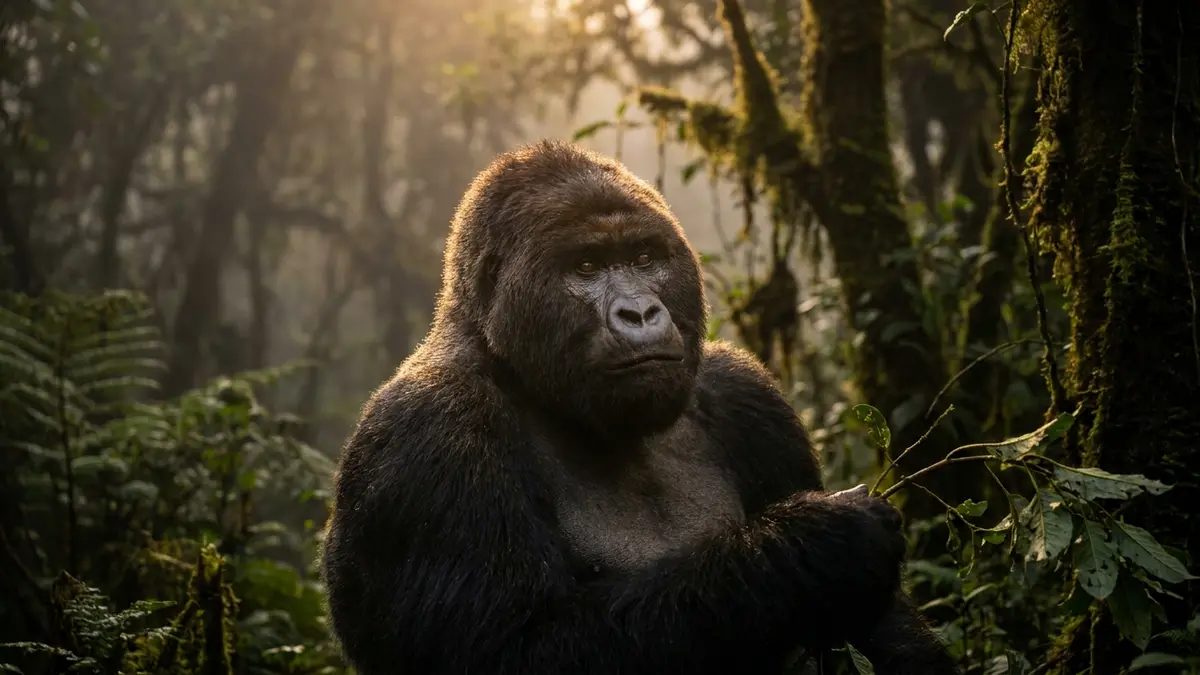
Silverbacks are the heaviest primates alive: over 400 pounds and 5.5 to 6 feet tall, from a birth weight of about 4 pounds. Their chest beats carry more than a kilometre through forest, and larger males produce lower-pitched beats, so the sound advertises body size rather than bluffing about it. Mountain gorillas number 1,063 (604 in the Virunga Massif, 459 in Bwindi-Sarambwe), while western lowland gorillas numbered around 360,000 in 2013 and are still falling about 2.7% a year.
An almanac
- Adult male weight
- Over 400 lb; about 4 lb at birth
- Standing height
- 5.5 to 6 feet
- Daily food
- Plants, up to 40 lb (18 kg)
- Pregnancy
- About 256 days (8.5 months)
- Vocal repertoire
- Up to 22 distinct calls
- Mountain gorillas left
- 1,063 (604 Virunga, 459 Bwindi-Sarambwe)
- DNA difference from humans
- About 1.6%
The gorilla most people carry in their heads was assembled in 1933 by a stop-motion animator. The animal itself is a plant-eater that builds a fresh nest on the ground every day, spends most of its time quiet, and settles disputes with sound rather than contact. The largest males are the heaviest primates on Earth, and they arrive weighing about four pounds.
The popular version also gets the arithmetic wrong in both directions. "Only a thousand left" describes one subspecies out of four; "our closest relative" belongs to chimpanzees and bonobos, not gorillas. Meanwhile the real emergencies are less famous: Grauer's gorilla lost 77% of its population in a single generation, and fewer than 300 Cross River gorillas remain.
Everything below is tied to a named source, and where a figure is an estimate rather than a measurement, it says so.
Gorilla facts worth knowing
- The heaviest primates alive. Adult male gorillas, the silverbacks, can weigh over 400 pounds and stand between 5.5 and 6 feet tall. They weigh only about 4 pounds at birth.
- Chest beating is an honest advertisement of body size, not a bluff. Across 25 wild silverbacks studied in Rwanda's Volcanoes National Park, the beats of larger males had significantly lower peak frequencies than those of smaller males.
- The beat is a long-distance broadcast. This multimodal signal can be heard more than a kilometre away through dense forest, and is performed most often by adult males.
- Tool use in wild gorillas went unrecorded until 9 October 2004. An adult female named Leah picked up a branch and used it to test the depth of a pool at Mbeli Bai, a swampy forest clearing in northern Congo, then leaned on it as a walking stick.
- They hum and sing over particular meals. Wild western lowland gorillas at Mondika (Republic of Congo) produce two distinct food-associated calls, humming and singing, but mostly the adult males, and only while feeding on certain foods (18 of 41 plant species in their diet, plus two insect species).
- Every gorilla has a unique nose print. The wrinkle pattern above the nostrils differs between individuals, and, like other primates, each gorilla also has distinctive fingerprints.
- Quiet animals with a sizeable vocabulary. Scientists have heard up to 22 different gorilla vocalisations, each apparently carrying its own meaning.
- Pregnancy runs about 256 days. That is roughly eight and a half months, only a few weeks shorter than a human pregnancy.
- An adult male eats up to 40 pounds (18 kg) of plant food a day. Treat that as an estimate rather than a measured ration: the Smithsonian's National Zoo puts an adult male nearer 45 pounds a day, and the Dian Fossey Gorilla Fund says silverbacks can take up to 60 pounds of vegetation.
- A new bed every day. Gorillas build a fresh nest on the ground every day, using it for daytime rest and for sleeping at night; infants share their mother's nest until about age 3 or 4.
- The nests double as tree nurseries. Gorillas deposit more than half of their faeces, and therefore half of the seeds they disperse, at their nesting sites. At one Cameroon study site (La Belgique), seeds of at least 58 plant species were found in gorilla faeces.
- One subspecies has genuinely recovered. On 14 November 2018 the mountain gorilla moved from Critically Endangered to Endangered on the IUCN Red List, after climbing from about 680 animals in 2008 to more than 1,000.
- The world holds 1,063 mountain gorillas: 604 counted in the Virunga Massif and 459 in the Bwindi-Sarambwe ecosystem. This is the number usually quoted as "how many gorillas are left", but it covers one of four subspecies, confined to two forest blocks straddling Rwanda, Uganda and the DR Congo. Other gorillas number in the hundreds of thousands.
- Grauer's gorilla, the largest subspecies, fell 77% in one generation. From roughly 16,900 animals before the 1996 civil war in eastern DR Congo to about 3,800 today.
- The Cross River gorilla is the most threatened ape in Africa: fewer than 300 survive across nine sites in a roughly 12,000 km² mountainous area straddling the Nigeria–Cameroon border.
- Around 360,000 gorillas lived in the forests of Western Equatorial Africa as of 2013, according to the first range-wide count of the western lowland gorilla, published in Science Advances in 2018. The size of that number is not reassurance: the same survey found the population dropping about 2.7% a year, and the subspecies remains Critically Endangered.
- Ebola is a gorilla disease as well as a human one. Two studied Ebola epizootics in the Republic of Congo, at Lossi sanctuary (2002–03) and at Lokoué in Odzala-Kokoua National Park (2004), killed an estimated 90–95% of the gorillas in the affected populations.
- Human and gorilla DNA differ by about 1.6%. Close, but not the closest: chimpanzees and bonobos differ from us by about 1.2%.
What people get wrong about gorillas
"Gorillas beat their chests with clenched fists." Gorillas strike with the palms of their hands, not closed fists. Using palms is less likely to injure the animal and creates a louder noise that carries much further through the forest.
"Gorillas are ferocious brutes that attack people on sight." Gorillas are overwhelmingly herbivorous and, in the fund's words, "typically gentle and peaceful... not aggressive and tend to avoid conflict." Chest beating is a signal — it can express aggression, occurs in play, and encodes the caller's body size — rather than a prelude to attack.
"You can go and see a mountain gorilla at a good zoo." Not one, anywhere, ever. Every gorilla in every zoo on Earth is a lowland gorilla, almost always a western lowland gorilla. Attempts in the 1960s and 70s to build a captive mountain gorilla population killed adults to seize infants, and none of the infants survived. To see a mountain gorilla you have to go to Rwanda, Uganda or the DR Congo.
"Gorillas are our closest living relatives." Chimpanzees and bonobos are. Human DNA differs from chimp and bonobo DNA by about 1.2%, and from gorilla DNA by about 1.6%. The gorilla lineage split from ours several million years before the chimp lineage did: gorillas are cousins, not siblings.
"There are only about a thousand gorillas left in the world." That figure describes mountain gorillas alone, 1,063 at the last count. The western lowland gorilla, the one in zoos and documentaries, numbered around 360,000 in 2013. It is still Critically Endangered, because the population is falling roughly 2.7% every year, but "a thousand left" conflates one subspecies with the whole genus.
The gorilla in pop culture
Almost every gorilla in popular culture descends from one film. King Kong premiered in New York on 2 March 1933, co-directed by Merian C. Cooper and Ernest B. Schoedsack with stop-motion animation by Willis O'Brien, and it fixed the gorilla in the public mind as a rampaging monster. The science has spent ninety years undoing that image.
Real gorillas got their own star turn in 1967, when National Geographic ran "Snowflake, the world's first white gorilla", turning a Barcelona albino into a global celebrity. In 1988 Michael Apted's Gorillas in the Mist cast Sigourney Weaver as Dian Fossey, drew five Academy Award nominations and made mountain gorilla conservation a mainstream cause.
Smaller stories have kept the animal in view since. Jersey Zoo's Jambo became the subject of the documentary Gerald Durrell: Jambo the Gentle Giant in 2005. Katherine Applegate's 2012 novel The One and Only Ivan, based on a real gorilla, was filmed in 2020. And Harambe, shot in Cincinnati in 2016, became one of the internet's longest-running memes.
Gorillas people know by name
Colo was born at the Columbus Zoo on 22 December 1956, the first gorilla ever born in a zoo. She died on 17 January 2017 at the age of 60, the oldest gorilla on record.
Snowflake, the only known albino gorilla, arrived at Barcelona Zoo on 1 November 1966 and died in 2003 of a skin cancer linked to his lack of pigment. Koko learned a modified sign language under Francine "Penny" Patterson and died on 19 June 2018, aged 46.
Jambo, a silverback at Jersey Zoo, stood guard over an unconscious five-year-old boy who fell into his enclosure on 31 August 1986. Ivan spent nearly three decades in a Tacoma shopping mall before moving to Zoo Atlanta in October 1994; he died on 20 August 2012, aged 50. Harambe was shot at Cincinnati Zoo on 28 May 2016.
Frequently Asked Questions
How much does a silverback gorilla weigh?
Adult males can weigh over 400 pounds and stand between 5.5 and 6 feet tall, which makes them the heaviest primates alive. They weigh only about 4 pounds at birth.
Why do gorillas beat their chests?
It is a signal rather than the opening move of an attack: it can express aggression, it also happens in play, and its pitch encodes the caller's body size. Among 25 wild silverbacks in Rwanda's Volcanoes National Park, larger males produced lower-frequency beats, and the sound carries more than a kilometre through dense forest. Gorillas strike with their palms, not closed fists.
Are gorillas dangerous to humans?
Gorillas are overwhelmingly herbivorous, and the Dian Fossey Gorilla Fund describes them as typically gentle and peaceful, not aggressive, and inclined to avoid conflict. The King Kong image comes from a 1933 film, not from field observation.
How many gorillas are left in the wild?
Mountain gorillas number 1,063: 604 in the Virunga Massif and 459 in Bwindi-Sarambwe. Western lowland gorillas numbered around 360,000 in Western Equatorial Africa as of 2013, but are declining about 2.7% a year. Grauer's gorilla has fallen to roughly 3,800 animals, and fewer than 300 Cross River gorillas survive.
Are gorillas the closest animal to humans?
No. Chimpanzees and bonobos differ from us by about 1.2% of their DNA; gorillas differ by about 1.6%. The gorilla lineage branched off earlier, so gorillas are cousins rather than our nearest relatives.
Can you see a mountain gorilla in a zoo?
No. Every gorilla in captivity is a lowland gorilla, nearly always a western lowland gorilla, and no mountain gorillas are known to exist in any captive facility. Seeing one means travelling to Rwanda, Uganda or the DR Congo.
More about the Gorilla
More from Animal Facts
Sources
Claims on this page were checked against these published sources.
- Inside the world of gorillas: Fun facts you didn't know
Silverback gorillas – adult males – are the heaviest primates alive. They can weigh over 400 pounds and stand between 5½ and 6 feet tall. Amazingly, they are only about 4 pounds at birth.
Read the source → - Chest beats as an honest signal of body size in male mountain gorillas (Gorilla beringei beringei)
The chest beat of larger males comprised significantly lower peak frequencies than smaller males
Read the source → - First Observation of Tool Use in Wild Gorillas
We first observed an adult female gorilla using a branch as a walking stick to test water deepness and to aid in her attempt to cross a pool of water at Mbeli Bai, a swampy forest clearing in northern Congo.
Read the source → - Western Lowland Gorilla
Scientists have heard up to 22 different gorilla vocalizations, each seeming to have its own meaning.
Read the source → - Western Lowland Gorilla
gestation typically takes 256 days, or about 8.5 months
Read the source → - Gorilla
An adult male eats up to 40 pounds (18 kilograms) of food each day.
Read the source → - Seed Dispersal by Western Lowland Gorillas: from Fruits to Seedlings
Gorillas deposit more than half of their faeces, and therefore half of the seeds they disperse, at their nesting sites.
Read the source → - Fin Whale, Mountain Gorilla recovering thanks to conservation action – IUCN Red List
The Mountain Gorilla has improved in status from Critically Endangered to Endangered thanks to collaborative conservation efforts
Read the source → - Recent survey shows continued growth among the world's last remaining mountain gorillas
the global population of mountain gorillas now stands at 1,063.
Read the source → - Catastrophic Decline of World's Largest Primate: 80% Loss of Grauer's Gorilla (Gorilla beringei graueri) Population Justifies Critically Endangered Status
We estimate that only 3,800 Grauer's gorillas remain in the wild
Read the source → - New Population Estimate for Western Lowland Gorillas
in 2013 around 360,000 gorillas were living in the forests of Western Equatorial Africa (WEA)
Read the source → - Genetics
The DNA difference with gorillas, another of the African apes, is about 1.6%.
Read the source →
Not sure which animal is yours?
Consult the quiz