Amphibians & Reptiles · Spirit animal
Chameleon Spiritual Meaning & Symbolism
The quiet shape-shifter who reads a room before it ever reveals itself
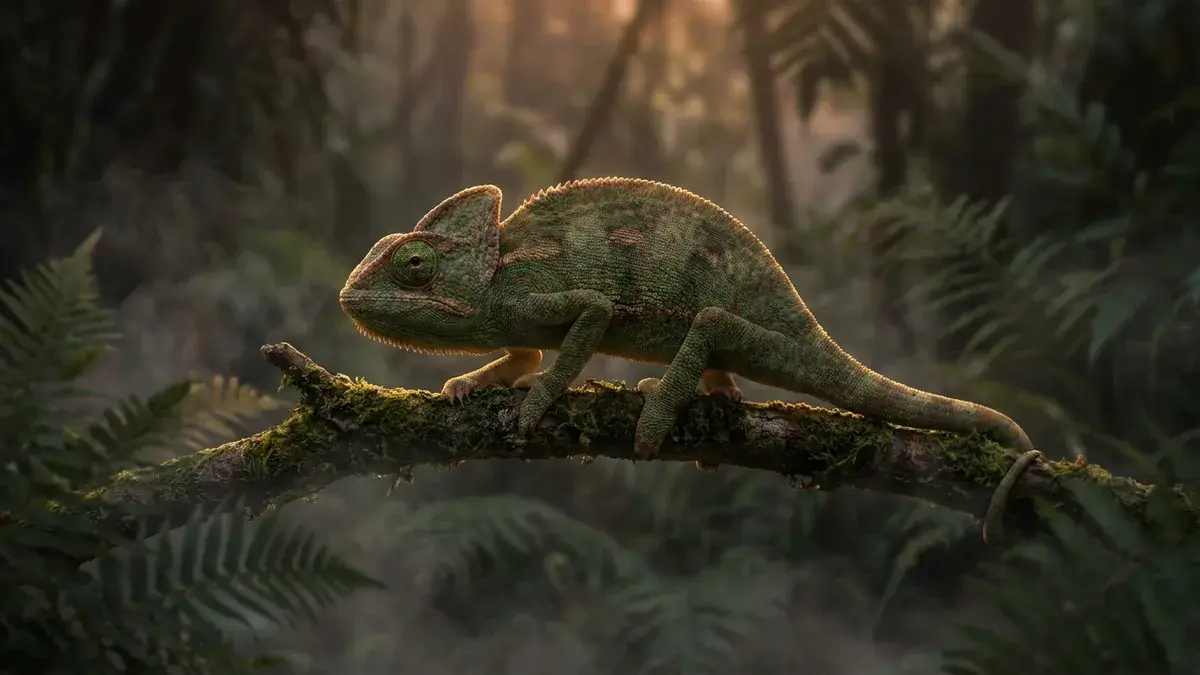
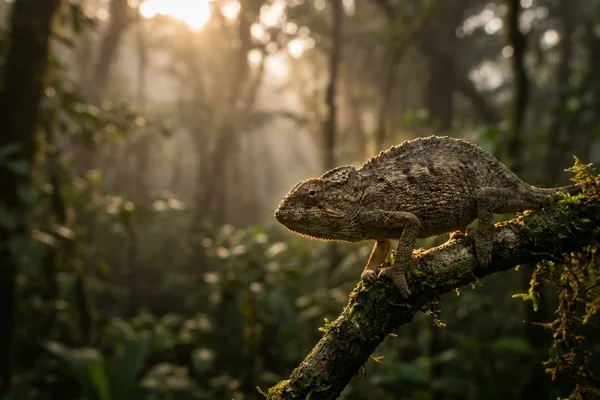
The chameleon is a reminder to be patient and to develop keen perceptions. It is also a symbol of self-transformation. It stands guard but changes its skin color to express its feelings rather than simply blend in.
As a totem or spirit animal, the chameleon reflects the experience of people who are alert, reserved, and attentive. As a power animal, it augurs the gift of sight and attunement to be able to wait for the right time and place.
As a symbol in dreams, it represents a readiness for positive change but can also indicate when you are going through an overly secretive period or when you are not getting your fair share of appreciation.
An almanac
- Core message
- Earned adaptability through patience and perception
- Spirit animal
- Watch quietly, then choose to reveal or retreat
- Totem for
- Guarded, intuitive, highly situationally aware people
- Power animal
- Sharper vision and patience before acting
- In dreams
- Reflects where you stand with change
- Cultural roots
- African/Bantu folklore and Native American lizard lore
- Species
- 200+ species, mostly Madagascar & Africa
The Malagasy have a saying for the chameleon: it has one eye on what's behind it and one on what's ahead. It is an alert creature, built more to see than to move quickly. The chameleon does not just borrow color from its surroundings to hide itself; it broadcasts its own mood through color. It is not merely camouflage, but an emotional signal.
The chameleon is a patient and perceptive creature. It changes not through force or influence but through its own direction.
Chameleon Symbolism & Meaning
The chameleon is famous for its ability to camouflage, but that's only part of the story. The chameleon can shift its color deliberately, especially when looking for a mate. That shows how they use their color to express themselves. They choose which parts of themselves to show and which to hide. That can be a reminder for people: sometimes you need to hide, but sometimes you have to show who you are.
The eyes are special too: they move independently from each other so that a chameleon can see almost every direction without moving its head. In people, this might mean having heightened insight. This way you can find what you want without moving your whole body.
When it wants food, the chameleon grabs it with a tongue. You could say that it's quick-thinking because it gets ready without moving. Then, once the food is there, it reaches out and gets what it needs.
Its skin keeps shedding itself.
Chameleon Spirit Animal
If a chameleon surfaces as a spirit animal, it might be because it's been watching you and waiting until the right moment. Something is about to change. The question is whether you're going to let this guide influence your choices, or if you're going to ignore it.
This animal also says it's time to slow down. It wants you to think about things before jumping into them head first, even if other people around you seem like they're just rushing through life. This guide isn't trying to hold you back, though. It only wants you to consider every move carefully so that any bad decisions won't come back later.
This animal also encourages us not just take ideas at face value when someone tells us something is spiritually true or important. We can decide for ourselves what feels right for our own lives without anyone else forcing their opinions onto us.
It's important sometimes not only listen with your ears but also pay attention what isn't being said when other people speak too!
Does Chameleon fit you?
Tap the ones that sound like you — 6 traits, no right answer.
0 of 6 Nothing picked yet — start tapping.
Chameleon Totem Animal
Chameleon-totem people are often good at hiding their feelings. It can also give people the impression that they're guarded or hard to understand.
Rather than focusing on what things seem like, Chameleon-totem people trust their instinct to look for deep, authentic connections. They're not usually interested in drama.
You might be surprised at how quickly Chameleon-totem people can change. This happens in the wild, when a chameleon changes color in twenty seconds. If they need privacy, no one seems able to find them.
These people are very sensitive to what's going on around them. It's almost like they can read your mind from a distance.
Many Chameleon-totem people work on their goals in small steps and are interested in energy work, which is good because they're very sensitive to subtle energies.
Chameleon Power Animal
Call on the spirit of the Chameleon if you need help establishing yourself as clearly visible, fully known — or, on the other hand, if you'd like to make yourself a little less obvious. This spirit animal understands both ends of the spectrum of visibility: when it's called for to express your mood openly through color, or when it's time to disappear into your surroundings.
As for vision, those independently moving eyes make this animal a good ally whenever you need to get a sharper grasp of what's going on — or when you're ready to look for the opening that will let you put your plan into action. Being a typically laid-back animal, Chameleon can also help you navigate periods of rest, deliberate slowness and patience while waiting for circumstances to resolve themselves.
Native American Symbolism
The chameleon itself isn't widely recognized in Native American spiritual traditions, but lizards more generally play a prominent role in many tribal cultures. In some Plains tribes, the lizard is associated with survival, healing, and masculine energy. During the birth of a child, a newborn's umbilical cord would sometimes be shaped into a lizard-form amulet meant to provide strength and lasting health.
Several California tribes tell origin stories that include lizards. Many traditions hold that lizards represent protection, abundance, and renewal.
African, Ghanaian & Caribbean Folklore
One well-known tale features Anansi, the trickster spider, who swindled a hardworking Chameleon out of fertile farmland. Seeking justice rather than revenge, Chameleon crafted a shimmering cloak woven from vines and iridescent-winged flies. The garment dazzled everyone who saw it, and Anansi wanted it desperately.
Chameleon agreed to trade it — but only for grain that, unknown to Anansi, actually came from Chameleon's own confiscated fields. While Anansi's children hauled load after load of grain to fill a hole Chameleon had dug, the flies eventually scattered from the cloak mid-celebration, exposing Anansi's trick before the village chief.
Ordered to return everything, plus more, Anansi lost the gamble entirely, and rain soon blessed Chameleon's reclaimed land with a bountiful harvest. The takeaway travels well beyond its origin: patience and quiet cleverness outlast greed.
A separate Bantu creation story casts Chameleon as a messenger sent to deliver the gift of eternal life to humankind. True to form, Chameleon moved unhurriedly — so slowly that the Creator reconsidered, dispatching a faster lizard (in some retellings, a hare) with the opposite message: that death would come for everyone.
The tribes obeyed the swifter messenger, and Chameleon's true message arrived too late. Versions of this story persist across Uganda and beyond, often retold in children's literature.
Chameleon in Dreams
A calm, at-ease chameleon in your dream indicates that you have come to terms with changes that have recently taken place in your life and feel ready to face whatever future transformations are ahead of you.
- A partly-hidden chameleon suggests that you want to put some physical or emotional distance between you and the attention of others, so you can make your own decisions without outside interference.
- A chameleon which blends perfectly into its background may represent a situation where your efforts are being swallowed up by louder or more dominant people or circumstances. You should find ways to make yourself heard.
- Chameleon colors can sometimes carry specific meanings. Red may indicate a suppressed resentment. Yellow might signify a need for clear communication of your goals.
- If the dream is connected with any specific scene, it probably means that you have already decided on the direction to take in a particular situation but need to stick to it and act on it.
Spiritual Meaning of Chameleon
The Chameleon teaches patience and preparation. When you wait for the right moment, you can act confidently and assertively.
The Chameleon also teaches you to trust your instincts.
True empowerment comes from finding your own truth and applying it to every part of your life, not just your spoken words.
Do not let outside noise cloud your vision and judgment. Move with caution, take the time necessary, and stay true to yourself.
What the Word "Chameleon" Actually Means
Before dream analysts adopted the chameleon as a symbol of adaptability, the meaning behind its name was established. "Chameleon" comes from khamaileon, a Greek coinage that combines khamai, meaning "on the ground," and leon, meaning "lion." Linguists remain divided over whether the second half derives from this sound-alike reason: Species of chameleon sometimes have a crested ridge on their heads that resembles a lion's mane.
The actual translation is, strictly speaking, "ground lion." But since chameleons are more noted for stillness than loud proclamations, this fits the spiritual interpretation well: Small creatures can carry themselves with the self-assurance of the mighty lion if they remain poised and attentive in their surroundings.
The ancient Greeks built the word into English via Latin and Old French by around the mid-1300s. Keeping its association with quiet authority intact through three languages and centuries indicates that this interpretation is too strong to be dispelled by linguistic erosion.
Why Chameleons Actually Change Color (It's Not Mainly Camouflage)
The belief that chameleons change color mainly to blend into their surroundings is largely a myth. Their color shift serves as communication, not concealment. The chameleon symbolism of previous generations has long intuited that the chameleon's color change can be a message to others, rather than a disguise.
Males often flare into their brightest, most colorful skin patterns to attract mates and warn off rivals, essentially displaying confidence rather than concealment. Females with young in their care will often darken instead, signaling that they're not interested in further attention from the males. When a chameleon feels threatened or stressed, its skin tends to darken because darker colors absorb more heat. Read spiritually, this reframes the core lesson of chameleons: the colors they present to others aren't random. Brighter skin patterns signal confidence and welcome. Darker colors may signal a need for personal space and protection.
Instead of immediately assuming a chameleon or someone with similar behavioral traits is hiding something, consider that they might be using an honest signal, only one that's more subtle and thus harder to read for others.
Chameleon Symbolism in Biblical Tradition
The Chameleon was beloved by African folk tales, but it's worth noting that not every culture thought of it as a source of positive symbolism. The Hebrew Bible's Levitical dietary codes file the chameleon alongside the mole, the ferret, and the snail as creatures to be kept at a distance.
This distinction may seem confusing or even discouraging. Modern readers often think of shape shifting as a gift rather than something that should be kept at arm's length. That's an instructive perspective. It reminds us that transformation itself is neutral — any culture's investment in what it means says as much about them as it does about the animal.
Frequently Asked Questions
What does it mean when a Chameleon crosses your path?
It's said to mean that you should slow down and think before acting. You may have to choose whether to stay quiet or stand up more strongly. The Chameleon's appearance means that a change may be approaching.
Is the Chameleon a good spirit animal to have?
Yes. It's linked to high sensory acuity, forbearance, emotional intelligence, and the talent to bend without sacrificing one's own particular character. People who correlate to it tend to analyze outcomes well and know when to open up versus pull back.
What does dreaming about a Chameleon usually symbolize?
In dreams, a Chameleon usually symbolizes where you stand with change. A calm or peaceful one could mean you're okay with transformation. One that's out of sight may mean you need more privacy or space. And one fading away can suggest feeling unseen or overlooked.
Do chameleons really change color to blend into their environment?
No, not primarily. Studies show that changing color primarily serves as communication in chameleons, rather than blending into the background. Chameleon males brighten up to attract female attention and challenge male rivals, while female chameleons darken to signal that they're not available. Chameleons who are stressed or cold shift toward darker colors which help them absorb more heat. However, being able to blend in is a bit of an added bonus.
What does it mean to dream about a dead chameleon?
It's not rare to dream of a dead chameleon. It means you have given up on a certain goal. The image urges you to notice where you have stopped adapting and started settling in your life and ask yourself whether or not that was really the choice you wanted to make.
Do all chameleons have horns?
No. Only certain species of chameleons, most famously Jackson's chameleon, have horns. Those horns are brow horns. Males of those species grow the horns. Females do not.
Spiritually, the fact that males but not females grow horns echoes a theme in Chameleon lore: you don't have to be showy or flashy if you're not. People who do make a big show are usually doing so to warn off a rival or to attract a mate.
Chameleon also represents
- Other animals that represent death →Alongside Raven, Crow, Buzzard & Vulture, Owl
- Other animals that represent rebirth and change →Alongside Butterfly, Snake, Dragonfly, Frog
- Other animals that represent patience →Alongside Turtle, Heron, Spider, Ant
- Other animals that represent intuition →Alongside Owl, Cat, Wolf, Raven
Sources
Claims on this page were checked against these published sources.
- Chameleon
Each eye can pivot and focus independently, allowing the chameleon to observe two different objects simultaneously. This gives them a full 360-degree arc of vision around their bodies.
Read the source → - Native American Lizard Mythology
In Plains Indian tribes, lizards are associated with healing and survival, and also with masculinity... a newborn boy's umbilical cord was sewn into an amulet in the shape of a lizard to ensure his health and strength.
Read the source → - Tumbuka mythology
the chameleon was supposed to bring a message to humans, that when they die, they would be reincarnated. On the other hand, the lizard's message would instead tell humans that their deaths are permanent. Unfortunately, the lizard was faster than the chameleon, and thus death became a permanent state.
Read the source → - Anansi and the Chameleon
Anansi and the Chameleon
Read the source → - chameleon | Etymology, origin and meaning of chameleon
from Greek khamaileon 'the chameleon,' from khamai 'on the ground' + leon 'lion.'
Read the source → - Chameleon facts and information
Contrary to popular belief, chameleons do not change color to match their surroundings... When a chameleon does change color, it's usually to stand out. Males display vibrant colors to attract mates or signal aggression toward rivals. Pregnant females adopt darker shades to discourage potential mates... chameleons become darker when stressed, scared, angry, or cold (as darker colors absorb more heat).
Read the source → - Leviticus 11:29-30 (KJV)
And the ferret, and the chameleon, and the lizard, and the snail, and the mole.
Read the source →