Mammals · Spirit animal
Red Panda Spiritual Meaning & Symbolism
A quiet, fiercely individual guide who shows you how to protect your inner world while still climbing toward growth.
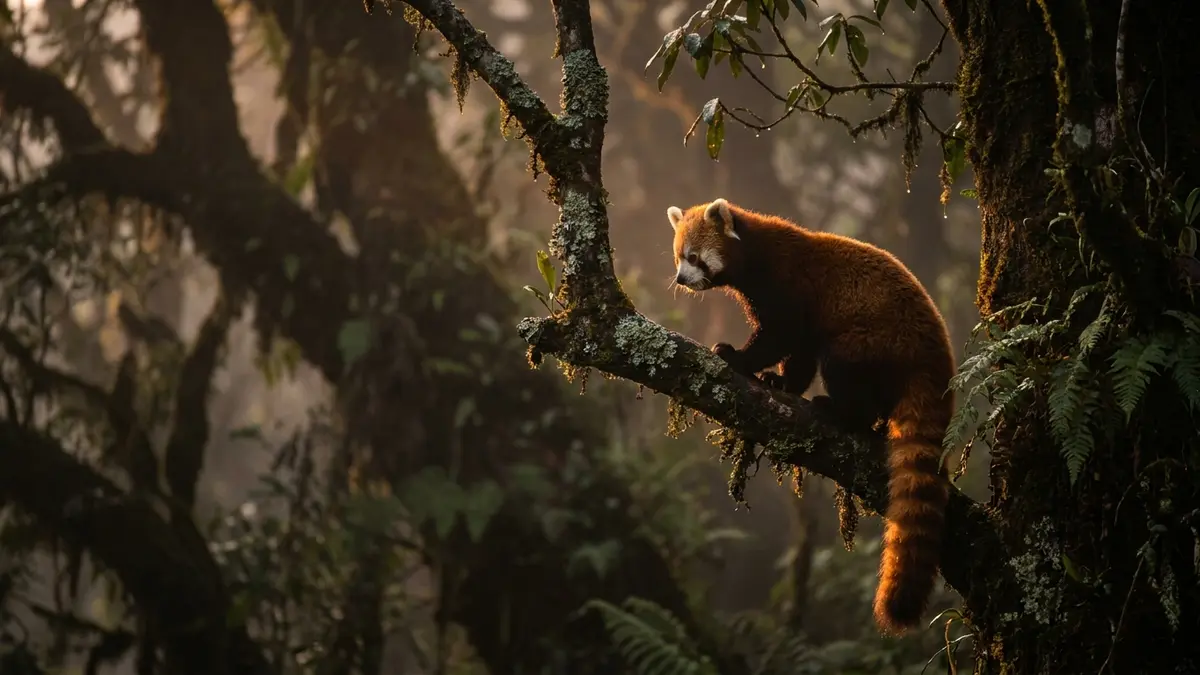
The red panda represents the value of being true to yourself. Even when something isn't worth fighting for, you can stand up for yourself without aggression. When you don't have to be the loudest and fastest, you can take time to grow.
Red pandas were part of local folklore in parts of Asia, where they were sometimes used as lucky charms. The animal is the official state symbol of Sikkim.
An almanac
- Core message
- Protect your identity, nourish your spirit
- Spirit animal
- Step back, rest, then reconnect selectively
- Totem for
- Old-soul, thoughtful, solitude-loving personalities
- Power animal
- Release resentment and reclaim your calm
- In dreams
- Stop overthinking; ease up and have fun
- Cultural roots
- State animal of Sikkim; folk good-luck charm
- Conservation status
- Endangered since 2008, ~10,000 left in the wild
- Nicknamed
- The "firefox," for its blazing coat
- Native range
- Himalayan forests from Nepal to China
The red panda is a little like a red fox, but it's not quite the same. It has its own identity. They usually live alone in the trees, and they feed their spirits by staying focused on their own goals. The red panda knows when it's better to be alone than to have to deal with too many people.
Red Panda Symbolism & Meaning
Taxonomists struggled to place the Red Panda neatly and eventually filed it in its own family, grouped loosely with raccoons and other small omnivores. This animal has never been easy to categorize, and neither should you feel obligated to be. The puzzle even has a formal name: the Red Panda is the only living species in the genus Ailurus, placed in its own family, Ailuridae, with no living relatives left beside it.
Roughly cat-sized with a longer tail, a fox-shaped face, and none of the Giant Panda's DNA despite the shared name, the Red Panda embodies individuality and refusal to conform.
Its russet coat and ringed tail blend into a forest canopy, while thickly furred paws cushion its steps across snow. A semi-retractable false thumb and rotating ankles let it descend trunks headfirst, something few climbers manage. These traits give the Red Panda meanings of camouflage, groundedness, and graceful retreat — the skill of exiting a situation safely rather than being trapped by it.
Bamboo dominates its diet, and it spends nearly every waking hour eating to sustain itself. That relentless appetite raises a personal question: what are you feeding your own mind and spirit? Despite that near-total bamboo diet, the Red Panda actually carries the gut of a carnivore, one poorly built to break down plant fiber, so bamboo passes through it in as little as two to four hours. That's why it must eat almost continuously just to get enough out of what it takes in — not laziness or excess, but the disciplined, unglamorous labor of thriving in a body that wasn't naturally built for the path it has chosen anyway. Beyond mating season, Red Pandas live largely alone, scent-marking territory and communicating through soft chirps and whistles — a reminder about self-sufficiency and honest, simple communication.
Mothers handle almost all of the child-rearing, a simple, traditional division of labor.
Even its old nickname carries the same idea: long before it lent its name to a web browser, the Red Panda was simply called the firefox, for a coat that looks lit from within.
Red Panda Spirit Animal
When the Red Panda arrives as your spirit guide, it usually means you need to step back from the noise — daily pressures may have splintered your focus into a dozen small irritations. This spirit animal asks you to find a private space to rest and recover, on your own timeline.
Even though it lives mostly alone, the Red Panda knows humans are wired for connection. Once you've had your solitude, it nudges you to reach back out — selectively, toward relationships that genuinely add value to your life. Being introverted doesn't mean disappearing entirely; you can stay meaningfully tied to a small circle or cause without constant immersion.
This guide also shows up when your temper needs tending. Its calm nature models patience: approach conflict with compassion rather than heat. It may also appear when you're drawn to bodywork, holistic healing, or touch-based therapies, since Red Pandas are known to self-groom in ways that boost circulation — a hint to prioritize your own care before pouring into others.
Because it lives its whole life among branches, this animal is also linked to tree wisdom, including practices like dendromancy or the Celtic Ogham system.
Does Red Panda fit you?
Tap the ones that sound like you — 6 traits, no right answer.
0 of 6 Nothing picked yet — start tapping.
Red Panda Totem Animal
Those born under the Red Panda totem tend to carry an old soul's temperament — thoughtful, restrained, and able to view a problem from multiple sides at once. If this creature were to pick a drink, it would choose something warm and calming, which mirrors the quiet energy at this person's core.
People with this totem cherish solitude but collaborate well, provided their effort is respected rather than assumed. Being volunteered for tasks without a say is a fast way to lose their cooperation; they need control over when they commit and when they step back. Independence, financial stability, and self-reliance all matter deeply to them.
Quiet meditation or daydreaming shows up often in their routine, and a well-written book can absorb them completely, especially if it teaches something useful. Many with this totem gravitate toward night hours, feeling most alive once the sun goes down.
Spiritual curiosity often simmers quietly in youth before becoming a central life focus in adulthood. They hold real patience for the slow unfolding of wisdom, respecting elders and unseen guidance rather than demanding instant answers.
Red Panda Power Animal
Call on the red panda if you're having trouble letting go of a conflict. It helps you release the resentment you've been holding onto, but it doesn't ask you to pretend the thing never happened.
Trust, once broken, can only be repaired on its own terms. If you can't repair it, this power animal supports a clean, deliberate separation from the person or thing that hurt you.
If the world seems loud to you, with many opinions demanding your attention, red panda can show you how to take some time to restore your energy and reconnect with yourself while still being engaged with modern life.
Carve out a private corner in which you can calm down and be by yourself. It could be a virtual place or an actual corner — as long as it's quiet and special just for you.
If you have an idea but don't know how to get started on it, this power animal says that sometimes it's best to just leave it for awhile and come back to it later. The idea might not be ready yet.
Red Panda in Far Eastern Symbolism
In Chinese culture, the red panda is traditionally considered a lucky omen, especially at weddings, as a symbol of good fortune for unions. There is folklore that also gives it the power to use illusion and trickery, fitting given its skills at blending into shadows.
Recently, red pandas have been used as a regional emblem in the eastern Himalayas; they also made an appearance as the mascot of the Darjeeling Tea Festival of the 1990s.
Red Panda in Dreams
When you dream of a red panda, be aware that you might be setting yourself up to worry about things that aren't really problems. It might be time to loosen up and have some fun. If you dream about a group of red pandas, it can mean that it is time for you to stop being shy and make friends. When a red panda is resting its eyes, this can mean that the dreamer is ready to start meditating or praying.
A red panda hanging upside down may reflect a feeling that your life has been turned upside down. You might want to pause and figure out a way to solve the problem rather than just giving up. This same image might also mean thinking about things in a different way, from a different perspective, such as looking at a problem from all sides.
If you keep getting stuck on something or can't move on, the dream may mean that you should start over with your plan or ideas. When the red panda in your dream is thin, afraid, or sickly, this could mean that something good in your life has been made weaker and smaller than it should be. You might want to make sure not to cut out something good in your life before it is gone.
You should also think about whether you are taking care of yourself as well as you have been caring for others.
Red Panda Spiritual Meaning
The red panda doesn't need fixing. It's different.
Take time off now and then to rest, and then return to those around you. Choose the relationships you want to have based on whether they nourish you, give you rest and strength.
The red panda is quietly strong. It has careful boundaries. It grows unhurriedly, at its own pace.
Red Panda Conservation: A Spirit Worth Actively Protecting
The Red Panda has been listed as an endangered species since 2008, and there are probably fewer than 10,000 of them left in the wild. It survives in the Himalayas — a range of mountains in Asia stretching from Nepal to China — and its habitat is in danger. Parts of its habitat have already disappeared, shrinking the wild population and making the remaining patches of forest more isolated.
In the wild, leopards hunt Red Pandas. If a leopard chases a Red Panda, it uses its skill at camouflage. In spiritual teachings, camouflage and graceful retreat are metaphors for getting through challenges. But the Red Panda depends on them every day for survival.
Frequently Asked Questions
What does the Red Panda symbolize spiritually?
The Red Panda's spiritual meaning centers on individuality, self-protection, and intentional nourishment of mind and spirit: embrace what makes you different rather than force yourself into a conventional mold. It also models healthy solitude and calm, thoughtful communication.
What does it mean when a Red Panda appears in your dream?
If a red panda appears in your dream, it might mean that you're worrying too much or that you need to relax more. If the red panda is upside down in your dream, this might mean that something is unstable and needs your attention. If several red pandas appear in your dream, this might mean it's time to socialize again.
Is the Red Panda a good luck symbol?
Red Pandas aren't necessarily regarded as good luck symbols in East Asian folk tradition, even though in certain areas they are thought of as auspicious, lucky animals.
But the official animal of the Indian state of Sikkim is the Red Panda.
Why is the red panda sometimes called a 'firefox'?
The red panda is often called a firefox. So is the red bear cat and the lesser panda. Before it was used as the name of a web browser, naturalists had long been calling it a firefox.
The red panda's blazing russet fur conveyed the core message of its spirit: an unapologetic individuality. It owes its name to its own fires, not to anything else.
Is the red panda actually endangered?
Red pandas are endangered. They have been listed on the IUCN Red List as endangered since 2008 and their wild population is estimated at roughly 10,000 individuals and still declining. Loss of habitat has harmed the red panda population across the Himalayan region. Their importance, fragility, and difference require deliberate, ongoing protection instead of passive admiration.
Red Panda also represents
Sources
Claims on this page were checked against these published sources.
- Red panda
modern genetic evidence places it in close affinity with raccoons, weasels, and skunks... though it has its own family, Ailuridae.
Read the source → - Red Panda
Bamboo constitutes about 95% of the red panda's diet.
Read the source → - 15 Fantastic Facts About Red Pandas
Red pandas will sleep for up to 17 hours a day!
Read the source → - Is a Red Panda a Bear? And More Red Panda Facts
Whether you know them as red pandas, red bear-cats, firefoxes, first pandas, lesser pandas or simply 'the other pandas,'
Read the source → - Red Panda Facts
They have also been called the 'firefox', 'lesser panda', and 'red-cat-bear'
Read the source →