Mammals · Spirit animal
Sugar Glider Spiritual Meaning & Symbolism
A small glider of the eucalyptus canopy that teaches bold release, gentle communication, and devoted community.
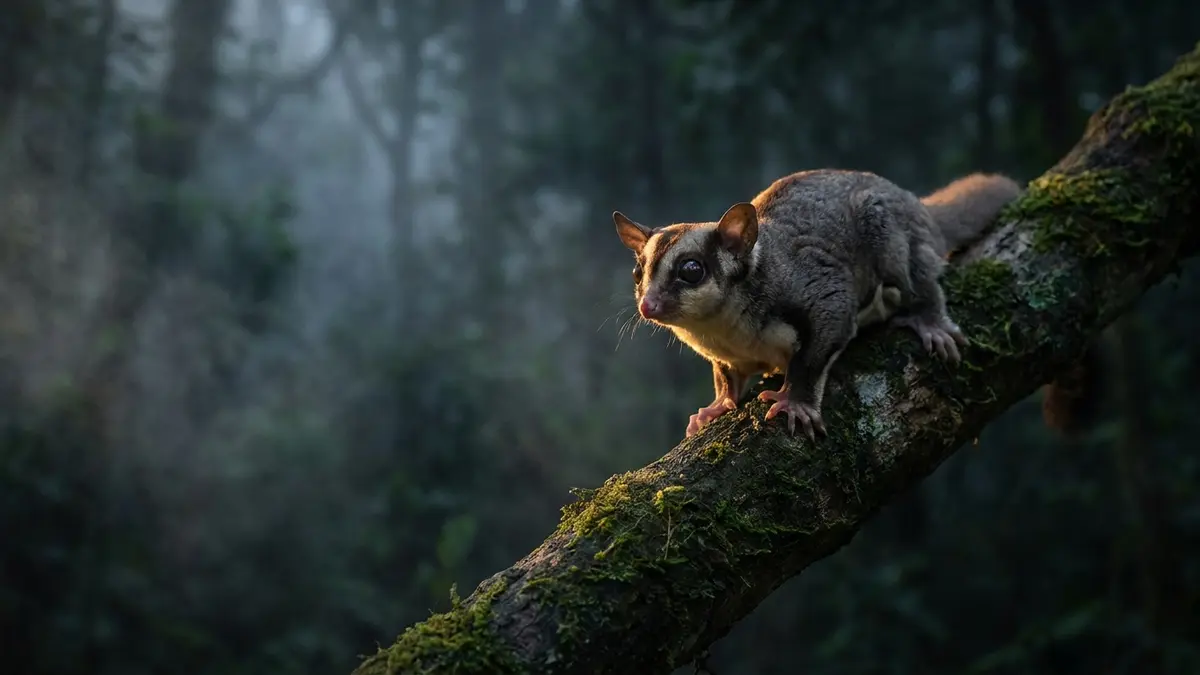
The sugar glider hangs on tight to its colony at night, even as it takes a leap of faith and glides between trees. It exemplifies the importance of finding support in your community, of trusting a bold leap even as you're staying close to home. Its life mirrors the kind of positive change that can take place in ours, when we can give up outmoded ways and put down new roots with people who understand us. Trusting in those we care for—and being trusted in return—can be its own powerful magic.
An almanac
- Core message
- Trust the leap, then build a soft place to land
- Spirit animal
- Appears at a leap-of-faith crossroads
- Totem for
- Sociable homebodies who value freedom
- Power animal
- Confident navigation without reckless risk
- In dreams
- Signals positive change already underway
- Cultural roots
- Aboriginal shaman-spirit Yurran, servant of Bunjil
- Lifespan
- Up to 9 years wild, 17.8 max in captivity
- Scientific name
- Petaurus breviceps, "short-headed rope-dancer"
The Sugar Glider looks like it's flying. In fact, it leaps from one branch of a tree to another. As a matter of safety and survival, trust that the next branch will be there is required. As a spirit guide, the Sugar Glider reminds us to release our current state in order to soar to higher ground in life, trusting that whatever comes next is what we need.
Sugar Glider Symbolism & Meaning
The sugar glider gets its name from the skin membrane between its front and back legs, which can stretch like a parachute so it can glide between trees in the forests of Australia. This is different from most other mammals, which is why the sugar glider is associated with being in the air.
When you see a sugar glider fly through the forest, it always drops first, then flattens out to catch an upward wind. The sugar glider does this with its tail and back legs, guiding itself and controlling its speed as it rises. A sugar glider is fully prepared to grab onto the branch it's flying toward.
Sugar gliders live together in groups of adults and young, all cuddling together for warmth. They also share caring for their babies. Each group only has one male leading it, and he has scent glands on his face and other places on his body that make special markings; he uses these to warn outsiders they don't belong.
Sugar gliders are very vocal, making different sounds for different things; they have a sound for cleaning each other and sounds for happiness too. Sugar gliders are also "trichromatic" vision; they see many colors most humans miss, including being sensitive to UV light.
People who care about the greater glider see it as a symbol of motherhood because it mothers her babies longer than most. People who care about the mahogany glider see it as a symbol of loyalty because they pair up so always stay with that same mate. People who care about the yellow-bellied sugar glider see it as a symbol of friendship and sweet things, probably because of its skin color and diet.
Sugar Glider Spirit Animal
The sugar glider appears when you're faced with a decision that seems irreversible, a moment when the next step feels big. This guide comes to remind you that often you can take one step at a time and that relaxing your grip on the familiar can give you space to act.
It also appears when someone validates one of your talents that you've downplayed or doubted. This is the messenger reminding you to see yourself as others see you.
If children or young dependents are part of your life—human or otherwise—the sugar glider shows how they help shape and guide your choices.
The main message is this: When next you feel stuck, sit and look around, watch closely, and pay attention. The guidance you need most is coming from someone young and unguarded—and it's easy to miss if we're not listening.
Does Sugar Glider fit you?
Tap the ones that sound like you — 6 traits, no right answer.
0 of 6 Nothing picked yet — start tapping.
Sugar Glider Totem Animal
People with the Sugar Glider totem feel that balance is important in their lives. They can be happy in a group, but they still need time by themselves. They would rather stick to things they know well than go exploring.
When things are changing, those with a Sugar Glider totem like to know that they will be okay. They do not mind a change if it is something that makes them feel safe.
The people who have this symbol also have common sense. If they get a good deal on something, they will know about it.
Sugar Glider people believe in showing kindness. They often want to help others who may need help.
Sugar Glider people like to stick together. They are nice and quiet, but when you know them, you realize that they are very smart and clever.
Sugar Glider Power Animal
Call on this power animal if you want to learn how to safely and confidently travel from point A to point B, or if you need help navigating your surroundings generally. It's also a good choice if you want to expand your understanding of the element of air.
This animal can help you teach, guide, and nurture others as well. It can inspire a commitment to caring for someone's emotional needs, and it can also help you reach the last push toward the completion of a goal or a project. When this occurs, the sugar glider can remind you that goals worth achieving seem impossible, even though it really only takes that extra nudge to get there.
Sugar Glider in Aboriginal Symbolism
In the traditions of Victoria's Aboriginal peoples, the glider possum known as Yurran is counted among six shaman-spirits who served the great ancestor Bunjil, the Eagle Hawk. The other five were the kestrel, the quail hawk, the parakeet, the parrot, and the brushtail possum. Together this circle of beings is credited with forming water, animal life, and plants, and with passing down the laws people were meant to follow.
Sugar Glider Dreams
Dreaming of the Sugar Glider is an indication that something significant is about to change in your waking life. The specific actions you see can provide insight:
- If you see it moving upwards — the changes are likely to be positive, with good things coming
- If it lands right on you — something you have put your trust in will prove itself reliable
- If it settles happily into its nest — there will be a sense of stability, with family and home taking up more of your attention
- If it rubs against you — it's a sign that this creature has taken an interest in you, so pay attention to other details in the dream
Sugar Glider Spiritual Meaning
Sugar gliders follow one simple rule: Trust the leap, and build a soft place to land. At the moment of every leap, Sugar Gliders learn to hold onto what they need and let go of what they don't. When Sugar Gliders leap for something they want, they always come back to their community.
Sugar Gliders constantly make noises in order to communicate with each other. These noises keep the group safe and help them to connect with each other. The lesson we can learn from this is that our words connect us with other people, just as the noises that Sugar Gliders make connect them.
Finally, daring and devotion are the two medicines of the sugar glider.
Sugar Glider Torpor & the Wisdom of Rest
What many people miss about this animal is the significance of its nightly dormancy: the deep, deliberate stillness that comes after every burst of motion. When food is scarce or the night is cold, the Sugar Glider will drop its body temperature and enter a state known as torpor, a natural energy-saving state where it reduces its metabolism to conserve energy. It may stay in this state for up to 23 hours, with its core temperature dropping down to around 10 to 20 degrees Celsius. This isn't a seasonal shutdown; the animal goes into torpor regularly, seeking shelter and warmth from the rest of its colony.
Read metaphorically, the concept of torpor suggests a necessary balance in movement and stillness. The Sugar Glider does not simply glide along on adrenaline; instead, it knows when to go quiet, conserve its energy, and let its body recover before embarking on another exciting escapade. In other words, it balances momentum with downtime and rest.
If you've encountered a Sugar Glider in your life recently or frequently seen this animal symbolically pop up in your journey, it may be trying to teach you an important lesson about the value of downtime and recovery time when engaging in intense movement or activities. The bold individuals who endure are not those who solely rely on excitement but rather those who know how to power down completely and prioritize rest between moments of extraordinary action.
What's in the Name: Sugar & Rope-Dancer
The name Sugar Glider comes from the plants it loves to eat and the way it slides through the air. It's also called the Petaurus breviceps in Latin, meaning "short-headed rope-dancer," which refers to how good it is at hanging from its skin in the open air.
There's something about these little marsupials that makes them seem very brave. Long before anyone else thought so, one naturalist looked at them dancing through a forest's canopy and decided they were like circus performers on a high-wire.
Sugar Glider Conservation & Fragile Freedom
The true sugar glider takes a far narrower range than previously thought along the southeastern coast of Australia. Tree hollows are essential to its survival, making it more vulnerable to fire than you might expect. The fires that swept through its range were tragic. But the glider's usual message is one of trust and daring leaps in flight. Whatever courageous step you need to take, be sure you're grounded—and keep your community, where you are jumping toward, in mind.
Frequently Asked Questions
What does the Sugar Glider symbolize spiritually?
Sugar Gliders, small arboreal marsupials, symbolize trusting in a leap of faith and releasing anything that no longer serves you. Their glide flight is the bold step of change that requires careful preparation, and the close-knit colonies of these animals emphasize loyalty, teamwork, and soft communication.
What does it mean when a Sugar Glider appears in your dream?
If a sugar glider appears in your dream, take that as a good omen that something positive is happening in your life. If the glider is flying upward, it means your circumstances are improving. If it lands on you, it confirms that your instincts and trust are well founded. If the glider goes back to its nest to rest, it suggests that domestic comfort is coming. And if the glider rubs against you, it means that spirit animal has gotten your attention.
What kind of person has the Sugar Glider as a totem animal?
Some people who have the Sugar Glider as a totem animal are sociable but need time alone, are good with money, and prefer gentleness to conflict. They favor easygoing relationships and take their time committing. They have a natural charm and quiet cleverness.
Do sugar gliders mate for life?
Sugar gliders don't strictly mate for life. Researchers have found that some colonies form groups where more than one male does the mating, while other colonies have a single male, who mates with more than one female. Males and females in either arrangement stay together closely, spending half their time within 25 meters of each other.
This is most often interpreted spiritually as "not a promise of eternal pairing", but instead as a devotion practiced daily, via closeness and attention rather than instinct or passion alone.
Is the Sugar Glider an endangered species?
It hasn't been officially declared an endangered species, though current genetic research indicates that the actual sugar glider is confined to a much smaller stretch of southeastern coastline in Australia than originally thought. In addition, with its reliance on hollow trees, it is particularly vulnerable to more severe wildfires, such as the Australian bushfires that occurred during the year 2019–20. As a spiritual guide, its message about being free to glide can be associated with another theme of stewardship: only by protecting the forest that it relies upon can the freedom of gliding be maintained.
Sugar Glider also represents
Sources
Claims on this page were checked against these published sources.
- Sugar glider
This creates an aerofoil enabling it to glide 50 metres (55 yards) or more.
Read the source → - Petaurus (squirrel gliders, sugar gliders, and yellow bellied gliders)
Mating is done in some monogamous pairs, but when food is abundant, polygynous units are popular... In monogamous pairs, males spend around half of their active time within 25m of their partner, and 55-85% of their sleeping time with their female partner.
Read the source →